Summary
Table of Content

Asia Pacific Fire Door Market
Get a free sample of this report
Form submitted successfully!
Error submitting form. Please try again.
Thank you!
Your inquiry has been received. Our team will reach out to you with the required details via email. To ensure that you don't miss their response, kindly remember to check your spam folder as well!
Request Sectional Data
Thank you!
Your inquiry has been received. Our team will reach out to you with the required details via email. To ensure that you don't miss their response, kindly remember to check your spam folder as well!
Form submitted successfully!
Error submitting form. Please try again.
Asia Pacific Fire Door Market Size
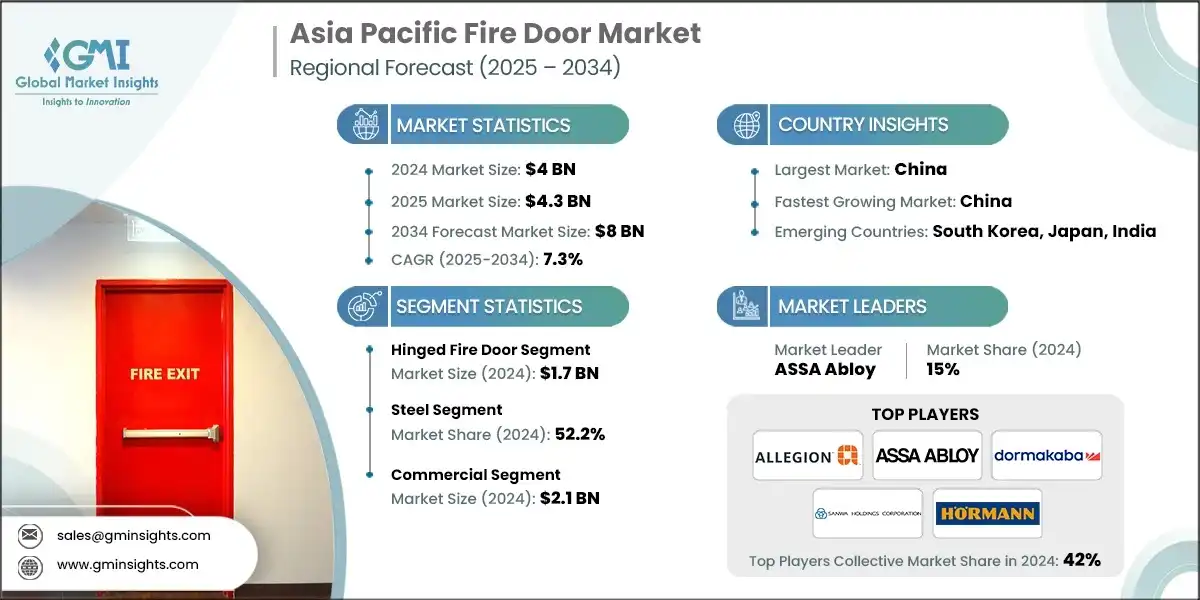
The Asia Pacific fire door market was valued at USD 4 billion in 2024. The market is expected to grow from USD 4.3 billion in 2025 to USD 8 billion in 2034, at a CAGR of 7.3%, according to latest report published by Global Market Insights Inc.
Asia Pacific Fire Door Market Key Takeaways
Market Size & Growth
- 2024 Market Size: USD 4 Billion
- 2025 Market Size: USD 4.3 Billion
- 2034 Forecast Market Size: USD 8 Billion
- CAGR (2025–2034): 7.3%
Key Market Drivers
- Stringent fire safety regulations and building codes.
- Growth in construction & infrastructure development.
- Increasing fire safety awareness.
Challenges
- High installation & maintenance costs.
- Lack of awareness in developing regions.
Opportunity
- Retrofit & renovation demand.
- Sustainability & green building certification.
Key Players
- Market Leader: ASSA Abloy led with over 15% market share in 2024.
- Leading Players: Top 5 players in this market include Allegion Plc, ASSA Abloy, Dormakaba Group, Sanwa Holdings, Hormann, which collectively held a market share of 42% in 2024.
Get Market Insights & Growth Opportunities
The Asia-Pacific fire door market is experiencing growth due to the stringent fire safety regulations and building codes. Governments across the region are implementing updated safety standards to minimize fire hazards in residential, commercial, and industrial buildings. For instance, the National Building Code of India (NBC) mandates fire-resistant doors in high-rise buildings, this regulatory push is driving the adoption of fire doors across the region. While Singapore follows the BS EN 1634-1 standard for fire resistance, companies like Sanwa, manufacture doors such as the DSST-R Lightweight Fire-Resistant Steel Door to meet these strict standards.
Also, growth of the fire door market is due to the rapid growth of construction and infrastructure across the Asia-Pacific region. China and India are undergoing urbanization, in addition to a rise in investments in infrastructure projects. The Asian Development Bank reports that Asia will need USD 1.7 trillion a year for infrastructure until 2030. The increase in construction activity correlates with an increase in fire door requirements for code compliance.
Manufacturers like Allegion Plc., ASSA ABLOY, and Dormakaba are using advanced fire door technologies to satisfy this increased demand such as intumescent seals made from hydrated sodium silicate and intercalated graphite that expand under heat to block smoke and flames. These manufacturers are focusing on innovation and complying with the regional codes to gain market share in the fire door market. For instance, ASSA ABLOY manufactures fire-rated doors such as the ProMetal Fire Rated Door to meet the new safety codes for the Asia Pacific market.
Government initiatives, alongside government association guidelines such as Fire and Security Association of India (FSAI) is heavily pushing fire safety awareness and compliance to technical guidelines that will comply with IS 3614:2021 and NBC 2016 along with other technical provisions. China’s Ministry of Emergency Management mentions that under the Article 9, Fire Protection Law of the People's Republic of China (2021 Amendment) all construction projects must comply with safety regulations including non-combustible materials and fire-rated materials, this was done in order to reduce the financial losses incurred during the fire incidents, with over USD 20 billion so far.
The use of fire doors surged after 2020 because of new safety standards. Bunka Shutter, Chase Doors, and China Buyang have increased their product offerings for the market. Chase Doors has UL-certified Durulite Industrial Fire Doors rated for up to 90 minutes while China Buyang has CE- and UL-certified steel and wooden fire doors rated for 30 to 120 minutes and EN1634-certified fire shutters. The steady growth of fire door is expected to continue with increasing safety awareness and regulation across Asia-Pacific region.
To get key market trends
Asia Pacific Fire Door Market Trends
Technological advancements are reshaping the market fueled by innovations that help in the development of fire doors in the region.
- The Asia-Pacific fire door market is experiencing competition as manufacturers expand their offerings and incorporate recent technologies such as IoT integration, e-glass and fire-resistant composites to satisfy differing safety and architectural requirements. One example, UL-listed Durulite Industrial Fire Doors offered by Chase Doors that features both impact ratings and fire ratings of up to 90 minutes. The Asia-Pacific Economic Cooperation (APEC) reports that fire incidents in the region exceed USD 20 billion in economic loss annually, which is a significant impetus to create or implement enhanced fire protections.
- There is also a growing trend of retrofitting existing buildings with compliant fire doors in urbanized parts of the Asia-Pacific region. Governments in the region, including China and India, are establishing stringent enforcement for building and fire safety laws and codes. The governments of India’s USD 7.5 billion Smart Cities Mission project are forcing discussions for upgrades and retrofitting fire safety systems into infrastructure. The idea is to rejuvenate an aging infrastructure to meet increased safety codes and to ensure civilian safety in dense urban centers.
- The demand for the usage of eco-friendly materials in the Asia-Pacific fire door market is also on the rise due to the increase in focus on sustainability. The Asia-Pacific Green Building Council is estimating that there is going to be 12% annual growth in green-certified buildings in the Asia-Pacific region, which will create a greater demand for sustainable construction materials in the region. For example, Nihon Funen integrates recycled steel and eco-conscious designs into its fire doors. Their CIM-integrated systems reduce waste and energy use, aligning with sustainability goals.
- Facility management specialists are now creating fire doors in a digital twin environment for predictive maintenance and coordination of compliance measures. According to the National Fire Protection Association (NFPA), predictive maintenance using these technologies reduces fire incidents by 30%. For example, Siemens provides residents with digital twin applications such as the Siemens Fire Digital Twin, that allows users to simulate fire-resistance performance in real-time by embedding fire safety systems into a digital twin.
- Manufacturers are providing modular fire door kits to facilitate installation and retrofitting, especially in congested urban areas. Prefabricated construction is emerging in countries like Japan, South Korea, and Australia, making up to 15% of new building projects in those countries in 2023, driven by demand for faster, more sustainable construction methods. ASSA ABLOY, for example, offers modular fire door systems since they allow for rapid assembly and are frequently used in prefabricated buildings.
Asia Pacific Fire Door Market Analysis

Learn more about the key segments shaping this market
Based on product type segments, the market is segmented into hinged fire door, double-action fire door, sliding fire door, fabric fire doors/curtains, flush-glazed fire door, others. The hinged fire door category held the largest share of the market and generated revenue of USD 1.7 billion in 2024, owing to their wide utilization in the fire door market since they are economical, long-lasting, and safety compliant.
These doors are particularly well-suited for the region's fast-paced city building and increasing high-rise construction. Manufacturers such as Dormakaba are advancing products with hinged fire doors offering improved resistance to fire and ease of installation. Dormakaba, for example, has developed a product with enhanced thermal insulation and fire rating for both residents and business owner needs. This fits the intensifying need for economic and reliable fire safety solutions in areas with high density.
- Government regulator associations such as the National Fire Protection Association (NFPA), and local authorities have a recommendation for hinged doors for emergency exits and evacuation routes. Hormann is one such leading manufacturer that produces hinged- and slide-type fire doors meeting these recommendations while mitigating fire safety concerns through certified codes. They supply doors for public infrastructure projects, such as hospitals and schools, with increasing fire safety regulations.
- Trends in urbanization, coupled with population growth, illustrates the rising demand for hinged fire doors across the Asia-Pacific market. According to the United Nations, urbanization in the Asia-Pacific region was 54% in 2020, is expected to rise to 68% by 2050 - creating the need for comprehensive fire safety measures. By creating innovative products that in part are made to local needs, vendors are sure hinged fire doors meet both safety needs, while conforming to the region’s fire safety codes.
- Manufacturers have created multiple, affordable hinged fire doors for the cost-sensitivity of the Asia-Pacific market. For instance, Mesker Openings – N-Series Doors is an affordable, non-handed hinged fire door that is made from steel and timber, further- National Firefighting Manufacturing manufactures steel and timber hinged fire doors at for customer who are price conscious further driving the market.
Learn more about the key segments shaping this market
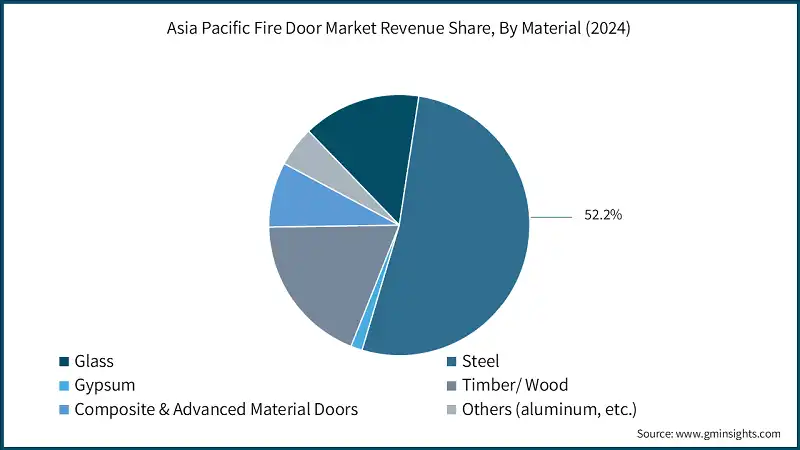
Based on material, the Asia Pacific fire door market is segmented into glass, steel, gypsum, timber/ wood, composite & advanced material doors and others (aluminum, etc.). The steel segment held the largest share, accounting for 52.2% of the market in 2024.
- Steel is non-combustible and offers low thermal conductivity, making it a suitable choice for fire-rated applications. The National Fire Protection Association (NFPA) claims that steel doors can withstand temperatures above 1,000°F for long periods of time compared with timber or composite products. UL-rated steel fire doors, among others, are commonly installed at commercial and industrial buildings for fire protection standards to be met. The durability of these doors is essential to meet code requirements in high-risk locations, including high-rise residential buildings.
- Rapid urbanization in Asia Pacific especially in countries like China, India, and has increased the demand for steel fire doors. The Indian Ministry of Housing and Urban Affairs stated in 2023 that there was an increase by 25% in urban construction projects, many of which call for fire safety compliance. Steel fire doors manufactured by the ASSA ABLOY and Dormakaba groups are preferred because they are durable, require less maintenance, and can withstand heavy utilization.
- Steel fire doors help to comply with strict international fire safety codes such as the International Building Code (IBC), and those framed by the NFPA. Generally, fire-rated steel doors with up to 3-hour ratings are utilized in office settings and manufacturing buildings. The increased safety provided with fire-rated doors can also lead to reduced insurance premiums for businesses as well.
Based on end use of the Asia Pacific fire door market, it is divided into residential, commercial, industrial and government and critical infrastructure. The commercial segment held the largest share, generating a revenue of 2.1 billion.
- This rise can be attributed to various countries, including China and India, enforcing rigorous rules regarding fire safety that require fire doors to be installed in non-residential buildings, like office buildings, shopping malls, and hospitals. In 2023, the commercial construction sector in the region grew about 6%, generating more demand.
- The changing demographics, urbanization, and development of commercial buildings has contributed to the commercial sector being a major segment. The United Nations reports that more than 50% of the Asia Pacific population now lives in urban areas leading to a greater number of high-rise buildings and larger-scale commercial projects.
- For instance, the development of smart cities in India, such as the Delhi-Mumbai Industrial Corridor, increased the amount of fire safety solutions, this is an opportunity for manufacturers to innovate and provide custom solutions to different regional needs.
- Furthermore, the continued emphasis on fire safety by businesses to reduce financial and reputational challenges continues to increase awareness. According to the National Fire Protection Association (NFPA), fire damage in commercial buildings exceeded $1 billion in 2022 in the Asia Pacific region. This increased awareness is encouraging companies to invest in fire doors in turn solidifying the commercial segment as the leading market segment overall.
Looking for region specific data?
China Fire Door Market
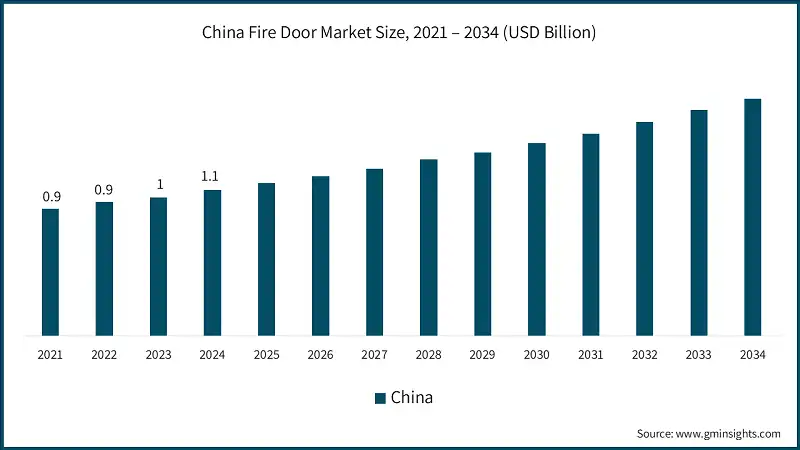
In 2024, the China contributed USD 1.1 billion to the Asia Pacific fire door market. Chinese companies are leveraging advanced technologies to modernize manufacturing processes as well as the quality and functionality of fire doors.
- The Chinese government has implemented policies mandating the use of certified fire doors in residential and commercial buildings, further boosting market demand. Additionally, the presence of major companies such as ASSA ABLOY and Dormakaba in the region has strengthened the market by introducing high-quality products and advanced technologies.
- Chinese companies are leveraging advanced technologies, such as automated manufacturing systems and innovative materials such as galvanized and stainless-steel hybrids as well as combination of gypsum, reinforced calcium carbonate to improve the thermal insulation and overall strength of fire doors. For example, leading players like Chinsun Fire Doors are investing in smart fire doors equipped with IoT sensors, which are increasingly being adopted in urban infrastructure projects across the country.
- The fire doors in China is further expected to grow, particularly as smart city initiatives, such as the Xiong'an New Area and the Greater Bay Area, are anticipated to increase interest in advanced fire solutions. With chances for growth due to adoption of intelligent and IoT-enabled fire door systems, local manufacturers are also expected to aid the increased demand. The fire door market looks set to benefit from a sustained period of growth supported by favorable government regulations and increasing general awareness of fire safety standards.
India Fire Door Market
In 2024, India fire door market is expected to grow at 8.3% during the forecast period.
- The Indian market is driven by increasing awareness of fire safety regulations and the rising adoption of fire-resistant infrastructure. The growing construction sector, particularly in commercial and residential spaces, is further fueling the demand for fire doors across the country.
- Additionally, government initiatives to enforce stringent fire safety norms and the rising focus on workplace safety are contributing to market growth. The increasing investments in smart buildings and infrastructure development are also expected to create significant opportunities for fire door manufacturers in India, ensuring sustained market expansion in the coming years.
Japan Fire Door Market
In 2024, Japan fire door market is expected to grow at 7.1% during the forecast period.
- The Japanese market is driven by the country’s focus on fire safety upgrades in aging buildings and public infrastructure. Demand is rising in sectors like healthcare and transportation, where compliance with Japanese Industrial Standards (JIS) is critical. Companies such as Hormann Japan offer fire-rated steel doors with seismic durability and automated closing systems, tailored for high-traffic environments
Hong Kong Fire Door Market
In 2024, Hong Kong fire door market is expected to grow at 6.9% during the forecast period.
- The Hong Kong market is driven by rising fire safety awareness and regulatory enforcement across urban districts like Kowloon, Central, and Tsuen Wan. The city's dense high-rise landscape and aging commercial buildings are prompting upgrades to certified fire-rated doors, especially in offices, hotels, and transit facilities. Companies such as Yee Fung Doors offer metal and glass fire doors with automatic closing systems and smoke seals, tailored to Hong Kong’s Fire Services Department standards
Asia Pacific Fire Door Market Shares
The top companies in the market Allegion Plc, ASSA ABLOY, Dormakaba Group, Sanwa Holdings and Hormann and collectively hold a share of 42% in the market. These prominent players are proactively involved in strategic endeavors, such as mergers & acquisitions, facility expansions & collaborations, to expand their product portfolios, extend their reach to a broad customer base, and strengthen their market position.
- Allegion, under its brands of FSH and Schlage, supplies fire-rated steel doors, frames, electromagnetic locks, and hold-open systems for use in high-security applications and style-compliant with local fire legislation. The company also supports integrated fire door control solutions such as door monitoring sensors and electric mortice locks to enhance the safety of fire door products.
- ASSA ABLOY provides various certified fire door sets under its brands of Powershield and SMARTec with fire resistance of up to 4 hours. The doors of timber and steel comply with both UK (BS) and European (EN) standards. In addition, the company also supplies complete doorsets and frames to suit the door installation. The company also offers its own-branded fire door closing systems to ensure the fire doors will automatically close in an emergency situation and, thus, further support fire safety provisions.
- Dormakaba Group provides self-closing fire doors with smoke detection integrated systems, with electromagnetic hold-open systems and automatic swing door operators (systems) such as the ED 100/250. The Group offers various fire protection solutions (access control) that include electric strikes and panic locks, while supplying a range of EN certified door closers. The Group's fire solutions are commonly installed in commercial and healthcare settings, as well as institutions throughout the Asia-Pacific area.
Asia Pacific Fire Door Market Companies
Major players operating in the Asia Pacific fire door industry are:
- Allegion Plc
- ASSA ABLOY
- Bunka Shutter
- Chase Doors
- China Buyang
- Dormakaba
- Hormann
- Mesker Openings Group
- National Firefighting Manufacturing
- Nihon Funen
- Ninz
- Orientaldor
- Promat Internationals
- Republic Doors and Frames
- Sanwa Holdings
Sanwa Holdings provides high-quality fire-rated shutters and steel doors through its subsidiaries, VINA-SANWA in Vietnam and PT. Sanwamas Metal Industry in Indonesia. The fire-rated shutters and doors are designed to extinguish fire spread and improving preparedness for disasters in commercial buildings, factories, and warehouses. IoT automatic wellness and climate-resilient design features allow Sanwa to give support to safety and sustainability objectives across the Asia Pacific. With an extensive commitment to innovation, Sanwa's solutions continue to meet the demands of the market.
Hörmann Group's portfolio of fire-rated steel and composite doors are certified to EN 1634-1 and BS476 Part 22 specifications to serve residential, commercial, and industry sectors. The doors also feature a multi-point lock and thermal insulation with customizable finishes; they also offer products such as Draig fire doors and EI30/EI60-rated doors and are available across the region.
Asia Pacific Fire Door Market Report Attributes
| Key Takeaway | Details |
|---|---|
| Market Size & Growth | |
| Base Year | 2024 |
| Market Size in 2024 | USD 4 Billion |
| Market Size in 2025 | USD 4.3 Billion |
| Forecast Period 2025 - 2034 CAGR | 7.3% |
| Market Size in 2034 | USD 8 Billion |
| Key Market Trends | |
| Drivers | Impact |
| Stringent fire safety regulations and building codes | Governments across APAC countries enforce strict fire safety standards for residential, commercial, and industrial buildings. Compliance with codes such as the Chinas GB standards boosts fire door installations. |
| Growth in construction & infrastructure development | Rising urbanization, smart city projects, and large-scale commercial and residential construction are driving demand for fire-rated doors, especially in high-rise buildings, hospitals, schools, and transit hubs. |
| Increasing fire safety awareness | Rising incidents of fire accidents and stricter insurance requirements are compelling building owners and facility managers to adopt certified fire doors for protection and liability compliance. |
| Pitfalls & Challenges | Impact |
| High installation & maintenance costs | Certified fire doors are significantly more expensive than standard doors. Maintenance, inspection, and periodic recertification add to lifecycle costs, discouraging adoption in cost-sensitive markets. |
| Lack of awareness in developing regions | In parts of Southeast Asia, awareness and enforcement of fire safety codes remain weak, limiting fire door adoption. |
| Opportunities: | Impact |
| Retrofit & renovation demand | Increasing focus on retrofitting older buildings to comply with updated fire safety codes creates recurring demand for fire doors. |
| Sustainability & green building certification | Demand for eco-friendly fire door materials (e.g., recyclable steel, low-emission wood, aluminum composites) is growing as more projects pursue LEED, BREEAM, and WELL certifications. |
| Market Leaders (2024) | |
| Market Leaders |
15% market share |
| Top Players |
The collective market share in 2024 is 42% |
| Competitive Edge |
|
| Regional Insights | |
| Largest Market | China |
| Fastest Growing Market | China |
| Emerging Country | South Korea, Japan, India, |
| Future Outlook |
|
What are the growth opportunities in this market?
Asia Pacific Fire Door Industry News
- In May 2025 Promat UK announced their partnership with PSG Glass, involving in converting a Grade II listed building in Windsor. The company supplied SYSTEMGLAS Ligna fire-rated glass screens and doors with EI30 and EI60 ratings. This project demonstrates Promat’s expertise in delivering certified fire door solutions. The solutions cater to complex architectural environments.
- In April 2025, ASSA ABLOY acquired Door System, a Denmark-based manufacturer of fire-rated doors. Door System serves the pharmaceutical, food, and retail industries. This acquisition strengthens ASSA ABLOY's fire door offerings. It also enhances its presence in the Asia Pacific region. The expansion is managed through its EMEIA division.
- In February 2025, Allegion completed the acquisition of Lemaar, an Australian door hardware company. Lemaar specializes in door entry systems and digital locks. The acquisition complements Allegion’s fire door and access solutions. It reinforces Allegion’s market position in the region. This move aligns with Allegion’s growth strategy.
- In January 2025, Dormakaba introduced EasyAssist Pro, a low-energy door assistant for fire-rated doors, at BAU 2025. It enhances barrier-free access while adhering to fire safety standards. The product is ideal for offices, schools, and healthcare facilities. EasyAssist Pro aims to improve accessibility and safety. The launch highlights Dormakaba’s commitment to innovation in fire door solutions.
- In Nov 2024, ASSA ABLOY inaugurated a new factory in Hai Phong, Vietnam, to produce 2 million door closers annually. These components are integral to fire-rated door systems. The facility addresses growing regional demand and supports smart building integration. This expansion strengthens ASSA ABLOY’s manufacturing capabilities. The factory underscores the company’s focus on meeting global market needs.
The Asia Pacific fire door market research report includes in-depth coverage of the industry, with estimates & forecasts in terms of revenue (USD Billion) and Volume (Thousand Units) from 2021 to 2034, for the following segments:
Market, By Product type
- Hinged fire door
- Double-action fire door
- Sliding fire door
- Fabric fire doors/curtains
- Flush-glazed fire door
- Others
Market, By Door Operation
- Single acting fire doors
- Double acting fire doors
- Electronic-integrated and automated doors
Market, By Fire Resistance
- EI 30
- EI 60
- EI 90
- Others (EI 120)
Market, By Material
- Glass
- Steel
- Gypsum
- Timber/ Wood
- Composite & Advanced Material Doors
- Others (aluminum, etc.)
Market, By Infill Type
- Honeycomb
- Rockwool
Market, By Application
- Interior
- Exterior
Market, By End Use
- Residential
- Commercial
- Industrial
- Government and critical infrastructure
Market, Distribution Channel
- Online Channels
- Company websites
- E-commerce platforms
- Digital distributors
- Procurement portals
- Offline Channels
- Authorized dealers & distributors
- Retail stores & showrooms
The above information is provided for the following countries:
- China
- Japan
- Hong Kong
- Australia
- New Zealand
- Singapore
- Thailand
- Vietnam
- Indonesia
- Malaysia
- South Korea
- Taiwan
- Philippines
- India
Frequently Asked Question(FAQ) :
What is the market size of the Asia Pacific fire door in 2024?
The market size was USD 4 billion in 2024, with a CAGR of 7.3% expected through 2034, driven by technological advancements and increasing safety regulations.
What is the projected value of the Asia Pacific fire door market by 2034?
The market is expected to reach USD 8 billion by 2034, fueled by innovations such as IoT integration, fire-resistant composites, and growing demand for fire safety solutions.
What is the projected size of the Asia Pacific fire door market in 2025?
The market is expected to reach USD 4.3 billion in 2025.
How much revenue did the hinged fire door segment generate?
The hinged fire door segment generated USD 1.7 billion in 2024, leading the market due to its cost-effectiveness, durability, and compliance with safety standards.
What was the market share of the steel segment in 2024?
The steel segment held the largest share, accounting for 52.2% of the market in 2024.
Which country contributed the most to the Asia Pacific fire door market in 2024?
China contributed USD 1.1 billion to the market in 2024, with companies leveraging advanced technologies to enhance manufacturing processes and product quality.
What are the upcoming trends in the Asia Pacific fire door market?
Key trends include the adoption of IoT-enabled fire doors, the use of fire-resistant composites, and innovations aimed at improving safety and architectural compatibility.
Who are the key players in the Asia Pacific fire door market?
Key players include Allegion Plc, ASSA ABLOY, Bunka Shutter, Chase Doors, China Buyang, Dormakaba, Hormann, Mesker Openings Group, National Firefighting Manufacturing, Nihon Funen, Ninz, and Orientaldor.
Asia Pacific Fire Door Market Scope
Related Reports