Summary
Table of Content

Asia Pacific Door Invisible Hinges Market
Get a free sample of this report
Form submitted successfully!
Error submitting form. Please try again.
Thank you!
Your inquiry has been received. Our team will reach out to you with the required details via email. To ensure that you don't miss their response, kindly remember to check your spam folder as well!
Request Sectional Data
Thank you!
Your inquiry has been received. Our team will reach out to you with the required details via email. To ensure that you don't miss their response, kindly remember to check your spam folder as well!
Form submitted successfully!
Error submitting form. Please try again.
Asia Pacific Door Invisible Hinges Market Size
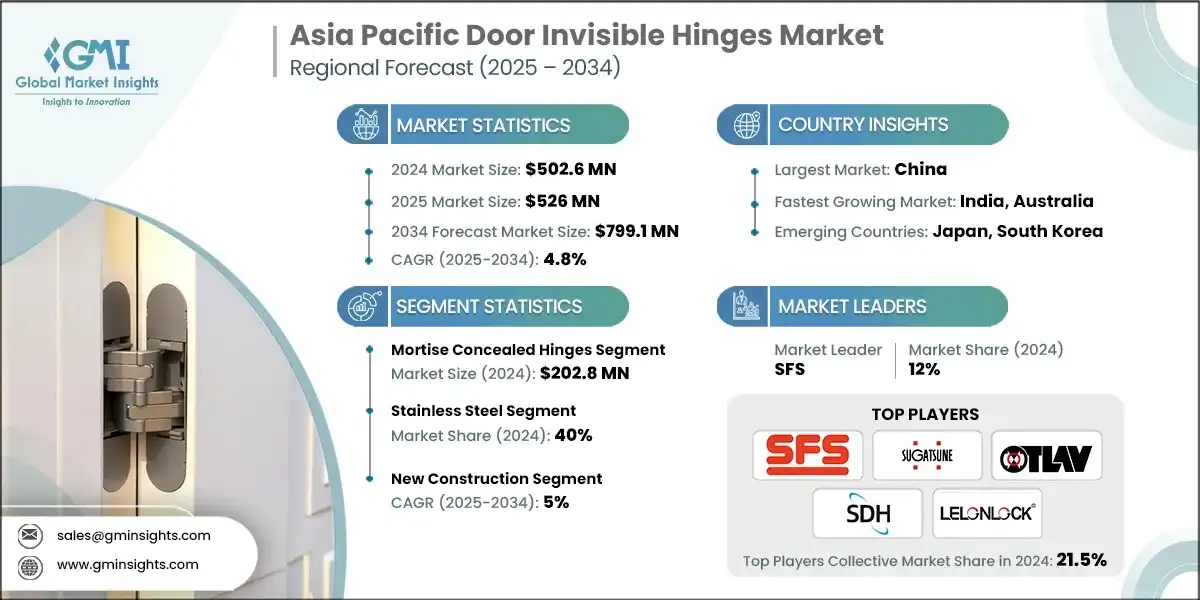
The Asia Pacific door invisible hinges market was estimated at USD 502.6 million in 2024. The market is expected to grow from USD 526 million in 2025 to USD 799.1 million in 2034, at a CAGR of 4.8%, according to latest report published by Global Market Insights Inc.
Asia Pacific Door Invisible Hinges Market Key Takeaways
Market Size & Growth
- 2024 Market Size: USD 502.6 Million
- 2025 Market Size: USD 526 Million
- 2034 Forecast Market Size: USD 799.1 Million
- CAGR (2025–2034): 4.8%
Regional Dominance
- Largest Market: China
- Fastest Growing Region: India, Australia
Key Market Drivers
- Increasing demand for aesthetically pleasing and modern architectural designs.
- Rapid urbanization and infrastructure development..
Challenges
- High initial costs of invisible hinges.
- Fluctuations in raw material prices.
Opportunity
- Rising investments in smart homes and advanced construction technologies.
- Expansion of e-commerce platforms.
Key Players
- Market Leader: SFS led with over 12% market share in 2024.
- Leading Players: Top 5 players in this market include SFS, Sugatsune, Otlav, SDH, Guangdong Reliance Hardware, which collectively held a market share of 21.5% in 2024.
Get Market Insights & Growth Opportunities
Demand for more aesthetically interior designs with a modern touch has grown in the market, thereby increasing growth in Asia Pacific door invisible hinges. The growth in construction activities in both residential and commercial sectors in Asia Pacific propels the market expansion. Increasing preference among consumers and builders toward high-quality, durable, and concealed hardware solutions supports this trend.
The rapid growth of luxury housing and high-end commercial spaces across countries like China, India, and Japan is promoting the uptake of these hinges. Growing urbanization and increasing disposable income across the region further boost market growth, as consumers increasingly show interest in high-quality and aesthetic home solutions.
According to the Government of India, the real estate sector in India is projected to reach a market size of US$ 1 trillion by 2030 from US$ 200 billion in 2021 and contribute 13% to the country's GDP by 2025. Similarly, retail, hospitality, and commercial real estate are also developing significantly to provide the required infrastructure to the fast-growing needs of the country.
According to the data, India's luxury housing market posted an unprecedented increase in 2025, with the sale of 7,000 homes in the price category of US$ 466-699 million, up 85% YoY, said CBRE South Asia and Assocham.
Other factors contributing to the growth of this market include the advancement in technology within hinge manufacturing, having to do with improved load-bearing capacity and higher durability. The increasing focus on space optimization in urban areas leads to the integration of invisible hinges, as they aid in better space utilization.
To get key market trends
Asia Pacific Door Invisible Hinges Market Trends
- The growth of the Asia Pacific door invisible hinges industry is characterized by an evolving trend. The increasing trend towards minimalistic and modern interior design has driven the adoption of invisible hinges that provide a seamless appearance.
- Within the residential sector, consumers adopt invisible hinges in complementing various contemporary architectural styles. This trend, therefore, has been hugely heightened by the increased focus on space optimization within urban areas since invisible hinges can enable space to be utilized efficiently without necessarily compromising on design aspects.
- Another emerging trend is involving the use of advanced materials and technologies for making hinges. Manufacturers are increasingly using robust, corrosion-resistant materials such as stainless steel and zinc alloy to help the product last longer and perform better.
- Innovations in hinge mechanisms involving adjustability and self-closing are also gaining popularity among end-users for convenience and functionality. The market has also been influenced by the evolution of smart home technologies, whereby consumers are demanding hinges that align with automated and high-tech home systems.
- Invisible hinges also find their application in the commercial sector to give a professional and elegant appearance to offices, hotels, and retail spaces. Businesses are giving first importance to quality fixtures that not only serve to enhance aesthetic appeal but also provide durability and reliability.
- With emphasis being increasingly laid on sustainable construction, several eco-friendly and energy-efficient building materials are coming into the market. Invisible hinges, among others, are also made from recyclable materials.
Asia Pacific Door Invisible Hinges Market Analysis

Learn more about the key segments shaping this market
Based on the product type, the Asia Pacific door invisible hinges market is divided into mortise concealed hinges, pivot concealed hinges, barrel/cylindrical concealed and concealed spring hinges. In 2024, mortise concealed hinges dominated the market generating revenue of USD 202.8 million and expected to grow at a CAGR of 4.8% during the forecast period.
- Mortise concealed hinges are gaining popularity due to their increasing focus on space optimization and minimalistic design provides further propelling the demand for mortise concealed hinges. Technological advancements in hinge materials and manufacturing processes are also contributing to growth in the segment, in the process assuring good functionality and longevity.
- Concealed pivot hinges are gaining momentum, as they can bear large and heavy doors, hence becoming suitable for high-end residential and commercial applications. The incorporation of oversized doors in luxury properties is one of the trends driving this segment.
Learn more about the key segments shaping this market
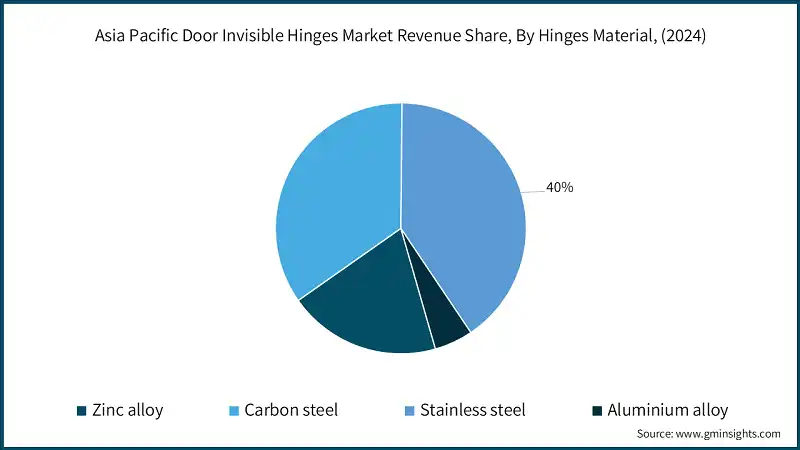
Based on hinges material, the Asia Pacific door invisible hinges market is segmented into zinc alloy, carbon steel, stainless steel, and aluminum alloy. In 2024, stainless steel segment dominates the market with 40% market share, and the segment is expected to grow at a CAGR of 5.1% from 2025 to 2034.
- The stainless-steel segment benefits from the material's corrosion resistance and aesthetic look, which is applied to high-end architectural projects. In addition, the growing preference for premium quality materials in residential and commercial areas has driven the demand for stainless steel invisible hinges.
- Aluminum alloy hinges are found adoption due to their lightweight nature and properties such as resistance to corrosion. These properties make them suitable for applications in modern furniture and lightweight doors.
- Properties such as resistance, durability, and low cost are the driving factors for zinc alloy invisible hinges in construction and furniture. Zinc alloy features good corrosion resistance and strength; thus, it is considered for a wide range of applications, from residential to commercial.
Based on end use, the Asia Pacific door invisible hinges market is segmented into new construction and retrofit/renovation. In 2024, the new construction segment dominates the market and is expected to grow at a CAGR of 5% from 2025 to 2034.
- The increasing urbanization and rise of modern architectural designs boost the demand for the new construction segment in the Asia Pacific door invisible hinges market. Builders and architects are showing more interest in incorporating invisible hinges to achieve seamless aesthetics and enhanced functionality in residential and commercial building projects.
- The trend of smart homes and energy-efficient buildings is thus driving the adoption of newer door hardware solutions, including invisible hinges. Government initiatives on sustainable construction practices further add to the segment's growth, as these hinges comply with the demand for durable and aesthetically pleasing building components.
Looking for region specific data?
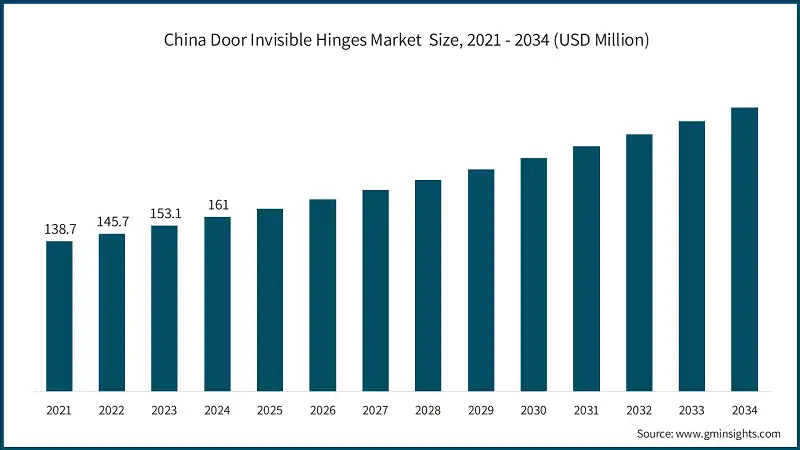
In terms of country, the China led the Asia Pacific door invisible hinges market with 32% of the market share and estimated USD 161 million in revenue during 2024.
- The invisible hinges market in China is gaining considerable momentum due to the growing demand for architectural design that looks modern and aesthetically pleasing. In addition, rapid urbanization and increasing disposable income spur the adoption of high-end door hardware, including invisible hinges.
- As of October 2025, according to the China Real Estate Index System (CREIS), the average price of newly built residential properties across 100 monitored cities was USD 2,389 per square meter, while second-hand homes averaged USD 1,867 per square meter.
- Data from the China Index Academy show that 876,700 existing homes were sold across 30 key cities between January and June, up 12.1% year-on-year.
The India door invisible hinges market was valued at USD 75.2 million in 2024 and is projected to grow at a CAGR of 5.3% between 2025 and 2034.
- Urbanization and growing demand for modern interior designs are driving the growth of the invisible hinges market in India. Increasing building construction and a rise in residential and commercial buildings are driving up demand for invisible hinges.
- Initiatives by the government of India on affordable housing and infrastructure development are further boosting market growth. Further, innovation in hinge technology and access to superior quality and durable products is improving customer interest and making India a fastest emerging market in the region.
Asia Pacific Door Invisible Hinges Market Share
- The top 5 companies in the Asia Pacific door invisible hinges industry are Guangdong Reliance Hardware, Otlav, SDH Hardware, SFS, Sugatsune collectively hold a share of 21.5% in the market.
- These companies continue to acquire and merge with others, expand facilities, and make various collaborations to increase their product offerings, access customer bases, and secure their market positions.
- SFS gains market share by focusing on product innovation and customization. It invests heavily in research and development to introduce advanced solutions with invisible hinges, meeting a wide range of customer demands. SFS has also increased its number of distribution points across Asia Pacific to ensure its product availability and timely delivery.
- SDH Hardware leverages its prestige in quality and reliability, gained for long years, as a means of expanding its market share. The company focuses on the durability and aesthetic appearance of invisible hinges for high-end residential and commercial applications. SDH intensively promotes marketing campaigns that will showcase the advantages of their products in terms of concealed installation and smooth operation.
- Sugatsune is expanding its share by offering a wide range of high-quality invisible hinges for different applications. Innovation is key at the company, hence the introduction of various new products with advanced functionality and sleek designs to meet modern architectural trends. With a strong online presence and e-commerce capabilities, its products are now easily accessible to more customers in Asia Pacific.
Asia Pacific Door Invisible Hinges Market Companies
Major players operating in the Asia Pacific door invisible hinges industry are:
- AGB
- Bartels Systembeschlage
- Ceam Italia
- Globe Manufacturing
- Guangdong Reliance Hardware
- Keil Hinge
- Krona Koblenz
- OL.MI Italy
- Otlav
- SDH Hardware
- SFS
- Simonswerk
- SOSS Door Hardware
- Sugatsune
- TKZ Polna
To improve the product and market share key players are constantly investing in technological activities and are also entering into partnerships to provide improved and better solutions for the customers. These investments are benefiting both companies and customers as they help develop and offer solutions as per the changing technological trends and thus the customer requirements.
Sugatsune is one of the major players in the Asia Pacific invisible hinges market. The product line encompasses a range of high-end offerings, reflecting a perfect blend of Japanese craftsmanship and technological capabilities that develop functional as well as aesthetic fittings. Applications are architectural, furniture, and industrial, with diversity and excellence found across these companies' uses for Sugatsune products.
SFS is a global key player in the manufacturing of invisible hinges, supplying the Asia Pacific market with precision-engineered solutions. The company is committed to delivering high-performance products that meet the demands of latest architecture and design. SFS hinges have a pedigree for durability, ease of installation, and seamless integration into a wide range of door systems.
Asia Pacific Door Invisible Hinges Market Report Attributes
| Key Takeaway | Details |
|---|---|
| Market Size & Growth | |
| Base Year | 2024 |
| Market Size in 2024 | USD 502.6 Million |
| Market Size in 2025 | USD 526 Million |
| Forecast Period 2025 – 2034 CAGR | 4.8% |
| Market Size in 2034 | USD 799.1 Million |
| Key Market Trends | |
| Drivers | Impact |
| Increasing demand for aesthetically pleasing and modern architectural designs | This trend is driving the adoption of invisible hinges, as they offer seamless integration into contemporary designs, boosting market growth. |
| Rapid urbanization and infrastructure development. | The growing construction activities in the Asia-Pacific region are fueling the demand for advanced hardware solutions, positively impacting the market. |
| Pitfalls & Challenges | Impact |
| High initial costs of invisible hinges | Premium pricing compared to traditional hinges may limit adoption, particularly in cost-sensitive markets, restraining market growth. |
| Fluctuations in raw material prices | Variability in material costs can increase production expenses, impacting profit margins and pricing strategies. |
| Opportunities: | Impact |
| Rising investments in smart homes and advanced construction technologies | The growing focus on smart infrastructure is creating opportunities for innovative hinge solutions, driving market growth. |
| Expansion of e-commerce platforms | Online platforms are enhancing product accessibility and visibility, enabling manufacturers to reach a broader customer base and boosting sales. |
| Market Leaders (2024) | |
| Market Leaders |
12% market share |
| Top Players |
Collective market share in 2024 is 21.5% |
| Competitive Edge |
|
| Regional Insights | |
| Largest Market | China |
| Fastest growing market | India, Australia |
| Emerging country | India, Australia |
| Future outlook |
|
What are the growth opportunities in this market?
Asia Pacific Door Invisible Hinges Industry News
- In October 2025, Sugatsune launched new hinge that streamlines the hidden door ideal for retrofits and refined finishes. The HES2S concealed hinge is the latest in Sugatsune’s evolving line of concealed hinges, and its defining move is a simple one: surface mounting.
- In November 2023, TKZ Polna introduced 3D adjustable invisible hinges ideal for simplifying installation or adjusting a functioning door over time. These hinges are suitable for standard interior doors of 40 mm thickness.
- In April 2023, With the “Pivota DXS Close 2.0”, BaSys is presenting the revised and patented version of its concealed door hinge with integrated door closer at BAU 2023. With the update, BaSys replaces the short-lived gas-filled spring and expands the adjustment options.
The Asia Pacific door invisible hinges market research report includes in-depth coverage of the industry with estimates & forecasts in terms of revenue (USD Million) and volume (Million Units) from 2021 to 2034, for the following segments:
Market, By Product Type
- Mortise concealed hinges
- Pivot concealed hinges
- Barrel/cylindrical concealed
- Concealed spring hinges
Market, By Technology
- Manual hinges
- Spring-assisted
- Hydraulic
Market, By Door Weight
- Light weight doors (up to 49 kg)
- Medium weight doors (50-99 kg)
- Heavy weight doors (100-149 kg)
- Extra heavy doors (above 149 kg)
Market, By Hinges Material
- Zinc alloy
- Carbon steel
- Stainless steel
- Aluminum alloy
Market, By Price
- Low
- Medium
- High
Market, By Application
- Residential
- Commercial
- Institutional
- Industrial
Market, By End Use
- New construction
- Retrofit/renovation
Market, By Distribution Channel
- Direct sales
- Indirect sales
The above information is provided for the following countries:
- China
- India
- Japan
- South Korea
- Australia
- Rest of Asia Pacific
Frequently Asked Question(FAQ) :
What is the market size of the Asia Pacific door invisible hinges industry in 2024?
The market size was USD 502.6 million in 2024, with a CAGR of 4.8% expected through 2034, driven by rapid urbanization and construction growth across residential and commercial sectors.
What is the current Asia Pacific door invisible hinges market size in 2025?
The market size is projected to reach USD 526 million in 2025, supported by demand for modern interior designs and adoption of concealed hardware in premium construction.
What is the projected value of the Asia Pacific door invisible hinges market by 2034?
The Asia Pacific door invisible hinges industry is expected to reach USD 799.1 million by 2034, driven by advancements in hinge technology, rising luxury housing, and adoption of space-saving architectural solutions.
How much revenue did the mortise concealed hinges segment generate in 2024?
The mortise concealed hinges segment generated USD 202.8 million in 2024 driven by rising preference for minimalistic design, space optimization, and improved durability offered by modern mortise hinge mechanisms.
What is the growth outlook for the stainless-steel hinges material segment from 2025 to 2034?
The stainless-steel hinges material segment is projected to grow at a 5.1% CAGR through 2034.
Which country leads the Asia Pacific door invisible hinges market?
China led the market with 32% share, valued at USD 161 million in 2024. Growth is driven by large-scale real estate development, rising disposable incomes, and increasing focus on modern, aesthetically pleasing architectural designs.
What are the upcoming trends in the Asia Pacific door invisible hinges industry?
Key trends include adoption of minimalistic interior designs, rising use of corrosion-resistant and advanced hinge materials, and integration of adjustable or self-closing mechanisms. Growing demand for smart homes and energy-efficient construction further accelerates industry innovation.
Who are the key players in the Asia Pacific door invisible hinges market?
Key players include SFS, Sugatsune, Otlav, SDH Hardware, and Guangdong Reliance Hardware, along with AGB, Ceam Italia, Keil Hinge, Krona Koblenz, Simonswerk, SOSS Door Hardware, and TKZ Polna.
Asia Pacific Door Invisible Hinges Market Scope
Related Reports