Summary
Table of Content

Asia Pacific Connected Cars Market
Get a free sample of this report
Form submitted successfully!
Error submitting form. Please try again.
Thank you!
Your inquiry has been received. Our team will reach out to you with the required details via email. To ensure that you don't miss their response, kindly remember to check your spam folder as well!
Request Sectional Data
Thank you!
Your inquiry has been received. Our team will reach out to you with the required details via email. To ensure that you don't miss their response, kindly remember to check your spam folder as well!
Form submitted successfully!
Error submitting form. Please try again.
Asia Pacific Connected Cars Market Size
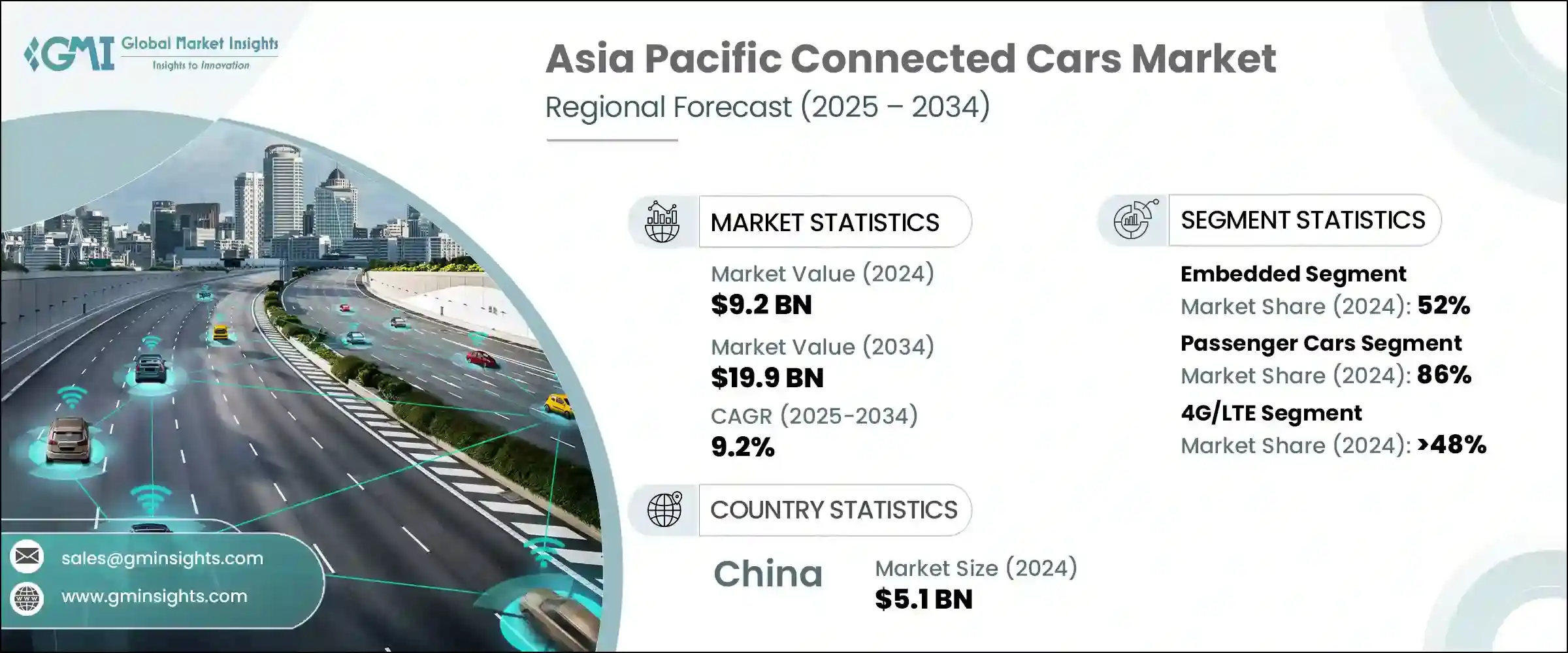
The Asia Pacific connected cars market size was estimated at USD 9.2 billion in 2024. The market is expected to grow from USD 9.9 billion in 2025 to USD 19.9 billion in 2034, at a CAGR of 9.2%.
Asia Pacific Connected Cars Market Key Takeaways
Market Size & Growth
- 2024 Market Size: USD 9.2 Billion
- 2034 Forecast Market Size: USD 19.9 Billion
- CAGR (2025–2034): 9.2%
Key Market Drivers
- Expanding 5G and smart infrastructure.
- Government policies and safety mandates.
- Rising demand for infotainment and digital features.
- Growth in electric and autonomous vehicles.
Challenges
- Data privacy and cybersecurity concerns.
- High cost of connected technologies.
Opportunity
- Emerging markets leading to mass adoption.
- Public-private partnerships for smart mobility.
- Aftermarket expansion.
- AI and predictive maintenance integration.
Key Players
- Market Leader: SAIC Motor led with over 11% market share in 2024.
- Leading Players: Top 5 players in this market include BYD, Honda, Nissan, SAIC Motor, Toyota Motor, which collectively held a market share of 29% in 2024.
Get Market Insights & Growth Opportunities
- The Asia Pacific connected cars industry is expanding rapidly, driven by surging consumer demand for in-vehicle connectivity, infotainment, and advanced driver-assistance features. Countries such as China, Japan, and South Korea are leading adoption with strong automotive production bases and tech integration capabilities.
- Rising urbanization, increasing smartphone penetration, and the proliferation of 4G/5G infrastructure are enhancing the connected vehicle ecosystem. Southeast Asian nations such as Thailand, Indonesia, and Vietnam are witnessing growing interest in smart mobility solutions.
- The COVID-19 pandemic initially disrupted supply chains, but it also accelerated digitization in the automotive sector. By 2022, the market rebounded strongly with growing interest in contactless services, remote diagnostics, and vehicle-to-everything (V2X) communication.
- Government policies supporting intelligent transport systems (ITS), smart city initiatives, and mandates on emergency call (eCall) systems and telematics are fueling demand. China’s aggressive push for autonomous driving and India’s draft telematics regulations further highlight the region’s regulatory momentum.
- Asia Pacific is becoming a key innovation hub for connected car technologies due to low-cost manufacturing, strong software development capabilities, and high EV penetration. Automakers are increasingly collaborating with telecom operators and cloud providers to scale connectivity offerings across vehicle segments.
To get key market trends
Asia Pacific Connected Cars Market Trends
- Since 2018–2019, the surge in smartphone usage, digital infrastructure, and middle-class vehicle ownership in China, India, and Southeast Asia has driven rapid adoption of connected car technologies. Consumers increasingly prioritize real-time navigation, infotainment, and vehicle safety, boosting demand for integrated connectivity solutions.
- In mid-2025, a major Japanese automaker unveiled its flagship connected SUV in South Korea and Thailand, featuring over-the-air (OTA) updates, AI-powered voice assistance, and in-car e-commerce capabilities. This underscores how OEMs are leveraging smart features to differentiate offerings in a competitive regional market.
- Governments across APAC including China, Singapore, and India have introduced regulations and pilot programs encouraging vehicle-to-infrastructure (V2I) and vehicle-to-vehicle (V2V) communication, fostering a regulatory environment supportive of connected mobility since 2017. These initiatives are also fueling public-private investment in smart traffic and safety systems.
- With the growing shift toward electric and autonomous vehicles, APAC manufacturers are investing in cloud-integrated telematics, cybersecurity, and energy-efficient data processors for connected cars. This aligns with consumer demand for tech-forward, sustainable vehicles as cities push for low-emission mobility ecosystems.
- In early 2025, at the Auto Tech Asia Expo in Tokyo, a prominent Chinese tech firm debuted a 5G-enabled connected car platform featuring AI-based predictive maintenance and cross-border cloud connectivity. This innovation reflects the region’s push toward seamless, intelligent mobility solutions tailored for diverse driving environments.
Asia Pacific Connected Cars Market Analysis
Learn more about the key segments shaping this market
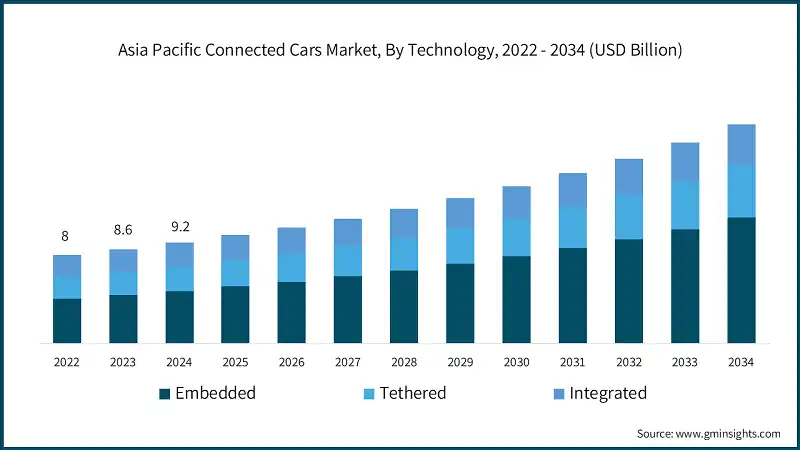
Based on technology, the Asia Pacific connected cars market is divided into embedded, tethered, and integrated. The embedded segment dominated the market, accounting for 52% market share in 2024 and is expected to grow at a CAGR of over 10% through 2034.
- The embedded segment leads the market due to its seamless integration with vehicle ECUs, offering real-time telematics, remote diagnostics, and OTA updates. OEMs in China, Japan, and South Korea are increasingly standardizing embedded systems to meet regulatory, and consumer demands for smart mobility features.
- The Tethered segment, holding a 25% of the Asia Pacific connected cars market share in 2024, continues to see healthy adoption, especially among mid-range and budget vehicle models in emerging markets such as India, Thailand, and Indonesia. Its cost-effectiveness and reliance on consumer smartphones for connectivity make it a viable option in price-sensitive markets.
- Consumer demand for always-connected experiences and in-vehicle infotainment is accelerating the shift toward embedded systems that enable continuous cloud-based services, voice assistants, and V2X communication. Automakers are investing in scalable, subscription-based services to monetize these embedded platforms.
- In early 2025, a major Japanese automotive manufacturer launched a new EV lineup equipped with 5G-based embedded connectivity solutions in Asia, enabling ultra-low latency vehicle data exchange, enhanced navigation, and real-time safety alerts, highlighting the growing synergy between electrification and connected technology.
- The rising emphasis on predictive maintenance, driver behavior monitoring, and remote vehicle management is fueling the development of advanced embedded telematics solutions across both passenger and commercial fleets. This shift supports the growing demand for proactive safety, operational efficiency, and personalized mobility in APAC markets.
Learn more about the key segments shaping this market
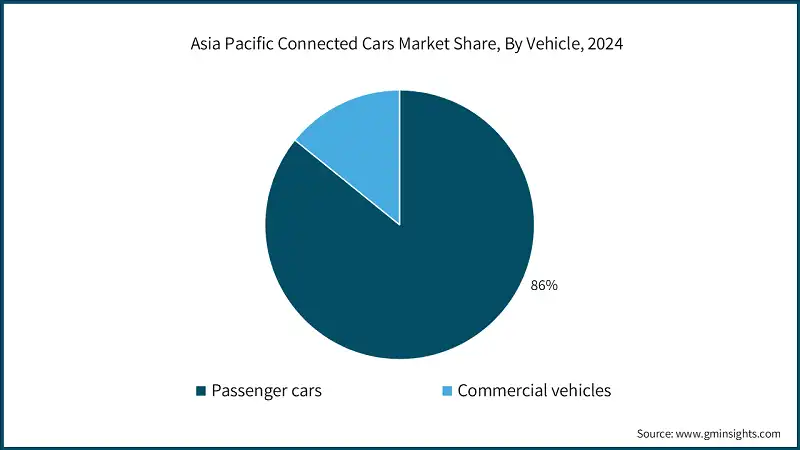
Based on vehicle, the market is segmented into passenger cars and commercial vehicles. The passenger cars segment held around 86% of the market share and generated revenue of over USD 7.5 billion in 2024.
- The passenger cars segment dominates the Asia Pacific connected cars market, driven by rising consumer demand for infotainment, navigation, telematics, and ADAS features. Countries like China, Japan, and South Korea are at the forefront, with OEMs embedding connected technologies as standard offerings in mid- to high-end models.
- The commercial vehicles segment is experiencing strong growth, registering a CAGR of 8.2% in 2024, as fleet operators increasingly adopt connected solutions for real-time tracking, route optimization, and predictive maintenance. This trend is especially notable in India, Australia, and Southeast Asia’s logistics and e-commerce sectors.
- Connected technologies in passenger cars are evolving to support enhanced driver experience, personalized services, and cloud-based navigation. Automakers are partnering with telecom providers to offer subscription-based connected services, aligning with rising customer expectations for a digital, always-connected driving experience.
- In early 2025, a Chinese commercial vehicle OEM announced the rollout of a connected fleet platform integrating AI-based analytics and remote diagnostics across its regional delivery trucks. This reflects the growing demand for operational efficiency and reduced downtime in the region’s expanding logistics and transportation industry.
- The increasing push for urban mobility solutions, EV integration, and smart city infrastructure is fueling innovation across both vehicle segments. Passenger vehicles lead in consumer-facing technologies, while commercial vehicles are adopting fleet-wide connectivity for enhanced safety, compliance, and cost control.
Based on connectivity, the Asia Pacific connected cars market is segmented into 5G, 4G/LTE, 3G, Wi-Fi, and Bluetooth. The 4G/LTE segment dominates the market with over 48% share in 2024, and the segment is expected to grow at a CAGR of over 10.6% from 2025 to 2034.
- The 4G/LTE segment remains the dominant connectivity technology in the APAC connected cars market, supported by its widespread network availability, stable data speeds, and proven capability to handle core connected services such as navigation, remote diagnostics, OTA updates, and infotainment streaming.
- The 5G segment, with a 9.1% CAGR in 2024, is rapidly gaining ground as automakers in China, Japan, and South Korea integrate ultra-low latency and high-bandwidth applications into their next-generation vehicles. The rollout of smart mobility infrastructure and autonomous vehicle testing zones is further accelerating 5G deployment.
- While 3G continues to hold the third-largest share, its relevance is declining as telecom operators phase out legacy networks in favor of more advanced technologies. However, 3G still supports basic telematics and navigation features in older vehicle models and cost-sensitive markets like Southeast Asia and rural India.
- In early 2025, a major Chinese OEM announced a strategic partnership with a domestic telecom provider to upgrade its entire connected vehicle fleet from 3G/4G modules to 5G-ready embedded systems, reflecting the ongoing transition toward next-generation vehicle connectivity across the region.
- The coexistence of 3G, 4G, and 5G across various APAC markets presents both opportunities and challenges for OEMs. While 4G remains the default standard, automakers are actively investing in 5G for future-ready applications and slowly phasing out 3G systems, especially in urban centers and tech-driven markets.
Looking for region specific data?
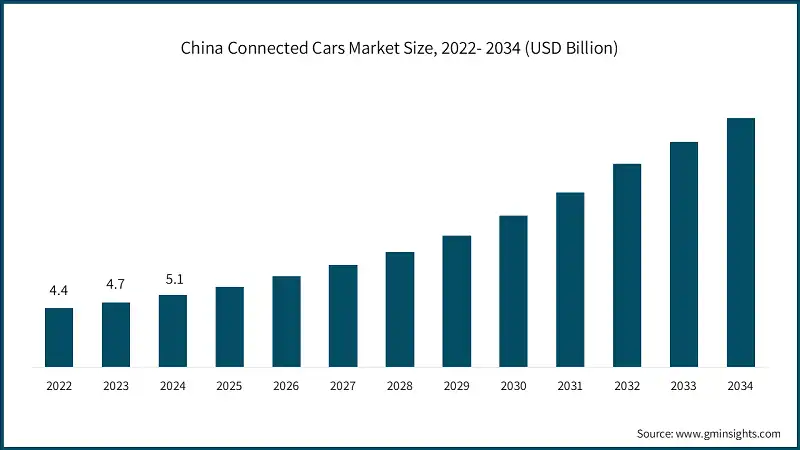
China dominated the Asia Pacific connected cars market with around 55% market share and generated around USD 5.1 billion in revenue in 2024.
- China leads the Asia Pacific connected cars industry, driven by its expansive automotive production base, proactive government policies, and early adoption of smart mobility technologies. As the region’s largest auto market, China has implemented supportive regulations and incentives for connected and intelligent vehicles, setting the pace for other APAC countries.
- The Asia Pacific connected cars market benefits from deep integration between domestic automakers, telecom giants, and tech companies, enabling rapid deployment of embedded connectivity, 5G infrastructure, and V2X communication systems. China’s “Intelligent Vehicle Innovation Development Strategy” and “New Energy Vehicle” plans continue to accelerate the rollout of connected platforms.
- China’s dominance is reinforced by high consumer demand for tech-rich driving experiences, booming EV sales, and a robust ecosystem of local Tier 1 suppliers and telematics providers. These stakeholders are equipping vehicles with real-time infotainment, predictive maintenance, and cloud-based services tailored for both mass and premium segments.
- Investment in urban smart infrastructure, government-mandated telematics for ride-hailing and commercial fleets, and AI-driven platforms are advancing connected car deployment across both private and public transport sectors. China’s end-to-end innovation capacity from semiconductors to cloud ecosystems—positions it as the region’s connected vehicle powerhouse.
- With a focus on autonomous driving readiness, cyber-secure platforms, and in-vehicle app ecosystems, China is setting benchmarks for regulatory frameworks and technological integration. Its leadership in connected car adoption continues to shape APAC’s trajectory, offering a scalable model for emerging markets in the region.
The connected cars market in Japan is expected to experience significant and promising growth from 2025 to 2034.
- The Japanese market is shaped by major automakers’ commitment to innovation, extensive deployment of 5G networks, and government initiatives promoting intelligent transportation systems (ITS). Local technology providers and Tier 1 suppliers excel in developing vehicle-to-everything (V2X) communication and AI-powered telematics solutions tailored for urban and highway environments.
- Japan’s dominance is further supported by a tech base consumer that values in-vehicle connectivity, autonomous driving capabilities, and seamless integration with smart infrastructure. Leading manufacturers have embedded connected services into vehicle infotainment and predictive maintenance platforms, driving widespread adoption.
- Robust digital infrastructure, smart city projects, and public-private R&D collaborations underpin continuous advancements in connected vehicle technologies. With a strategic focus on sustainable mobility and next-generation safety, Japan remains the benchmark for connected car innovation, regulation, and ecosystem development in the Asia Pacific region.
The connected cars market in South Korea is expected to experience significant and promising growth from 2025 to 2034.
- South Korea stands as a leading and technologically advanced market for connected cars in the Asia Pacific region, driven by its robust automotive industry, rapid 5G network rollout, and high consumer demand for smart mobility solutions. Major OEMs such as Hyundai and Kia have been pioneers in embedding connected car technologies as standard across their vehicle lineups.
- The country’s connected cars market is accelerated by strong government support through initiatives like the Korean Intelligent Transport System (ITS) and Smart Mobility projects, which promote vehicle-to-everything (V2X) communication, autonomous driving development, and real-time traffic management.
- South Korea’s dominance is reinforced by its cutting-edge domestic technology ecosystem, with top electronics and semiconductor companies advancing innovations in telematics, AI-based driver assistance, and over-the-air (OTA) updates, ensuring seamless integration between vehicles and digital infrastructure.
- In 2025, Hyundai announced the expansion of its connected car platform ‘Blue Link’ across all new models, featuring enhanced AI-driven predictive maintenance, voice-activated controls, and deep integration with smart city infrastructure, reflecting South Korea’s commitment to next-generation connected mobility solutions.
The connected cars market in India is expected to experience significant and promising growth from 2025 to 2034.
- India is emerging as a dynamic and rapidly growing market for connected cars in the Asia Pacific region, fueled by its expanding automotive industry, increasing smartphone penetration, and rising consumer appetite for affordable smart vehicle technologies. Domestic and global OEMs are accelerating the integration of connected features to meet growing market demand.
- The connected car market in India benefits from supportive government initiatives like the Faster Adoption and Manufacturing of Hybrid & Electric Vehicles (FAME) scheme and Digital India, which drive infrastructure development, including 4G/5G networks and smart city projects that enable enhanced vehicle connectivity.
- India’s growth is further propelled by a vibrant local tech ecosystem, with startups and established companies innovating in telematics, infotainment, and vehicle tracking solutions. The focus is on cost-effective, scalable connected car platforms tailored for emerging market needs, including real-time diagnostics, navigation, and safety alerts.
- In 2025, major OEMs such as Tata Motors and Mahindra introduced new models equipped with integrated connected car technologies, featuring app-based remote monitoring, over-the-air updates, and enhanced safety features, reflecting India’s rising leadership in connected mobility adoption across Asia Pacific.
The connected cars market in Australia is expected to experience significant and promising growth from 2025 to 2034.
- Australia is a prominent and technologically advanced market for connected cars in the Asia Pacific region, driven by high consumer demand for safety, convenience, and digital connectivity in vehicles. The country’s mature automotive aftermarket and strong regulatory framework support widespread adoption of connected car technologies.
- The Australian connected cars market is propelled by government initiatives aimed at improving road safety and smart transport infrastructure, including the Intelligent Transport Systems (ITS) Australia program and investments in nationwide 5G rollout, enabling robust vehicle-to-everything (V2X) communications.
- Australia’s leadership is reinforced by collaboration between domestic technology firms, telecom providers, and OEMs to develop and deploy advanced telematics, navigation, and autonomous driving support systems. The market also benefits from a digitally savvy consumer base with growing expectations for integrated mobile and vehicle connectivity.
- In 2025, leading automotive brands introduced new connected car platforms in Australia featuring enhanced cloud-based services, over-the-air updates, and real-time traffic and hazard alerts, underscoring the country’s commitment to smart, safe, and connected mobility solutions.
Asia Pacific Connected Cars Market Share
- The top 7 companies in the Asia Pacific connected cars industry are Toyota Motor, Hyundai, Honda, SAIC Motor, Nissan, BYD, and Tata Motors contributing over 32% of the market in 2024.
- Toyota Motor Corporation leads the Asia Pacific connected cars market with its extensive portfolio of smart vehicle technologies. Renowned for integrating advanced telematics, AI-driven driver assistance, and cloud-connected platforms, Toyota drives innovation in predictive maintenance and seamless connectivity across its diverse model range.
- Hyundai Motor Company is a major player advancing connected car adoption through its Blue Link platform and strong focus on AI-powered infotainment and vehicle-to-everything (V2X) communication. Hyundai’s continuous investments in 5G-enabled smart mobility solutions position it at the forefront of next-generation connected vehicles in the region.
- Honda Motor Co., Ltd. delivers cutting-edge connected car technologies with a focus on safety and user experience. Honda’s integration of telematics, remote vehicle monitoring, and over-the-air updates enhances driver convenience and supports its vision for autonomous and electrified mobility in Asia Pacific markets.
- SAIC Motor Corporation is a leading Chinese automaker driving the regional connected cars market through its innovative vehicle connectivity ecosystems. Leveraging partnerships with tech firms and strong digital infrastructure, SAIC offers intelligent infotainment and real-time vehicle diagnostics tailored for smart urban mobility.
- Nissan Motor Corporation advances connected car technology with its NissanConnect system, emphasizing seamless smartphone integration, remote monitoring, and smart navigation. Nissan’s commitment to connected services supports enhanced driver safety and predictive maintenance across Asia Pacific markets.
- BYD Company Limited is a pioneer in electric and connected vehicle solutions in Asia Pacific, combining its leadership in EV technology with advanced telematics and cloud-based connectivity. BYD’s focus on integrating vehicle data analytics and smart fleet management propels connected mobility adoption in emerging markets.
- Tata Motors is a key contributor to the connected cars market in India and beyond, offering cost-effective connected vehicle solutions. With app-based remote diagnostics, OTA updates, and integration with digital services, Tata Motors is enabling broader accessibility to smart vehicle technologies in the rapidly growing regional market.
Asia Pacific Connected Cars Market Companies
Major players operating in the Asia Pacific connected cars industry are:
- BYD
- Changan Automobile
- Honda
- Hyundai
- Isuzu Motors
- Kia
- Nissan
- SAIC Motor
- Tata Motors
- Toyota Motor
- In the Asia Pacific connected cars market, leading players such as Toyota, Hyundai, and SAIC Motor have made significant investments in advanced connectivity technologies customized for regional automotive manufacturers and evolving regulatory frameworks.
- Toyota continues to innovate with AI-driven telematics and integrated digital platforms optimized for hybrid and electric vehicles, while Hyundai leverages its robust connected services ecosystem to enhance vehicle-to-everything (V2X) communication across passenger and commercial fleets. SAIC Motor focuses on smart urban mobility solutions, integrating real-time data analytics and cloud connectivity tailored to Asia Pacific’s diverse infrastructure landscape.
- Nissan and Honda emphasize user-centric connected car experiences, developing seamless smartphone integration, remote diagnostics, and over-the-air update capabilities to meet rising consumer expectations.
- BYD and Tata Motors strengthen their presence by delivering cost-effective connected vehicle solutions with scalable telematics and smart fleet management, accelerating adoption in emerging markets. Collaborations with telecom providers and technology firms are central to enabling widespread 5G connectivity and intelligent transportation systems throughout the region.
- Collectively, these players prioritize localized innovation, regulatory alignment, and strategic partnerships with government and industry stakeholders to address Asia Pacific’s rapid urbanization and mobility transformation.
- Their focused investments in R&D, digital infrastructure, and ecosystem development aim to empower OEMs, service providers, and consumers with cutting-edge connected car solutions adapted to regional market dynamics and future mobility trends.
Asia Pacific Connected Cars Market Report Attributes
| Key Takeaway | Details |
|---|---|
| Market Size & Growth | |
| Base Year | 2024 |
| Market Size in 2024 | USD 9.2 Billion |
| Forecast Period 2025 – 2034 CAGR | 9.2% |
| Market Size in 2034 | USD 19.9 Billion |
| Key Market Trends | |
| Drivers | Impact |
| Expanding 5G and smart infrastructure | Enables real-time data exchange and V2X communication, accelerating connected vehicle deployment. |
| Government policies and safety mandates | Drives mandatory adoption of telematics and connectivity features to meet regulatory compliance. |
| Rising demand for infotainment and digital features | Pushes OEMs to integrate advanced in-car experiences, boosting connected car sales. |
| Growth in electric and autonomous vehicles | Necessitates connected technologies for remote monitoring, navigation, and system updates. |
| Pitfalls & Challenges | Impact |
| Data privacy and cybersecurity concerns | Slows adoption as consumers and regulators demand robust protection for vehicle and user data. |
| High cost of connected technologies | Limits penetration in cost-sensitive markets, particularly for entry-level vehicle segments. |
| Opportunities: | Impact |
| Emerging markets leading to mass adoption | Expands market base as rising income and digital infrastructure drive connectivity demand. |
| Public-private partnerships for smart mobility | Accelerates development of supportive ecosystems for connected vehicle integration. |
| Aftermarket expansion | Opens new revenue streams through retrofit connectivity solutions for existing vehicle fleets. |
| AI and predictive maintenance integration | Enhances vehicle uptime and user satisfaction through data-driven service optimization. |
| Market Leaders (2024) | |
| Market Leaders |
11% market share |
| Top Players |
Collective market share in 2024 is 29% |
| Competitive Edge |
|
| Regional Insights | |
| Largest Market | China |
| Fastest growing market | India |
| Emerging countries | Thailand, Vietnam, Indonesia, Philippines |
| Future outlook |
|
What are the growth opportunities in this market?
Asia Pacific Connected Cars Industry News
- In November 2024, Toyota partnered with the Korea Advanced Institute of Science and Technology (KAIST) to launch a specialized connected car certification program emphasizing AI-driven telematics and vehicle-to-everything (V2X) communication technologies. The initiative aims to upskill engineers and OEM partners across Asia Pacific in next-generation connected mobility solutions.
- In October 2024, Hyundai expanded its regional innovation academy by introducing training modules on 5G-enabled smart vehicle platforms and over-the-air (OTA) update management. These micro-certifications help automotive service providers in South Korea, India, and China align connected car maintenance skills with evolving digital infrastructure and safety protocols.
- In July 2024, SAIC Motor deepened collaboration with Alibaba Cloud to embed cloud-based real-time vehicle analytics and AI-powered predictive maintenance features into its connected car ecosystem. Concurrently, SAIC launched enterprise training for OEMs and Tier 1 suppliers focused on smart city integration and data security in connected vehicles.
- In June 2024, Nissan India introduced its Connected Mobility Professional Program, offering hands-on training modules and case studies designed for service technicians and fleet operators. This initiative supports India’s accelerating adoption of telematics, remote diagnostics, and intelligent vehicle management systems.
- In February 2024, BYD partnered with leading universities across China and Southeast Asia to develop tailored connected vehicle curriculum bundles for engineering students and early-career professionals. These training pathways cover cloud connectivity, AI in driver assistance, and regional regulatory compliance.
- In January 2024, Tata Motors launched a blended learning initiative combining virtual labs, instructor-led workshops, and real-time connected car diagnostic simulations. Designed for OEM quality assurance teams and service centers across India and Australia, the program supports certification in Tata’s latest connected vehicle technologies, emphasizing scalable telematics and smart fleet management.
The Asia Pacific connected cars market research report includes in-depth coverage of the industry with estimates & forecasts in terms of revenue ($ Mn/Bn), and shipment (Units) from 2021 to 2034, for the following segments:
Market, By Technology
- Embedded
- Tethered
- Integrated
Market, By Vehicle
- Passenger cars
- Hatchback
- Sedan
- SUV
- Commercial vehicle
- Light-duty
- Medium-duty
- Heavy-duty
Market, By Connectivity
- 5G
- 4G/LTE
- 3G
- Wi-Fi
- Bluetooth
Market, By Application
- Navigation
- Infotainment
- Telematics
- Remote Diagnostics
- Safety & Security
- Fleet Management
Market, By Sales Channel
- OEM
- Aftermarket
The above information is provided for the following regions and countries:
- China
- India
- Japan
- Australia
- South Korea
- Singapore
- Vietnam
- Thailand
- Philippines
- Malaysia
- Indonesia
- Rest of Asia Pacific
Frequently Asked Question(FAQ) :
What is the market size of the Asia Pacific connected cars in 2024?
The market size was estimated at USD 9.2 billion in 2024 and is grow at a CAGR of 9.2% through 2034, driven by increasing demand for in-vehicle connectivity, infotainment, and advanced driver-assistance features.
What is the projected value of the Asia Pacific connected cars market by 2034?
The market is expected to reach USD 19.9 billion by 2034, fueled by advancements in connectivity technologies and smart mobility solutions.
How much revenue did the embedded segment generate in 2024?
The embedded segment accounted for 52% of the market share in 2024, due to its seamless integration with vehicle ECUs and support for real-time telematics, remote diagnostics, and OTA updates.
What was the valuation of the passenger cars segment in 2024?
The passenger cars segment held approximately 86% of the market share, generating over USD 7.5 billion in revenue in 2024.
What is the growth outlook for the 4G/LTE segment from 2025 to 2034?
The 4G/LTE segment is projected to grow at a CAGR of over 10.6% from 2025 to 2034, supported by its widespread network availability, stable data speeds, and ability to handle core connected services.
Which country leads the Asia Pacific connected cars sector?
China leads the Asia Pacific sector with a 55% market share and USD 5.1 billion in revenue in 2024. The market growth is led by its strong automotive base, government policies, and early adoption of smart mobility technologies.
What are the upcoming trends in the Asia Pacific connected cars market?
AI-powered voice assistance, over-the-air updates, in-car e-commerce, V2I and V2V communication, cloud-based telematics, and 5G-enabled platforms are driving growth.
Who are the key players in the Asia Pacific connected cars industry?
Key players include BYD, Changan Automobile, Honda, Hyundai, Isuzu Motors, Kia, Nissan, SAIC Motor, Tata Motors, and Toyota Motor.
Asia Pacific Connected Cars Market Scope
Related Reports