Summary
Table of Content

Asia Pacific Composite Insulators Market
Get a free sample of this report
Form submitted successfully!
Error submitting form. Please try again.
Thank you!
Your inquiry has been received. Our team will reach out to you with the required details via email. To ensure that you don't miss their response, kindly remember to check your spam folder as well!
Request Sectional Data
Thank you!
Your inquiry has been received. Our team will reach out to you with the required details via email. To ensure that you don't miss their response, kindly remember to check your spam folder as well!
Form submitted successfully!
Error submitting form. Please try again.
Asia Pacific Composite Insulators Market Size
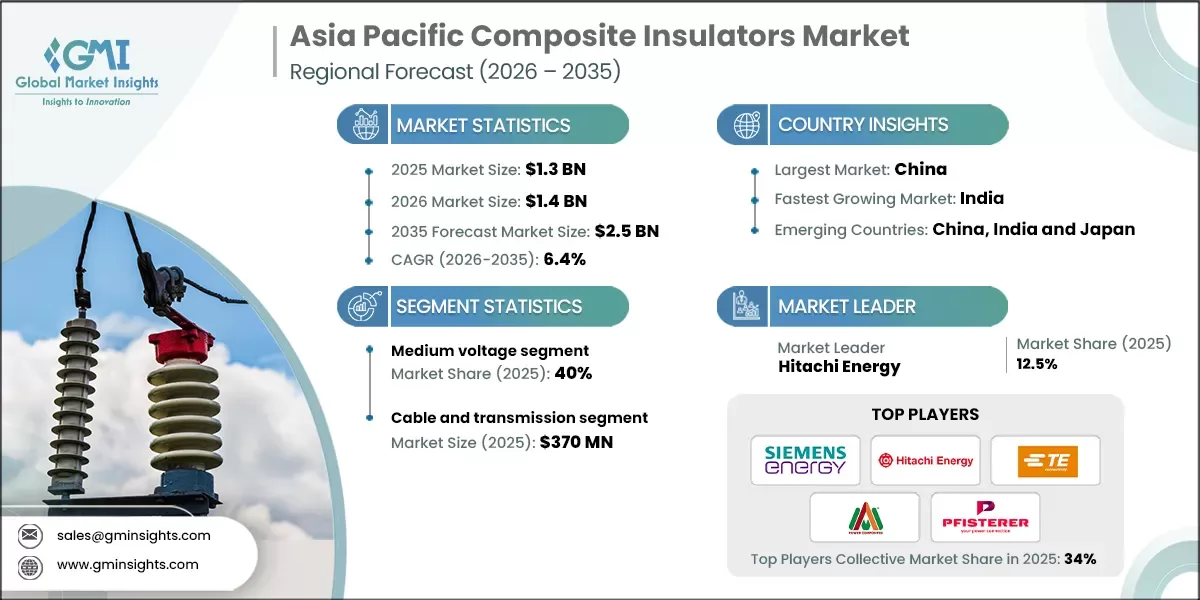
According to a recent study by Global Market Insights Inc., the Asia Pacific composite insulators market was valued at USD 1.3 billion in 2025 and is estimated to grow from USD 1.4 billion in 2026 to USD 2.5 billion by 2035, at a CAGR of 6.4%.
Asia Pacific Composite Insulators Market Key Takeaways
Market Size & Growth
- 2025 Market Size: USD 1.3 Billion
- 2026 Market Size: USD 1.4 Billion
- 2035 Forecast Market Size: USD 2.5 Billion
- CAGR (2026–2035): 6.4%
Regional Dominance
- Largest Market: China
- Fastest Growing Region: India
Key Market Drivers
- Increasing investment for power generation and development of electrical infrastructure.
- Ongoing expansion and refurbishment of existing grid networks.
- Ongoing renewable integration.
Challenges
- Fluctuating raw material cost.
Opportunity
- Expansion of transmission and distribution networks.
- Integration of renewable energy sources.
- Technological advancements composite insulator materials.
- Initiatives for energy infrastructure development.
Key Players
- Market Leader: Hitachi Energy led with over 12.5% market share in 2025.
Get Market Insights & Growth Opportunities
- Ongoing efforts to upgrade transmission networks and government-led programs aimed at strengthening weak infrastructure and minimizing power outages are complementing industry growth. Supportive policies aimed at enhancing the transmission and distribution infrastructure, coupled with rising investments to expand power grids, are further augmenting the Asia Pacific composite insulators market landscape.
- For instance, India’s National Electricity Plan, announced in September 2024, includes funding of approximately USD 111 billion to enhance transmission systems and meet increasing energy requirements. The initiative targets expanding network length from 4.85 lakh circuit kilometers (ckm) to 6.48 lakh ckm and boosting transformation capacity to 2,342 GVA, ensuring readiness for an anticipated peak demand of 458 GW.
- Rapid urbanization and industrial growth across the region have increased energy demand along with flourishing investments to strengthen prevailing electrical infrastructure, has accelerated the need for reliable insulation solutions. These insulators, with their adaptability to high humidity, coastal, and high-pollution environments, and can withstand varied climatic conditions further shaping the Asia Pacific composite insulators market dynamics.
- Increasing integration of renewable energy sources influencing market expansion with wind farms, solar installations and cross-regional transmission corridors require insulation systems that can withstand environmental stress while maintaining electrical performance, widely adopted in these applications due to their resistance to contamination, mechanical flexibility, and suitability for long-span transmission lines.
- For instance, in November 2024, the India-Australia Renewable Energy Partnership was launched which strengthens bilateral cooperation in clean energy through eight strategic areas, including solar PV, green hydrogen, energy storage, and circular economy initiatives. The partnership aims to build a skilled renewable workforce, advance technology commercialization, and promote two-way investments.
- Favorable initiatives toward advancements in grid infrastructure along with introduction of advanced technological components have led utilities to comply with environmental regulations while supporting the expansion of renewable energy sources. Moreover, utilities are focusing on refurbishing aging transmission networks and replacing outdated insulator components to maintain uninterrupted electricity flow, further contributing to Asia Pacific composite insulators market growth.
- For instance, in November 2024, Brazil’s Eletrobras authorities visited Shemar Gorup to explore its experience center, composite materials laboratory, and Composite Insulator Cross Arm (CICA) application site. The team observed bending, electrical, and overload tests, along with assembly training, gaining insights into CICA’s mechanical and electrical performance. Shemar focused on optimizing CICA design, anti-swing technology, and cross-rope applications, reinforcing collaboration to advance low-carbon transformation in power grids.
- China holds a dominant position in Asia-Pacific composite insulators market, driven by surging electricity demand, rapid urbanization, and extensive infrastructure development. Ongoing efforts to integrate renewable energy sources, coupled with significant investments in grid expansion and modernization of aging transmission systems to ensure reliable electricity will augment Asia Pacific composite insulators market outlook.
- For instance, in January 2025, State Grid Corporation of China unveiled plans to invest approximately USD 88.7 billion to upgrade the national power infrastructure. This initiative emphasizes grid optimization, reinforcement of distribution networks, and enhanced support for renewable energy integration. It involves expanding ultra-high-voltage transmission lines to efficiently transfer electricity from western generation hubs to densely populated urban centers, ensuring stable power supply.
- India is one of the emerging markets across the Asia Pacific composite insulator industry owing to rapidly increasing electricity consumption, strong population growth, robust development of urban infrastructure. Rapid progress in building inter-state transmission networks, integrating renewable energy into power grids, and the development of smart city projects have further augmented industry landscape.
To get key market trends
Asia Pacific Composite Insulators Market Trends
- Asia Pacific composite insulators industry is witnessing significant momentum driven by rapidly increasing electricity demand along with grid operators focusing on enhancing reliability and longevity of transmission and distribution networks. Increasing utilization of smart grids coupled with addition of distributive energy sources comprising wind and solar energy systems are accelerating product deployment.
- Composite insulators are increasingly replacing traditional ceramic and glass types due to their lightweight design, superior durability, and cost efficiency. They offer easier installation and deliver reliable performance in polluted and in extreme environments, making them well-suited for high-voltage applications. Additionally, these insulators have an extended service life and require minimal maintenance, which helps power utilities achieve significant cost savings over time.
- For instance, in July 2024, researchers in Australia have developed a silicone-based composite to enhance fire resistance, prevent electrical sparking in power-pole insulators, improves safety and reliability in challenging environmental conditions. The material combines silicone rubber with fiberglass, aluminum hydroxide, and volcanic ash-derived clay, delivering superior flame retardancy, reduced heat release, and minimal smoke generation.
- Ongoing development of industrial infrastructure across major economies across the region including China, India and Australia along with flourishing investments toward development of power infrastructure will stimulate product deployment. Their suitability for line designs and modern tower configurations accelerate product adoption across densely populated and industrialized areas is contributing to Asia Pacific composite insulators market growth.
- For instance, in July 2025, India planned to invest about USD 146.7 billion toward transmission infrastructure upgrades by 2035 to modernize its power network. With peak electricity demand surged to reach 446 GW by FY2034–35, this initiative emphasizes building new transmission corridors and upgrading existing systems to enhance grid resilience and ensure efficient power delivery across the country.
Asia Pacific Composite Insulators Market Analysis
Learn more about the key segments shaping this market
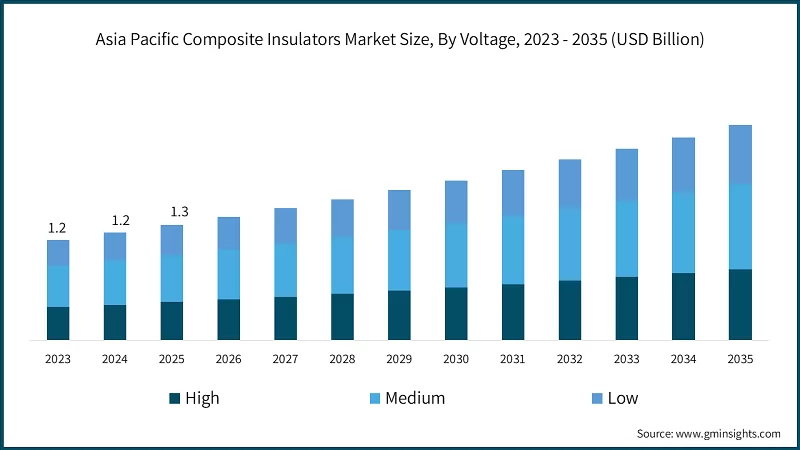
- Based on the voltage, the industry is categorized into low, medium, and high. The medium voltage segment dominated Asia Pacific composite insulators industry accounting for around 40% share in 2025 and is set to grow at a CAGR of 6% through 2035.
- Flourishing investments toward expansion of transmission networks along with development of medium voltage distribution networks play a major role in connecting renewable energy sources to distribution grids will accelerate product demand. Composite insulators are preferred for the ease of their mechanical strength, resistance to environmental stress and suitability for variable load conditions will further stimulate product deployment.
- Rising grid modernization, smart grid development and expansion of inter-regional networks to ensure reliable electricity across remote or far areas will stimulate product penetration. For instance, in December 2025, Salasar Techno Engineering awarded a contract worth approximately USD 27.8 million from UPPTCL, Uttar Pradesh, India to construct a 400 kV DC Twin Moose transmission line connecting to regions, Banda and Chitrakoot.
- The high voltage segment is anticipated to grow at a CAGR of over 6% by 2035. Rapid expansion of high-voltage power networks and initiatives to reduce supply interruptions have accelerated demand for composite insulators across diverse transmission and distribution applications. Increasing adoption of renewable energy sources, coupled with integration of advanced technologies and supportive government policies for grid stabilization, is augmenting high voltage composite insulators deployment.
- For instance, in December 2025, Xizang launched its first ultra-high voltage (UHV) power transmission project, situated at an altitude of 3,720 meters, successfully completed a 168-hour trial run and is now operational. This development enables clean hydropower from a 750,000-kW station on the Jinsha River, strengthening power supply to central China.
- The low voltage segment was valued at over USD 355 million in 2025. Paradigm shift toward polymer-based composite alternatives to reduce maintenance requirements and improve operational safety, will accelerate product demand. Growing use of composite insulators in compact and space-constrained electrical installations along with the ongoing expansion of distribution network and new construction projects will augment low voltage composite insulators industry outlook.
- For instance, in January 2024, State Grid Corporation of China announced plans to invest over USD 69.6 billion to strengthen its transmission and distribution infrastructure. This strategic investment aims to enhance grid reliability, ensure uninterrupted power supply, and support the integration of renewable energy sources.
Learn more about the key segments shaping this market
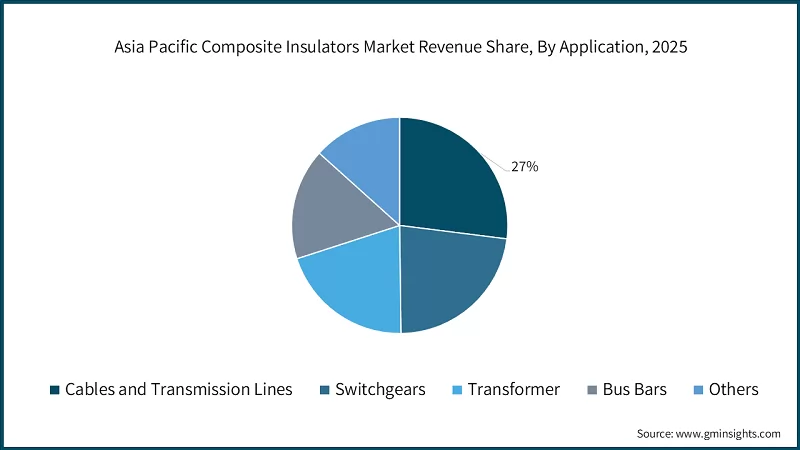
- Based on application, the Asia Pacific composite insulators market is divided into cables and transmission lines, switchgears, transformers, bus bars and others. The cable and transmission segment was evaluated at above USD 370 million in 2025. Growing demand for dependable transmission networks to support rising electricity consumption, coupled with continuous grid expansion, is positively influencing business dynamics.
- Composite insulators deliver superior insulation compared to conventional options, enhance transmission line efficiency, and minimize leakage currents, driving their widespread adoption. Additionally, government programs aimed at extending electrical networks to remote regions, along with initiatives to refurbish and replace outdated components, are further fueling Asia Pacific composite insulators market growth.
- Favorable initiatives toward renewable energy integration require new transmission corridors and upgrades to existing lines, will accelerate demand for composite insulators owing to their ability to perform reliably under continuous electrical and mechanical loads.
- For instance, in November 2024, Sterlite Power finalized the Goa-Tamnar Transmission Project in India, through its dedicated entity, GTTPL. This project has significantly upgraded Goa’s power infrastructure and introduced the state’s first 400 kV gas-insulated substation at Dharbandora, operational to deliver a stable and high-quality electricity supply.
- The switchgears segment was valued at more than USD 310 million in 2025. The switchgear application is set to witness significantly momentum, driven by growing emphasis on grid reliability and operational safety of electrical networks. Substantial investments toward enhancing the durability and performance of critical equipment coupled with rapid development of smart grid infrastructure is accelerating the adoption of advanced, intelligent switchgear solutions.
- For instance, in August 2024, Hitachi Energy has introduced EconiQ, the world’s highest-voltage SF?-free switchgear, replaces SF with sustainable alternatives, maintaining performance and reliability while significantly reducing environmental impact. Each 550 kV GIS substation using EconiQ eliminates emissions equivalent to hundreds of transatlantic flights, supporting global decarbonization and regulatory compliance in high-voltage transmission systems.
- Rising demand for transformers across commercial, industrial and utility sectors owing to rapid grid modernization programs, government initiatives promoting smart grids, and ultra-high-voltage transmission corridors will stimulate product penetration. Increasing electricity consumption, utilities expansion initiatives have led transformers to play a critical role in efficiently transmitting and distributing power throughout extensive electrical networks, further contributing to the industry growth.
- For instance, in July 2024, Toshiba Group planned to invest USD 63.5 million in India to expand power transmission and distribution equipment production. Toshiba Transmission & Distribution Systems India will boost transformer manufacturing capacity by 1.5 times between FY2024 and FY2026, enhancing assembly and testing lines for 400kV/765kV transformers. This upgrade aims to meet rising domestic demand and strengthen export capabilities for global transmission networks.
- Ongoing technological advancements in materials and manufacturing processes along with the development in silicone rubber formulations and fiberglass core design have enhanced electrical performance and aging resistance. These innovations meet stringent technical standards required for transformer applications, improving consistency and quality across large-scale deployments.
- In Asia Pacific composite insulator market, busbar segment was evaluated with a revenue at over USD 230 million in 2025. Utilities are focusing on improving network efficiency and reducing transmission losses, encouraging the adoption of advanced busbar systems, which contribute to stable performance, supporting long-term infrastructure planning and asset management strategies.
- For instance, in May 2025, China Railway Electrification Bureau International energized 22 kV high-voltage distribution transformers and switchgear for Sengkang-Punggol Depot Power Supply Reconstruction Project located in Singapore. The upgrade enhances traction power for 36 double-unit trains, using modular construction and digital commissioning to meet stringent technical and safety standards, ensuring improved efficiency and reliability for urban transit.
Looking for region specific data?
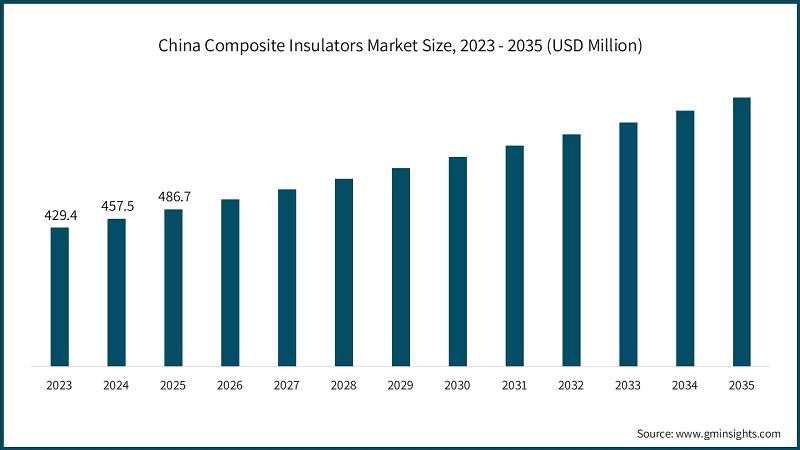
China leads the Asia Pacific composite insulators market with around 35% share in 2025 and generated USD 486.7 million in revenue. Growing electricity consumption, expansion of transmission networks, development of modern grid infrastructure, rapid population growth, and government-driven targets for renewable energy adoption have stimulate industry outlook.
- Paradigm shift toward renewable energy integration growing adoption of smart grid technologies, supported by favorable government policies aimed at strengthening electricity infrastructure, will further augment industry growth. Moreover, utility-led initiatives to modernize transmission and distribution systems, coupled with ongoing clean energy projects, are accelerating the demand for composite insulators.
- For instance, in May 2025, Hubei Power Grid commissioned the 500 kV Tongdu Substation in Daye City, China, its first fully remote-controlled facility with single-button sequential control, supporting major industrial projects. It acts as a critical node in the West-to-East Power Transmission channel and will transmit over 20 TWh of clean energy annually, strengthen grid reliability, benefiting more than five million residents in eastern Hubei.
- Japan composite insulators market is set to grow at a CAGR of 3.9% by 2035. Ongoing upgrades in aging power infrastructure along with efforts toward replacing conventional ceramic and glass insulators to improve system resilience and reduce grid maintenance needs. Flourishing the expansion of solar and wind projects created requirements for reliable transmission lines capable of operating in diverse terrains and climatic conditions.
- India composite insulator market is set reach USD 390.6 million by 2035. Flourishing investments in grid expansion, robust urbanization, modernization of aging infrastructure, addition of new transmission corridors, and robust renewable integration, are some of the key factors shaping business dynamics. Ongoing replacement of existing components across T&D networks to withstand harsh climatic and environmental conditions, support higher system efficiency and improve operational reliability will contribute to industry growth.
- Utilities and transmission operators prioritize materials that offer lower maintenance requirements, lighter weight for long-span transmission lines and inaccessible locations across the country. For instance, in December 2025, GE Vernova T&D India has secured a major contract from AESL Projects for the design and construction of a ±500 kV HVDC VSC terminal station (2×1250 MW) to evacuate 2,500 MW of renewable power from Khavda to South Olpad. Part of Adani Energy Solutions newly acquired ISTS scheme under TBCB, the USD 1.3 billion project supports Gujarat’s Phase-V renewable energy expansion.
- South Korea composite insulators market was valued at USD 135.4 million in 2025. Supportive government initiatives aimed at modernizing grid infrastructure and expanding inter-regional transmission corridors further driving the adoption of composite insulators. Significant initiatives toward smart grid deployment across urban and industrial regions along with expansion of high-voltage transmission corridors to meet rising electricity demand will augment industry landscape.
- For instance, in November 2025, Korea Research Institute of Standards and Science (KRISS) launched the country’s first comprehensive measurement standards for High Voltage Direct Current (HVDC) systems. This development establishes a robust framework for validating ultra-high high-voltage equipment performance, bolstering domestic manufacturing capabilities, reducing dependence on overseas testing, helping to build an advanced, resilient power grid.
- Australia composite insulators market is anticipated to grow at a CAGR of 5% by 2035. Rising electricity demand, coupled with efforts to enhance grid reliability and efficiency, creating a strong need for advanced insulating solutions. Composite insulators are gaining momentum as they offer superior performance compared to traditional ceramic and the glass alternatives in harsh environmental conditions and high-voltage applications.
- For instance, in May 2024, Australian engineers achieved a breakthrough in improving the fire and spark resistance of power-pole insulators, aiming to reduce pole-top fires and minimize power outages. This advancement stems from collaborative research among leading Australian universities, with results published in a prominent international journal.
Asia Pacific Composite Insulators Market Share
- The top five companies in the Asia Pacific composite insulators industry are Aditya Birla Power Composites, Hitachi Energy, PFISTERER, Siemens Energy, and TE Connectivity contribute around 34% of the market share in 2025.
- Manufacturers in the Asia-Pacific composite insulators market are adopting strategies focused on technological innovation, regional expansion, and cost optimization to strengthen their competitive position. Moreover, companies are aiming for strategic collaborations, partnerships, mergers, join ventures and acquisitions to align with regional energy transition goals and infrastructure modernization programs.
- These companies leverage advanced composite insulator technologies, to provide lightweight, durable, and high-performance solutions for transmission and distribution lines, substations, and renewable energy applications, to cater to rising electricity demand and grid modernization needs.
- Siemens Energy designs and manufactures composite insulators that combine lightweight polymer housing with strong fiberglass cores, ensuring superior mechanical strength, electrical reliability, and resistance to environmental stressors such as pollution, moisture, and extreme temperatures. These insulators are widely used in overhead lines, substations, and other critical grid infrastructure, offering advantages, longer service life and improved safety compared to traditional ceramic or glass alternatives.
- PFISTERER specializes in designing, manufacturing, and supplying high-performance composite insulators, offering superior mechanical and electrical properties compared to traditional materials for overhead power lines. It delivers advanced solutions in electrical transmission and distribution systems, ensuring enhanced reliability, durability, and efficiency, supporting modern grid infrastructure.
- Aditya Birla Power Composites Ltd. operates as a joint venture between Aditya Birla Insulators, and Reinhausen Power Composites, a Maschinenfabrik Reinhausen subsidiary and manufacturer of hollow composite insulators. The company provides comprehensive portfolio of composite insulators hollow core type, rated up to 400 kV, designed to serve the power transmission and distribution sector.
Asia Pacific Composite Insulators Market Companies
Some of the key market players operating across the Asia Pacific composite insulators industry are:
- Aditya Birla Power Composites Ltd.
- Advait Energy Transitions Limited
- CNC ELECTRIC GROUP CO.,LTD.
- Cowin Electrical Co.,Ltd.
- CYG Insulator Co.,Ltd.
- DCI
- DECCAN ENTERPRISES PRIVATE LIMITED
- Hitachi Energy
- Jilin Nengxing Electrical Equipment Co. Ltd.
- Nanjing Electric Technology Group Co., Ltd.
- Navitas Insulators Pvt Ltd.
- Nooa Electric Co., Ltd.
- PFISTERER Holding SE
- Saravana Global Energy Limited
- Siemens Energy
- SPARK INSULATORS PVT LTD
- TE Connectivity
- Wenzhou Jieni Electric Co., Ltd.
- Xiangyang Guowang Composite Insulators Co., Ltd.
- Yamuna Power & Infrastructure Ltd.
- Zhongrui Electric Co., Ltd.
- PFISTERER Holding SE, headquartered in Germany, reported revenues of USD 249.9 million in first half of 2025 and USD 450.7 million revenue for the year 2024. The company’s composite post insulators enhance substation availability and operational safety through hydrophobic silicone material, offering superior resistance to vandalism and seismic impacts. Their mechanical strength and durability make them ideal for busbar systems, disconnecting devices, and earthing switches in demanding environments.
- Hitachi Energy reported revenues of USD 387.9 million in first half of 2025 and a revenue of USD 731.2 million in 2024. The comprehensive portfolio of composite insulators, supported by flexible manufacturing capabilities that enable leakage current control for high voltage applications. The company specializes in designing and producing hollow core composite insulators, ensuring high performance for high-voltage and substation environments.
- Siemens Energy recorded a revenue of around USD 45.4 billion for 2025 and a revenue of approximately USD 40 billion for the year 2024. The company provides advanced long rod composite insulators that are engineered to enhance the reliability and performance of electrical grids, even under extreme environmental conditions. It leverages its expertise and advanced technologies to address challenges in power transmission and distribution systems with superior efficiency.
- TE Connectivity recorded a revenue of USD 15.8 billion for the whole year 2024. The company’s Axicom Hollow Core Insulators are designed to ensure reliability in high-voltage equipment. Manufactured using premium glass-fiber reinforced resin tubes, silicone rubber housings, and aluminum alloy flanges, these insulators are suitable for outdoor applications up to 1100 kV AC and 800 kV DC.
Asia Pacific Composite Insulators Market Report Attributes
| Key Takeaway | Details |
|---|---|
| Market Size & Growth | |
| Base Year | 2025 |
| Market Size in 2025 | USD 1.3 Billion |
| Market Size in 2026 | USD 1.4 Billion |
| Forecast Period 2026-2035 CAGR | 6.4% |
| Market Size in 2035 | USD 2.5 Billion |
| Key Market Trends | |
| Drivers | Impact |
| Increasing investment for power generation and development of electrical infrastructure | Flourishing investments toward new power generation projects and modern electric infrastructure to enhance grid reliability and efficiency is fueling product demand. |
| Ongoing expansion and refurbishment of existing grid networks | Ongoing efforts to upgrade aging transmission infrastructure and expansion of grid networks will accelerate the deployment of composite insulators. |
| Ongoing renewable integration | Ongoing integration of renewable energy sources is driving the adoption of advanced insulator solutions, to offer durability and performance benefits. |
| Pitfalls & Challenges | Impact |
| Fluctuating raw material cost | Volatile raw material prices increase production costs, disrupt supply chains, and reduce profit margins, creating pricing uncertainty and hindering long-term investment. |
| Opportunities: | Impact |
| Expansion of transmission and distribution networks | Growing investments in grid modernization and rural electrification increase demand for composite insulators, ensuring reliable performance and reducing maintenance costs across diverse environments. |
| Integration of renewable energy sources | Rising renewable installations require advanced insulation solutions for high-voltage applications, creating opportunities for composite insulators to enhance efficiency and withstand harsh operating conditions. |
| Technological advancements composite insulator materials | Innovations in polymer and composite materials improve durability, lightweight design, and resistance to environmental stress, driving adoption in high-performance electrical infrastructure projects. |
| Initiatives for energy infrastructure development | Supportive policies and investments for power sector upgrades will accelerate composite insulator deployment, ensuring compliance with stringent safety and reliability standards |
| Market Leaders (2025) | |
| Market Leader |
12.5% market share |
| Top 5 Players |
Collective market share of 34% |
| Competitive Edge |
|
| Regional Insights | |
| Largest Market | China |
| Fastest growing market | India |
| Emerging countries | China, India and Japan |
| Future outlook |
|
What are the growth opportunities in this market?
Asia Pacific Composite Insulators Market News
- In August 2025, Dalian Insulator announced that its subsidiary, Dalian Insulator Group Transmission and Transformation Material Co., Ltd., was awarded with multiple State Grid Corporation of China procurement packages. The anticipated contracts include porcelain insulator packages from the 2025 34th and 49th batch procurements, as well as composite insulator package 3, reinforcing its strong position in the power transmission market.
- In June 2025, ENSTO introduced composite line post insulators designed for 24 kV overhead lines, offering superior durability and reliability for modern power networks. These advanced composite materials provide excellent resistance to corrosion and environmental stress, ensuring consistent long?term performance and reducing the risk of network faults, the insulators contribute to safer and more resilient electricity distribution systems. Their robust design makes them an ideal choice for overhead applications where reliability and efficiency are critical.
- In May 2025, Wuhan Line Power Transmission Equipment Co., Ltd. completed the lightning impulse test of 500 kV suspension insulator at the China Electric Power Research Institute (CEPRI). Conducted using a 540 kV impulse voltage system with ±2% accuracy, the test adhered to IEC 61109 standards, validating performance under simulated lightning conditions. This routine type test confirms product reliability, compliance with global standards, and readiness for high-voltage applications in modern power transmission networks.
- In March 2025, TID POWER SYSTEM launched a new range of composite post insulators designed for metro contact rail systems, offering a high-performance replacement for traditional porcelain variants. These insulators feature fiberglass-reinforced epoxy core and weather-resistant silicone sheds, delivering lightweight construction, exceptional mechanical strength, and corrosion, UV, and pollution resistance.
- In December 2024, PFISTERER expanded its presence through a strategic alliance with Japan’s Nippon Katan Co., Ltd., focusing on composite insulators for overhead transmission lines. Under a licensing agreement, the company will supply insulators for final assembly at Nippon Katan’s Hirakata facility. The production process of composite insulators is scheduled to commence in early 2025, further strengthening the long-standing partnership between the two companies.
The Asia Pacific composite insulators market research report includes in-depth coverage of the industry with estimates & forecast in terms of “USD Million” from 2022 to 2035 for the following segments:
Market, By Voltage
- High voltage
- Medium voltage
- Low voltage
Market, By Application
- Cables and transmission lines
- Switchgears
- Transformer
- Bus Bars
- Others
Market, By Product
- Pin insulators
- Suspension insulators
- Shackle insulators
- Other insulators
Market, By End-Use
- Residential
- Commercial & industrial
- Utilities
Market, By Rating
- ≤ 11 kV
- > 11 kV to ≤ 22 kV
- > 22 kV to ≤ 33 kV
- > 33 kV to ≤ 72.5 kV
- > 72.5 kV to ≤ 145 kV
- > 145 kV to ≤ 220 kV
- > 220 kV to ≤ 400 kV
- > 400 kV to ≤ 800 kV
- > 800 kV to ≤ 1,200 kV
- > 1,200 kV
Market, By Installation
- Distribution
- Transmission
- Substation
- Railways
- Others
The above information has been provided for the following countries:
- China
- Japan
- India
- South Korea
- Australia
Frequently Asked Question(FAQ) :
What is the market size of the Asia Pacific composite insulators in 2025?
The market size was USD 1.3 billion in 2025, with a CAGR of 6.4% expected through 2035 driven by grid upgrades, infrastructure strengthening initiatives, and efforts to reduce power outages.
What is the projected value of the Asia Pacific composite insulators market by 2035?
The Asia Pacific composite insulators market is expected to reach USD 2.5 billion by 2035, propelled by renewable energy integration, transmission network expansion, and grid modernization programs.
What is the current Asia Pacific composite insulators market size in 2026?
The market size is projected to reach USD 1.4 billion in 2026.
How much revenue did the medium voltage segment generate in 2025?
Medium voltage segment dominated the market accounting for around 40% share in 2025 and is set to grow at a CAGR of 6% through 2035.
What was the valuation of the cable and transmission lines segment in 2025?
The cable and transmission lines segment was evaluated at above USD 370 million in 2025.
What is the growth outlook for the high voltage segment from 2026 to 2035?
The high voltage segment is anticipated to grow at a CAGR of over 6% by 2035, driven by expansion of high-voltage power networks and renewable energy integration.
Which country leads the Asia Pacific composite insulators market?
China leads the market with around 35% share in 2025 and generated USD 486.7 million in revenue, driven by growing electricity consumption and transmission network expansion.
What are the upcoming trends in the Asia Pacific composite insulators market?
Key trends include integration of sensors and digital monitoring for predictive maintenance, emphasis on eco-friendly materials and recycling, adherence to stringent international standards, and increasing local production facilities.
Who are the key players in the Asia Pacific composite insulators market?
Key players include Aditya Birla Power Composites Ltd., Hitachi Energy, PFISTERER Holding SE, Siemens Energy, TE Connectivity, Advait Energy Transitions Limited, CNC ELECTRIC GROUP CO.,LTD., Cowin Electrical Co.,Ltd., CYG Insulator Co.,Ltd., DCI, DECCAN ENTERPRISES PRIVATE LIMITED, Jilin Nengxing Electrical Equipment Co. Ltd., Nanjing Electric Technology Group Co., Ltd., Navitas Insulators Pvt Ltd., Nooa Electric Co., Ltd., Saravana Global Energy Limited, SPARK INSULATORS PVT LTD, Wenzhou Jieni Electric Co., Ltd., Xiangyang Guowang Composite Insulators Co., Ltd., Yamuna Power & Infrastructure Ltd., and Zhongrui Electric Co., Ltd.
Asia Pacific Composite Insulators Market Scope
Related Reports