Summary
Table of Content

Asia Pacific Bunker Fuel Market
Get a free sample of this report
Form submitted successfully!
Error submitting form. Please try again.
Thank you!
Your inquiry has been received. Our team will reach out to you with the required details via email. To ensure that you don't miss their response, kindly remember to check your spam folder as well!
Request Sectional Data
Thank you!
Your inquiry has been received. Our team will reach out to you with the required details via email. To ensure that you don't miss their response, kindly remember to check your spam folder as well!
Form submitted successfully!
Error submitting form. Please try again.
Asia Pacific Bunker Fuel Market Size
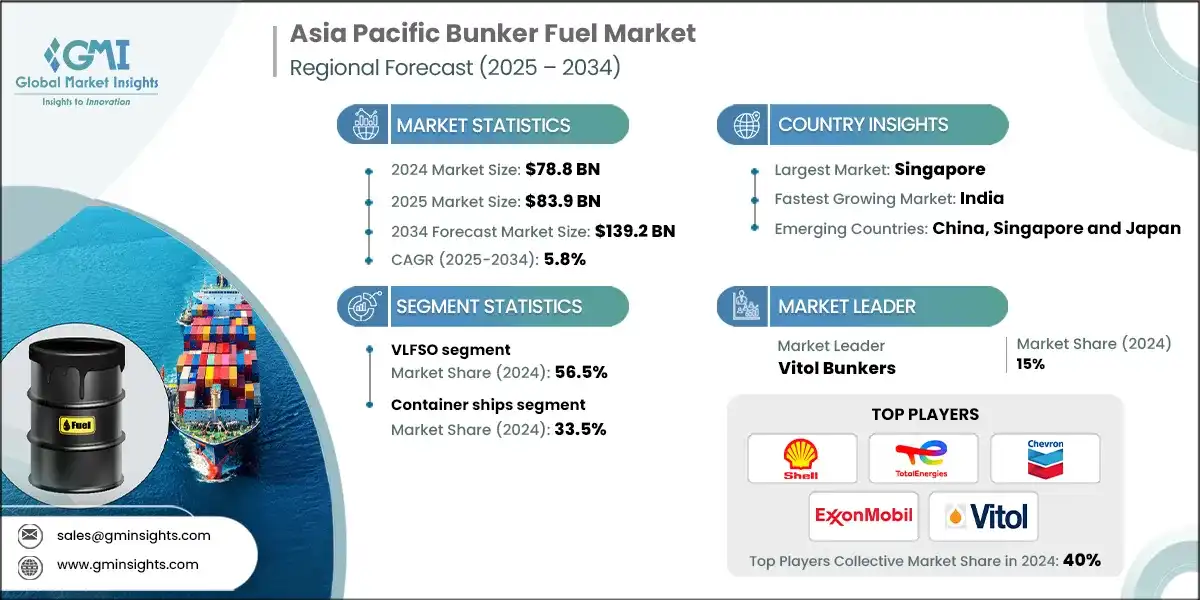
According to a recent study by Global Market Insights Inc., the Asia Pacific bunker fuel market was estimated at USD 78.8 billion in 2024. The market is expected to grow from USD 83.9 billion in 2025 to USD 139.2 billion in 2034, at a CAGR of 5.8%.
Asia Pacific Bunker Fuel Market Key Takeaways
Market Size & Growth
- 2024 Market Size: USD 78.8 Billion
- 2025 Market Size: USD 83.9 Billion
- 2034 Forecast Market Size: USD 139.2 Billion
- CAGR (2025–2034): 5.8%
Regional Dominance
- Largest Market: Singapore
- Fastest Growing Country: India
Key Market Drivers
- Growing maritime trade.
- Stringent environment policies and emission mandates.
- Expansion of port infrastructure.
Challenges
- High initial investment.
Opportunity
- Shifting focus toward low-sulfur fuels.
- Adoption of LNG and alternative marine fuels.
- Digitalization of fuel supply chains.
- Strategic port development initiatives.
Key Players
- Market Leader: Vitol Bunkers led with over 15% market share in 2024.
- Leading Players: Top 5 players in this market include Shell, TotalEnergies, Chevron Corporation, Exxon Mobil Corporation, Vitol, which collectively held a market share of 40% in 2024.
Get Market Insights & Growth Opportunities
- The evolving environmental regulations and shifting energy dynamics with the global maritime industry’s push toward cleaner to more sustainable operations. The implementation of the International Maritime Organization’s (IMO) 2020 sulfur cap, which restricts the sulfur content in marine fuels to a low level. This regulation has prompted widespread adoption of very low sulfur fuel oil (VLSFO) and marine gas oil (MGO), leading refiners and suppliers to adjust their product offerings to meet compliance standards and change customer demand.
- The growing adoption of LNG as a marine fuel driven by a significant reduction in sulfur oxides, nitrogen oxides and particulate matter by utilizing LNG across vessels. This shift is supported by the development of dual fuel engines and LNG bunkering infrastructure in major ports around the region. Additionally, methanol, ammonia and biofuels are gaining attention as viable options for long-term decarbonization, owing to stringent emissions mandates in the upcoming years.
- For instance, in April 2025, Singapore is set to begin sea-based LNG bunkering trials in the second half of 2025, reinforcing its status as a global leader in maritime energy transition. Led by the Maritime and Port Authority of Singapore (MPA), this initiative is a pivotal step toward expanding the nation’s alternative marine fuel infrastructure. This move aligns with the country’s broader strategy to support sustainable maritime practices and reduce emissions across international waters.
- Ongoing technological innovation and digitalization in the bunker fuel supply chain along with rapid development of bunkering infrastructure is augmenting the business outlook. Shipowners and fuel suppliers are leveraging digital platforms to enhance fuel procurement efficiency and ensure quality control with real-time monitoring of fuel consumption and emissions. Furthermore, advancements in fuel testing and certification ensuring stakeholders maintain consistency in fuel quality and reducing maintenance risks associated with inferior or contaminated fuels.
- For instance, in November 2024, the MPA Singapore reaffirmed that all bunker fuels in Singapore must comply with ISO 8217 standards. In collaboration with industry experts, MPA introduced a provisional national standard for marine biofuels and implemented enhanced testing protocols from June 2024. These measures ensure upstream fuel quality. To date, MPA has received no reports of vessel issues linked to bunkered fuel in Singapore, but any future cases will be investigated.
- Singapore holds a substantial share in the Asia Pacific bunker fuel market owing to paradigm shift toward alternative fuels driven by the push for sustainable shipping along with the nation’s strategic location and development of port infrastructure. Shifting focus toward adoption of cleaner fuels including Liquefied Natural Gas driven by stricter environmental regulations and the maritime sector’s commitment to carbon reduction goals will boost the industry scenario.
- For instance, in October 2025, consortium led by Keppel Infrastructure, with Advario and Sumitomo Corporation, has advanced to the FEED stage for an integrated ammonia-powered plant, terminal, and bunkering facility. Selected by Singapore’s EMA and MPA, the project builds on a successful pre-FEED study. If realized, it would be Singapore’s first direct-ammonia combustion power plant, showcasing scalable, low-emission energy infrastructure and setting a benchmark for clean fuel innovation and maritime decarbonization.
- China is one of the fastest growing market in the Asia Pacific bunker fuel industry driven by the strategic focus on maritime infrastructure, fuel production, and clean energy development. The country’s recognized ports including Shanghai, Ningbo-Zhoushan, and Hong Kong, China has centered itself as a central hub for international shipping and bunker fuel distribution. The nation’s vast and technologically advanced port network along with modern logistics and refueling systems that enable efficient and timely bunker fuel delivery will augment business landscape.
- For instance, in March 2025, COSCO SHIPPING Lines two vessels, COSCO ASIA and NEW LOS ANGELES, refueled with B24 marine biofuel oil, 24% biodiesel and 76% low-sulfur fuel. COSCO ASIA set a record at Fujian Port with 2,400 tons, while NEW LOS ANGELES marked a milestone in Hong Kong with 5,400 tons, highlighting progress in sustainable marine fuel adoption.
To get key market trends
Asia Pacific Bunker Fuel Market Trends
- The Asia Pacific bunker fuel market is witnessing significant transformation due to a combination of environmental and regional government regulations, technological innovation and evolving energy strategies among key stakeholders. Growing inclination toward adoption of cleaner alternatives including LNG, biofuels, and hydrogen, driven by stricter environmental rules and global decarbonization goals is shaping the business outlook.
- For instance, in September 2025, the Government of India has approved a USD 7.86 billion initiative to revitalize the shipbuilding and maritime sectors. The plan includes extending financial assistance until 2036, establishing a USD 2.8 billion Maritime Development Fund, and launching a USD 2.2 billion Shipbuilding Development Scheme. These efforts aim to expand shipbuilding capacity, support infrastructure growth, and promote innovation through a new Ship Technology Centre under the Indian Maritime University.
- The growing emphasis on decarbonization is pushing the bunker fuel market toward cleaner energy sources. Moreover, suppliers and distributors are increasingly investing in storage facilities, blending operations and digital fuel management systems to enhance operational efficiency and transparency. Rising digital technologies including blockchain, automated delivery systems and real-time fuel tracking contributing to improved logistics with reduced risk of fuel quality disputes shaping the business landscape.
- For instance, in February 2025, Hong Kong has successfully completed its first ship-to-ship LNG bunkering operation, marking a major milestone in its green maritime ambitions. The operation transferred 2,200 tons of ultra-low-temperature LNG from the bunker vessel Xin APT Hao to the container ship which is dual-fuel, Zim Aquamarine at Cheung Chau anchorage.
- The demand for bunker fuel tends to fluctuate with the level of economic activity, container throughput and commodity exports with the regional economic cycles. Ship operators and owners are focusing on meeting stringent regulations along with growing inclination toward sustainable maritime fuel adoption and eco-friendly shipping solutions, further shaping the business dynamics.
- Furthermore, the inclusion of maritime emissions in regional frameworks is expected to further reshape fuel economics by placing a monetary value on carbon output. Shifting inclination toward emissions mitigation technologies, including carbon capture systems and green fuel certificates, will positively influence the business dynamics. Digital transformation and data-centric logistics are streamlining operations and improving regulatory compliance across port systems, reshaping the industry landscape.
Asia Pacific Bunker Fuel Market Analysis
Learn more about the key segments shaping this market
- Based on the product the industry is classified into HSFO, VLSFO, MGO, LNG and others. The VLFSO segment dominated around 56.5% market share in 2024 and is anticipated to grow at a CAGR of over 7.5% through 2034.
- The VLFSO market is expected to reach over USD 95 billion by 2034. The industry is set to grow driven by stringent environmental regulations along with adoption of immediate compliance solutions by majority of shipping operators, requiring minimal engine modifications. Wide availability across different ports coupled with strategic partnerships, collaborations are refineries optimizing their output to meet rising demand will shape the VLFSO market dynamics.
- For instance, in February 2025, Petrobras entered the Asian bunker market with its first sale of B24 fuel in Singapore, blending 76% mineral oil from its refineries with 24% ISCC-EU certified biofuel from used cooking oil. Sold to Golden Island, the fuel was formulated at Jurong Port Universal Terminal, where Petrobras holds tank leases for fuel oil and B24.
- The marine gas oil (MGO) segment is set to witness a CAGR of more than 2% from 2025 to 2034, driven by its cleaner-burning properties and increasing demand in coastal shipping, ferries and Emission Control Areas (ECAs). MGO is favored by enforcing strict sulfur and particulate emission norms due to its high combustion efficiency and low sulfur content. The adoption is supported by shipowners who seek compliance without the need for expensive scrubbers or significant engine retrofitting.
- For instance, in July 2025, Chimbusco Pan Nation Petro-Chemical (CPN) completed Hong Kong’s first B30-marine gasoil delivery, supplying a 30% biodiesel and 70% MGO blend to OOCL. The milestone supports carbon reduction and sustainability goals in East Asia. The operation also included a simultaneous supply of B30 high-sulfur marine fuel, reinforcing CPN’s commitment to advancing green marine fuels.
- The HFSO segment captured a market share of over 10% in 2024. The high sulfur fuel oil (HSFO) is largely fueled by the continued operation of vessels equipped with scrubbers. Shifting focus toward low-sulfur alternatives have impacted business dynamics, while HSFO remains relevant in segments where retrofitting scrubbers proves economically viable, especially in long-haul and bulk carrier fleets.
- Liquefied Natural Gas (LNG) segment is set to grow significantly by 2034 on account of the growing inclination toward adoption of low-carbon alternatives along with focus on adhering to the carbon reduction mandates by respective authorities. LNG is gaining strong traction as a transitional marine fuel, offering substantial reductions in greenhouse gas, sulfur oxide, and nitrogen oxide emissions.
- Investments in LNG bunkering infrastructure and the growing fleet of LNG-powered vessels across key ports across different countries will significantly accelerate its adoption. For instance, in October 2025, IAPH launched safety tools for emerging bunker fuels via its new products portal. Its Clean Marine Fuels group introduced the first public ammonia bunker checklist and updated LNG and hydrogen protocols. The clean marine fuels ready tool helps ports align safety systems, train staff, and manage ship-terminal operations, ensuring safe handling of diverse marine fuels.
Learn more about the key segments shaping this market
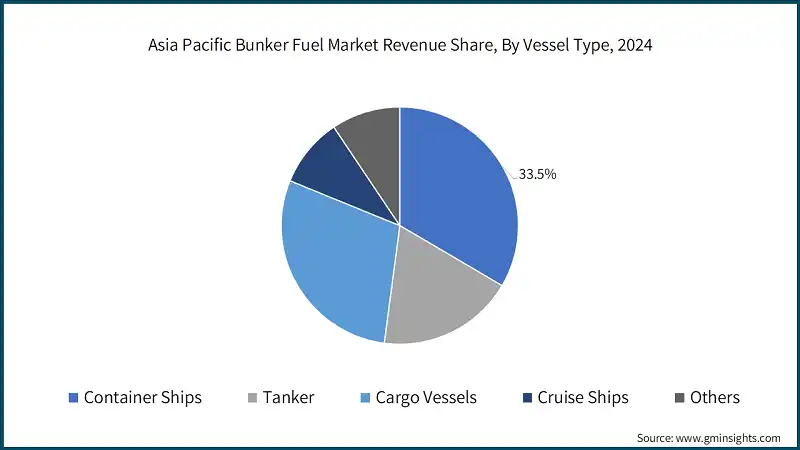
- Based on the vessel type, the Asia Pacific bunker fuel industry is classified as container ships, tankers, cargo vessels, cruise ships and others. The container ships segment dominates the market with 33.5% share in 2024 and is set to grow at a CAGR of over 5.5% from 2025 to 2034. Container ships are among the largest and most fuel-intensive vessels in shipping industry, which significantly increases the need for reliable, high-grade bunker fuels to support their demanding operational requirements.
- The container ships segment is set to witness significant growth driven by the sustained expansion of trade and rising demand for fast, large-volume cargo transport. Ongoing integration of fuel-efficient technologies and alternative propulsion systems along with operators shifting toward compliant fuels are very low sulfur fuel oil (VLSFO) and marine gas oil (MGO) to meet regulatory requirements is shaping the business dynamics.
- For instance, in September 2025, Axpo successfully delivered 3,000 m³ of bio-LNG to the container ship MSC Gabon at the Port of Malaga. This marked the port’s first bio-LNG ship-to-ship bunkering operation. As the first authorized bio-LNG supplier in Malaga, Axpo reinforces the port’s role as a key Mediterranean hub for alternative marine fuels, promoting cleaner energy solutions and sustainable maritime services.
- The cargo vessels segment in the bunker fuel market is anticipated to cross USD 38 billion by 2034. The broad range of ship types including bulk carriers, general cargo ships, and specialized freight vessels along with their essential role in transporting raw materials and finished goods across continents is shaping the industry outlook. Rising demand for bunker fuel among cargo vessels is heavily reliant on fuel for long-voyage operations along with retrofitting of vessels will further augment industry landscape.
- For instance, in July 2025, Fujian Highton Development has invested USD 32 million to acquire two multipurpose cargo vessels previously owned by German interests. In a statement to the exchange, the Shanghai-listed dry bulk company said the purchase of the 28,400-dwt Pacific Honour and Pacific Hero aligns with its strategy to expand into project cargo and logistics shipping.
- The tankers vessels segment is anticipated to grow at a CAGR of over 6% by 2034. Tankers remain dominant in the region owing to their essential role in transporting crude oil, refined products, and chemicals, driven by robust energy demand. High fuel consumption during long-distance voyages along with introduction of new tanker designs, offering both environmental and performance benefits will boost business outlook.
- Tanker operators are ensuring fuel availability, cost-efficiency and environmental compliance along with exploring hybrid propulsion technologies to reduce greenhouse gas emissions further augmenting business landscape. For instance, in June 2025, MOL, MISC and PETRONAS CCS Ventures, formed Jules Nautica Sdn. Bhd., a joint venture to develop and own Liquefied CO2 tanker carriers for carbon capture and storage. They completed FEED for a 62,000 m³ vessel, designed by SDARI, which received DNV’s GASA certification in December 2024, ensuring low-pressure, low-temperature LCO2 transport technology.
- The cruise ships segment is set to witness significant growth, driven by rising demand for luxury sea travel along with shifting consumer inclination toward leisure and comfort. Cruise operators are investing heavily in fleet modernization, aiming to comply with international emissions standards while improving fuel efficiency and sustainability. Additionally, cruise lines are integrating exhaust gas cleaning systems and shore power capabilities to further enhance sustainability, positively influencing business landscape.
- Increased retrofitting of older vessels with scrubber systems or dual-fuel engines to remain compliant while controlling operational costs is shaping the business dynamics. For instance, in September 2025, an Asian shipbuilder has commissioned Everllence to deliver complete propulsion systems for five 8,400 TEU container vessels being built in China. The package includes LNG-ready dual-fuel main and auxiliary engines, a fuel supply system, and related components, supporting the shift toward cleaner marine energy and advanced vessel performance.

Looking for region specific data?
China dominated the Asia Pacific bunker fuel market in with around 16.6% of share in 2024 and evaluated at over USD 13 billion revenue. The China bunker fuel market is shaped by the country's strategic role in maritime trade and ongoing investments in port infrastructure along with transition from high sulfur fuel oil (HSFO) toward compliant fuels including very low sulfur fuel oil and other emission reduction fuels.
- In addition, China has made advancements in supporting the use of alternative fuels including liquefied natural gas (LNG) and is actively exploring bio-marine fuel applications through government-backed pilot programs.
- For instance, in June 2025, CNOOC has announced the successful completion of its largest LNG bunkering operation to date in Hong Kong, carried out by the world’s largest LNG bunkering vessel, Hai Yang Shi You 301. The operation set a new benchmark for refueling efficiency in the region, taking just 8.5 hours to deliver the full load.
- The Singapore bunker fuel market was evaluated at over USD 34 billion in 2024, fueled with the rapid adaptation of storage, blending and quality control infrastructure to meet compliance standards. Singapore has embraced digital bunkering initiatives including e-BDN (electronic bunker delivery notes) and mass flow meters, ensuring accuracy, efficiency, and accountability in fuel transactions. Flourishing investment by authorities and companies toward LNG terminal capacity, fueling barges along with regulatory support to encourage the adoption of cleaner marine fuels is shaping business dynamics.
- For instance, in April 2025, a subsidiary of Shell plc called Shell Eastern Trading acquired Pavilion Energy, marking a strategic move to reinforce Shell’s global leadership in the liquefied natural gas (LNG) sector. The acquisition includes 100% ownership of Pavilion Energy, a prominent Singapore-based LNG trading and shipping firm. This deal significantly enhances Shell’s LNG portfolio, expands its trading capabilities, and strengthens its presence in key Asian markets.
- Japan bunker fuel market is anticipated to grow at a CAGR of over 5.5% by 2034. Ongoing technological innovation in vessel propulsion and engine technology, nation’s wide shipbuilding base and policy support by authorities is positively influencing the business outlook. Growing emphasis on technological advancement with companies integrating digital systems into bunkering operations for real-time tracking, emissions monitoring and performance optimization is shaping business dynamics.
- For instance, in April 2025, Osaka Gas Co., Ltd. has made a landmark move by launching Japan’s first shore-to-ship LNG bunkering service offered by a gas utility company. This service is designed to help cut carbon dioxide emissions from shipping, aligning with global efforts to decarbonize the industry.
Asia Pacific Bunker Fuel Market Share
- The top 5 bunker fuel industry players operating across the industry include ExxonMobil, Shell, Chevron, Vitol and TotalEnergies. These companies contribute a market share of approximately 40% in 2024.
- These companies hold a significant share of the market for their expansive refining capabilities with vast distribution networks and long-term contracts with key ports and shipping companies. They offer a range of compliant marine fuels in response to tightening international regulations. The major key strategy involves diversifying product portfolios with a strong focus on low-sulfur fuels including VLSFO and MGO to meet IMO 2020 and regional emission standards.
- Manufacturers operating across the Asia Pacific bunker fuel market are adopting a range of strategic initiatives to navigate regulatory shifts, changing fuel preferences, and the global push for decarbonization. Additionally, Manufacturers are also emphasizing digital transformation, leveraging advanced analytics, blockchain and automated fuel management systems to improve operational efficiency to enhance fuel traceability and ensure quality assurance. Strategic collaborations, mergers and acquisitions are further helping companies consolidate market presence that gain access to new technologies and scale up clean fuel capabilities.
- TotalEnergies is steadily growing its presence in the bunker fuel sector, with a strong emphasis on low-sulfur and alternative fuels. Its strategic focus on cleaner energy and carbon reduction sets it apart from competitors. By integrating operations across refining, distribution, and emerging energy technologies, the company effectively serves environmentally conscious markets aligned with global regulatory standards.
- Chevron maintains a solid position in the bunker fuel across the Asia-Pacific region. The company focuses on innovation and low-sulfur fuels and excels in supply chain reliability and operational efficiency. Its market approach remains specialized, catering to specific regional demands rather than broad global leadership.
Asia Pacific Bunker Fuel Market Companies
Major players operating in the Asia pacific bunker fuel system industry are:
- BP
- Brightoil Petroleum
- Chemoil Energy Limited
- Cheniere Energy
- Chevron Corporation
- China Marine Bunker (PetroChina) Co., Ltd.
- Exxon Mobil Corporation
- Hindustan Petroleum Corporation Limited
- Innospec
- Indian Oil Corporation
- KOREA LNG BUNKERING
- Minerva Bunkering
- PetroChina Company Limited
- Petroliam Nasional Berhad (PETRONAS)
- Repsol
- Sempra Energy
- Shell
- TFG Marine Pte. Ltd.
- TotalEnergies
- Vitol Bunkers
- TotalEnergies is expanding its LNG bunkering infrastructure to support cleaner maritime operations. With a presence in over 120 global ports, it supplies conventional fuels like MGO and VLSFO, alongside LNG and biofuels. The company reported revenues of USD 101.8 billion for the first half of 2025 and USD 214.5 billion for the full year of 2024.
- ExxonMobil delivers IMO 2020-compliant marine fuels, including low-sulfur options and premium cylinder oils. Its portfolio also includes HFO, MGO, bio marine fuels, and the innovative EMF.5 Engineered Marine Fuels. The company actively invests in R&D for alternative fuel technologies. The company’s revenue was evaluated at USD 164.6 billion in H1 2025 and USD 349.5 billion in 2024.
- Shell operates one of the largest marine fuel networks, offering HSFO, VLSFO, MGO, biofuels, LNG, and ULSFO. The company emphasizes digital bunkering solutions, sustainability tracking, and fuel traceability. Shell recorded USD 134.6 billion in revenue for the first half of 2025 and USD 289 billion for 2024.
- Chevron provides a wide range of marine fuels tailored to regulatory needs, including HSFO for scrubber-equipped vessels, VLSFO for low-emission compliance, and MGO for cleaner operations. Its biofuel blends, such as FAME from waste oils, offer sustainable alternatives. The company recorded USD 92.4 billion in revenue for H1 2025.
- Vitol offers a broad range of premium marine fuels, including multiple grades, biofuel blends, and offset bunker options. Beyond its core fuel offerings, the company is expanding its portfolio of decarbonization solutions. Available products include HSFO, ULSFO, VLSFO, LSMGO, and environmentally friendly bio marine fuel oils. The company’s annual turnover for 2024 was USD 331 billion.
Asia Pacific Bunker Fuel Market Report Attributes
| Key Takeaway | Details |
|---|---|
| Market Size & Growth | |
| Base Year | 2024 |
| Market Size in 2024 | USD 78.8 Billion |
| Market Size in 2025 | USD 83.9 Billion |
| Forecast Period 2025 - 2034 CAGR | 5.8% |
| Market Size in 2034 | USD 139.2 Billion |
| Key Market Trends | |
| Drivers | Impact |
| Growing maritime trade | Rising maritime activity boosts demand for bunker fuel owing to increasing shipping volumes, and regional trade routes are becoming more active and economically vital. |
| Stringent environment policies and emission mandates | Introduction of strict regulations will shift focus toward cleaner bunker fuels including low-sulfur and LNG, reshaping fuel supply chains and encouraging innovation in sustainable marine fuel technologies. |
| Expansion of port infrastructure | Upgraded and expanded ports enhance fuel storage and refueling capabilities, supporting higher vessel traffic and enabling smoother distribution of compliant bunker fuels across key maritime hubs. |
| Pitfalls & Challenges | Impact |
| High initial investment | Substantial upfront costs for infrastructure and cleaner fuel technologies may hamper operations, especially among smaller operators, impacting overall industry growth and transition pace. |
| Opportunities: | Impact |
| Shifting focus toward low-sulfur fuels | Growing demand for low-sulfur bunker fuels due to IMO regulations opens opportunities for suppliers to innovate and expand cleaner fuel offerings across major Asia Pacific shipping routes. |
| Adoption of LNG and alternative marine fuels | Rising interest in LNG and biofuels creates a market for sustainable bunker fuel solutions, encouraging infrastructure development and long-term investment in alternative fuel technologies. |
| Digitalization of fuel supply chains | Implementing digital tools for fuel tracking, pricing, and logistics enhances operational efficiency, transparency, and competitiveness, attracting tech-driven investments in the bunker fuel ecosystem. |
| Strategic port development initiatives | Government-backed port modernization projects across Asia Pacific improve refueling capabilities and storage infrastructure, boosting regional bunker fuel demand and enabling smoother distribution of compliant fuels. |
| Market Leaders (2024) | |
| Market Leaders |
15% market share |
| Top Players |
Collective market share in 2024 is 40% |
| Competitive Edge |
|
| Regional Insights | |
| Largest Market | Singapore |
| Fastest Growing Market | India |
| Emerging Countries | China, Singapore and Japan |
| Future outlook |
|
What are the growth opportunities in this market?
Asia Pacific Bunker Fuel Industry News
- In August 2025, MOL and ITOCHU have signed a joint development agreement to conduct ship-to-ship ammonia bunkering trials in Singapore by 2027, using their own ammonia-fueled vessels. MOL, in partnership with CMB.TECH, is developing three ammonia dual-fuel bulkers, while ITOCHU has ordered a 5,000 m³ ammonia bunkering vessel. Post-demonstration, ITOCHU plans to commercialize ammonia bunkering across key maritime hubs, supporting the shift to low-carbon marine fuels.
- In June 2025, Marubeni Corporation signed a strategic partnership agreement with SINOPEC Fuel Oil Sales, strengthening their long-standing collaboration in the global marine fuel sector. This alliance supports the maritime industry's shift toward cleaner energy, including biofuels, LNG, and methanol, in response to the IMO’s 2050 net-zero emissions goal. The partnership aims to address evolving fuel demands and promote sustainable solutions amid major changes in shipping energy needs.
- In May 2025, SK Incheon Petrochem has made a significant breakthrough in sustainable energy by launching Korea’s first bio marine fuel, B30, marking a major step toward decarbonizing the maritime industry. The new fuel, which contains 30% bio-based content, is designed to reduce greenhouse gas emissions and comply with tightening environmental regulations. This innovation aligns with SK's broader commitment to green transformation with the advancing eco-friendly fuel alternatives for the marine sector.
- In February 2025, Cargill and Hafnia announced the launch of Seascale Energy, a joint venture aimed at transforming marine fuel procurement services in Singapore. This new initiative is designed to streamline fuel sourcing and delivery, offering customers consistent access to high-quality marine fuels at competitive prices.
- In August 2024, Bharat Petroleum Corporation Limited introduced India’s first biofuel-blended HFHSD bunker fuel at Mumbai Port, marking a major step toward sustainable maritime fuel. This initiative reflects BPCL’s commitment to reducing emissions and supporting global decarbonization goals. With a strong presence along India’s western coast, BPCL is expanding its green fuel portfolio, including LNG, hydrogen, and methanol, reinforcing its leadership in eco-friendly marine fuel solutions.
The Asia pacific bunker fuel market research report includes in-depth coverage of the industry with estimates & forecast in terms of “USD Million” from 2021 to 2034 for the following segments:
Market, By Product
- HSFO
- VLSFO
- MGO
- LNG
- Others
Market, By Vessel type
- Container ships
- Tanker
- Cargo vessels
- Cruise ships
- Others
The above information has been provided for the following countries:
- China
- India
- Japan
- South Korea
- Australia
- Singapore
Frequently Asked Question(FAQ) :
What is the market size of the Asia Pacific bunker fuel in 2024?
The market size was USD 78.8 billion in 2024, with a CAGR of 5.8% expected through 2034 driven by evolving environmental regulations and the maritime industry's shift toward cleaner and more sustainable operations.
What is the projected value of the Asia Pacific bunker fuel market by 2034?
The Asia Pacific bunker fuel market is expected to reach USD 139.2 billion by 2034, propelled by stringent environmental policies, adoption of low-sulfur fuels, and expansion of port infrastructure.
What is the current Asia Pacific bunker fuel market size in 2025?
The market size is projected to reach USD 83.9 billion in 2025.
How much revenue did the VLSFO segment generate and what is its market share in 2024?
VLSFO dominated with approximately 56.5% market share in 2024 and is expected to reach over USD 95 billion by 2034, driven by IMO compliance requirements and wide availability across ports.
What was the valuation of Singapore's bunker fuel market in 2024?
Singapore's bunker fuel market was valued at over USD 34 billion in 2024, fueled by rapid adaptation of storage infrastructure and digital bunkering initiatives.
Which country leads the Asia Pacific bunker fuel market?
China dominated the market with around 16.6% share and over USD 13 billion revenue in 2024, driven by strategic maritime trade role and ongoing port infrastructure investments.
What are the upcoming trends in the Asia Pacific bunker fuel market?
Key trends include adoption of cleaner alternatives (LNG, biofuels, ammonia), digital transformation through blockchain and automated delivery systems, carbon pricing schemes, and development of localized fuel blending hubs.
Who are the key players in the Asia Pacific bunker fuel market?
Key players include BP, Brightoil Petroleum, Chemoil Energy Limited, Cheniere Energy, Chevron Corporation, China Marine Bunker (PetroChina) Co., Ltd., Exxon Mobil Corporation, Hindustan Petroleum Corporation Limited, Innospec, Indian Oil Corporation, KOREA LNG BUNKERING, Minerva Bunkering, PetroChina Company Limited, Petroliam Nasional Berhad (PETRONAS), Repsol, Sempra Energy, Shell, TFG Marine Pte. Ltd., TotalEnergies, and Vitol Bunkers.
Asia Pacific Bunker Fuel Market Scope
Related Reports