Summary
Table of Content

Asia-Pacific Automotive 48V Systems Market
Get a free sample of this report
Form submitted successfully!
Error submitting form. Please try again.
Thank you!
Your inquiry has been received. Our team will reach out to you with the required details via email. To ensure that you don't miss their response, kindly remember to check your spam folder as well!
Request Sectional Data
Thank you!
Your inquiry has been received. Our team will reach out to you with the required details via email. To ensure that you don't miss their response, kindly remember to check your spam folder as well!
Form submitted successfully!
Error submitting form. Please try again.
Asia-Pacific Automotive 48V Systems Market Size
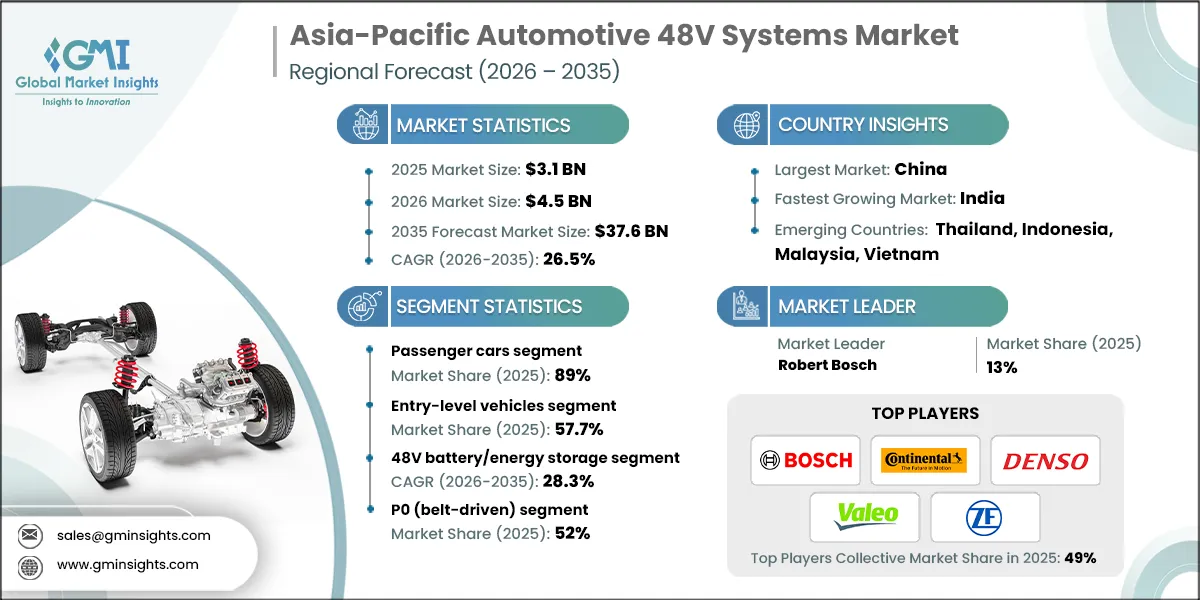
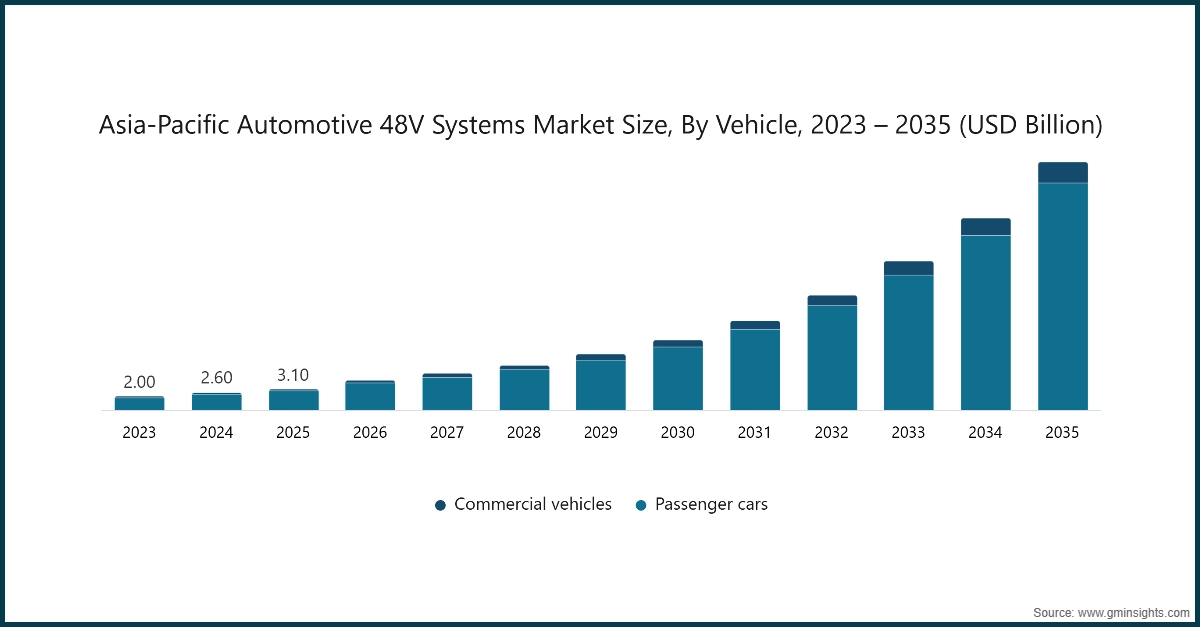
Asia-Pacific automotive 48v systems market was estimated at USD 3.1 billion in 2025. The market is expected to grow from USD 4.5 billion in 2026 to USD 37.6 billion in 2035, at a CAGR of 26.5% according to latest report published by Global Market Insights Inc.
Asia-Pacific Automotive 48V Systems Market Key Takeaways
Market Size & Growth
- 2025 Market Size: USD 3.1 Billion
- 2026 Market Size: USD 4.5 Billion
- 2035 Forecast Market Size: USD 37.6 Billion
- CAGR (2026–2035): 26.5%
Regional Dominance
- Largest Market: China
- Fastest Growing Country: India
Key Market Drivers
- Stringent emission and CO2 reduction regulations across Asia-Pacific.
- Rising fuel costs and demand for fuel-efficient vehicles.
- Government incentives supporting vehicle electrification.
- Rapid urbanization increasing adoption of start-stop systems.
- OEM electrification strategies and ADAS integration.
Challenges
- High initial cost of 48V systems and components.
- Competition from full hybrids and battery electric vehicles.
Opportunity
- Growing adoption in commercial and fleet vehicles.
- Advancements in battery and power semiconductor technologies.
- Two-wheeler and three-wheeler 48V applications in Asia.
- Localization of manufacturing and strategic partnerships.
Key Players
- Market Leader: Robert Bosch led with over 13% market share in 2025.
- Leading Players: Top 5 players in this market include Robert Bosch, Continental, Denso, Valeo, ZF Friedrichshafen, which collectively held a market share of 49% in 2025.
Get Market Insights & Growth Opportunities
The Asia-Pacific automotive 48V systems industry is growing rapidly, driven by the push for vehicle electrification and stricter emission standards. Governments in China, India, Japan, and South Korea are enforcing tighter CO₂ regulations under Paris Agreement commitments, prompting manufacturers to adopt 48V mild-hybrid systems as a cost-effective compliance solution.
The 48V system technology improves fuel economy by 15-20% compared to conventional powertrains. It is more affordable than full hybrids or battery electric vehicles, making it ideal for the cost-sensitive Asia-Pacific market.
China mandates that by 2030, half of all new vehicles must feature some level of electrification. Meanwhile, Japan aims for a fuel economy target of 25.4 km/l by 2030, and India sets its sights on achieving a standard of 113g CO₂/km by 2028 under the CAFE-II standards. These synchronized regulations across China, Japan, and India are acting as powerful catalysts, driving an accelerated expansion of the automotive market in the region.
Major tier-1 suppliers have announced over USD 2.8 billion in capacity expansions for 48V systems infrastructure in the Asia-Pacific region during 2023-2025. These investments, covering lithium-ion battery production, starter-generator manufacturing, and power electronics plants, represent approximately 95% of the current annual market size. This reflects supplier confidence in a sustained high-growth trajectory and readiness to meet future demand.
China dominates the Asia-Pacific 48V systems market, despite its adoption being at an earlier stage compared to Japan and South Korea, where penetration rates are higher. As domestic OEMs in China transition to 48V-compatible platforms in the coming years, significant growth opportunities are expected.
In November 2025, Toyota, Hyundai, and SAIC Motor increased production of 48V-equipped mild-hybrid vehicles in China, Japan, and India to comply with stricter emission and fuel efficiency standards. They also invested in domestic supply chains to expand capacities for 48V batteries, starter-generators, and power electronics, addressing growing regional demand.
To get key market trends
Asia-Pacific Automotive 48V Systems Market Trends
The Asia-Pacific automotive 48V systems market is rapidly growing due to evolving regulations, technological advancements, urbanization, and strategic industry shifts. These factors are fundamentally transforming vehicle electrical architecture across the region.
The Asia-Pacific region leads in stringent automotive emission regulations, driving OEMs to adopt 48V mild-hybrid technology. China's CAFC standards, managed by the Ministry of Industry and Information Technology, aim for a 20% reduction in fleet-average fuel consumption by 2025, targeting 4.0 L/100km.
India's Corporate Average Fuel Economy (CAFE-II) standards aim to reduce emissions to 113g CO₂/km by 2028, down from 130g CO₂/km. CAFE-III standards, targeting sub-100g CO₂/km, are planned for 2032. Meeting these goals through conventional powertrain optimization requires USD 800-1,200 per vehicle, while 48V mild-hybrid systems, costing USD 800-1,000, offer a cost-effective solution with 15-20% fuel savings.
The growing adoption of Advanced Driver Assistance Systems (ADAS) in Asia-Pacific vehicles is straining conventional 12V electrical architectures. ADAS features add 300-800W of continuous electrical load to base vehicle loads of 1,000-1,500W. With ADAS penetration expected to rise from 18% in 2024 to 68% by 2035, electrical architecture capacity faces increasing constraints.
The 48V electrical architecture delivers the power of 12V systems at the same current four times or reduces resistive losses by 75% at equivalent power levels. This efficiency is crucial for Level 2+ and Level 3 autonomous vehicles, which require sensor fusion, real-time processing, and actuator redundancy. Additionally, ISO 26262 standards mandate redundant power systems for safety-critical functions, increasing the strain on electrical architecture.
In October 2025, Toyota and Hyundai launched their 48V mild-hybrid platforms in China and India. These platforms support ADAS and partial automation features with upgraded 48V electrical systems, meeting regional CAFC and CAFE-II fuel efficiency standards.
Asia-Pacific Automotive 48V Systems Market Analysis
Learn more about the key segments shaping this market
Based on vehicles, Asia Pacific automotive 48V systems market is segmented into passenger cars and commercial vehicles. The passenger cars segment dominates the market with 89% share in 2025, and the segment is expected to grow at a CAGR of 26.8% from 2026 to 2035.
- Stricter emission norms and rising fuel prices in countries like China, Japan, and South Korea are driving the adoption of mild hybrid electric vehicles (MHEVs), prompting manufacturers to integrate advanced 48V systems into passenger vehicles.
- Passenger cars are increasingly adopting 48V systems, primarily because these systems enable mild hybridization, enhancing fuel efficiency without a notable rise in vehicle costs.
- For instance, in March 2024, Hyundai launched the Elantra MHEV in the Asia Pacific market, featuring a 48V mild hybrid system for lower CO2 emissions and better fuel efficiency. This highlights the growing adoption of 48V technology by automakers to meet regulations and consumer demand for greener vehicles.
- Passenger cars equipped with 48V systems provide smoother start-stop functionality, enable regenerative braking, and minimizing vibrations during acceleration. These features not only enhance driving comfort but also resonate with environmentally conscious consumers.
- Automakers in Asia Pacific are adopting 48V mild hybrid systems in compact and mid-size passenger cars to boost urban fuel efficiency. In January 2025, Honda launched its City 48V MHEV in India, targeting urban commuters.
- The adoption of 48V systems in light commercial vehicles (LCVs) and medium-duty trucks is rising to reduce costs and enhance fuel efficiency. In August 2025, Isuzu introduced a 48V hybrid N-Series truck in Southeast Asia to address growing logistics fleet demand.
- Limited adoption of 48V systems in heavy-duty applications has resulted in the commercial vehicles segment holding a smaller share of the market.
- Commercial fleets are exploring electrification and hybridization, but high initial costs and advanced power system requirements have slowed 48V technology adoption in buses and trucks. However, government incentives in countries like India and China are expected to drive adoption soon.
Learn more about the key segments shaping this market
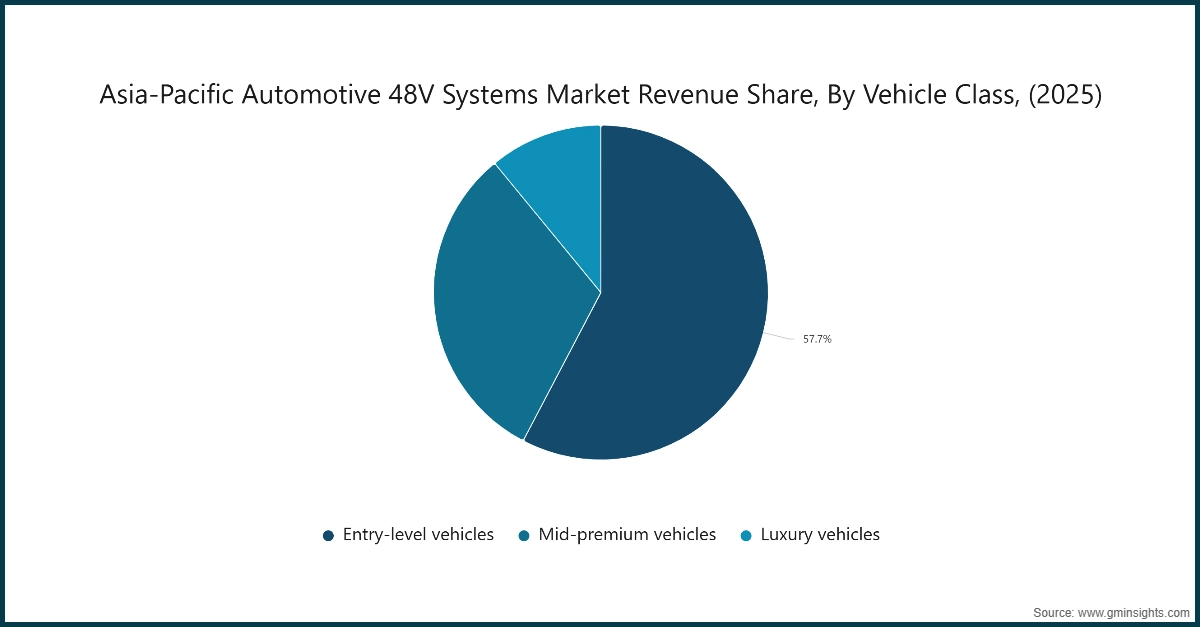
Based on vehicle class, Asia Pacific automotive 48V systems market is divided into entry-level vehicles, mid-premium vehicles and luxury vehicles. The entry-level vehicles segment dominates with 57.7% market share in 2025 and is growing at 25.4% CAGR.
- The rising adoption of cost-effective 48V mild hybrid systems in small and compact cars is driving dominance in emerging economies like India, Indonesia, and Vietnam.
- Automakers are integrating 48V mild hybrid systems into entry-level hatchbacks and sedans to enhance fuel efficiency and meet emission regulations while keeping prices competitive.
- For instance, in February 2025, Maruti Suzuki introduced a 48V mild hybrid version of its Swift model in India, improving fuel efficiency and lowering CO2 emissions.
- While smaller than the entry-level car segment, the mid-premium vehicle category is experiencing consistent growth. Buyers in this segment prioritize enhanced performance and comfort, coupled with fuel efficiency, making 48V systems a sought-after feature.
- For instance, in April 2025, Hyundai launched the 48V mild hybrid Tucson SUV in South Korea, targeting eco-conscious buyers seeking efficiency and premium features.
- Government incentives and subsidies are pivotal in promoting adoption within the entry-level segment.
- In March 2025, India's FAME II scheme incentivized manufacturers to incorporate mild hybrid systems, such as 48V technology, into compact and subcompact vehicles, leading to a surge in adoption within the entry-level segment.
- The luxury vehicle segment holds a minor share of the 48V systems market, as it emphasizes full hybrid and electric powertrains over mild hybrid solutions.
- Luxury automakers are increasingly adopting 48V systems to enhance efficiency and meet regulations. For instance, in June 2025, BMW introduced 48V mild hybrid technology in its 5 Series models across Asia Pacific, combining luxury with lower emissions.
Based on component, the market is segmented into 48V battery/energy storage, starter-generator units, DC-DC converters, inverters, control units & power distribution and others. The 48V battery/energy storage segment dominates with 34% market share in 2025 with 28.3% CAGR during 2026 to 2035.
- The 48V Battery/Energy Storage segment held the largest market share. It comprises lithium-ion battery packs designed for 48V mild-hybrid applications, with a 0.5-1.5 kWh capacity optimized for high power density.
- Battery technology plays a pivotal role in the functionality of 48V systems, facilitating energy capture during regenerative braking, providing electric boosts, and supporting start-stop cycling.
- China, Japan, and South Korea collectively account for 78% of global lithium-ion battery cell production, giving the Asia-Pacific region a competitive advantage in battery-integrated 48V systems.
- Chinese battery manufacturers, including CATL, BYD, and Gotion High-Tech, are developing 48V batteries for automotive mild-hybrid applications, leveraging economies of scale from their EV battery production.
- Starter-Generator Units are expected to be the second-largest segment by 2025, valued at USD 1 billion. The segment is projected to grow at a CAGR of 27.4%, reaching USD 11.4 billion by 2035.
- Belt-driven starter-generators (BSG) dominate P0 architectures due to their lower cost and simple integration, requiring minimal transmission modifications. Crankshaft-mounted units support P1, while transmission-mounted units cater to P2, P3, and P4 configurations.
- Higher-integration P2 and P3 systems are gaining traction in premium segments due to their enhanced regenerative braking efficiency and electric boost capabilities, which offset the higher costs.
- China, Japan, and Taiwan leverage their strong electric motor manufacturing expertise, with companies like Bosch, Denso, Hitachi Automotive, and Zhejiang Founder Motor supplying starter-generator units worldwide.
- DC-DC converters regulate voltage between 48V and 12V domains, usually handling 2-3 kW continuously, with peaks reaching 4-5 kW.
- This component allows conventional 12V accessories such as lighting, infotainment, and other convenience features to keep functioning, even as the vehicle's primary electrical system shifts to 48V.
- Silicon-based converters currently achieve 92-94% efficiency, while silicon carbide (SiC) designs reach 96-98%, offering notable improvements in system-level fuel economy.
- In 2025, inverters represented 11% of the market share. They convert DC battery power to AC, supporting motor operations in electric power steering, HVAC compressors, and active suspension systems.
- The adoption of 48V systems is driving the electrification of engine-driven accessories, increasing the demand for inverters. For instance, electric HVAC compressors alone require an inverter capacity of 1.5-2.5 kW.
- The control units & power distribution segment manages 48V system controllers, which oversee battery charging, power distribution, safety monitoring, and communication with vehicle systems via CAN bus interfaces.
- Control algorithms optimize regenerative braking, electric boost timing, and thermal management of 48V components. As 48V systems integrate with ADAS and powertrain strategies, control unit complexity and value increase.
Based on system architecture, the Asia Pacific automotive 48V systems market is divided between P0 (belt-driven), P1 (crankshaft-mounted), P2 (transmission input shaft), P3 (dual-clutch/transmission-mounted), and P4 (rear axle/output shaft). P0 (belt-driven) dominates with 52% market share in 2025, and with a CAGR of 26.6% during forecast period.
- P0 systems mount the motor-generator unit externally to the engine, connecting via the accessory belt drive, representing the simplest and most cost-effective 48V implementation.
- This architecture requires minimal changes to existing powertrains, involving the replacement of the conventional alternator with a belt-driven starter-generator and the addition of a 48V battery, DC-DC converter, and control system.
- P0 adoption is strongest in entry-level and mid-range vehicles where fuel economy improvement requirements balance against cost constraints.
- Chinese and Indian OEMs particularly favor P0 systems for domestic market applications, while also developing higher-integration architectures for export markets.
- P2 (transmission input shaft) architecture is expected to grow from USD 642.7 million in 2025 to USD 8.2 billion by 2035, registering a 27.2% CAGR.
- P2 systems, placed between the engine and transmission (typically on the transmission input shaft), deliver 15-25 kW electric boost, 70-80% regenerative braking efficiency, and torque-fill during gear shifts.
- The architecture requires significant transmission modifications including clutch systems to decouple the engine during electric-only operation and reinforced input shafts to handle motor torque.
- P2 systems support electric-only driving at low speeds (30-40 km/h) for short distances (1-2 km), significantly reducing fuel consumption and emissions in congested urban traffic.
- P1 systems directly attach the motor-generator to the engine crankshaft, placing it between the engine and transmission. This setup offers performance traits that sit between the P0 and P2 architectures.
- P1 architecture requires moderate powertrain modifications including reinforced crankshaft, modified flywheel, and sometimes adapted engine mounts to accommodate motor-generator mass and inertia.
- P1 adoption is concentrated in Asian OEMs including Hyundai-Kia and certain Japanese manufacturers seeking performance balance between cost-effective P0 and higher-capability P2 systems.
- P3 systems place the motor-generator on the transmission output shaft, enabling electric-only driving and improving regenerative braking by reducing engine friction losses.
- P3 systems excel in applications requiring frequent electric-only operation including urban delivery vehicles and taxi fleets where zero-emission zones and congestion charging create operational imperatives.
- Chinese manufacturers developing electric vehicle platforms are exploring P3 architectures as pathway to range-extended electric vehicles where 48V motor provides propulsion with small engine serving primarily as generator.
- P4 systems mount the motor-generator on the rear axle of front-wheel-drive vehicles or front axle of rear-wheel-drive vehicles, creating through-the-road hybrid architecture enabling electric all-wheel-drive functionality.
- P4 systems provide unique value proposition in premium SUV and crossover segments where consumers value all-wheel-drive capability but traditional mechanical AWD systems add cost, weight, and fuel economy penalties.
- P4 adoption is concentrated in premium vehicle segments with manufacturers including Audi, Volvo, and Jaguar Land Rover offering electric rear axle options.
- Chinese manufacturers are focusing on P4 systems for domestic SUV models to meet the strong demand for AWD capabilities. They are developing compact electric drive units that integrate the motor, inverter, and reduction gearing, ensuring compatibility with existing vehicle architectures.
Looking for region specific data?
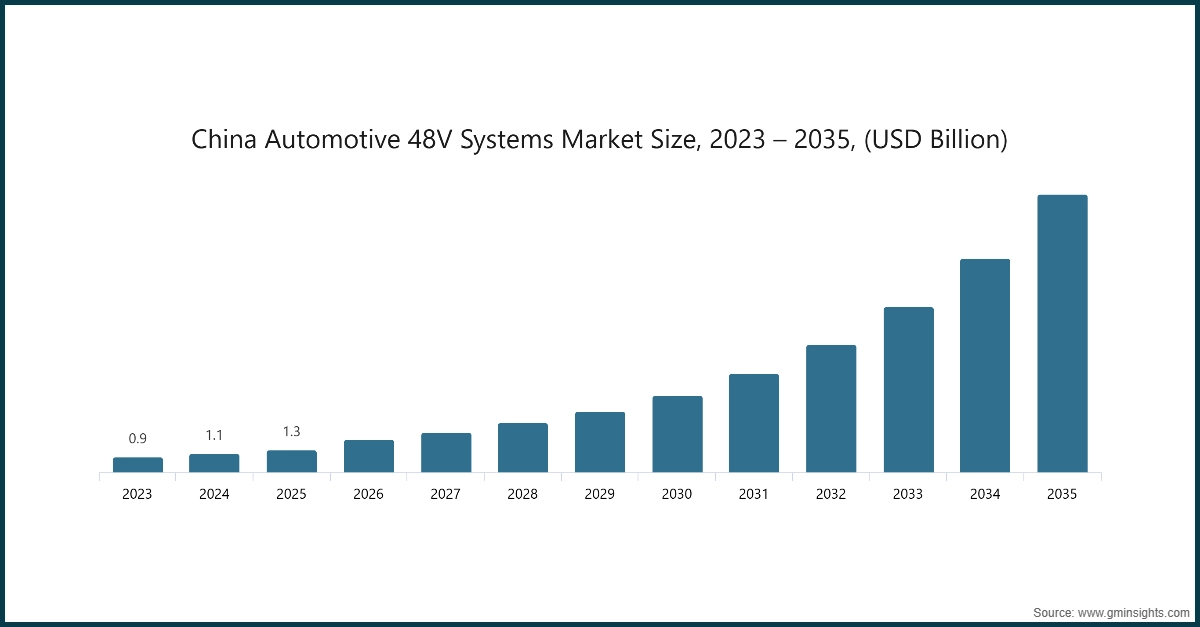
China dominated Asia Pacific automotive 48V systems market generating revenue of USD 1.3 billion in 2025 with CAGR of 26.7% during the forecasted timeframe from 2026 to 2035.
- China remains the world's largest automotive market in 2024, with 26 million vehicle sales, driven by robust government policies promoting electrification.
- The Ministry of Industry and Information Technology (MIIT) mandates a fleet-average fuel consumption target of 4.0 L/100km by 2025, achievable through increased adoption of mild-hybrid, full hybrid, and electric vehicles.
- By 2025, automakers in China must achieve NEV credits equal to 18% of sales, increasing to 28% by 2030. Mild hybrids receive credit multipliers of 2 to 3, depending on fuel economy performance.
- Chinese government support extends beyond regulation to industrial policy actively cultivating domestic 48V systems supply chains.
- China's "Made in China 2025" initiative has prioritized automotive power electronics and electric drivetrain components, granting them benefits like preferential financing, tax incentives, and dedicated R&D support.
- Government procurement policies favor vehicles with domestically manufactured 48V systems, ensuring a protected market share for Chinese suppliers.
- Provinces like Jiangsu, Guangdong, and Zhejiang provide additional subsidies and incentives for 48V system manufacturers, with annual government support estimated at RMB 8-12 billion.
- China's automotive market structure particularly favors 48V adoption given the dominance of domestic brands in volume segments where cost-effective electrification solutions are most valuable.
- Domestic manufacturers, including Geely, BYD, Great Wall Motors, Changan, SAIC, Dongfeng, FAW, and GAC, hold 52% of the domestic market and are actively adopting 48V technology to enhance compliance and competitiveness.
- China's 15 megacities, including Shanghai, Beijing, and Shenzhen, each with populations exceeding 10 million, significantly influence 48V adoption patterns due to severe urban vehicular congestion.
- For instance, in March 2025, Geely Auto unveiled a significant rollout of 48V mild-hybrid systems, integrating them into its mainstream passenger lineup, which features updated versions of the Geely Emgrand and Boyue models.
The growth forecast for the automotive 48V systems market in India from 2026 to 2035 is highly encouraging.
- India is experiencing the highest regional CAGR of 31% from 2026 to 2035, driven by 4.8 million annual vehicle sales, emerging emission regulations, and significant electrification potential.
- India's automotive market, marked by strong price sensitivity, a preference for compact vehicles, and intense urban congestion, sets the stage for the widespread adoption of cost-effective 48V mild hybrids.
- The Ministry of Road Transport and Highways (MoRTH) forecasts India's vehicle market to achieve 8-10 million annual sales by 2035, driving substantial opportunities for 48V technology adoption.
- India's Corporate Average Fuel Economy (CAFE) standards are advancing to drive adoption. CAFE-I mandates a fleet average of 130g CO₂/km by 2022-23, while CAFE-II targets 113g CO₂/km by 2028.
- The Indian government, under the FAME-II (Faster Adoption and Manufacturing of Electric Vehicles) scheme, has allocated INR 10,000 crore to promote electric mobility and support the adoption of 48V systems.
- India's PLI scheme for automotive components provides 16-18% incentives on increased sales of advanced technologies, notably including 48V system components.
- This incentive enables domestic manufacturing cost structures approaching Chinese levels, making India an attractive global 48V manufacturing hub.
- Several international suppliers including Bosch, Continental, and Valeo have announced Indian manufacturing expansions for 48V components leveraging PLI incentives.
- The Indian market structure drives diverse 48V technology adoption patterns across segments. Maruti Suzuki, with a 42% domestic market share, significantly influences these trends through its mild-hybrid deployment strategies.
- Tata Motors and Mahindra & Mahindra, with a combined 26% market share, are developing localized 48V systems designed for Indian conditions, including high temperatures, dusty environments, and moderate power demands.
- India's commercial vehicle segment, with 1.2 million annual sales, offers significant 48V growth potential, driven by urban goods transportation and passenger movement. The logistics sector's 12% annual growth and fuel costs comprising 35-42% of fleet operating expenses further boost demand for fuel-efficient vehicles.
Japan is expected to show remarkable and promising development in the automotive 48V systems market from 2026-2035.
- Japan is projected to dominate the Asia-Pacific market for 48V systems, achieving a 17% share by 2025, with a strong CAGR of 25.9% during 2026 to 2035.
- In 2024, Japan produced 7.8 million vehicles compared to China's 26 million. However, Japan's vehicles featured higher 48V content per unit, highlighting its advanced technology adoption.
- Japan's extensive experience in hybrid vehicle development has enabled companies like Honda, Nissan, Mazda, and Subaru to create advanced 48V systems by leveraging decades of expertise.
- Japanese manufacturers are leveraging 48V technology to complement full hybrid systems, targeting mainstream segments where full hybrid costs ($2,500-3,500 per vehicle) exceed consumer willingness to pay, but electrification is necessary to meet fuel economy and emission standards.
- In Japan, consumer preference for domestic brands, which command a 91% market share, underscores a pronounced favoring of 48V technology. This level of brand dominance is the highest among major global markets.
- Honda, Nissan, Mazda, and Subaru are adopting 48V systems across various platforms. Honda integrates it into Civic, Accord, and CR-V, while Nissan incorporates it into e-Power systems. Mazda pairs it with Skyactiv-X engines, and Subaru applies it to horizontally opposed engines.
- Japan's dominance in the global technology landscape is evident through its 48V system components. Denso Corporation, drawing on its expertise from Toyota's hybrid component development, supplies these 48V systems to leading global OEMs.
- Japan leads globally in 48V system components, with Denso Corporation supplying these systems to major OEMs, leveraging its expertise from Toyota's hybrid component development.
- Panasonic and GS Yuasa manufacture 48V lithium-ion batteries for automotive applications. Rohm Semiconductor and Renesas develop power management ICs and microcontrollers for 48V systems.
- A strong domestic supply chain provides Japanese OEMs with cost, quality, and technology advantages, positioning their suppliers for growth in the global 48V market.
The automotive 48V systems market in South Korea region is expected to experience significant and promising growth from 2026 to 2035.
- South Korea plays a dual role in the automotive market, with 1.6 million annual domestic vehicle sales and 2.9 million units exported annually. The adoption of 48V systems spans both domestic and export-oriented production.
- Hyundai Motor Group, comprising Hyundai, Kia, and Genesis brands, holds a 75% share of the Korean market. As a top five global automotive manufacturers, its 48V strategies carry significant global importance.
- The group's announcement of 48V system deployment across 75% of ICE vehicle models by 2027 creates substantial market expansion.
- The Korean government, through the Eco-Friendly Vehicle Promotion Law managed by MOLIT, mandates that eco-friendly vehicles account for 35% of new vehicle sales by 2030 and 83% by 2035.
- Korea's environmental policy is progressively tightening emission zones in cities like Seoul, Busan, and Incheon, restricting older vehicles while promoting eco-friendly options such as mild hybrids.
- Korean automotive industry structure creates distinct 48V development patterns emphasizing integration with advanced electronics and connectivity.
- Korean manufacturers excel in vehicle electronics, infotainment, and connectivity systems, creating natural synergies with 48V electrical architectures supporting expanded electronic content.
- Hyundai-Kia's development of integrated cockpit controllers, OTA software update capabilities, and advanced ADAS systems all benefit from 48V power availability and architectural modernization.
- Korean manufacturers are differentiating their 48V offerings by integrating advanced features and connectivity, appealing to technology-focused consumers beyond just fuel economy improvements.
- Korean market's premium segment orientation affects 48V adoption patterns with emphasis on higher-integration architectures.
- Hyundai's N performance division, Kia's GT models, and the Genesis luxury brand utilize P2 and P0+P4 architectures to enhance performance and refinement, diverging from entry-level P0 systems focused on fuel economy.
- This aligns with Korean OEMs' strategy of emphasizing technological leadership and catering to domestic demand for feature-rich vehicles supported by 48V power availability.
- Stellantis' strong European presence and investments in connected vehicle platforms benefit Italy and Spain, despite their smaller automotive markets compared to Germany.
- ENISA, the European Union Agency for Cybersecurity, leads member states' efforts by forming expert groups on smart car security and guiding implementation of R155/R156.
Asia-Pacific Automotive 48V Systems Market Share
The top 7 companies in the Asia Pacific automotive 48V systems industry are Robert Bosch, Continental, Denso, Valeo, ZF Friedrichshafen, BorgWarner and Magna International contributed around 58% of the market in 2025.
- Bosch leads the market with a broad technology portfolio that covers all key components of the 48V system, such as batteries, starter-generators, DC-DC converters, and control systems. With decades of innovation in automotive electrical systems, Bosch has honed its engineering expertise, offering integrated solutions that OEMs appreciate for their ease of sourcing and assured compatibility.
- Continental focuses on power electronics expertise, integrating it with ADAS and autonomous driving technologies, supported by its 48V architecture. Its power electronics division develops DC-DC converters and inverters, while the powertrain division delivers starter-generator units and integrated motor-transmission systems.
- Denso, Japan's largest automotive tier-1 supplier and part of the Toyota Group, utilizes its extensive hybrid vehicle component expertise to provide advanced 48V systems designed for Japanese and Korean OEMs.
- Valeo leverages its European market leadership to focus on system integration and innovative stop-start technologies. Its StARS (Stop & Start) technology supports the development of advanced 48V systems with improved power and functionality.
- ZF utilizes its transmission manufacturing expertise to integrate P2 and P3 48V architectures into its 8-speed and 9-speed automatic transmissions, which are widely adopted in premium vehicles and support mild-hybrid systems.
- BorgWarner focuses on thermal management and electric boosting technologies, utilizing 48V power for advanced functionalities. Its acquisition of Delphi Technologies enhances its portfolio with DC-DC converters, battery management systems, and power distribution modules, complementing its expertise in turbochargers andengine components.
- Magna specializes in full system integration and vehicle engineering services, enabling turnkey 48V implementations for OEMs lacking internal development resources. Its expertise spans powertrain integration, electrical architecture, and vehicle assembly, offering solutions beyond component supply.
Asia-Pacific Automotive 48V Systems Market Companies
Major players operating in Asia Pacific automotive 48V systems industry are:
- Aptiv
- BorgWarner
- Continental
- Denso
- Infineon Technologies
- Magna International
- Mitsubishi Electric
- Robert Bosch
- Valeo
- ZF Friedrichshafen
- Key players in the Asia-Pacific automotive 48V systems market, including Aptiv PLC, BorgWarner, Continental, Denso, and others, are delivering integrated 48V architectures. These solutions, such as mild-hybrid powertrains and advanced power electronics, aim to enhance fuel efficiency and support electrification goals.
- These companies are driving 48V system adoption by integrating high-efficiency semiconductors, compact electric motors, and intelligent power management. Their solutions help OEMs meet emission norms while enhancing vehicle performance with features like regenerative braking and electrified auxiliaries.
- The Asia-Pacific 48V systems market is growing rapidly, driven by stricter emission regulations and cost-effective hybridization strategies in China, Japan, South Korea, and India. Key players are leveraging OEM partnerships, localized manufacturing, and scalable platforms to advance mild-hybrid and software-enabled vehicle architectures.
- Key players in the Asia-Pacific automotive 48V systems market, including Aptiv PLC, BorgWarner, Continental, Denso, and others, are delivering integrated 48V architectures. These solutions, such as mild-hybrid powertrains and advanced power electronics, aim to enhance fuel efficiency and support electrification goals.
Asia-Pacific Automotive 48V Systems Market Report Attributes
| Key Takeaway | Details |
|---|---|
| Market Size & Growth | |
| Base Year | 2025 |
| Market Size in 2025 | USD 3.1 Billion |
| Market Size in 2026 | USD 4.5 Billion |
| Forecast Period 2026-2035 CAGR | 26.5% |
| Market Size in 2035 | USD 37.6 Billion |
| Key Market Trends | |
| Drivers | Impact |
| Stringent emission and CO2 reduction regulations across Asia-Pacific | Pushes OEMs to adopt 48V mild-hybrid systems, reducing fuel consumption and emissions while meeting regulatory targets. |
| Rising fuel costs and demand for fuel-efficient vehicles | Encourages manufacturers to integrate 48V systems, improving fuel efficiency and lowering operational costs for consumers |
| Government incentives supporting vehicle electrification | Accelerates 48V system adoption by making hybrid and mild-hybrid vehicles more financially attractive to buyers. |
| Rapid urbanization increasing adoption of start-stop systems | Boosts demand for 48V start-stop technology, reducing idling emissions in congested city traffic. |
| OEM electrification strategies and ADAS integration | Drives integration of 48V architecture with hybrid powertrains and advanced driver-assistance systems, enhancing overall vehicle performance and energy efficiency. |
| Pitfalls & Challenges | Impact |
| High initial cost of 48V systems and components | Increases upfront investment and may slow adoption among price-sensitive OEMs and fleet operators. |
| Competition from full hybrids and battery electric vehicles | Limits market penetration of 48V mild-hybrid systems as OEMs prioritize higher-voltage hybrid or fully electric solutions. |
| Opportunities: | Impact |
| Growing adoption in commercial and fleet vehicles | Expands 48V system demand by improving fuel efficiency and reducing emissions across high-mileage vehicle segments. |
| Advancements in battery and power semiconductor technologies | Enhances system performance, energy efficiency, and reliability, enabling wider integration of 48V architectures. |
| Two-wheeler and three-wheeler 48V applications in Asia | Opens new market segments in densely populated regions, supporting electrification of light mobility vehicles. |
| Localization of manufacturing and strategic partnerships | Reduces costs, ensures supply chain resilience, and accelerates market adoption through regional collaborations. |
| Market Leaders (2025) | |
| Market Leader |
13% Market Share |
| Top Players |
Collective Market Share is 49% |
| Competitive Edge |
|
| Regional Insights | |
| Largest Market | China |
| Fastest growing market | India |
| Emerging countries | Thailand, Indonesia, Malaysia, Vietnam |
| Future outlook |
|
What are the growth opportunities in this market?
Asia-Pacific Automotive 48V Systems Industry News
- In January 2026, Geely Automobile Holdings announced plans to expand its 48V mild-hybrid technology to 80% of its internal combustion engine models by the end of 2026, targeting approximately 1.2 million units annually.
- In December 2025, Continental AG opened a new 48V systems manufacturing facility in Yantai, China, with an annual capacity of 800,000 units and a USD 420 million investment. The facility produces integrated 48V systems, including motors, inverters, DC-DC converters, and controllers, designed for Chinese OEM platforms.
- In November 2025, India's Ministry of Heavy Industries unveiled an updated FAME-III scheme. For the first time, the scheme extends its backing to 48V mild-hybrid vehicles, offering subsidies ranging from INR 5,000 to 8,000 per vehicle. This financial support is designated for systems that meet specified minimum efficiency standards.
- In October 2025, Honda Motor Company introduced the "Honda Architecture New Generation Advanced" (HANGA), a global compact platform featuring standardized 48V electrical architecture. This platform will support the Civic, CR-V, Accord, and HR-V successors, slated for release between 2026 and 2028.
The Asia Pacific automotive 48V systems market research report includes in-depth coverage of the industry with estimates & forecasts in terms of revenue (USD Bn) and shipment (Units) from 2022 to 2035, for the following segments:
Market, By Component
- 48V battery/energy storage
- Starter-generator units
- DC-DC converters
- Inverters
- Control units & power distribution
- Others
Market, By System Architecture
- P0 (belt-driven)
- P1 (crankshaft-mounted)
- P2 (transmission input shaft)
- P3 (dual-clutch/transmission-mounted)
- P4 (rear axle/output shaft)
Market, By Vehicles
- Passenger cars
- Hatchbacks
- SUV
- Sedan
- Commercial vehicles
- Vans
- Utility & service vehicles
- Pickup trucks
- Light-duty buses
Market, By Vehicle Class
- Entry-level vehicles
- Mid-premium vehicles
- Luxury vehicles
Market, By Application
- Regenerative braking & energy recuperation
- Start-stop functionality
- Electric boost/torque assist
- Active chassis & stability control
- Electric power steering (EPS)
- HVAC & thermal management
- Electric turbocharging
- Fuel efficiency optimization
- Others
The above information is provided for the following countries:
- China
- Japan
- South Korea
- India
- Thailand
- Australia
- Malaysia
- Vietnam
- Indonesia
- Singapore
- New Zealand
- Rest of Asia Pacific
Frequently Asked Question(FAQ) :
What was the market size of the Asia-Pacific automotive 48V systems in 2025?
The market size was USD 3.1 billion in 2025, growing at a CAGR of 26.5% till 2035. The market is driven by the push for vehicle electrification and stricter emission standards.
What is the projected value of the Asia-Pacific automotive 48V systems market by 2035?
The market is poised to reach USD 37.6 billion by 2035, due to advancements in 48V mild-hybrid systems and increasing adoption of ADAS.
What is the expected size of the Asia-Pacific automotive 48V systems industry in 2026?
The market size is projected to reach USD 4.5 billion in 2026.
What was the market share of the passenger cars segment in 2025?
The passenger cars segment dominated the market with an 89% share in 2025 and is expected to grow at a CAGR of 26.8% up to 2035.
What was the valuation of the 48V battery/energy storage segment in 2025?
The 48V battery/energy storage segment accounted for 34% of the market share in 2025, with a projected CAGR of 28.3% through 2035.
What is the growth outlook for the entry-level vehicles segment from 2026 to 2035?
The entry-level vehicles segment is set to expand at a CAGR of 25.4% till 2035, maintaining its dominance with a 57.7% market share in 2025.
Which country leads the Asia-Pacific automotive 48V systems sector?
China leads the market, generating USD 1.3 billion in revenue in 2025, with a CAGR of 26.7% projected during the forecast period.
What are the upcoming trends in the Asia-Pacific automotive 48V systems market?
Trends include 48V mild-hybrid adoption for emissions compliance, rising ADAS penetration, advanced electrical architectures, and ISO 26262 safety compliance.
Who are the key players in the Asia-Pacific automotive 48V systems industry?
Key players include Aptiv, BorgWarner, Continental, Denso, Infineon Technologies, Magna International, Mitsubishi Electric, Robert Bosch, Valeo, and ZF Friedrichshafen.
Asia-Pacific Automotive 48V Systems Market Scope
Related Reports