Summary
Table of Content

Asia Automatic Fish Feeder for Marine Cage Farming Market
Get a free sample of this report
Form submitted successfully!
Error submitting form. Please try again.
Thank you!
Your inquiry has been received. Our team will reach out to you with the required details via email. To ensure that you don't miss their response, kindly remember to check your spam folder as well!
Request Sectional Data
Thank you!
Your inquiry has been received. Our team will reach out to you with the required details via email. To ensure that you don't miss their response, kindly remember to check your spam folder as well!
Form submitted successfully!
Error submitting form. Please try again.
Asia Automatic Fish Feeder for Marine Cage Farming Market Size
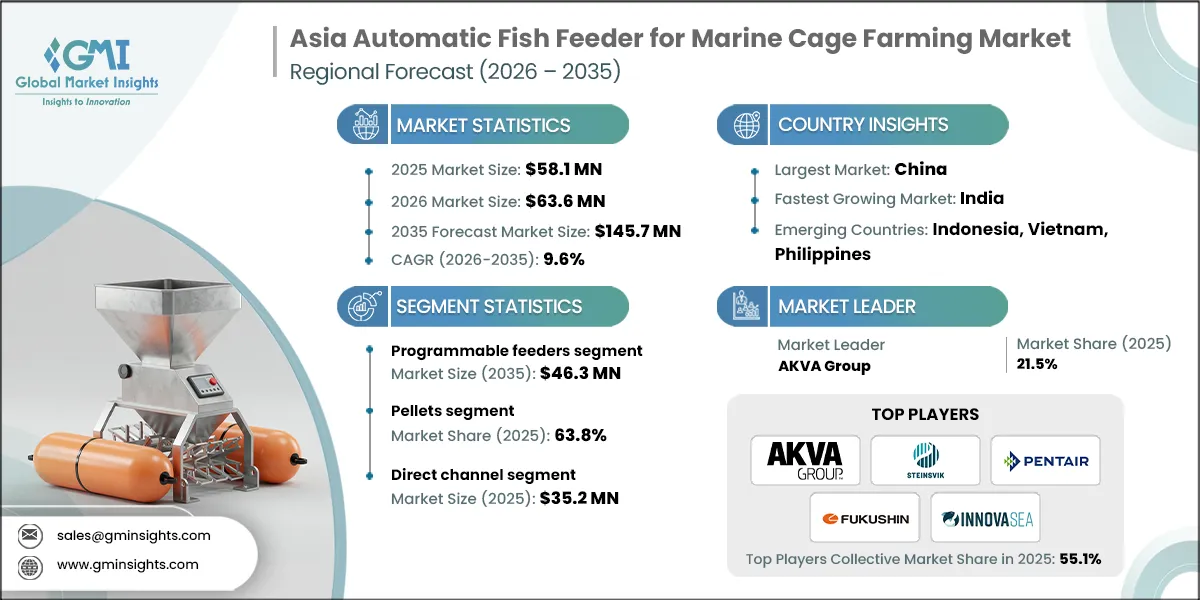
The Asia automatic fish feeder for marine cage farming market was valued at USD 58.1 million in 2025. The market is expected to grow from USD 63.6 million in 2026 to USD 145.7 million in 2035, at a CAGR of 9.6%, according to latest report published by Global Market Insights Inc.
Asia Automatic Fish Feeder for Marine Cage Farming Market Key Takeaways
Market Size & Growth
- 2025 Market Size: USD 58.1 Million
- 2026 Market Size: USD 63.6 Million
- 2035 Forecast Market Size: USD 145.7 Million
- CAGR (2026–2035): 9.6%
Regional Dominance
- Largest Market: China
- Fastest Growing Country: India
Key Market Drivers
- Growing popularity of aquaculture.
- Technological advancements in smart feeders.
- Labor cost reduction in marine cage farming.
Challenges
- High initial investment and intensive maintenance requirement.
- Volatility in raw material prices & supply chain disruptions.
Opportunity
- Integration with IoT and sensor-based feeding systems.
- Customization for species-specific diets and feeding patterns.
Key Players
- Market Leader: AKVA Group led with over 21.5% market share in 2025.
- Leading Players: Top 5 players in this market include AKVA Group, Steinsvik, Pentair AES, FUKUSHIN Electric, INNOVASEA, which collectively held a market share of 55.1% in 2025.
Get Market Insights & Growth Opportunities
The Asia automatic fish feeders for marine cage farming market is witnessing robust growth, driven by the region's dominance in global aquaculture production. According to the Food and Agriculture Organization (FAO), Asia contributes over 89% of the world's aquaculture output, underscoring its pivotal role in the industry.
The automatic fish feeder are essential for all marine cage farmers to manage fish feeding schedules, meet fish feed consumption requirements, reduce feed wastage from overfeeding and damaged fish, and maximise fish health status; integrated technologies (IoT), artificial intelligence (AI) and cloud-based technology (CBT) are further optimising the operational efficiency of many farmers.
Government backed initiatives to modernise aquaculture are helping drive the development of automatic fish feeders in the marine cage farming industry, in particular China and India; China's 14th 5-Year Plan promotes the use of new technologies within aquaculture including automated feeding systems while India’s blue revolution initiative is urging fish farmers to increase production through more sustainable means thus strengthening and creating a favourable business environment for automatic fish feeder market growth.
The expansion of the field of AI and machine learning also represents another significant driver behind this trend. For example, Pentair has developed a new type of automatic feeder using AI technology to monitor fish behaviour and develop their optimal feeding timelines. These new systems improve the efficiency of feed conversions, decrease operational costs and promote environmentally sustainable marine cage farming practices, thus making these feeders a sought-after option for marine farmers.
Increasing adoption rates of marine cage farming systems in countries such as Indonesia, Vietnam and the Philippines represent an additional catalyst for the increasing demand for automatic feeders. For example, Gaelforce Marine is now providing feeding systems designed specifically to meet the unique requirements of these countries.
To get key market trends
Asia Automatic Fish Feeder for Marine Cage Farming Market Trends
Changing innovation and technology transformation are important for the growth of the Asia automatic fish feeder for marine cage farming industry.
- The marine cage farming market in Asia is expanding rapidly in terms of both technology and aquaculture practices, with the increasing consumer demand for efficient aquaculture and government support for developing sustainable aquaculture businesses throughout the region such as in China and India. Additionally, the Ministry of Agriculture and Rural Affairs of China has announced an increase in aquaculture production efficiency of 15% for 2023 due to the implementation of automated systems
- Manufacturers have developed new class of IoT-enabled automatic fish feeders that provide users with the ability to control feeding remotely. Such as AKVA Group developed on-board sensors and real-time data analytics capabilities to allow for precise feeding schedules and reduced feed loss and waste. This type of innovation increases operational efficiencies and will help to achieve many sustainability objectives that many businesses support or adhere to.
- Another trend is the focus on sustainability with manufacture utilizing new technology to reduce feed loss and waste and minimize the overall impact that these types of systems have on the environment. Products from companies such as Blue Ocean Technology also incorporate onboard sensors that accurately dispense feed at the appropriate times, thereby helping fish farms achieve compliance with strict environmental guidelines.
- Aquaculture digital transformation is increasing rapidly and many of the aquaculture farms are applying automated and computerized solutions. These solutions are used to improve feed efficiency and for enhancement of the welfare of the fish. According to the report of Indian Council of Agricultural Research published in the year 2023, the increased use of automatic feeders amongst marine cage farming has resulted in an increase of 20% in Feed Efficiency.
- There is high growth currently occurring due to an increase in R&D expenditure from the manufacturer side. Manufacturers such as Pentair and Fish Farm Feeder are focused on producing advanced feeding solutions for the marine cage farming market segment that are catered for the special needs of the marine cage industry. This aligns with the global push for sustainable food production processes.
Asia Automatic Fish Feeder for Marine Cage Farming Market Analysis
Learn more about the key segments shaping this market
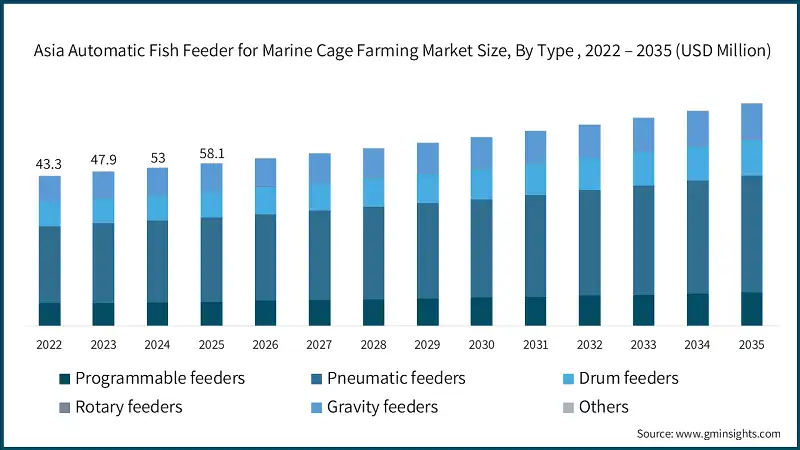
Based on type, the Asia automatic fish feeder for marine cage farming industry is segmented into programmable feeders, pneumatic feeders, drum feeders, rotary feeders and gravity feeders and others. Programmable feeders segment accounts for revenue of around USD 17.4 million in the year 2025 and is expected to reach USD 46.3 million by 2035.
- In the Asia market for automatic fish feeders in marine cage farming, programmable feeders represent a dominant share of the market. Programmable feeders provide the user with precise control over the amount and timing of feed, allowing for optimal feeding of fish while minimizing feed wastage. As an example, China and India have seen a rapid increase in the use of programmable feeders because of the complementary nature of the use of these feeders within aquaculture.
- Programmable feeders are rapidly becoming more popular within marine cage farming as these feeders provide an effective method for supporting the sustainable use and efficient production of marine fish in the region. For example, Japan's Ministry of Agriculture, Forestry and Fisheries have recognized the need for advancements in technology to improve the efficiency and productivity of marine aquaculture.
- Programmable feeders developed by companies such as FishFarmFeeder and AQ1 Systems are being developed specifically for marine cage farming. The feasibility of the use of these programmable feeders is improved through the addition of features such as real-time monitoring and analysis of feeding activity, which allows farmers to optimize their feeding practices.
- Compared to traditional feeders such as gravity and drum feeder, programmable feeders offer higher levels of control and data integration. In marine cage farming where the effects of precision feeding on health and production are significant, this superiority is essential to the producer. Countries such as Vietnam and Indonesia have recorded improved aquaculture production since implementing programmable feeder technology.
- There is growing interest in sustainable aquaculture practices with greater adoption rates of programmable feeders. Demand for programmable feeding systems as a result of lower feed costs and improving fish health has led to increased adoption rates within Asian-based marine cage farms; thus, it can be expected to continue growth this segment based on continued advancement of technology and continuing support from government policy.
Learn more about the key segments shaping this market
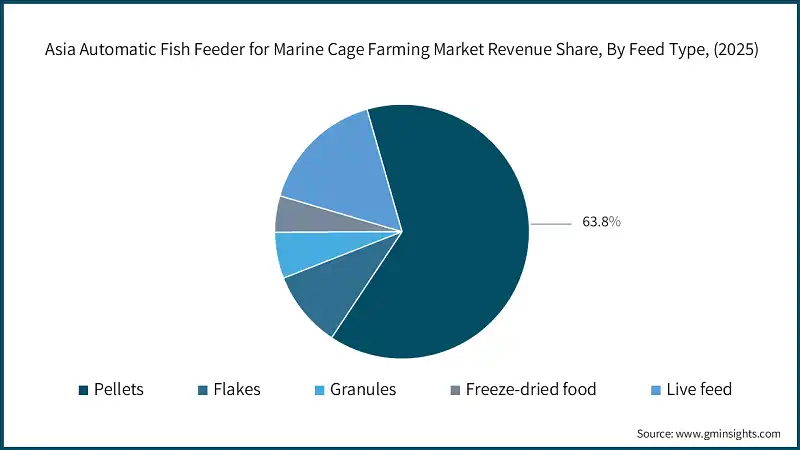
Based on the feed type, the Asia automatic fish feeder for marine cage farming market is bifurcated into pellets, flakes, granules, freeze-dried food and live feed The pellets segments held the largest share, accounting for 63.8% of the market in 2025.
- The rise of aquaculture in Asia can largely be attributed to the sheer volume of aquatic animal production in the area. As of 2022, Asia produced more than 64% of all aquatic animals globally, with China, India and Vietnam dominating the sector. The increasing use of automated feeding technology will allow farmers to operate more efficiently, grow faster, reduce labor costs and scale the operations of marine cage farms.
- Of the various types of feeds available in aquaculture, pellet feeds dominate the market due to their water stability, reduced feed conversion ratios and balanced nutritional profiles. As reported by FAO/APFIC, 90% of shrimp feed produced and used in Asia is pellet-based. The major producers of pellet feeds, such as Cargill and Skretting, are developing and enhancing pellet formulations for marine cage farms to optimise impact on the environment.
- Asian governments are also promoting pellet feed technology through initiatives such as the development of pellet feed formulations using locally available ingredients such as by ICAR-CIFT Research Institute in India, which aims to reduce costs and improve environmental sustainability. Similarly, the QCVN Technical Standards for Aquaculture Feed in Vietnam ensure the safety and quality of pellet feeds and encourage their widespread use in aquaculture.
- The Philippine government states that feed costs are between 50-60% of all production expenses in aquaculture however, due to their ability to provide more efficient delivery of nutrients and cause less waste, pellet feeds are becoming increasingly popular due to their cost savings. Biomar for instance has developed cost-effective pellet solutions that are driving the demand for pellet feeds in the aquaculture industry.
- Leading aquaculture manufacturers have invested funds into R&D for making pellet feeds more efficient. For example, Skretting’s Nutra RC range was created specifically for marine cage farming, it is claimed to deliver improved feed conversion ratios and reduces the environmental impact of its products. With the assistance of government support and established technical guidelines, the pellet feed industry is growing rapidly throughout Asia.
Based on distribution channels, the Asia automatic fish feeder for marine cage farming market is segmented into direct and indirect. The direct channel segment held the largest share, generating a revenue of USD 35.2 million of the market in 2025.
- The dominance of the direct channel can be attributed to its efficiency in meeting the specific needs of marine cage farming operations. Governments in Asia have been promoting aquaculture, including through the provision of subsidies and other incentives. For example, in India, the Pradhan Mantri Matsya Sampada Yojana (PMMSY) has also been encouraging fish farming as a way to increase production and modernise fishery practices. The PMMSY supports the growth and adoption of new technologies in fish farming, including automatic feeding systems for farms.
- The manufacturers play a very important role in supporting the growth of direct channels. Manufacturers such as AKVA Group and Gaelforce Group are able to provide marine cage farmers with unique, customised products and services that are specifically designed for that type of farming. For example, AKVA Group provides customised feeding systems that are designed to meet the unique needs of each individual farm, thereby maximizing feed usage and decreasing feed waste.
- Direct sales provide after-sale services and support, technical support, and training for automatic feeding systems, and also build a sense of trust and loyalty with their customers. Their close and personal relationship with their customers helps to solidify the dominance of the direct channel in the market.
- Further, manufacturers who sell their products directly to retailers can also offer customer support, pre- and post-sale technical service, and training for the customer on how to use automatic fish feeders effectively. Creating an environment of trust and professionalism with the end user, thereby enhancing and securing the dominant role of direct sales in the marketplace.
Looking for region specific data?
China Automatic Fish Feeder for Marine Cage Farming Market
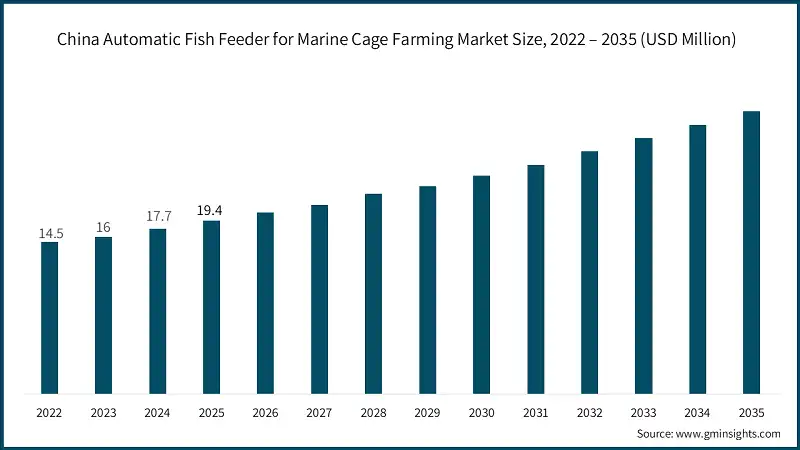
In 2025, China dominated the Asia automatic fish feeder for marine cage farming market, accounting for 33.4% of the share in the region.
- China dominates the aquaculture industry as the world's largest producer of aquaculture. The scale of aquaculture developments allows for large volumes of automatic feed delivery systems on marine cage sites and provides solutions for labor shortages and improve feed conversions with greater efficiency.
- In addition, the Chinese Government is making efforts to promote deep-sea aquaculture. The policy is known as the 2023 "FAO Opinion on Accelerating the Development of Deep-Sea Aquaculture" and includes targets to increase the ocean aquaculture area by 6.8% by 2023. The government have invested in smart feeding technologies, including underwater sensors and biomass estimation devices, and centralized feeding systems, thus supporting the increased use of auto-feeders in marine aquaculture systems.
India Automatic Fish Feeder for Marine Cage Farming Market
India automatic fish feeder for marine cage farming market is expected to grow at 11.7% during the forecast period.
- India’s automatic feeder market is set for strong growth, driven by rapid aquaculture expansion- fish production surged to 18.4 million MT in 2023–24. Government programs like PMMSY and FIDF are boosting infrastructure, credit, and digital innovation. With 8,118 km coastline and sea cage farming initiatives scaling from 1,500 cages to a potential 820,000, support from ICAR-CMFRI and NFDB is accelerating adoption of automated feeding systems, underpinning the projected 11.7% CAGR.
Asia Automatic Fish Feeder for Marine Cage Farming Market Share
The top companies in the Asia automatic fish feeder for marine cage farming industry include AKVA Group, Steinsvik, Pentair AES, FUKUSHIN Electric and INNOVASEA and collectively hold a share of 55.1% of the market in 2025. These prominent players are proactively involved in strategic endeavors, such as mergers & acquisitions, facility expansions & collaborations, to expand their product portfolios, extend their reach to a broad customer base, and strengthen their market position.
- AKVA Group delivers advanced feed barges for marine cage farming, featuring capacities from 96–900 tons and pneumatic or waterborne pellet transport. Its AKVA Connect platform enables real-time feeding control, environmental monitoring, and predictive maintenance for optimized operations.
- Steinsvik offers the Cannon feeding system, designed for precision pellet delivery in marine cages using pneumatic technology. Integrated cameras and sensors allow remote monitoring, while compatibility with digital platforms ensures efficient feed management and reduced waste.
- Pentair AES provides programmable feeders including belt, vibratory, and directional models for aquaculture. The Aquatic Xtreme Directional Feeder projects pellets up to 45 ft, powered by rechargeable batteries and optional solar kits, supporting sustainable cage farming in Asia.
Asia Automatic Fish Feeder for Marine Cage Farming Market Companies
Major players operating in the Asia automatic fish feeder for marine cage farming industry are:
- ABP Aquaculture Equipment Ltd.
- AKVA Group
- Aquasyster
- eFishery
- Eruvaka Technologies
- FishFarmFeeder
- FUKUSHIN ELECTRIC Co., Ltd.
- Hung Star Enterprise Corp.
- IAS Products
- Innovasea
- Kamber Tech
- Pentair AES
- Pioneer Group
- Steinsvik Group
- Ternakin
Fukushin Electric manufactures solar/AC-powered feeders like PFX-300, PFX-60, and Feeding Master, offering up to 12 feedings per day. Built with durable FRP/ABS materials, these feeders are widely used in Asian markets for reliable, energy-efficient feeding.
Innovasea’s FlowFeeder system delivers feed underwater via slurry pumping, reducing pellet breakage and energy use by over 50%. Combined with cameras and sensors, it enables real-time biomass tracking and adaptive feeding strategies for offshore cage farms.
Asia Automatic Fish Feeder for Marine Cage Farming Market Report Attributes
| Key Takeaway | Details |
|---|---|
| Market Size & Growth | |
| Base Year | 2025 |
| Market Size in 2025 | USD 58.1 Million |
| Market Size in 2026 | USD 63.6 Million |
| Forecast Period 2026 - 2035 CAGR | 9.6% |
| Market Size in 2035 | USD 145.7 Million |
| Key Market Trends | |
| Drivers | Impact |
| Growing popularity of aquaculture | Rising demand for seafood and sustainable protein sources is driving marine cage farming, creating strong market potential for automatic feeders to improve efficiency and scalability. |
| Technological advancements in smart feeders | Integration of automation, sensors, and AI enables precise feeding, reducing waste and improving feed conversion ratios, which enhances profitability for cage farmers. |
| Labor cost reduction in marine cage farming | Automatic feeders minimize manual feeding tasks, cutting labor costs significantly and allowing farms to operate with leaner teams while maintaining productivity. |
| Pitfalls & Challenges | Impact |
| High initial investment and intensive maintenance requirement | The upfront cost of advanced feeding systems and ongoing maintenance can deter small-scale farmers, slowing adoption in price-sensitive markets. |
| Volatility in raw material prices & supply chain disruptions | Frequent breakdowns or calibration errors can disrupt feeding schedules, impacting fish health and growth, and increasing operational complexity. |
| Opportunities: | Impact |
| Integration with IoT and sensor-based feeding systems | IoT-enabled feeders allow real-time monitoring and data-driven decisions, improving feed efficiency and enabling predictive maintenance for long-term savings. |
| Customization for species-specific diets and feeding patterns | Tailored feeding programs enhance growth rates and reduce feed waste, creating opportunities for premium solutions targeting diverse marine species. |
| Market Leaders (2025) | |
| Market Leaders |
21.5% market share |
| Top Players |
|
| Competitive Edge |
|
| Regional Insights | |
| Largest market | China |
| Fastest growing market | India |
| Emerging countries | Indonesia, Vietnam, Philippines |
| Future outlook |
|
What are the growth opportunities in this market?
Asia Automatic Fish Feeder for Marine Cage Farming Industry News
- In June 2025, in collaboration with Japan Pet Design (JPD), Fukushin launched “Feeder Pro” for koi ponds. Based on the established “Feeding Master,” the new model features upgraded dials, bear-proof accessories, dual solar/AC power, and modular circuitry. Sales began in early June following announcements on 20 May 2025 and 26 May 2025.
- In March 2025, Fish Farm Feeder showcased its solutions at the VietShrimp aquaculture fair in Can Tho, Vietnam, exhibiting its Aqua3F smart feeder software and marine cage feeding systems targeted at the Southeast Asian market.
- In July 2024, AKVA Group acquired the UK-based Observe Technologies for USD 13.7 million, strengthening its position in AI-driven aquaculture solutions. Observe Technologies specializes in artificial intelligence systems that optimize fish feeding through real-time data and computer vision. The acquisition builds on a partnership established in 2018, which has already deployed AI feeding solutions across multiple global sites.
- In December 2024, Mowi’s renewed global agreement with Innovasea signals a strong trend toward automation and smart feeding in large-scale aquaculture. For Asia, where offshore farming is rapidly expanding in countries like China, India, and Vietnam, this partnership highlights the growing adoption of integrated feeding and monitoring systems. The focus on real-time water quality data and precision feeding aligns with regional priorities to reduce feed waste, improve fish health, and enhance sustainability.
- In August 2022, Nutreco raised its stake in Eruvaka to 93.7%, moving from a 25% minority share. The move strengthens Nutreco’s Skretting 360+ program by integrating Eruvaka’s smart feeding devices and pond-management suite into its aquaculture toolkit.
The Asia automatic fish feeder for marine cage farming market research report includes in-depth coverage of the industry, with estimates & forecasts in terms of revenue (USD Million) (Thousand Units) (from 2022 to 2035), for the following segments:
Market, By Type
- Programmable feeders
- Pneumatic feeders
- Drum feeders
- Rotary feeders
- Gravity feeders
- Others
Market, By Feed Type
- Pellets
- Flakes
- Granules
- Freeze-dried food
- Live feed
Market, By Marine Fish Species
- Sea bass and sea bream
- Grouper species
- Salmon and trout species
- Others
Market, By Delivery Mechanism
- Water-assisted feed distribution systems
- Hydraulic feeding mechanisms
- Underwater feed dispensing technologies
- Air-assisted delivery systems
Market, By Cage Operation Scale
- Small-scale (<100 tons/year)
- Medium-scale (100-1000 tons/year)
- Large-scale (>1000 tons/year)
Market, By Distribution Channel
- Direct
- Indirect
The above information is provided for the following countries:
- China
- India
- Japan
- Indonesia
- Vietnam
- Philippines
- Rest of Asia
Frequently Asked Question(FAQ) :
What is the market size of the Asia automatic fish feeder for marine cage farming industry in 2025?
The market size exceeded USD 58.1 million in 2025 and is projected to grow at a CAGR of 9.6% through 2035, supported by rising aquaculture production and automation across the region.
What is the current Asia automatic fish feeder for marine cage farming industry size in 2026?
Asia automatic fish feeder for marine cage farming market is estimated to reach USD 63.6 million in 2026, reflecting increasing adoption of automated feeding solutions in marine cage farming operations.
What is the projected value of the Asia automatic fish feeder for marine cage farming industry by 2035?
The industry is expected to reach USD 145.7 million by 2035, driven by IoT-enabled feeders, AI-based feeding optimization, and government-backed aquaculture modernization initiatives.
How much revenue did the programmable feeders segment generate in 2025?
Programmable feeders generated approximately USD 17.4 million in 2025, accounting for a significant share due to their precise feed control and reduced wastage.
What share did pellet-based feed account for in the Asia automatic fish feeder for marine cage farming industry in 2025?
Pellet-based feed held 63.8% of the market share in 2025, supported by better feed conversion ratios and widespread use in large-scale marine cage farming.
What was the valuation of the direct distribution channel segment in 2025?
The direct distribution channel generated USD 35.2 million in 2025, benefiting from customized solutions, after-sales support, and strong manufacturer–farmer relationships.
Which country leads the Asia automatic fish feeder for marine cage farming market?
China accounted for 33.4% of the Asia market in 2025. This dominance is driven by large-scale aquaculture operations, government support for deep-sea farming, and rapid adoption of smart feeding technologies.
What are the key growth drivers shaping the Asia automatic fish feeder for marine cage farming market?
Major drivers include the growing popularity of aquaculture, labor cost reduction through automation, and integration of AI, IoT, and sensor-based feeding systems to improve efficiency and sustainability.
Who are the key players operating in the Asia automatic fish feeder for marine cage farming market?
Key Asia automatic fish feeder for marine cage farming industry participants include AKVA Group, Steinsvik, Pentair AES, FUKUSHIN Electric, Innovasea, eFishery, and Eruvaka Technologies, collectively holding over half of the market share in 2025.
Asia Automatic Fish Feeder for Marine Cage Farming Market Scope
Related Reports