Summary
Table of Content

ASEAN Electric Vehicle Market
Get a free sample of this report
Form submitted successfully!
Error submitting form. Please try again.
Thank you!
Your inquiry has been received. Our team will reach out to you with the required details via email. To ensure that you don't miss their response, kindly remember to check your spam folder as well!
Request Sectional Data
Thank you!
Your inquiry has been received. Our team will reach out to you with the required details via email. To ensure that you don't miss their response, kindly remember to check your spam folder as well!
Form submitted successfully!
Error submitting form. Please try again.
ASEAN Electric Vehicle Market Size
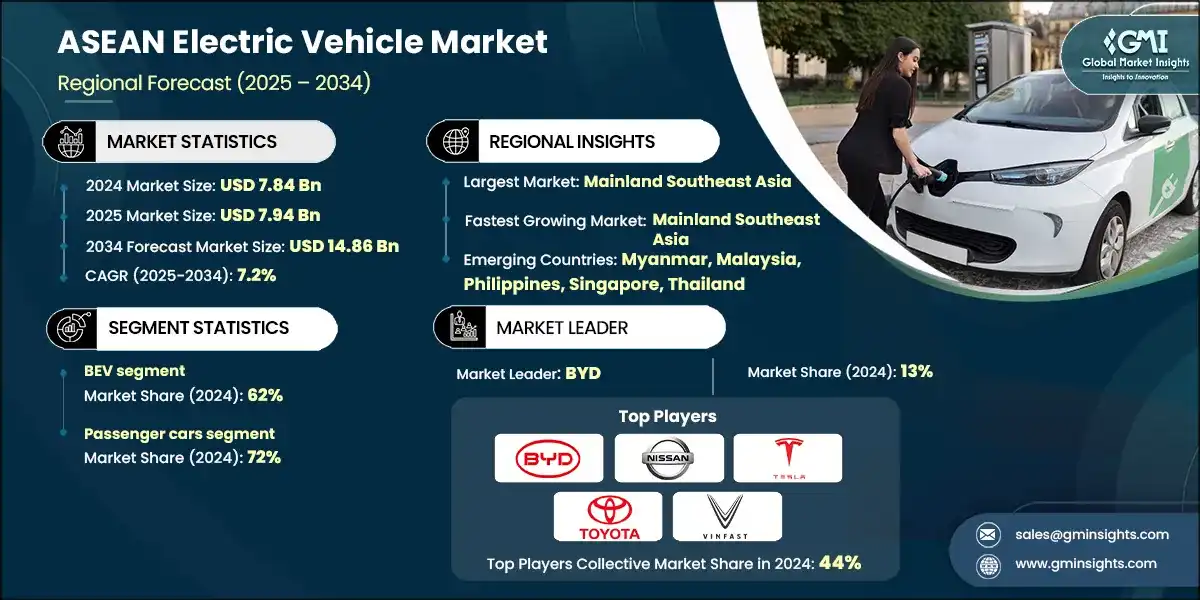
The ASEAN electric vehicle market was estimated at USD 7.84 billion in 2024. The market is expected to grow from USD 7.94 billion in 2025 to USD 14.86 billion in 2034, at a CAGR of 7.2%, according to latest report published by Global Market Insights Inc.
ASEAN Electric Vehicle Market Key Takeaways
Market Size & Growth
- 2024 Market Size: USD 7.84 Billion
- 2025 Market Size: USD 7.94 Billion
- 2034 Forecast Market Size: USD 14.86 Billion
- CAGR (2025–2034): 7.2%
Regional Dominance
- Largest Market: Mainland Southeast Asia
- Fastest Growing Region: Maritime Southeast Asia
Key Market Drivers
- Increase in government incentives & policy support.
- Surge in fuel prices & energy security concerns.
- Expansion of EV charging infrastructure.
- Rise in foreign direct investment & local manufacturing.
Challenges
- High upfront cost of EVs.
- Limited charging infrastructure in emerging markets.
Opportunity
- Increase in battery manufacturing potential.
- Surge in demand for electric two-wheelers & micro-mobility.
- Growth in smart city & green mobility initiatives.
- Rise in export-oriented EV production.
Key Players
- Market Leader: BYD led with over 13% market share in 2024.
- Leading Players: Top 5 players in this market include BYD, Nissan, Tesla, Toyota, VinFast, which collectively held a market share of 44% in 2024.
Get Market Insights & Growth Opportunities
- Rapid urbanization and population growth within the ASEAN region has increased the need to have sustainable mobility solutions. Statista indicates that EV sales in the region exceeded 124.46 thousand units in 2024, and the value is anticipated to increase by many times by 2030 as the governments will have tighter emission setups and will encourage net-zero motives. Moreover, the total EV vehicle unit sold in ASEAN country has exceeded more than 2 million units in 2024.
- In June 2025, Green & Smart Mobility (GSM) also Xanh SM supported by VinFast introduced the first all-electric taxi service in the Philippines, introducing a fleet of 2,500 VinFast Nerio Green EVs into Metro Manila. The program includes the use of apps to book the trip, set fares, trained so-called Green Ambassadors, and AI-facilitated safety, which indicates a significant movement toward the sustainable urban mobility within the area.
- The trend of energy diversification and decarbonization is forcing ASEAN countries to spend a lot of money on EV charging stations and renewable energy integration. Battery-swapping models and smart grid-enabled chargers in Indonesia, Thailand, and Singapore are opening the door to cost-effective, scalable EV deployments. Research indicates that by combining renewables and EV fleets, lifecycle carbon emissions can be reduced by up to 30% relative to charging fossil-based charging.
- The COVID-19 pandemic reshaped mobility demand patterns in ASEAN, with greater adoption of electric two-wheelers, delivery EVs, and shared fleets to support e-commerce and last-mile logistics. Regional have and operators have since prioritized AI-based fleet monitoring, predictive battery maintenance, and digital payment-enabled charging systems to strengthen resilience and cost efficiency.
- The heavy influx of EV manufacturing centers in Thailand, Indonesia, and Vietnam has solidified the necessity of high-tech battery supply chains. The manufacturing of nickel-based lithium-ion and solid-state batteries is hastening its investments that are backed by the fact that ASEAN has rich mineral deposits. As per the IEA estimates that EV costs will be lower by 15-20% across regional battery manufacturing over the next five years, leading to the spread of EV adoption.
- Thailand led the ASEAN EV market leader, driven by robust government policy that has included tax breaks, manufacturing subsidies, and the 30-30 policy (targeting 30% EVs of local production by 2030). Global players such as BYD, Toyota, and SAIC have made worthy investments in the country.
- Vietnam and Indonesia are becoming the most rapidly developing EV markets in the region. Vietnam is export-driving when Vietnam, VinFast is in the process of expanding its export and scaling domestic adoption but at the same time, Indonesia is using its vast nickel deposits to entice global players in the battery industry including LG Energy Solution and CATL. The ASEAN EV value chain is undergoing a shift to both markets as government subsidies, local partnership, and growing consumer acceptance support the theory.
To get key market trends
ASEAN Electric Vehicle Market Trends
- The EV growth of ASEAN is being driven by battery manufacturing. Investments in lithium-ion and solid-state battery manufacturing have gone very high in countries such as Indonesia, Thailand and Vietnam, where local gigafactories and collaborations obtained cells in the supply chain. Such facilities minimize dependency on imports, reduce supply chains and meet government incentives of localization. The connection between the sourcing of regional raw materials and modern technologies during production is making EVs more affordable, contributing to local labor markets, and increasing the rapidity of a widespread transition to electric mobility in ASEAN.
- The ASEAN EV ecosystems are changing due to digital technologies. Auto makers and fleet operators are using AI, IoT and telematics in cars to measure battery health, anticipate maintenance requirements and utilize energy in the most optimal manner. The software platforms that are AI-enabled enhance the efficiency of the charging process, predict the demand, and minimize the amount of time that the vendors are out of commission. These innovations make EVs smart and connected assets that facilitate smart fleet management, urban mobility planning, and sustainable energy management on the regional level.
- The charging infrastructure and modular energy platforms are becoming prioritized. Public-fast chargers, depot charging buses and two/three-wheelers with modular battery-swapping are being invested into by governments and private companies. These scalable and service-based solutions enable nations to break gridlocks, speed up the adoption and offer scalable options to both urban commuters and logistics fleets.
- For example, in July 2025, CATL announce the commencement of its Indonesian battery plant, intended to provide localized and high-capacity cells to Southeast Asian manufacturers. High technology recycling and modular pack assembly are incorporated into the facility, and this makes Asia a leader in both sustainable supplying and deploying models.
ASEAN Electric Vehicle Market Analysis
Learn more about the key segments shaping this market
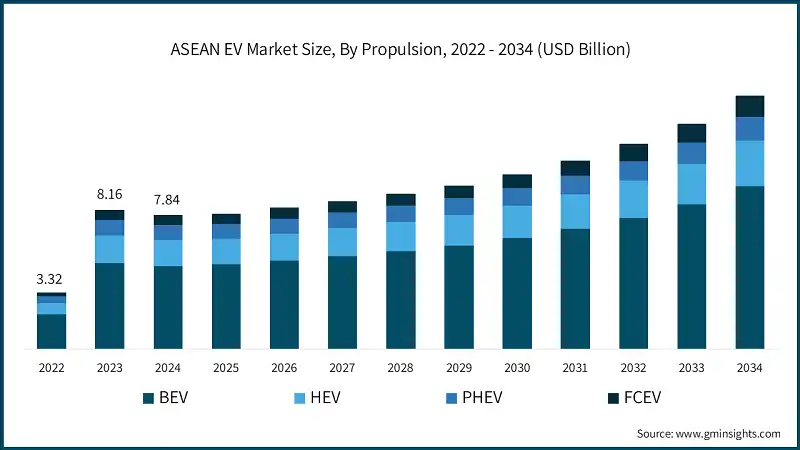
Based on propulsion, the ASEAN electric vehicle market is divided into BEV, HEV, PHEV, and FCEV. The BEV segment accounted for around 62% in 2024 and is expected to grow at a CAGR of 7.6% through 2025 to 2034.
- The popularity of BEVs in ASEAN is motivated by low costs, growing supply, and high policy inducement in major regional markets. The governments of the region such as Thailand, Indonesia, and Singapore have implemented subsidies, tax breaks, and infrastructural development initiatives to speed up the adoption of BEVs. The charging network is growing dramatically, with lowered prices on lithium-ion batteries, BEVs have become a more viable and cost-effective option to the consumer and fleet operators.
- Moreover, major automakers such as BYD, VinFast, and Great Wall Motor are in the process of localizing BEV production to guarantee competitive prices and expanded access to the products. Cities with high air pollution consider BEVs as a short-term measure to reduce emissions and are therefore the most appealing ones when it comes to personal transport and large-scale fleets.
- For example, in August 2025, BYD declared it had intended to set up a CKD assembly facility in Tanjung Malim, Malaysia, which would start in 2026. This investment does not only strengthen BYD as the leading brand in terms of sales of the EVs in Malaysia but also emphasizes its intentions to expand affordable BEV manufacturing in the ASEAN countries.
- The fuel cell electric vehicle (FCEV) segment will experience the strongest CAGR of over 9%, as more people show interest in hydrogen mobility solutions in heavy-duty and long-haul purposes. Malaysia and Singapore are among the countries that are strongly investing into hydrogen infrastructure, pilot bus fleets, and clean energy hubs, which ranks FCEVs as a viable option in logistics, in public transport, and in cross-border operations.
Learn more about the key segments shaping this market
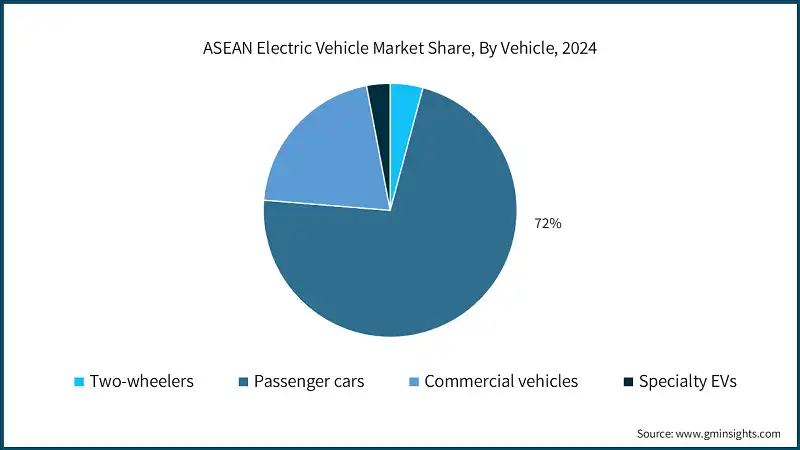
Based on vehicle, the ASEAN electric vehicle market is segmented into two-wheelers, passenger cars, commercial vehicles, and specialty EVs. The passenger cars segment dominates the market with 72% share in 2024, and the segment is expected to grow at a CAGR of over 7% from 2025 to 2034.
- Passenger cars dominate the ASEAN EV market, as growing middle-income, urbanization and favorable government policy will push the demand to affordable and environmentally friendly mobility options. Companies like BYD, VinFast, and Great Wall Motor are launching compact and mid-sized BEVs adapted to the city-based commuting habits of ASEAN with incentives and lower registration costs in Thailand, Indonesia, and Vietnam.
- Additionally, in ASEAN, the booming growth of EVs in the private sector is facilitated by escalating fuel costs, the growing environmental consciousness, and access to affordable models. For example, in the Indonesia International Motor Show (IIMS) 2025, Wuling recorded 1,653 vehicle bookings, 464 of which were on the Air EV, indicating its popularity among urban customers who favor practical and affordable electric cars.
- Government subsidies and the growth of charging systems also contribute to this process, and the financing mechanisms and charging packages provided by automakers such as Wuling make EV accessible to households and urban citizens in megacities and in the second cities.
- Two-wheeler segments are expanding at a high rate due to the need to have affordable and efficient movements in the cities that are densely populated. E-scooters and e-motorcycles with brand names such as Gogoro, VinFast, and Honda are common in the last-mile delivery sector, as well as in ride-hailing and personal transportation, where battery-swapping infrastructure has been established in places, such as Taiwan, Indonesia, and the Philippines.
- Electric commercial vehicles continue to experience a surge with logistics and fleet operators switching to clean energy solutions. Electric vans, trucks, and buses are also being piloted in ASEAN by companies such as Mitsubishi Fuso eCanter and BYD eBuses that are being used in Singapore, Thailand, and Malaysia. Fleet electrification is supported by ESG targets, rising fuel costs, and government incentives for sustainable transport.
Based on drivetrain, the market is segmented into front-wheel drive, rear-wheel drive, and all-wheel drive. The front-wheel drive segment is expected to dominate the market.
- The front-wheel drive (FWD) dominates the ASEAN EV market, as they offer a balanced mix of performance, efficiency, and affordability in urban and suburban driving environments. FWD layouts are lighter, easier to manufacture, and need fewer parts compared to rear or all-wheel drive systems, lowering the cost of manufacturing and enhancing energy efficiency. That is why they are especially appealing to cost-effective buyers and fleet owners who want to find their vehicles reliable with low maintenance.
- Moreover, FWD cars have predictable handling, improved space efficiency, and increased safety during wet or congested road-going situations that are typical of the ASEAN cities. Companies such as BYD, VinFast, and Wuling also focus on FWD-based compact and mid-size EVs and in this way they can provide practical and can offer high range vehicles at affordable prices that enhance their position of dominance in regional EV markets.
- In February 2025, Wuling officially introduced the New Air EV in Indonesia at the Indonesia International Motor Show, with variants of 200 km and 300 km. It is affordable at a competitive price, and it targets urban commuters with a need to find affordable EVs.
- The ASEAN EV market segment in the Rear-Wheel Drive (RWD) has high potential to grow quickly because of its better handling, superior weight distribution, and greater performance than the FWD models. Sports EV, high torque, and luxury are some examples of RWD. This growth is being fueled by increased demand of high-end EVs and performance-focused models by car manufacturers such as BYD, VinFast, and Great Wall Motor.
Based on battery, the market is segmented into sealed lead acid, nickel metal hydride (NIMH), and lithium ion. The sealed lead acid segment is expected to dominate the market.
- The lithium-ion batteries segment represents the largest share in the ASEAN EV market due to its superior energy density, lightweight design, and long cycle life, which collectively improves driving range and vehicle efficiency. Lithium-ion cells enable automakers to design small, high-performance EVs that could be used in urban commutes and long-range travel compared to the Sealed Lead Acid and Nickel Metal Hydride batteries. The decline in prices of batteries, because of the scale-ups in production in the global set-up and the technology, ensure that lithium-ion-powered EVs are now more affordable to consumers and fleet owners in the region.
- Moreover, lithium-ion can be charged rapidly and easily combined with high-tech battery management systems (BMS), improving safety and efficacy. Asian giants in the electric vehicles industry such as BYD, VinFast and Wuling are basing their passenger cars, two-wheelers and commercial EVs on lithium-ion technology. The introduction of lithium-ion-powered EVs in the ASEAN market is strengthened by government incentives, infrastructure development, and growing consumer awareness of sustainable mobility.
- In July 2024, Hyundai Motor Group and LG Energy Solution opened the first EV battery cell factory in Indonesia, with 10 GWh capacity per year. It is an investment of 1.1 billion dollars, which highlights the increasing significance of lithium-ion batteries within the EV ecosystem of the region.
- Further, the Sealed Lead Acid (SLA) battery segment will see a soaring surge in the ASEAN EV market owing to its affordability, trustworthiness and ease. SLA batteries have been popular in the entry-level electric bikes, small utility vehicles, and local EV fleets. The expansion of this segment is caused by increasing the need to have affordable EV solutions in urban and semi-urban regions.
Looking for region specific data?
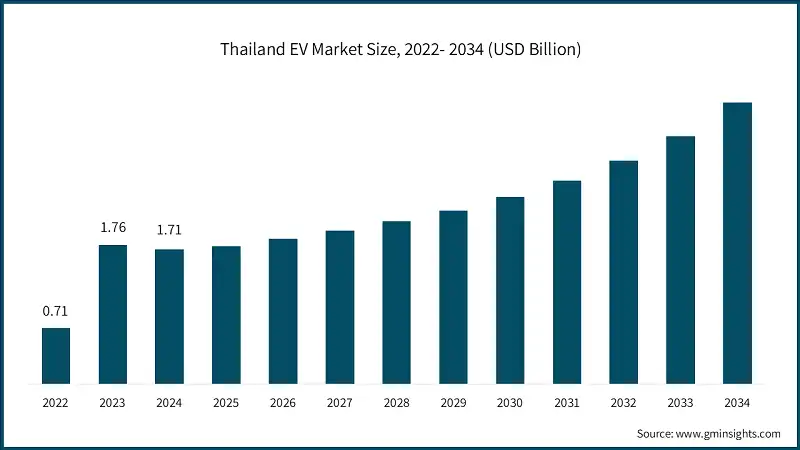
Thailand dominated the EV market in Mainland Southeast Asia with around 48% share and generated USD 1.71 billion revenue in 2024.
- Thailand dominates the ASEAN market due to strong government support, robust automotive manufacturing capacity, and favorable policies. The government’s EV 3.0 and EV 3.5 schemes provide tax incentives, subsidies, and import duty reductions to encourage both manufacturers and consumers. This proactive stance has attracted global EV players to set up production bases, boosting local assembly, battery manufacturing, and supply chain development.
- In addition, Thailand’s well-established automotive ecosystem gives it a competitive edge. With decades of experience as a regional hub for vehicle exports, it offers skilled labor, supplier networks, and advanced logistics infrastructure. Coupled with rapid expansion of charging stations and growing domestic demand, Thailand positions itself as the leading hub for EV adoption and production in ASEAN.
- For example, Thailand is rapidly building EV infrastructure to support adoption. By March 2025, there were over 3,700 public charging stations offering 11,600 connectors, including more than 6,000 fast (DC) chargers.
- Vietnam is emerging as a fast-growing EV market in Mainland Southeast Asia due to strong government policies, rising middle-class demand, and rapid infrastructure development. The government has introduced tax incentives, reduced registration fees, and prioritized EV adoption in public transport fleets, creating a favorable environment for both consumers and manufacturers. These supportive policies have accelerated the shift toward electric mobility across urban centers.
Indonesia dominated the EV market in Maritime Southeast Asia with around 49% share in 2024.
- Indonesia dominates the ASEAN market largely because of its abundant nickel reserves, a critical raw material for EV batteries. By leveraging this resource, the government has positioned the country as a regional hub for battery manufacturing and EV production. Strategic policies, such as export bans on raw nickel and incentives for downstream processing, have attracted global automakers and battery producers to invest in local facilities, strengthening Indonesia’s EV supply chain.
- In addition, Indonesia’s large domestic market and proactive government initiatives drive adoption. Policies like tax breaks, reduced import duties, and investment incentives support both producers and consumers. Rapid development of charging infrastructure, coupled with partnerships in public transportation electrification, further accelerates growth, making Indonesia a key driver of ASEAN’s EV future.
- For example, in May 2025, the government pledged stronger incentives for EV producers fulfilling higher domestic component levels (TKDN), encouraging localization and scaling of manufacturing.
- Singapore is the fastest-growing EV market in ASEAN because of its strong policy framework and advanced infrastructure readiness. The government’s Green Plan 2030 mandates phasing out internal combustion vehicles by 2040 and offers attractive incentives such as rebates under the Vehicular Emissions Scheme (VES) and EV Early Adoption Incentive (EEAI). These policies make EV ownership more cost-competitive while ensuring alignment with Singapore’s broader sustainability goals.
- Additionally, Singapore’s compact size and advanced urban planning support rapid EV adoption. The government is rolling out 60,000 charging points by 2030, with both public and private sector collaboration accelerating installations.
ASEAN Electric Vehicle Market Share
- The top 7 companies in the ASEAN EV industry are BYD, Tesla, Toyota, VinFast, Honda, Nissan, and Bosch, contributed around 48% of the market in 2024.
- BYD focuses on local assembly and CKD plants to reduce costs and increase accessibility. It emphasizes affordable, mass-market EVs, expands charging infrastructure partnerships, and offers battery leasing options. BYD also integrates connected vehicle technologies and leverages government incentives to accelerate adoption across metropolitan and secondary cities in ASEAN.
- Tesla relies on premium EV positioning, emphasizing high-performance, long-range electric vehicles. The strategy includes leveraging digital sales channels, supercharger network expansion, and over-the-air software updates. Tesla engages with local policymakers to align with incentives while building brand awareness through sustainable mobility campaigns and selective market entry in high-demand urban centers.
- Toyota focuses on hybrid and hydrogen-based EV solutions initially, gradually introducing full BEVs. Its strategy includes leveraging strong dealership networks, promoting hybrid EV adoption to address infrastructure limitations, and partnering with governments to meet regulatory standards. Toyota emphasizes reliability, fuel efficiency, and localized production to appeal to cost-conscious ASEAN consumers.
- VinFast emphasizes regional manufacturing, affordable entry-level EVs, and quick localization of production to ASEAN markets. The strategy includes aggressive marketing campaigns, financing schemes, battery leasing models, and collaboration with local governments to expand charging networks and build brand trust in emerging EV markets.
- Honda’s ASEAN strategy focuses on hybrid EVs and small BEVs initially, targeting urban commuters. It leverages existing dealership networks, invests in battery and charging infrastructure partnerships, and promotes affordable mobility solutions. Honda integrates smart connectivity and efficient performance to gain traction among environmentally conscious consumers in metropolitan and secondary cities.
- Nissan emphasizes affordable BEVs and hybrid models with a focus on urban mobility. Its strategy includes local assembly, battery leasing, and investment in charging infrastructure. Nissan also promotes connected services, government-aligned incentive utilization, and awareness campaigns to strengthen consumer trust and increase adoption in ASEAN countries.
- Bosch focuses on supplying EV components, battery management systems, and charging infrastructure solutions to OEMs in ASEAN. Its strategy includes partnerships with automakers, smart mobility integration, and local R&D initiatives to support EV adoption. Bosch aims to strengthen its ecosystem presence through connected vehicle technologies, predictive maintenance, and sustainable mobility solutions.
ASEAN Electric Vehicle Market Companies
Major players operating in the ASEAN EV industry are:
- BMW
- Audi
- Bosch
- BYD
- Honda
- Hyundai
- Nissan
- Tesla
- Toyota
- VinFast
- Most EV players in ASEAN prioritize local production and assembly to reduce costs, minimize import duties, and cater to regional price-sensitive consumers. By establishing local manufacturing hubs and partnerships with suppliers, companies aim to provide affordable EV options while ensuring faster delivery and service networks. This strategy helps overcome price barriers, promotes regional employment, and strengthens supply chain resilience.
- A key market strategy is investing in charging infrastructure, battery swapping stations, and digital ecosystem solutions to enhance convenience and accessibility for consumers. Companies support governments in expanding public and private charging networks while integrating connected services such as fleet management, predictive maintenance, and mobile apps. This approach improves adoption rates by addressing range anxiety and fostering a seamless user experience across metropolitan and secondary cities.
- Companies actively leverage and align with regional government incentives, including tax reductions, subsidies, and EV-friendly regulations, to boost sales and market penetration. Strategic engagement with policymakers ensures compliance with local standards while influencing policy developments that favor electric mobility. This proactive approach not only enhances affordability for consumers but also positions EV players to scale operations quickly, accelerate adoption, and strengthen their competitive advantage in ASEAN markets.
ASEAN Electric Vehicle Market Report Attributes
| Key Takeaway | Details |
|---|---|
| Market Size & Growth | |
| Base Year | 2024 |
| Market Size in 2024 | USD 7.84 Billion |
| Market Size in 2025 | USD 7.94 Billion |
| Forecast Period 2025 - 2034 CAGR | 7.2% |
| Market Size in 2034 | USD 14.86 Billion |
| Key Market Trends | |
| Drivers | Impact |
| Increase in government incentives & policy support | ASEAN governments are offering subsidies, tax exemptions, and investment incentives to accelerate EV adoption. Policies such as Thailand’s EV roadmap and Indonesia’s battery supply push are boosting OEM entry, charging infrastructure growth, and consumer confidence. |
| Surge in fuel prices & energy security concerns | Rising fossil fuel prices and reliance on imports are driving ASEAN economies to diversify towards EV adoption. EVs reduce exposure to oil price volatility, supporting energy security, sustainable mobility, and long-term economic resilience in the region. |
| Expansion of EV charging infrastructure | The rollout of fast-charging networks across urban hubs, highways, and smart cities is improving EV adoption rates. Partnerships between governments, utilities, and private players are bridging infrastructure gaps, enhancing accessibility, and enabling mass electrification across ASEAN. |
| Rise in foreign direct investment & local manufacturing | FDI from global OEMs and battery leaders is transforming ASEAN into an EV production hub. Manufacturing plants in Thailand, Indonesia, and Vietnam strengthen supply chains, lower costs, and create jobs while boosting regional competitiveness in electrification. |
| Pitfalls & Challenges | Impact |
| High upfront cost of EVs | Despite incentives, EVs remain costlier than ICE vehicles due to battery prices and import duties. This limits adoption among price-sensitive ASEAN consumers, especially in emerging markets where affordability strongly influences vehicle purchase decisions. |
| Limited charging infrastructure in emerging markets | Major cities are progressing, rural and secondary ASEAN markets lack adequate charging coverage. Insufficient infrastructure creates range anxiety, slows adoption, and requires significant investment to ensure equitable access across all regions. |
| Opportunities: | Impact |
| Increase in battery manufacturing potential | Abundant nickel and cobalt resources in Indonesia and the Philippines position ASEAN as a global EV battery hub. Regional investment in gigafactories and supply chain localization will reduce dependency on imports and enhance cost competitiveness. |
| Surge in demand for electric two-wheelers & micro-mobility | ASEAN’s dense urban environments and reliance on scooters make two-wheelers the fastest-growing EV segment. Startups and OEMs are launching affordable e-motorcycles and battery-swapping ecosystems, accelerating electrification in daily commutes and last-mile delivery. |
| Growth in smart city & green mobility initiatives | Government-backed smart city projects across ASEAN are integrating EVs into sustainable transport ecosystems. EV buses, shared fleets, and green corridors are being prioritized to reduce emissions and improve urban mobility in megacities. |
| Rise in export-oriented EV production | ASEAN is emerging as a global EV export hub, with Thailand and Vietnam targeting international markets. Competitive labor costs, localized supply chains, and strong OEM investments position the region to capture global EV demand growth. |
| Market Leaders (2024) | |
| Market Leaders |
13% market share |
| Top Players |
Collective Market Share in 2024 is 44% |
| Competitive Edge |
|
| Regional Insights | |
| Largest Market | Mainland Southeast Asia |
| Fastest growing market | Maritime Southeast Asia |
| Emerging countries | Myanmar, Malaysia, Philippines, Singapore, Thailand |
| Future outlook |
|
What are the growth opportunities in this market?
ASEAN Electric Vehicle Industry News
- In January 2025, VinFast launched its first fully electric car models in Thailand, marking a strategic step to expand its ASEAN presence. Leveraging Thailand’s status as a regional EV hub, the move highlights VinFast’s ambition to compete with global OEMs, tap rising demand, and strengthen its regional brand visibility.
- In December 2024, BYD introduced its electric vehicles in Thailand, highlighting the launch of the Atto 3 SUV. This move reinforced BYD’s competitive push in ASEAN’s leading EV hub, capitalizing on Thailand’s strong EV roadmap, government incentives, and growing consumer demand for affordable yet advanced electric mobility solutions.
- In November 2024, Tesla signed an agreement with Thailand to establish a local assembly facility. The project reflects Tesla’s commitment to scaling EV production in Southeast Asia, leveraging Thailand’s automotive ecosystem, supply chain strengths, and policy support to expand accessibility and reinforce its global leadership in electrification.
- In August 2024, Hyundai, the South Korean automotive major, announced a USD 28 million investment in a new production facility in Thailand dedicated to electric vehicle (EV) and battery assembly. Strategically located southeast of Bangkok, the plant is scheduled to begin operations in 2026, strengthening Thailand’s position as a regional EV hub.
- In March 2024, SVOLT Energy, a leading Chinese battery manufacturer, commenced mass production of EV battery packs at its newly launched facility in Si Racha, Chonburi province, Thailand. With an annual capacity of around 60,000 modules and packs, the plant will supply batteries for new energy vehicles (NEVs) produced by Horizon New Energy Automobile (Neta Auto) and Great Wall Motor’s brands including Ora, Tank, and Haval assembled locally in Thailand.
The ASEAN electric vehicle market research report includes in-depth coverage of the industry with estimates & forecasts in terms of revenue ($Bn) and shipments (Units) from 2021 to 2034, for the following segments:
Market, By Propulsion
- BEV
- HEV
- PHEV
- FCEV
Market, By Vehicle
- Two-wheelers
- Electric scooters
- E-bikes
- Electric mopeds
- Passenger cars
- Sedan
- SUV
- Hatchback
- Commercial vehicles
- Light
- Medium
- Heavy
- Specialty EVs
- Off-road EVs
- Golf carts
- Utility EVs
Market, By Drivetrain
- Front-wheel drive
- Rear-wheel drive
- All-wheel drive
Market, By Battery
- Sealed lead acid
- Nickel metal hydride (NiMH)
- Lithium Ion
Market, By Kilometer Range
- Less than 100 km
- 100 km to 200 km
- 200 km to 300 km
- Above 300 km
Market, By Price Range
- Below USD 10,000
- USD 10,000 to USD 30,000
- USD 30,000 to USD 50,000
- Above USD 50,000
Market, By End Use
- Personal
- Commercial
- Ride-sharing & ride-hailing
- Logistics & delivery
- Corporate fleets
- Government
- Public transportation
- Utility fleets
- Law enforcement
- Private
- Universities
- Industrial campuses
The above information is provided for the following regions and countries:
- Mainland Southeast Asia
- Cambodia
- Laos
- Myanmar
- Thailand
- Vietnam
- Maritime Southeast
- Brunei Darussalam
- Indonesia
- Malaysia
- Philippines
- Singapore
Frequently Asked Question(FAQ) :
What was the market size of the ASEAN electric vehicle in 2024?
The market size was USD 7.84 billion in 2024, with a CAGR of 7.2% expected through 2034. Rapid urbanization, population growth, and the demand for sustainable mobility solutions are driving market growth.
What is the projected value of the ASEAN electric vehicle market by 2034?
The market is poised to reach USD 14.86 billion by 2034, driven by advancements in battery manufacturing, digital technologies, and government incentives for EV adoption.
What is the expected size of the ASEAN electric vehicle market in 2025?
The market size is projected to reach USD 7.94 billion in 2025.
What was the market share of the BEV segment in 2024?
The BEV segment accounted for approximately 62% of the market in 2024 and is set to witness 7.6% CAGR till 2034.
What is the growth outlook for the passenger cars segment from 2025 to 2034?
The passenger cars segment, which held a 72% market share in 2024, is anticipated to expand at a CAGR of over 7% up to 2034.
Which country dominated the ASEAN electric vehicle sector?
Thailand led the ASEAN market in 2024, capturing approximately 48% of the market share and generating USD 1.71 billion in revenue.
What are the key trends in the ASEAN electric vehicle market?
Key trends include localized battery manufacturing, AI-driven fleet management, expanded charging infrastructure, and advanced recycling-enabled production facilities.
Who are the key players in the ASEAN electric vehicle industry?
Key players include BMW, Audi, Bosch, BYD, Honda, Hyundai, Nissan, Tesla, Toyota, and VinFast.
ASEAN Electric Vehicle Market Scope
Related Reports