Summary
Table of Content

Artisanal Ice Cream Market
Get a free sample of this report
Form submitted successfully!
Error submitting form. Please try again.
Thank you!
Your inquiry has been received. Our team will reach out to you with the required details via email. To ensure that you don't miss their response, kindly remember to check your spam folder as well!
Request Sectional Data
Thank you!
Your inquiry has been received. Our team will reach out to you with the required details via email. To ensure that you don't miss their response, kindly remember to check your spam folder as well!
Form submitted successfully!
Error submitting form. Please try again.
Artisanal Ice Cream Market Size
- The market growth is due to rising customer desire for high-quality, handcrafted, and natural food items. Artisanal ice cream uses only fresh local ingredients which makers select with care while they avoid using both artificial elements and preservatives. Health-conscious consumers prefer natural and authentic ingredients because they want to consume unprocessed food items which meet their dietary needs. The artisanal ice cream market benefits from consumer demand for personalized ice cream products. Customers may customize their ice cream experience by selecting from a wide variety of vegan and dairy-free alternatives, mix-ins, and toppings at many artisanal ice cream shops and brands. The solution enables users to meet multiple dietary restrictions and different food preferences.
- The high cost of manufacture is a key restriction to the artisanal ice cream market's revenue growth. Artisanal ice cream uses high-quality natural components which the company considers its primary strength. The expense of these premium ingredients increases when products originate from local facilities or environmentally friendly supply chains. The company uses quality materials to attract customers, but this approach results in increased production expenses. The production process of artisanal ice cream requires smaller batches to maintain product quality and taste consistency. Small-scale production methods become more expensive than those used by large ice cream manufacturers who operate mass production facilities. The process requires equipment which needs specific skills to operate and demands more time-consuming work leading to increased expenditures.
The global artisanal ice cream market was valued at USD 8.9 billion in 2025. The market is expected to grow from USD 9.7 billion in 2026 to USD 18.7 billion in 2035, at a CAGR of 7.6% according to latest report published by Global Market Insights Inc.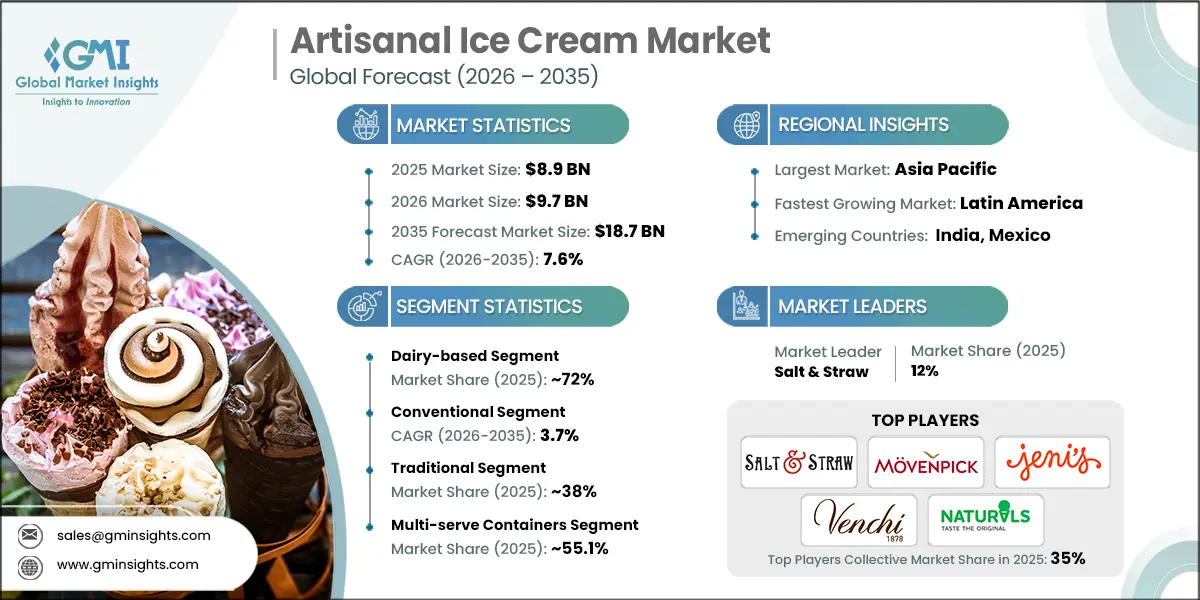
Artisanal Ice Cream Market Key Takeaways
Market Size & Growth
- 2025 Market Size: USD 8.9 Billion
- 2026 Market Size: USD 9.7 Billion
- 2035 Forecast Market Size: USD 18.7 Billion
- CAGR (2026–2035): 7.6%
Regional Dominance
- Largest Market: Asia Pacific
- Fastest Growing Region: Latin America
Key Market Drivers
- Rising consumer demand for premium & authentic experiences.
- Growing health consciousness & clean label preferences.
- Expanding plant-based & dietary alternative adoption.
Challenges
- High production costs & ingredient price volatility.
- Limited distribution infrastructure & cold chain complexity.
Opportunity
- Expansion into emerging markets with growing middle class.
- Innovation in functional & fortified ice cream.
Key Players
- Market Leader: Salt & Straw led with over 12% market share in 2025.
- Leading Players: Top 5 players in this market include Salt & Straw, Mövenpick, Jeni's Splendid Ice Creams, Venchi (gelato), Natural Ice Cream, which collectively held a market share of 35% in 2025.
Get Market Insights & Growth Opportunities
To get key market trends
Artisanal Ice Cream Market Trends
- The market for artisanal ice cream has evolved from niche status to become a premium lifestyle product which customers perceive through its authentic design and skilled production and its value as an exclusive consumer experience. Brands are establishing themselves through clean label products, sustainable sourcing practices, and local ingredient origins which help them meet new customer demands for sustainability and transparent business operations. The current trend change makes artisanal ice cream products more suitable for serious consumption because they now serve as special food items that fulfill specific customer needs in the premium food market.
- The process of product innovation through new production methods and distribution approaches brings about major changes which impact their competitive stance within the entire product range. The producers use natural components and plant-based substitutes together with functional product developments and texture improvement techniques to maintain their artisanal production standards. The combination of flexible production systems and local material sourcing and environmentally friendly waste management methods enables organizations to achieve better operational performance while maintaining their profit margins and environmental sustainability goals.
- The value of artisanal ice cream has evolved into a key strategic asset which companies use to create brand identities through customer experience programs. The combination of limited edition products and flavor storytelling and personalized experiences and direct consumer communication channels works to create customer loyalty which enables businesses to set higher product prices.
Artisanal Ice Cream Market Analysis
Learn more about the key segments shaping this market
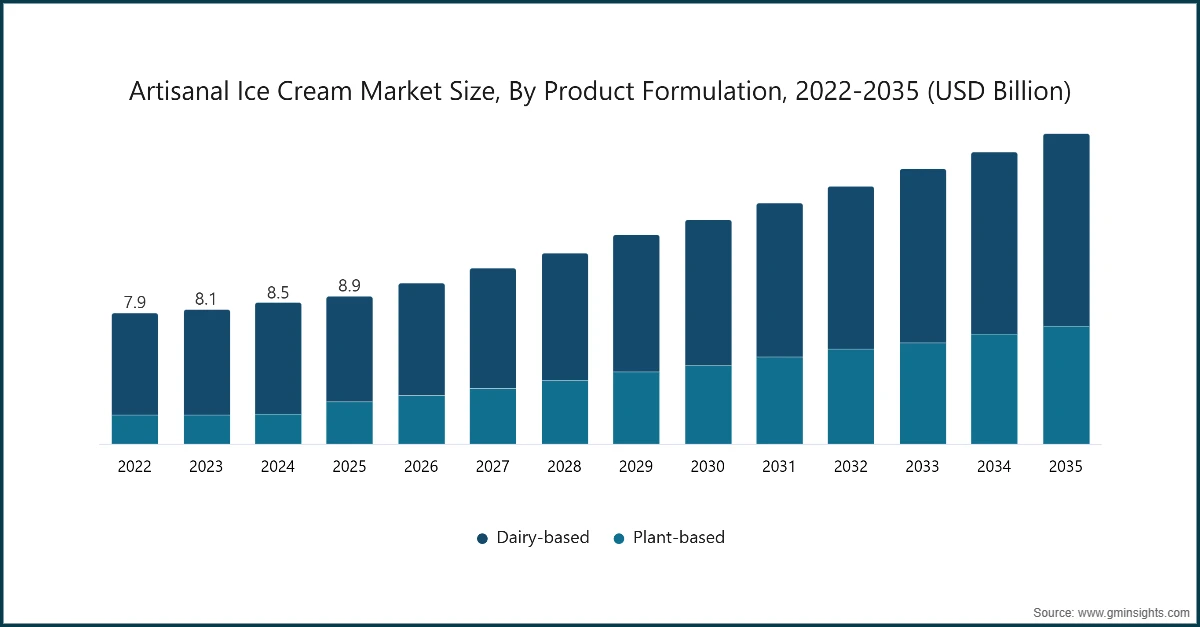
Based on product formulation, the market is segmented into dairy-based, plant-based. Dairy-based dominated the market with an approximate market share of 72% in 2025 and is expected to grow with a CAGR of 6.1% by 2035.
- The worldwide market divides into two product categories based on its formulations which include dairy-based and plant-based products but dairy-based offerings remain the most prevalent. The dairy-based artisanal ice cream market maintains its top position because it delivers better taste and texture and genuine flavor than other products which makes it popular among premium customers who prefer traditional craft ice cream in established markets. Plant-based artisanal ice cream has developed into a vital business component because its existence responds to changing consumer dietary needs and increasing interest in non-traditional dessert choices.
Learn more about the key segments shaping this market
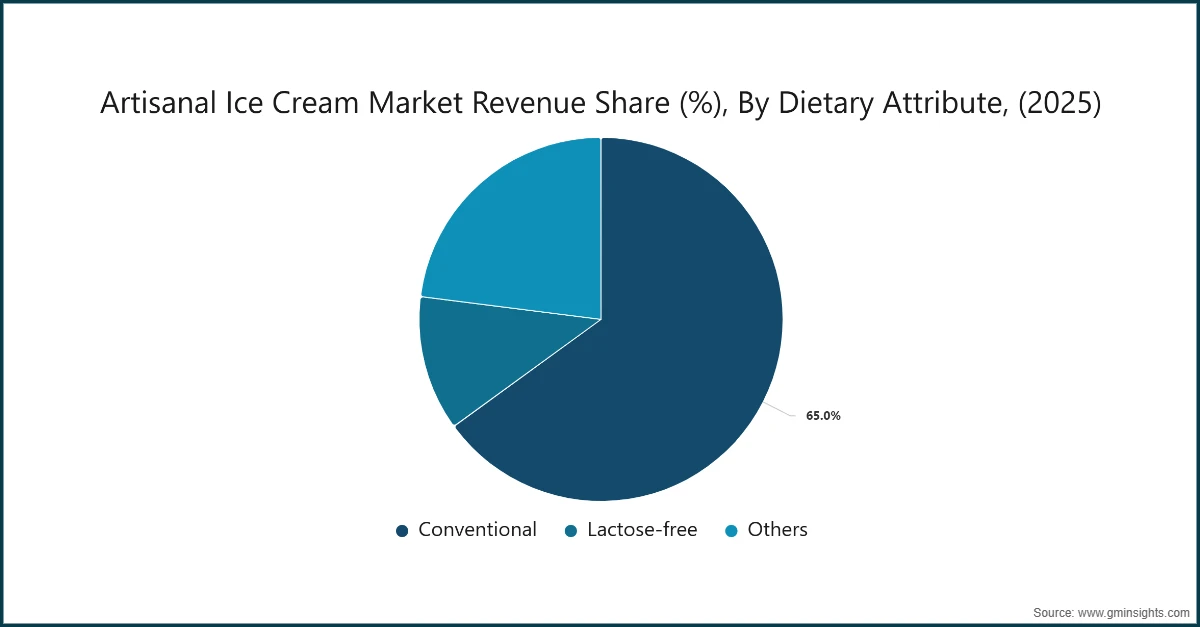
Based on dietary attribute, the Artisanal Ice Cream market is segmented into conventional, lactose-free, others. Conventional held the largest market share of 65% in 2025 and is expected to grow at a CAGR of 3.7% during 2026-2035.
- The primary revenue source for worldwide artisanal producers comes from conventional artisanal ice cream which maintains its market lead because consumers prefer traditional taste and rich dairy flavors and they know the product.
- The category gains new customers through lactose-free products and other specialty items which also create new market opportunities for future business expansion. The product lineup contains both traditional items and contemporary offerings which help brands reach health-focused and niche markets through their portfolio expansion, while traditional products maintain brand heritage and high-end market status.
Based on flavor, the market is segmented into traditional, fruits & nuts, exotic & seasonal, others. Traditional segment dominated the market with an approximate market share of 38% in 2025 and is expected to grow with the CAGR of 5.6% by 2035.
- The global artisanal ice cream market divides into four segments according to flavor, which include traditional flavors, fruits & nuts, exotic & seasonal flavors and other specialty flavors, yet traditional flavors maintain market leadership. The classic flavors drive artisanal portfolios because they include vanilla and chocolate together with traditional regional recipes, which customers recognize and demand, thus enabling artisans to demonstrate their craft through exceptional ingredient quality and texture skills. The fruits & nuts and exotic & seasonal flavors maintain not only their critical function for brand differentiation but also their capacity to create brand connections with customers throughout the market.
Based on packaging format, the market is segmented into single-serve, multi-serve containers, bulk / foodservice. Multi-serve containers segment dominated the market with an approximate market share of 55.1% in 2025 and is expected to grow with the CAGR of 7.1% by 2035.
- Multi-serve packaging benefits from strong household consumption patterns and repeat usage occasions and its balance between premium positioning and everyday indulgence which makes it the most commercially scalable format for artisanal brands. Single-serve packages and bulk/foodservice formats work together to improve brand visibility while expanding distribution channels. The global artisanal ice cream market sees multi-serve containers as the main factor which creates brand loyalty and leads to home consumption because they drive most volume sales.
Based on distribution channel, the market is segmented into supermarkets & hypermarkets, specialty stores, online retail, foodservice & hospitality, convenience stores, others. Specialty stores dominated the market with an approximate market share of 35.1% in 2025 and is expected to grow with the CAGR of 6.4% by 2035.
- The specialty store sector leads its market because it enables artisanal producers to maintain their craftsmanship standards through its curated product selection and brand storytelling and its experiential brand engagement activities. The market uses various distribution channels which work together to increase product visibility while making it more accessible to customers. Supermarkets and hypermarkets support broader reach, online retail enables direct‑to‑consumer engagement and niche discovery, and foodservice channels strengthen brand presence through cafés, restaurants, and premium hospitality formats; however, specialty stores remain the core channel driving brand equity, consumer trust, and differentiated positioning in the market.
Looking for region specific data?
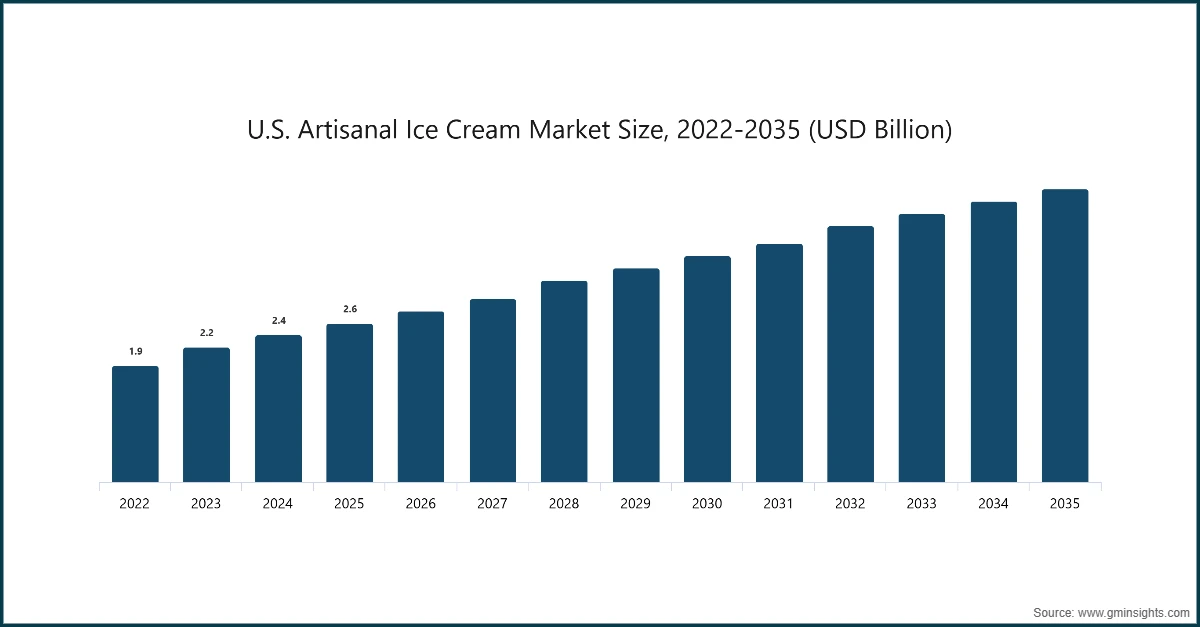
The North artisanal ice cream industry is growing rapidly on the global level with a market share of 30.3% in 2025.
- North America represents a mature and innovation‑driven market for artisanal ice cream, supported by strong consumer appetite for premium, clean‑label, and locally crafted products. The region establishes an environment that enables artisanal businesses to grow their operations because it contains both operational cold-chain systems and people who recognize their brand and have a strong preference for trying different food experiences.
U.S. dominates the North America artisanal ice cream market, showcasing strong growth potential.
- The United States remains the primary growth engine within North America because its consumers now prefer gourmet ice cream and health‑conscious ice cream and plant‑based ice cream.
Europe artisanal ice cream industry is growing in the industry with revenue of USD 2.6 billion in 2025 and is anticipated to show lucrative growth over the forecast period.
- The artisanal ice cream market in Europe exists under the influence of traditional cooking practices and rigorous food safety regulations and required standards of product origin verification. Steady demand exists because consumers choose natural ingredients and traditional recipes and environmentally friendly product sourcing.
The Asia Pacific artisanal ice cream market is anticipated to grow at a CAGR of 8.6% during the analysis timeframe.
- The Asia Pacific region has become the most rapidly expanding area for artisanal ice cream because urbanization combined with rising disposable incomes and increasing access to high-end Western dining experiences.
Latin America artisanal ice cream accounted for 4.8% market share in 2025 and is anticipated to show highest growth over the forecast period.
- Latin America shows strong potential for market expansion because its young consumers and growing middle class and rising demand for premium desserts which have unique flavors.
Middle East & Africa artisanal ice cream is anticipated to show lucrative growth over the forecast period.
- The Middle East & Africa market experiences slow development which shows potential for future growth because urban centers grow and people choose premium dining options and hospitality services expand together with tourism.
Artisanal Ice Cream Market Share
The top 5 companies in Artisanal Ice Cream industry include Salt & Straw, Mövenpick, Jeni's Splendid Ice Creams, Venchi (gelato), Natural Ice Cream. These are prominent companies operating in their respective regions covering approximately 35% of the market share in 2025. These companies hold strong positions due to their extensive experience in artisanal ice cream market. Their diverse product portfolios, backed by robust production capabilities and distribution networks, enable them to meet the rising demand across various regions.
- Salt & Straw creates unique flavors through its partnerships with local producers. The company practices ingredient disclosure through seasonal ingredient collection while using culinary experimentation to develop its product line. The company provides traditional ice cream bases together with unique flavor combinations which are created from local agricultural products and cultural traditions and modern culinary trends.
- Mövenpick operates as a European premium ice cream brand which builds upon its history in European hospitality and culinary traditions. The brand presents its products through pristine displays which showcase natural ingredients and traditional flavors for premium consumption.
- Jeni’s Splendid Ice Creams operates an artisanal ice cream business in the United States dedicated to producing small batches of its unique ice cream flavors. The brand uses direct ingredient sourcing methods which require minimal processing and produce authentic products to establish its clean label image.
- Venchi operates as an Italian chocolate and gelato company which builds on its history of candy making. The company's gelato products follow traditional Italian recipes which use pure ingredients to create flavors that feature cocoa, nuts, and traditional dessert elements.
- Natural Ice Cream operates as an artisanal ice cream brand that creates its products through fruit-based recipes which require minimal ingredient processing. The company produces its products through fresh fruits and dairy products and natural sweeteners while avoiding synthetic additives to keep clean label standards.
Artisanal Ice Cream Market Companies
Major players operating in the artisanal ice cream industry include:
- Afters Ice Cream
- Amorino
- Bi-Rite Creamery
- Blue Bell Creameries
- Coolhaus
- Graeter's Ice Cream
- Humphry Slocombe
- Jeni's Splendid Ice Creams
- McConnell's Fine Ice Creams
- Morgenstern's Finest Ice Cream
- Mövenpick
- Natural Ice Cream
- Nestlé
- Nick's Ice Cream
- Salt & Straw
- Unilever
- Van Leeuwen Ice Cream
- Wanderlust Creamery
Artisanal Ice Cream Market Report Attributes
| Key Takeaway | Details |
|---|---|
| Market Size & Growth | |
| Base Year | 2025 |
| Market Size in 2025 | USD 8.9 Billion |
| Market Size in 2026 | USD 9.7 Billion |
| Forecast Period 2026-2035 CAGR | 7.6% |
| Market Size in 2035 | USD 18.7 Billion |
| Key Market Trends | |
| Drivers | Impact |
| Rising consumer demand for premium & authentic experiences | The brand uses storytelling and provenance and sensory appeal to create distinct brand identity |
| Growing health consciousness & clean label preferences | Lead to product development that uses natural ingredients and reduced sugar content and clear ingredient lists |
| Expanding plant-based & dietary alternative adoption | Leads to business growth that extends beyond the traditional dairy market. The market gap exists for businesses that want to sell vegan and lactose-free and allergen-free artisanal products |
| Pitfalls & Challenges | Impact |
| High production costs & ingredient price volatility | The combination of expensive raw materials and small production facilities results in reduced profit margins. The combination of expensive raw materials and small production facilities results in reduced profit margins |
| Limited distribution infrastructure & cold chain complexity | The business model depends on urban high-income areas as its main sales source which delays the process of reaching all potential customers |
| Opportunities: | Impact |
| Expansion into emerging markets with growing middle class | The rising disposable income levels and premium product demand create additional market demand for businesses |
| Innovation in functional & fortified ice cream | The artisanal brands create a market space which combines two opposite values of indulgent treats and healthy products |
| Market Leaders (2025) | |
| Market Leader |
12% Market Share |
| Top Players |
Collective Market Share of 35% in 2025 |
| Competitive Edge |
|
| Regional Insights | |
| Largest Market | Asia Pacific |
| Fastest growing market | Latin America |
| Emerging countries | India, Mexico |
| Future outlook |
|
What are the growth opportunities in this market?
Artisanal Ice Cream Industry News
- In January 2021, Havmor, a prominent ice cream company, introduced MOR2GO, a line of artisanal ice creams. It is a first-of-its-kind ice cream category, with parlor specific ice creams packaged in temperature barrier packaging.
These artisanal ice cream market research report includes in-depth coverage of the industry, with estimates & forecasts in terms of revenue (USD Billion) and volume (Kilo Tons) from 2022 to 2035, for the following segments:
Market, By Product Formulation
- Dairy-based
- Traditional cream-based
- Premium milk-based
- Others
- Plant-based
- Coconut-based
- Almond-based
- Oat-based
- Soy-based
- Cashew-based
- Others
Market, By Dietary Attribute
- Conventional
- Lactose-free
- Others
Market, By Flavor
- Traditional
- Vanilla
- Chocolate
- Strawberry
- Fruits & nuts
- Berry blends
- Stone fruit varieties
- Tropical fruit
- Nut-infused (pistachio, hazelnut, pecan)
- Exotic & seasonal
- Others
Market, By Packaging Format
- Single-serve
- Cones (wafer, sugar, waffle)
- Sticks & bars
- Cups (<500 ml)
- Multi-serve containers
- Pints (500 ml–600 ml)
- Tubs (1 L–2 L)
- Family size (>2 L)
- Bulk / foodservice
Market, By Distribution Channel
- Supermarkets & hypermarkets
- Specialty stores
- Online retail
- Foodservice & hospitality
- Convenience stores
- Others
The above information is provided for the following regions and countries:
- North America
- U.S.
- Canada
- Europe
- Germany
- UK
- France
- Spain
- Italy
- Rest of Europe
- Asia Pacific
- China
- India
- Japan
- Australia
- South Korea
- Rest of Asia Pacific
- Latin America
- Brazil
- Mexico
- Argentina
- Rest of Latin America
- Middle East and Africa
- Saudi Arabia
- South Africa
- UAE
- Rest of Middle East and Africa
Frequently Asked Question(FAQ) :
What was the market size of the artisanal ice cream in 2025?
The market size was USD 8.9 billion in 2025, growing at a CAGR of 7.6% till 2035. The market is driven by increasing consumer demand for high-quality, handcrafted, and natural food products.
What is the projected value of the artisanal ice cream market by 2035?
The market is poised to reach USD 18.7 billion by 2035, fueled by rising preferences for personalized and natural ice cream options.
What is the expected size of the artisanal ice cream industry in 2026?
The market size is expected to reach USD 9.7 billion in 2026.
What was the market share of dairy-based artisanal ice cream in 2025?
Dairy-based artisanal ice cream held a dominant market share of approximately 72% in 2025 and is expected to grow at a CAGR of 6.1% through 2035.
What was the market share of the conventional segment in 2025?
The conventional segment accounted for 65% of the market share in 2025 and is set to expand at a CAGR of 3.7% through 2035.
What was the valuation of the multi-serve containers segment in 2025?
The multi-serve containers segment dominated the market with a share of 55.1% in 2025 and is anticipated to observe around 7.1% CAGR up to 2035.
Which region leads the artisanal ice cream sector?
North America leads the market with a 30.3% share in 2025, supported by strong consumer demand for premium, clean-label, and locally crafted products, along with robust cold-chain systems.
What are the upcoming trends in the artisanal ice cream market?
Trends include premiumization, sustainable and clean-label products, plant-based and functional innovations, and personalized experiences through limited-edition offerings.
Who are the key players in the artisanal ice cream industry?
Key players include Afters Ice Cream, Amorino, Bi-Rite Creamery, Blue Bell Creameries, Coolhaus, Graeter's Ice Cream, Humphry Slocombe, Jeni's Splendid Ice Creams, and McConnell's Fine Ice Creams.
Artisanal Ice Cream Market Scope
Related Reports