Summary
Table of Content

Artificial Intelligence (AI) Chipsets Market
Get a free sample of this report
Form submitted successfully!
Error submitting form. Please try again.
Thank you!
Your inquiry has been received. Our team will reach out to you with the required details via email. To ensure that you don't miss their response, kindly remember to check your spam folder as well!
Request Sectional Data
Thank you!
Your inquiry has been received. Our team will reach out to you with the required details via email. To ensure that you don't miss their response, kindly remember to check your spam folder as well!
Form submitted successfully!
Error submitting form. Please try again.
Artificial Intelligence Chipsets Market Size
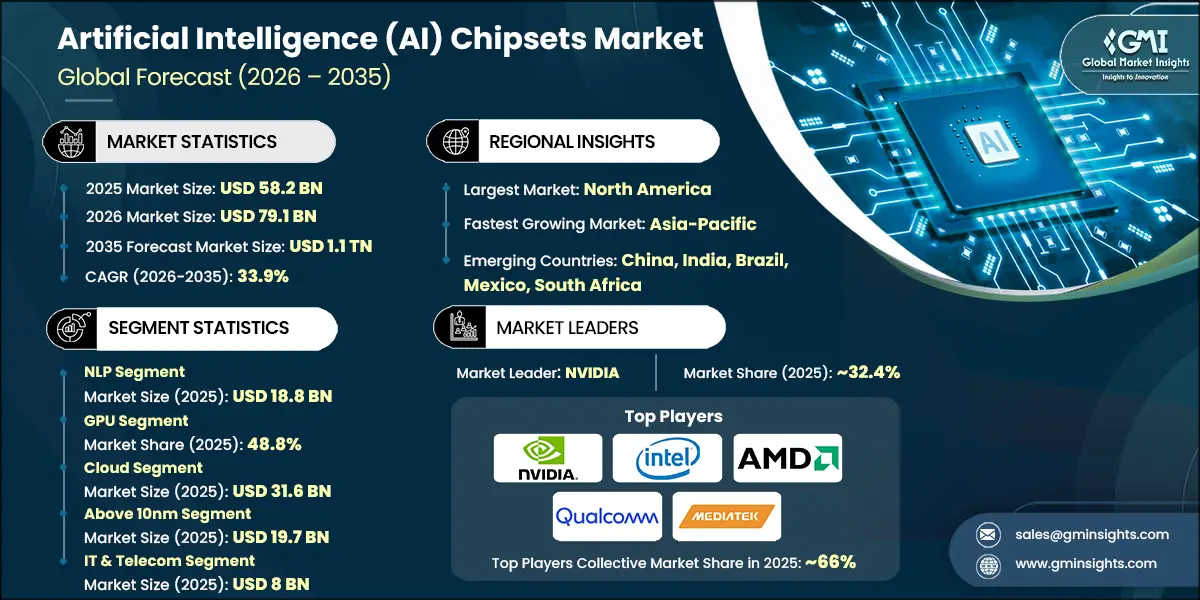
The global artificial intelligence chipsets market was valued at USD 58.2 billion in 2025. The market is expected to grow from USD 79.1 billion in 2026 to USD 1.1 trillion in 2035, at a CAGR of 33.9% during the forecast period, according to the latest report published by Global Market Insights Inc.
To get key market trends
Growth is driven by increasing adoption of AI across industries such as automotive, healthcare, consumer electronics, and data centers. Rising demand for high-performance computing, machine learning applications, edge AI devices, and AI-enabled IoT solutions is fueling market expansion. Continuous innovations in semiconductor technologies, energy-efficient architectures, and AI-optimized processors further support the market’s rapid development and adoption worldwide.
Innovations in semiconductor technologies, energy-efficient architectures, and AI-optimized processors are transforming the market. Companies are developing specialized GPUs, NPUs, and ASICs to accelerate machine learning, deep learning, and neural network processing, enabling faster, smarter, and more energy-efficient AI computations across diverse applications. For instance, in November 2025, Microsoft partnered with Anthropic and Nvidia to launch cloud infrastructure which leds strengthening advanced AI development and deployment.
Artificial Intelligence (AI) Chipsets Market Report Attributes
| Key Takeaway | Details |
|---|---|
| Market Size & Growth | |
| Base Year | 2025 |
| Market Size in 2025 | USD 58.2 Billion |
| Market Size in 2026 | USD 79.1 Billion |
| Forecast Period 2026 - 2035 CAGR | 33.9% |
| Market Size in 2035 | USD 1.1 Trillion |
| Key Market Trends | |
| Drivers | Impact |
| Rising demand from automotive industry | Artificial intelligence applications account for approximately 35% of the demand for AI chipsets. Growing use of AI in data analysis, automation, and high-speed processing across enterprises drives this trend. Organizations rely on powerful GPUs, accelerators, and specialized AI processors to enhance cloud computing, data center operations, and AI workloads, fueling market expansion. |
| Increasing demand for smart homes & smart cities across the globe | Edge computing and 5G technologies are expected to contribute about 30% of AI chipset market growth. As applications shift from cloud to edge, demand for compact, energy-efficient AI chipsets rises. These processors are increasingly integrated into smartphones, IoT devices, autonomous vehicles, and automated industrial systems, accelerating market adoption. |
| Increasing integration of AI in smartphone & smart wearable devices | AI implementation in automotive, healthcare, and industrial automation represents roughly 25% of market growth. Advanced driver-assistance systems, AI-powered diagnostics, robotics, and smart factories require high-performance, low-latency chipsets that enable real-time decision-making, operational efficiency, and enhanced functionality in AI-enabled devices. |
| Growing industrial automation across the globe | The remaining 10% of growth stems from investments in AI research, innovative chipset designs, and government initiatives. Funding for AI startups, development of neuromorphic and quantum-inspired processors, and national AI programs are driving technological advancements, promoting innovation, and supporting sustained market growth for AI chipsets. |
| Pitfalls & Challenges | Impact |
| High development and production costs | The artificial intelligence (AI) chipsets market faces challenges due to high development and production costs. Designing advanced AI processors, integrating cutting-edge architectures, and ensuring reliability require significant investment. These expenses can slow adoption, limit entry for smaller players, and impact pricing strategies in a competitive market. |
| Heat dissipation and power consumption issues | AI chipsets often generate substantial heat and consume high power during intensive workloads, creating technical challenges. Efficient thermal management and energy optimization are critical to maintain performance, prevent hardware degradation, and ensure sustainability. These issues can hinder large-scale deployment in data centers, edge devices, and high-performance computing applications. |
| Opportunities: | Impact |
| Expansion of Generative AI and Edge AI Applications | The rise of generative AI and edge AI presents significant growth opportunities for the AI chipsets market. Increasing demand for real-time processing, personalized content generation, and AI-driven decision-making at the edge drives the need for high-performance, energy-efficient, and specialized AI processors. |
| Growing Adoption Across Healthcare, Finance, and Industry 4.0 | AI chipsets are increasingly adopted across healthcare, finance, and Industry 4.0 applications. From predictive diagnostics and fraud detection to smart manufacturing and automation, these sectors require powerful and reliable AI processors, offering substantial market potential and encouraging investment in advanced, industry-specific chipset solutions. |
| Market Leaders (2025) | |
| Market Leaders |
~32.4% market share. |
| Top Players |
|
| Competitive Edge |
|
| Regional Insights | |
| Largest Market | North America |
| Fastest growing market | Asia-Pacific |
| Emerging countries | China, India, Brazil, Mexico, South Africa |
| Future outlook |
|
What are the growth opportunities in this market?
AI chipsets play a critical role in autonomous driving, advanced driver-assistance systems (ADAS), and in-vehicle infotainment systems. By enabling real-time decision-making, predictive maintenance, and enhanced safety, these chipsets are essential for electric and autonomous vehicles, contributing significantly to the market’s expansion in the automotive sector. For instance, in November 2025, Airtel partnered with San Francisco–based AI startup Perplexity to integrate advanced AI-driven search and conversational capabilities into its digital ecosystem.
From 2022 to 2023, the artificial intelligence chipsets market really grew, going from USD 25.2 billion to USD 35.1 billion. A major trend during this period was Rising adoption of AI-enabled devices such as smartphones, smart speakers, wearables, and home assistants is driving demand for AI chipsets. These processors facilitate natural language processing, facial recognition, voice commands, and enhanced user experiences, making AI chipsets increasingly vital in next-generation consumer electronics. For instance, in October 2025, Oppo partnered with MediaTek to introduce the new Dimensity 9500 chipset in its upcoming Oppo Find X9 Series. This collaboration aims to deliver enhanced performance, improved energy efficiency, and advanced AI capabilities, ensuring a seamless and high-speed user experience.
AI chipsets are essential for data centers and cloud computing, powering high-performance AI workloads, analytics, and large-scale machine learning models. For instance, October 2025, Oracle Cloud has announced plans to deploy 50,000 AMD AI chips, signaling a strategic move to compete with Nvidia in the rapidly growing AI infrastructure market. Moreover, this large-scale deployment aims to enhance Oracle’s cloud computing capabilities, accelerate AI workloads, and provide customers with high-performance, energy-efficient solutions. Increasing cloud adoption, AI-driven automation, and demand for real-time processing in enterprises fuel investment in AI-optimized processors, boosting the market’s growth globally.
Artificial Intelligence Chipsets Market Trends
- The AI chipsets market is witnessing a transition from general-purpose processors to advanced AI-optimized architectures, including GPUs, NPUs, and AI accelerators. Leading companies such as NVIDIA, Intel, and AMD are increasing investments in R&D and next-generation AI processor technologies, driven by growing demand for higher accuracy, efficiency, and integration across AI workloads and applications. Legacy CPU-only solutions continue to see reduced adoption, although they remain relevant for entry-level and cost-sensitive AI deployments.
- In 2025, AI contractors and chip companies got together to create chipsets just for making AI. These chipsets handle all sorts of data and make big models run faster. They're putting together really good GPUs, NPUs, and image processors to get better speeds, save energy, and let businesses think in real-time.
- AI chipsets are increasingly embedded within intelligent computing networks, supporting cloud AI, edge computing, autonomous systems, and real-time analytics. Demand is rising for compact, high-performance processors capable of low-latency inference, real-time data processing, and AI-enabled device communication. AI chipsets are expanding across data centers, consumer electronics, automotive, and industrial applications, enabling faster, smarter, and more efficient AI solutions.
- AI-driven processor solutions and heterogeneous computing architectures are revolutionizing performance. Features such as real-time decision-making, predictive analytics, natural language processing, and neural network acceleration are being integrated across high-end servers, autonomous vehicles, robotics, and intelligent IoT devices. These technologies enhance operational efficiency, computational speed, and AI capabilities, enabling intelligent, context-aware processing in complex applications.
Artificial Intelligence Chipsets Market Analysis
Learn more about the key segments shaping this market
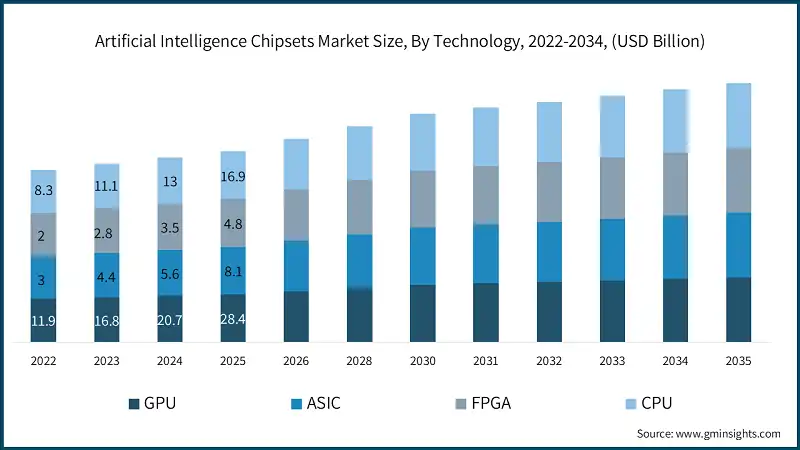
The artificial intelligence (AI) chipsets market was valued at USD 25.2 billion and USD 35.1 billion in 2022 and 2023, respectively. The market size reached USD 58.2 billion in 2025, growing from USD 42.8 billion in 2024.
Based on technology, the artificial intelligence chipsets market is segmented into NLP, RPA, Computer Vision, Network Security, and Others. The NLP segment dominated the market in 2025 with a revenue of USD 18.8 billion.
- In Artificial Intelligence (AI) Chipsets Market NLP segment attained highest market share. They're mostly for things like chatbots, virtual assistants, translation, figuring out how people feel from text, and voice stuff. Because these things use tons of text and speech, they need to be super-fast. Chipsets for NLP help speed up how language models learn and make guesses, so we get better real-time chats, automatic customer service, and smarter data analysis. Lots of businesses, hospitals, online stores, and gadgets are using NLP.
- Manufacturers should focus on developing high-performance, energy-efficient AI chipsets optimized for natural language processing. Enhancing processing speed, model training capabilities, and real-time inference will support applications like chatbots, virtual assistants, and automated translation. Prioritizing scalability, low latency, and integration across devices will drive adoption in enterprises, healthcare, e-commerce, and consumer electronics.
- Robotic Process Automation (RPA) is expected to experience substantial growth, projected to reach USD 389.1 billion by 2035 at a CAGR of 35.9% during the forecast period. This expansion is driven by increasing adoption of automation across industries to streamline repetitive tasks, improve operational efficiency, and reduce human error. Organizations are implementing RPA for finance, HR, customer service, and supply chain operations. Rising demand for cost-effective, scalable, and intelligent automation solutions further fuels the market’s rapid growth globally.
- Manufacturers should focus on developing scalable, cost-effective, and intelligent RPA solutions that streamline repetitive tasks across finance, HR, customer service, and supply chain operations. Enhancing automation capabilities, ease of integration, and user-friendly interfaces will drive adoption, improve operational efficiency, reduce errors, and support businesses in achieving digital transformation and productivity goals globally.
Based on the product, the artificial intelligence (AI) chipsets market is divided into GPU, ASIC, FPGA, and CPU. The GPU segment accounted for 48.8% of the market in 2025.
- The GPU segment has the largest share in the artificial intelligence chipsets market owing to its extraordinary parallel processing capabilities, high computational powers, and efficiency in handling complex AI workloads. GPUs accelerate machine learning, deep learning, and neural network training, thus enabling fast data processing and real-time analytics. Their versatility across automotive, healthcare, robotics, and cloud computing applications has made them the favorite choice for AI developers and OEMs, hence their wide adoption and dominance in the AI chipset landscape.
- Manufacturers must implement strategies to enhance GPU performance while reducing power consumption and increasing integration with AI frameworks. Investments in scalable, cost-effective, energy-efficient GPU solutions would ultimately meet the growing demand arising from automotive, healthcare, robotics, and cloud computing applications, securing competitive advantage while also contributing to faster AI processing and real-time analytics.
- The ASIC (Application-Specific Integrated Circuit) segment of the artificial intelligence (AI) chipsets market, valued at USD 8.1 billion in 2024 and projected to grow at a CAGR of 41.1%, is driven by its high efficiency, low power consumption, and tailored design for specific AI workloads. ASICs are optimized to perform deep learning, neural network processing, and edge AI applications with faster inferences at lower latency. This special architecture allows the manufacturer to achieve better computational speed and power efficiency than general-purpose chips, hence becoming an ideal choice for autonomous vehicles, data centers, robotics, and AI-powered consumer electronics.
- The key target of manufacturers should be high-performance, low-power ASICs developed for specific AI loads. Further developing computational speed, energy efficiency, and integration with deep learning and edge AI applications will surely help them meet growing demand related to autonomous vehicles, data centres, robotics, and consumer electronics, thus staying competitive within the AI chipsets market segment.
Based on the processing type, the artificial intelligence chipsets market is segmented into edge, and cloud. The cloud segment dominated the market in 2025 with a revenue of USD 31.6 billion.
- The cloud segment accounts for the largest share of the Artificial Intelligence (AI) Chipsets market due to the growing demand for high-performance computing, large-scale AI model training, and data-intensive applications hosted on cloud platforms. Cloud AI workloads require powerful GPUs, AI accelerators, and specialized processors to enable real-time analytics, machine learning, and deep learning. Increasing adoption of AI-as-a-Service, enterprise cloud solutions, and scalable data center infrastructure is driving the demand for cloud-optimized AI chipsets, making this segment the market leader globally.
- Manufacturers should focus on developing high-performance, energy-efficient AI chipsets optimized for cloud computing. Enhancing processing power, scalability, and support for large-scale AI model training will meet the growing demand from data centers and enterprise cloud solutions. Prioritizing reliability, low latency, and seamless integration will strengthen adoption globally.
- The edge segment is anticipated to witness significant growth, projected to reach USD 582.6 billion by 2035 at a CAGR of 36% during the forecast period. This growth is driven by increasing demand for low-latency AI processing, real-time analytics, and on-device intelligence in smartphones, IoT devices, autonomous vehicles, and industrial automation. Edge AI reduces dependency on cloud infrastructure, enhances data privacy, and improves operational efficiency, making high-performance, energy-efficient AI chipsets for edge applications increasingly critical for global adoption.
- Manufacturers should focus on developing high-performance, energy-efficient AI chipsets optimized for edge computing. Enhancing low-latency processing, on-device intelligence, and real-time analytics will support applications in smartphones, IoT devices, autonomous vehicles, and industrial automation. Prioritizing reliability, scalability, and energy efficiency will drive widespread adoption of edge AI solutions globally.
Based on the node size, the artificial intelligence chipsets market is segmented into Above 10nm, 7nm, 5nm, 3nm and below. The above 10nm segment dominated the market in 2025 with a revenue of USD 19.7 billion.
- The above 10 nm segment accounts for the largest share of the Artificial Intelligence (AI) Chipsets market due to its balance of performance, power efficiency, and cost-effectiveness. These chipsets support high-performance AI workloads, including deep learning, machine learning, and data analytics, without the manufacturing complexities of smaller nodes. Widespread adoption in data centers, cloud AI, edge devices, and consumer electronics drives demand. Their reliability, scalability, and compatibility with existing infrastructure make above 10 nm AI chipsets the preferred choice for enterprises and developers globally.
- Manufacturers should focus on producing reliable, scalable, and cost-effective AI chipsets above 10 nm that deliver high performance and energy efficiency. Prioritizing compatibility with existing infrastructure and optimization for deep learning, machine learning, and data analytics will meet growing demand across data centers, cloud AI, edge devices, and consumer electronics worldwide.
- The 3nm segment is anticipated to witness significant growth, projected to reach USD 494.9 billion by 2035 at a CAGR of 41.7% during the forecast period. This growth is driven by the demand for ultra-high-performance AI chipsets with enhanced processing speed, energy efficiency, and computational density. 3nm technology enables advanced deep learning, machine learning, and real-time analytics, supporting applications in data centers, edge devices, autonomous vehicles, and consumer electronics, while facilitating miniaturization and scalability for next-generation AI solutions globally.
- Manufacturers should focus on developing ultra-high-performance 3nm AI chipsets optimized for speed, energy efficiency, and computational density. Enhancing support for deep learning, machine learning, and real-time analytics will enable adoption across data centers, edge devices, autonomous vehicles, and consumer electronics, while ensuring scalability and miniaturization for next-generation AI applications globally.
Learn more about the key segments shaping this market
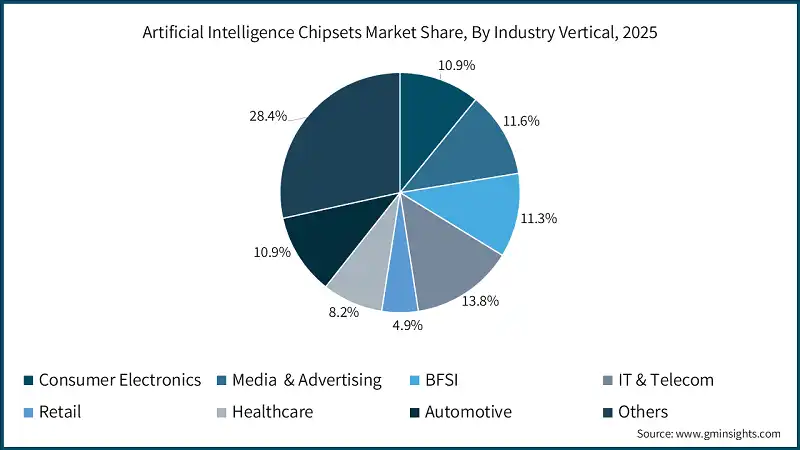
Based on the industry vertical, the artificial intelligence chipsets market is segmented into consumer electronics, media & advertising, BFSI, IT & Telecom, retail, healthcare, automotive, and others. The IT & Telecom segment dominated the market in 2025 with a revenue of USD 8 billion.
- The IT & Telecom segment accounts for the largest share of the Artificial Intelligence (AI) Chipsets market due to the growing demand for AI-driven network optimization, data center automation, and advanced analytics. AI chipsets enable faster data processing, real-time decision-making, and enhanced service delivery across cloud computing, 5G infrastructure, and telecommunications networks. Increasing deployment of AI-based applications, intelligent network management, and predictive maintenance solutions drives adoption, making IT and telecom the leading segment for high-performance, energy-efficient, and scalable AI chipset solutions globally.
- Manufacturers should focus on developing high-performance, energy-efficient AI chipsets optimized for IT and telecom applications. Enhancing real-time data processing, network optimization, and predictive analytics will support cloud computing, 5G infrastructure, and intelligent network management, driving adoption of scalable AI solutions across telecommunications, data centers, and enterprise networks globally.
- The automotive segment is anticipated to witness significant growth at a CAGR of 39.2% during the forecast period. This growth is driven by increasing adoption of AI chipsets in autonomous vehicles, advanced driver-assistance systems (ADAS), in-vehicle infotainment, and connected car technologies. Rising demand for real-time processing, safety enhancements, and intelligent navigation systems is boosting the integration of high-performance, energy-efficient AI processors in passenger vehicles, commercial fleets, and electric vehicles, supporting smarter, safer, and more efficient automotive solutions globally.
- Manufacturers should focus on developing high-performance, energy-efficient AI chipsets for the automotive sector. Enhancing real-time processing, safety features, and intelligent navigation will support ADAS, autonomous vehicles, connected cars, and in-vehicle infotainment systems. Prioritizing reliability, scalability, and integration will drive adoption across passenger vehicles, commercial fleets, and electric mobility solutions globally.
Looking for region specific data?
North America artificial intelligence chipsets market share of 31.6% in 2025.
- In North America, the artificial intelligence (AI) chipsets market is driven by the rapid adoption of AI technologies across industries such as healthcare, automotive, IT, and finance. Strong presence of major AI chipset manufacturers, increasing investment in data centers, cloud computing, edge AI, and autonomous systems, and rising demand for high-performance, energy-efficient processors for machine learning, deep learning, and real-time analytics are fueling market growth. Government support, research initiatives, and early adoption of emerging AI applications further accelerate regional expansion.
- Manufacturers should focus on developing high-performance, energy-efficient AI chipsets tailored for North American industries such as healthcare, automotive, IT, and finance. Enhancing support for machine learning, deep learning, and real-time analytics, while ensuring compatibility with cloud, edge, and autonomous systems, will drive adoption and capitalize on regional growth opportunities.
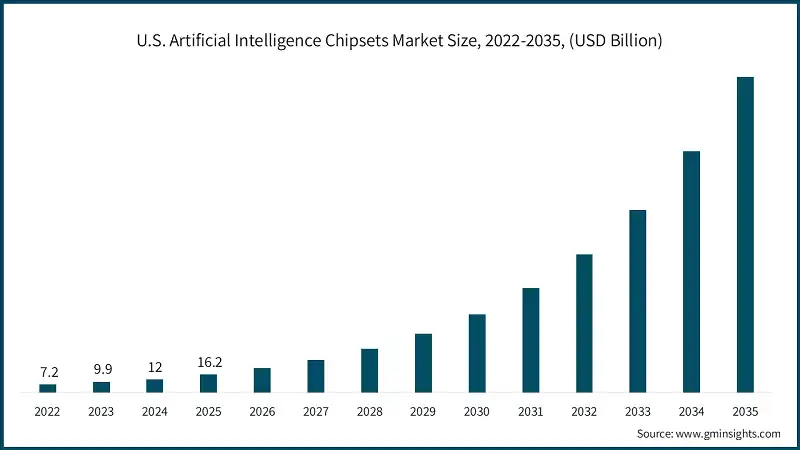
The U.S. artificial intelligence chipsets market was valued at USD 7.2 billion and USD 9.9 billion in 2022 and 2023, respectively. The market size reached USD 16.2 billion in 2025, growing from USD 12 billion in 2024.
- The U.S. continues to dominate the artificial intelligence (AI) chipsets market, driven by the presence of leading AI chipset manufacturers, robust R&D investments, and early adoption of advanced AI technologies across sectors such as healthcare, automotive, IT, and finance. Increasing deployment of cloud computing, edge AI, autonomous systems, and data center infrastructure fuels demand for high-performance, energy-efficient processors. Supportive government initiatives, technology-focused policies, and strong venture capital funding further accelerate innovation and adoption, reinforcing the U.S. as a global leader in the AI chipsets market.
- Manufacturers should focus on developing high-performance, energy-efficient AI chipsets for the U.S. market. Prioritizing innovation, R&D-driven designs, and compatibility with cloud computing, edge AI, autonomous systems, and data centers will support adoption across healthcare, automotive, IT, and finance, while leveraging government initiatives and venture capital to maintain a competitive edge.
In Europe the artificial intelligence chipsets market accounted for USD 13.8 billion in 2025 and is anticipated to show lucrative growth over the forecast period.
- Europe holds a significant share of the artificial intelligence (AI) chipsets market, driven by increasing adoption of AI technologies across automotive, manufacturing, healthcare, and IT sectors. Rising investments in AI research, smart factories, autonomous vehicles, and edge computing are fueling demand for high-performance, energy-efficient AI processors. Supportive government initiatives, EU policies promoting digital transformation, and collaborations between technology providers and enterprises further enhance regional growth. The focus on sustainable, scalable, and secure AI solutions continues to strengthen Europe’s position in the global AI chipsets market.
- Manufacturers should focus on developing high-performance, energy-efficient AI chipsets tailored for Europe’s automotive, manufacturing, healthcare, and IT sectors. Prioritizing sustainability, scalability, and security, while supporting smart factories, autonomous vehicles, and edge computing, will drive adoption and capitalize on government initiatives, EU digital transformation policies, and collaborative regional growth opportunities.
Germany dominates the Europe artificial intelligence chipsets market, showcasing strong growth potential.
- Germany, holds a substantial share of the artificial intelligence (AI) chipsets market due to its strong industrial base, advanced automotive sector, and rapid adoption of Industry 4.0 technologies. Investments in smart manufacturing, autonomous vehicles, and edge AI applications drive demand for high-performance, energy-efficient AI processors. Government initiatives supporting digitalization, AI research, and technological innovation, along with collaborations between technology providers and enterprises, further strengthen Germany’s position as a key market for AI chipsets in Europe.
- Manufacturers should focus on developing high-performance, energy-efficient AI chipsets for Germany’s industrial and automotive sectors. Enhancing support for Industry 4.0, smart manufacturing, autonomous vehicles, and edge AI applications, while aligning with government digitalization initiatives and fostering enterprise collaborations, will drive adoption and strengthen market presence in Europe’s leading AI chipset market.
The Asia-Pacific artificial intelligence chipsets market is anticipated to grow at the highest CAGR of 36% during the analysis timeframe.
- The Asia-Pacific region is experiencing rapid growth in the artificial intelligence (AI) chipsets market, driven by increasing adoption of AI technologies across automotive, consumer electronics, IT, and manufacturing sectors. Rising investments in cloud computing, edge AI, and smart devices fuel demand for high-performance, energy-efficient AI processors. Supportive government initiatives, technological innovation, and collaborations between regional enterprises and global technology providers further accelerate market expansion. Growing smartphone penetration, autonomous vehicle development, and industrial automation are also key factors driving regional AI chipset adoption.
- Manufacturers should focus on developing high-performance, energy-efficient AI chipsets for the Asia-Pacific region. Enhancing support for automotive, consumer electronics, IT, and manufacturing applications, while enabling cloud computing, edge AI, and smart devices, will drive adoption. Leveraging government initiatives, regional collaborations, and emerging technologies will strengthen market presence and growth.
China artificial intelligence chipsets market is estimated to grow with a significant CAGR 37.2% from 2026 to 2035.
- China dominates the Asia-Pacific artificial intelligence (AI) chipsets market, driven by rapid adoption of AI technologies across sectors such as automotive, consumer electronics, IT, and manufacturing. Significant investments in AI research, edge computing, cloud infrastructure, and smart devices are fueling demand for high-performance, energy-efficient AI processors. Supportive government policies, national AI strategies, and strong collaboration between domestic technology firms and global providers further strengthen China’s market leadership. Growing development of autonomous vehicles, industrial automation, and AI-enabled consumer products also drives regional adoption.
- Manufacturers should focus on developing high-performance, energy-efficient AI chipsets for China’s rapidly growing market. Prioritizing applications in automotive, consumer electronics, IT, and manufacturing, while supporting edge computing, cloud infrastructure, and AI-enabled devices, will drive adoption. Leveraging government policies, national AI strategies, and domestic collaborations will strengthen market presence and growth.
In 2025, the Latin America AI chipset market should hit $2.8 billion. This is because AI is used more and more in cars, factories, IT, and smart city projects, which increases the need for these chipsets.
The Middle East and Africa AI chipset market should reach $27.4 billion by 2035. This rise is because AI is being used more in smart cities, factory automation, cars, and improving IT.
UAE artificial intelligence chipsets market to experience substantial growth in the Middle East and Africa market in 2024.
- The UAE is demonstrating significant growth potential in the Middle East and Africa artificial intelligence (AI) chipsets market, driven by rapid adoption of AI technologies across sectors such as smart cities, healthcare, finance, and telecommunications. Investments in data centers, cloud computing, edge AI, and autonomous systems are fueling demand for high-performance, energy-efficient AI processors. Supportive government initiatives, technology-driven policies, and strategic collaborations with global technology providers further accelerate market expansion. Rising digital transformation and AI-enabled infrastructure development are key growth drivers in the region.
- Manufacturers should focus on developing high-performance, energy-efficient AI chipsets for the UAE market. Enhancing support for smart cities, healthcare, finance, telecommunications, cloud computing, edge AI, and autonomous systems, while leveraging government initiatives and strategic collaborations, will drive adoption and capitalize on the region’s growing digital transformation and AI infrastructure development.
Artificial Intelligence Chipsets Market Share
The Artificial Intelligence (AI) Chipsets Market is highly competitive, with companies constantly innovating, forming partnerships, and investing heavily in research and development. Leading players such as NVIDIA, Intel, AMD, Qualcomm, and MediaTek hold approximately 66% of the market. These companies focus on delivering high-performance, energy-efficient AI chipsets for applications in machine learning, deep learning, edge computing, and data centers. Continuous improvements in AI processing, chip design, and system integration are enhancing speed, efficiency, and scalability. These companies are also collaborating with cloud service providers, automotive manufacturers, and technology firms to expand adoption across diverse AI applications. Efforts to miniaturize chips, improve performance, and scale production are reducing costs and facilitating widespread use.
In addition, emerging players are developing compact, cost-effective, and energy-efficient AI chipsets for edge devices, autonomous vehicles, and industrial AI applications. Innovations in neural processing units, AI accelerators, and security features are enhancing performance, durability, and data protection. Collaborations with tech companies and AI startups accelerate feature integration into smart systems, improving real-time processing, scalability, and affordability, thus driving adoption across automotive, healthcare, IT, manufacturing, and consumer electronics globally.
Artificial Intelligence Chipsets Market Companies
Prominent players operating in the artificial intelligence (AI) chipsets market are as mentioned below:
- Alphabet Inc.
- AMD (Advanced Micro Devices)
- Analog Devices, Inc.
- Apple Inc.
- Arm Ltd.
- Blaize
- Graphcore
- Groq, Inc.
- Hailo
- Huawei Technologies Co., Ltd.
- IBM
- Imagination Technologies
- Infineon Technologies Inc
- Intel Corporation
- Kalray
- LG Electronics
- MediaTek Inc.
- Micron Technology Inc
- NVIDIA Corporation
- NXP Semiconductors
- Qualcomm Technologies, Inc
- ROHM Co., Ltd.
- Samsung Electronics Co., Ltd.
- STMicroelectronics
- Texas Instruments Incorporated
- NVIDIA
NVIDIA is a leading player in the Artificial Intelligence (AI) Chipsets Market, holding an estimated 32.4% share. The company specializes in high-performance GPUs and AI accelerators optimized for machine learning, deep learning, data centers, edge computing, and autonomous systems. NVIDIA’s technologies, including Tensor Cores and advanced parallel processing architectures, enhance AI training and inference capabilities. Strategic collaborations with cloud providers, automotive manufacturers, and technology firms, along with continuous innovation in energy-efficient and scalable AI chipsets, strengthen its market leadership and global adoption across diverse AI applications. - Intel
Intel is a leading player in the Artificial Intelligence (AI) Chipsets Market, holding an estimated 10.7% share. The company offers a diverse portfolio of CPUs, AI accelerators, and specialized processors designed for machine learning, deep learning, edge computing, and data center applications. Intel invests heavily in R&D to enhance AI processing performance, energy efficiency, and scalability. Strategic partnerships with cloud providers, automotive firms, and technology companies strengthen its market presence, enabling widespread adoption of AI chipsets across industries globally.
AMD is a leading player in the Artificial Intelligence (AI) Chipsets Market, known for its high-performance GPUs and adaptive processors optimized for AI workloads. The company focuses on energy-efficient, scalable solutions for machine learning, deep learning, edge computing, and data center applications. AMD invests in advanced chip architecture and innovative designs to enhance processing speed and parallel computing capabilities. Collaborations with cloud providers, technology firms, and enterprises further strengthen their market presence, driving adoption of AI chipsets across diverse global industries.
Artificial Intelligence Chipsets Industry News
- In October 2025, Qualcomm launched new AI processors for data centers marking a significant expansion beyond its traditional smartphone focus. Rising demand for AI solutions has prompted cloud providers, chip manufacturers, and enterprises to invest in high-performance processors capable of training large language models and powering generative AI applications.
- In October 2024, AMD launched the MI325X AI accelerator chip designed to enhance machine learning and data center performance. This processor improves speed and efficiency for AI workloads in enterprise and cloud environments, enabling faster and more effective AI operations.
- In May 2025 MediaTek partnered with leading AI hardware providers to launch a 2 nm AI chipset. The product aims to accelerate high-end AI adoption by delivering efficient, powerful, and competitive solutions for next-generation AI hardware markets.
- In June 2024, Etched launched the Sohu chip a specialized AI chipset optimized for transformer models. This application-specific integrated circuit (ASIC) offers substantial performance gains over traditional GPU solutions, improving AI computation efficiency.
- In June 2024, Intel announced its new AI-focused Xeon 6 processors at Computex in Taiwan. Targeted at data centers, these chips deliver enhanced performance while reducing power consumption, making them ideal for handling demanding AI workloads efficiently.
The artificial intelligence chipsets market research report includes in-depth coverage of the industry with estimates and forecast in terms of revenue in USD Billion from 2022 – 2035 for the following segments:
Market, By Product
- GPU
- ASIC
- FPGA
- CPU
Market, By Technology
- NLP
- RPA
- Computer Vision
- Network Security
- Others
Market, By Processing Type
- Edge
- Cloud
Market, By Industry Vertical
- Consumer Electronics
- Smartphones & Tablets
- Laptops & PCs
- Wearables
- AR/VR/MR Devices
- Smart Home Devices
- Others
- Media & Advertising
- BFSI
- IT & Telecom
- Cloud Data Centers
- Edge Data Centers
- Cybersecurity & Threat Detection
- AI-powered 5G/6G RAN Solutions
- Others
- Retail
- Healthcare
- Medical Imaging & Diagnostics
- Drug Discovery & Genomics
- Wearable Health Monitoring Devices
- Hospital Automation & Workflow Management
- Telemedicine & Virtual Health Platforms
- Others
- Automotive
- Advanced Driver Assistance Systems (ADAS)
- Autonomous Vehicles (AV Compute Units)
- In-Vehicle Infotainment (IVI)
- V2X Communication Systems
- Others
- Others
The above information is provided for the following regions and countries:
- North America
- U.S.
- Canada
- Europe
- Germany
- UK
- France
- Spain
- Italy
- Netherlands
- Asia Pacific
- China
- India
- Japan
- Australia
- South Korea
- Latin America
- Brazil
- Mexico
- Argentina
- Middle East and Africa
- South Africa
- Saudi Arabia
- UAE
Frequently Asked Question(FAQ) :
Who are the key players in the artificial intelligence chipsets market?
Leading players include NVIDIA, Intel, AMD, Qualcomm, MediaTek, Alphabet, Huawei, Samsung, NXP Semiconductors, STMicroelectronics, and Texas Instruments. These companies are accelerating innovation in energy-efficient AI processors, cloud/edge accelerators, and advanced GPU/NPU architectures.
What are the upcoming trends in the AI chipsets industry?
Key trends include adoption of generative AI accelerators, AI-optimized GPU/ASIC architectures, 3nm and below semiconductor nodes, and edge-AI integration across IoT devices. Development of neuromorphic chips, low-power accelerators, and AI-enabled 5G/6G networks is further shaping future market growth.
Which region currently leads the AI chipsets market?
North America led the market with a 31.6% share in 2025, supported by strong AI adoption across healthcare, IT, finance, and automotive industries. The U.S. alone generated USD 16.2 billion in 2025, driven by cloud infrastructure expansion, R&D investments, and widespread deployment of AI processors.
What is the growth outlook for the edge processing segment from 2025 to 2035?
The edge segment is projected to grow at a CAGR of 36% through 2035, reaching USD 582.6 billion. Rising demand for low-latency inference, on-device intelligence, privacy-centric processing, and IoT-driven automation supports long-term growth.
What was the valuation of the GPU segment in 2025?
The GPU segment accounted for 48.8% of the market in 2025, making it the largest product category. GPUs lead due to their massive parallel processing capabilities, which accelerate training and inference across AI workloads.
How much revenue did the NLP technology segment generate in 2025?
The NLP segment generated USD 18.8 billion in 2025, making it the leading technology category. Increased adoption of chatbots, virtual assistants, automated translation, and sentiment analysis contributed to its strong dominance.
What is the projected value of the artificial intelligence chipsets market by 2035?
The AI chipsets market is expected to reach USD 1.1 trillion by 2035, growing at a CAGR of 33.9% from 2026 to 2035. Growth is driven by generative AI, advanced accelerators, edge intelligence, and AI-optimized semiconductor architectures.
What is the artificial intelligence chipsets market size in 2025?
The global artificial intelligence (AI) chipsets market was valued at USD 58.2 billion in 2025. Rapid adoption of AI in automotive, healthcare, data centers, and consumer electronics continues to fuel strong market expansion.
What is the market size of the AI chipsets industry in 2026?
The market size for AI chipsets reached USD 79.1 billion in 2026, reflecting accelerated demand for high-performance computing, cloud AI workloads, and edge-based AI deployments.
Artificial Intelligence (AI) Chipsets Market Scope
Related Reports