Summary
Table of Content

Architectural Coatings, Enamels, Primers, Stains, Solvents, and Lacquers Market
Get a free sample of this report
Form submitted successfully!
Error submitting form. Please try again.
Thank you!
Your inquiry has been received. Our team will reach out to you with the required details via email. To ensure that you don't miss their response, kindly remember to check your spam folder as well!
Request Sectional Data
Thank you!
Your inquiry has been received. Our team will reach out to you with the required details via email. To ensure that you don't miss their response, kindly remember to check your spam folder as well!
Form submitted successfully!
Error submitting form. Please try again.
Architectural Coatings, Enamels, Primers, Stains, Solvents, and Lacquers Market Size
The global architectural coatings, enamels, primers, stains, solvents, and lacquers market was estimated at USD 90.5 billion in 2024, and it is expected to grow at a CAGR of 4.6% from 2025 to 2034. Architectural coatings form the bulk of the product mix with almost 85% of the market share, while supporting segments like enamels, primers, stains, solvents, and lacquers capture the rest 15%, catering to specialized aesthetic and functional needs across end-use sectors.
Architectural Coatings, Enamels, Primers, Stains, Solvents, and Lacquers Market Key Takeaways
Market Size & Growth
- 2024 Market Size: USD 90.5 Billion
- 2034 Forecast Market Size: USD 142 Billion
- CAGR (2025–2034): 4.6%
Key Market Drivers
- Surge in residential and commercial construction activity.
- Rising demand for eco-friendly and low-VOC products.
- Technological innovation in formulations and application efficiency.
Challenges
- Volatile raw material and input costs.
- Regulatory pressure on solvent-based products.
Get Market Insights & Growth Opportunities
Some of the major drivers pushing this market include fast urbanization in developing countries, increased renovation and maintenance activities in mature markets and a growing consumer shift towards eco-friendly low VOC formulations. As per industry statistics, the Asia Pacific region remains the largest and fastest growing, with a substantial portion of the regional demand coming from China and India. For example, India is projected to grow by more than 10% per year for their decorative paints sector until 2027 which will in turn create a rising need for primers, enamels and lacquers.
In addition, the improvement in product functionalities with regard to high-humidity, UV exposure, and industrial use-cases is now possible because of the greater sap technology advancements in resin chemistries, pigment dispersion, and cross-linking technologies. Waterborne systems are also gaining traction and now constitute over 77.7% of architectural coatings owing to the waterborne maroon and Gulliver coating principles, research developments, and restrictions from North America and Europe.
Even though the industry maintains a positive balance, the volatility in solvent prices and precursors of resin maintain an unrelenting pace. Moreover, the concentration of mid-tier manufacturers drives competition for lower R&D spending companies that do not have sufficient distribution resources. On the contrary, market leaders like Sherwin-Williams, PPG Industries, AkzoNobel continue to dominate the market through consolidation of market shares using mergers and acquisitions alongside product innovations.

To get key market trends
Architectural Coatings, Enamels, Primers, Stains, Solvents, and Lacquers Market Trends
- Shift toward waterborne and low-VOC technologies: The most important shift is the change in formulations from solvent-based to waterborne due to the enforcement of environmental regulations and consumers’ interest in safer levels of indoor air pollution. In 2024, more than 77% of architectural coatings sold worldwide were water-based. The EU and North America markets have also imposed stricter VOC emissions limits.
- Rising demand for multi-functional and smart coatings: Nowadays, coatings are needed not only for beauty but also for additional functionality such as anti-microbial, self-cleaning, anti-carbonation, heat-reflective, etc. Smart coatings have found new applications in hospitals, schools and green buildings. Increased spending on these areas is being driven by R&D expenditure from top companies such as Sherwin-Williams and Nippon Paint.
- Policy-driven push toward sustainability: Policies like the U.S. EPA Safer Choice Program, Green Pro Certification in India, and China’s 14th Five-Year Plan for green development policy actively encourage sustainable manufacturing and products. These policies also urge businesses to reconsider and redirect their efforts towards smoother formulation and supply chain restructuring.
- Unmet needs in emerging markets: Emerging economies are still grappling with deep gaps in affordability, long product life, and ease of application. A lack of high-performance coatings in rural parts of Southeast Asia and Sub-Saharan Africa highlights an opportunity for low-cost compliant value engineered coatings.
Architectural Coatings, Enamels, Primers, Stains, Solvents, and Lacquers Market Analysis

Learn more about the key segments shaping this market
Based on product type, market is divided into architectural coatings, enamels, primers, stains, solvents, and lacquers. Architectural coatings segment generated a revenue of USD 90.5 billion in 2024 and USD 120.7 billion in 2034 at a CAGR of 4.6%.
- Architectural coatings category captures the largest market share of approximately 85.3% of the total global coatings market due to its extensive use in residential and commercial buildings. These coatings are crucial for beauty as well as surface protection which creates constant demand in both construction and renovation activities. Volume growth is also supported by rapid urbanization, increasing public infrastructure investments, and housing demand in the Asia-Pacific region.
- Furthermore, the movement towards eco-friendliness and water-based coatings, along with multi-surface quick-drying and washable paints, has driven innovation in this segment.
Based on application, the architectural coatings, enamels, primers, stains, solvents, and lacquers market is divided into water-based, and solvent-based. In 2024, Water-based segment held major market share, accounted for 77.7% share.
- Increased government regulatory pressure on VOC emissions and heightened consumer interest in low-odor greener alternatives to solvent-based systems is the explained reason.
- The EU and North America are spearheading these policies, and many manufacturers are shifting their R&D focus towards high-performance waterborne formulations.
Learn more about the key segments shaping this market
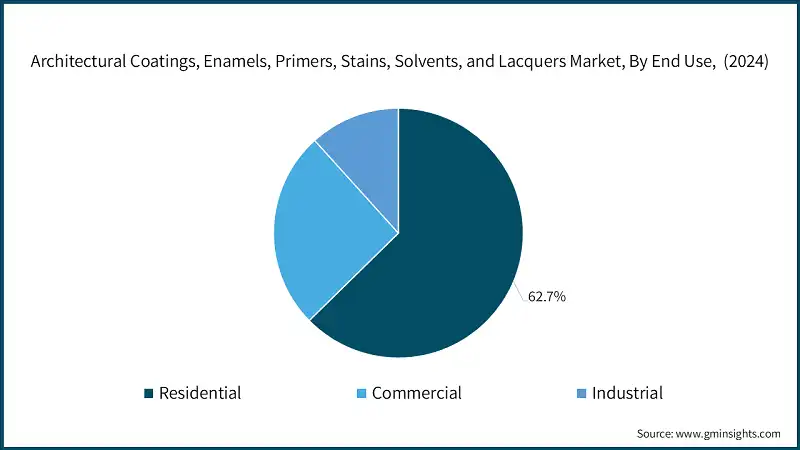
Based on end use, the architectural coatings, enamels, primers, stains, solvents, and lacquers market is divided into residential, commercial, and industrial. In 2024, residential segment held major market share, accounted for 62.7% share.
- This demand is primarily supported by the continued expansion of urban housing construction. Additionally, emerging economies like India, Vietnam, and Indonesia are experiencing increased affordability of housing, leading to greater consumption of interior and exterior coatings.
- Furthermore, consumer preferences are changing toward greater Aesthetic Versatility along with products with low VOC emissions, influencing product innovation in residential coatings. The increasing use of e-commerce platforms and paint visualizer applications has made engagement with the products far more accessible, increasing volume growth in this segment.

Looking for region specific data?
China architectural coatings, enamels, primers, stains, solvents, and lacquers market generated a revenue of USD 12.6 billion in 2024. The market is projected to grow at a CAGR of 4.9% reaching USD 20.2 billion by 2034 as it is driven by increased the consumption.
- The persistent pace of urbanization remains one of the key contributing factors, especially for the tier-2 and tier-3 cities which are developing at a faster rate. In the residential segment, there is a shift in the sphere of demand toward greater coating performance, durability, and aesthetic value. There is a growing market for premium products that offer antibacterial and self-cleaning functionalities.
- Both domestic and international companies are working to grow their market presence in China, which tells us that the competitive landscape in the region is intense. Businesses are now more focused than before on innovations in products, partnership strategies, and widening their distribution services to meet the multifaceted requirements of the Chinese market.
The architectural coatings, enamels, primers, stains, solvents, and lacquers market in the U.S. is expected to experience promising growth from 2025 to 2034 due to growth of increasing consumption within the country.
- The architectural coatings market of the US remains intact. With almost No VOC waterborne coatings dominating the market share of 80% in 2024, the submarket is expected to witness further growth due to growing environmental regulations and consumer expectations.
Architectural Coatings, Enamels, Primers, Stains, Solvents, and Lacquers Market Share
Top 5 companies in the market are Sherwin-Williams Company, PPG Industries, AkzoNobel, Nippon Paint Holdings, and RPM International. As of 2024, the global market for architectural coatings and related products remains moderately consolidated, top 5 players holding over 55% of the global market share. The rest of the market share is composed of regional and local players that focus primarily on pricing and niche products.
The competition in the market is based primarily on price, innovation in VOC technologies, and other custom durability features like anti-microbial or UV-resistant coatings. Other non-price factors include joint ventures, mergers, and geographic expansions. For example, In 2021, Nippon Paint's acquisition of Cromology in Spain has bolstered its market share in Europe. Furthermore, RPM International has also been bolstering its architectural and specialty coatings portfolio through bolt-on acquisitions.
Architectural Coatings, Enamels, Primers, Stains, Solvents, and Lacquers Market Companies
Some of the eminent market participants operating in the Architectural Coatings, Enamels, Primers, Stains, Solvents, and Lacquers industry include: AkzoNobel, Asian Paints Limited, Axalta Coating Systems, BASF Coatings, Benjamin Moore & Co., Hempel, Jotun Group, Kansai Paint, Masco Corporation, Nippon Paint Holdings, PPG Industries, RPM International, Sherwin-Williams Company, Tikkurila Oyj, etc.
Sherwin-Williams stands as one of the key global seller of architectural coatings as they have a self-contained system of procurement, production, and retailing through their 4700 stores. The company has also been focusing on innovations in waterborne technologies as well as pro contractor loyalty programs, advanced coatings for moisture barriers, and energy-saving coatings. Recent investments include digital contractor productivity tools, customer service contracting portals, and express delivery logistics systems.
PPG Industries, ranked second, continues to increase the range of architectural, automotive, and industrial coatings offered. In the architectural segment, PPG concentrates on adding value by deploying new smart coatings alongside powerful color selection tools aimed at retail and professional markets. The company also leads in recycled-content coatings and pledged to achieve net-zero emissions which is appealing to their environmentally responsible stakeholders.
Architectural Coatings, Enamels, Primers, Stains, Solvents, and Lacquers Market Report Attributes
| Key Takeaway | Details |
|---|---|
| Market Size & Growth | |
| Base Year | 2024 |
| Market Size in 2024 | USD 90.5 Billion |
| Forecast Period 2025 - 2034 CAGR | 4.6% |
| Market Size in 2034 | USD 142 Billion |
| Key Market Trends | |
| Growth Drivers |
|
| Pitfalls & Challenges |
|
What are the growth opportunities in this market?
Architectural Coatings, Enamels, Primers, Stains, Solvents, and Lacquers Industry News
- In January 2024, AkzoNobel launched a new bio-based primer, which is developed using renewable starting materials. This underscores the company’s efforts toward sustainability as well as marketing architectural coatings.
- In November 2023, AkzoNobel has launched architectural powder coating Interpon D1036 that cures at 150°C, which is relatively low. This temperature for curing can save up to 20% energy and 25% time compared to traditional powders.
- In June 2023, Nippon Paint Holdings signed a business cooperation agreement for developing smart primers with self-repairing functions and advanced durability.
- In February 2023, PPG Industries launched an advanced epoxy intumescent fire protection coating for architectural steel, PPG STEELGUARD 951. It provides up to three hours of cellulosic fire protection and effective corrosion resistance in extremely corrosive environments without a topcoat.
Tariff Impact on the Market
The coatings industry alongside other Canadian and American sectors that rely on imports are feeling the brunt of the new tariffs proposed by the Trump administration as these are expected to shake up the economy since February 2025.
Coatings production and inspection is scalable and depend on the supply of essential tier one ingredients like titanium dioxide. With Canada being a prominent supplier and trading partner, Canada's new major 25% and 10% tariff and southwestern allied countries pay most of their relies on alliances goods will significantly raise the expected costs of production and inspection services.
These tariffs raised the price of raw materials like resins and titanium dioxide, which are necessary for the manufacture of paint, and upset supply chains in the United States. Supply chain difficulties were exacerbated by an effective 54% tariff rate imposed on China, a major supplier of raw materials. With localized production in the United States and China, European companies such as Akzo Nobel reported manageable effects, estimating that tariffs cost them €35 million annually in EBITDA. The current 26% import tax on paints in India exacerbates the problems caused by US tariffs and has an impact on global supply dynamics. All things considered, the tariffs have raised production costs, disrupted supply chains, and created market uncertainty in the global architectural coatings sector.
Thus, the manufacturers may economize in specific regions, therefore seeking out new suppliers to shift reliance, which may incur disruption and delays. This could stifle growth in some segments, especially among customers with tighter budgets, and push back the adoption of sophisticated coating technologies.
The architectural coatings, enamels, primers, stains, solvents, and lacquers market research report includes in-depth coverage of the industry, with estimates & forecast in terms of revenue (USD Billion) & volume (Tons) from 2021 to 2034, for the following segments:
Market, By Product Type
- Architectural coatings
- Enamels
- Primers
- Stains
- Solvents
- Lacquers
Market, By Technology
- Water-based
- Solvent-based
Market, By End Use
- Residential
- Commercial
- Industrial
The above information is provided for the following regions and countries:
- North America
- U.S.
- Canada
- Europe
- Germany
- UK
- France
- Spain
- Italy
- Rest of Europe
- Asia Pacific
- China
- India
- Japan
- Australia
- South Korea
- Rest of Asia Pacific
- Latin America
- Brazil
- Mexico
- Argentina
- Rest of Latin America
- Middle East and Africa
- Saudi Arabia
- South Africa
- UAE
- Rest of Middle East and Africa
Frequently Asked Question(FAQ) :
How big is the architectural coatings, enamels, primers, stains, solvents, and lacquers market?
The market for architectural coatings, enamels, primers, stains, solvents, and lacquers was valued at USD 90.5 billion in 2024 and is expected to reach around USD 142 billion by 2034, growing at a 4.6% CAGR through 2034.
What is the size of the architectural coatings segment in the market?
The architectural coatings segment generated a revenue of USD 90.5 billion in 2024.
How much revenue did the China market generate in 2024 for architectural coatings, enamels, primers, stains, solvents, and lacquers?
The China market generated a revenue of USD 12.6 billion in 2024 for architectural coatings, enamels, primers, stains, solvents, and lacquers.
Who are the key players in the architectural coatings, enamels, primers, stains, solvents, and lacquers market?
Some of the major players in the industry include AkzoNobel, Asian Paints Limited, Axalta Coating Systems, BASF Coatings, Benjamin Moore & Co., Hempel, Jotun Group, Kansai Paint, and Masco Corporation.
Architectural Coatings, Enamels, Primers, Stains, Solvents, and Lacquers Market Scope
Related Reports