Summary
Table of Content

Aquaponics Market
Get a free sample of this report
Form submitted successfully!
Error submitting form. Please try again.
Thank you!
Your inquiry has been received. Our team will reach out to you with the required details via email. To ensure that you don't miss their response, kindly remember to check your spam folder as well!
Request Sectional Data
Thank you!
Your inquiry has been received. Our team will reach out to you with the required details via email. To ensure that you don't miss their response, kindly remember to check your spam folder as well!
Form submitted successfully!
Error submitting form. Please try again.
Aquaponics Market Size
- As more people want a way to farm in an environmentally friendly and efficient manner, the market for aquaponics will continue to grow. More farmers and urban gardeners want an alternative to the traditional method of using a lot of water and chemicals by combining fish farming with planting vegetables, thereby creating a closed-loop system for nutrients. Compared to other forms of farming using soil, aquaponics uses less water than traditional soil technology farming. More sustainable methods of farming lead to increased productivity for agricultural businesses located in areas with water shortages. People are becoming more aware of the need to choose foods that use sustainable methods of producing food, have less impact on the earth, and can be verified regarding their production method. Aquaponics reduces the need to use synthetic fertilizers because they can recycle the natural nutrients used by fish. Urban agriculture programs are using aquaponics to grow food using minimal amounts of land. Controlled environment agriculture enables consistent yields regardless of environmental factors and seasonal yield fluctuations. Various governments around the world are providing support by means of legislation and monetary aid to promote environmentally and socially sustainable farming practices. To meet this growing demand for local, fresh, and sustainable produce, commercial farmers are investing in aquaponics.
- An increase in investment towards vertical and urban farming initiatives drives the growth of the aquaponics market. Both public and private entities are putting capital into innovative infrastructure for food production. Urban farming projects are designed for space efficiency, with these systems designed to produce as much food as possible within a limited amount of real estate. Aquaponic systems provide integrated fish production and plant production within vertical farming structures. Investing in urban farming will also allow for developing controlled environment facilities with the newest technologies for monitoring their environment. Vertical farming projects will also place an emphasis on water and nutrient efficiency to reduce environmental impact and maintain the sustainability of the system. Aquaponic systems provide for this type of sustainable operation through their use of recirculating water and organic nutrient cycles. Continued investment in urban farming will promote and expedite the ability to conduct research and commercialize scalable aquaponics technology. Urban planners will also create projects that focus on sustainable agriculture to increase the availability of locally grown food and enhance food security.
- Aquaponic systems can provide tremendous benefits because they combine producing food from two unique sources: both aquaculture and hydroponic. When these two methods are integrated into one system, they become a cohesive unit that can use resources more efficiently and conserve water. Thus, commercial growers use sophisticated systems to produce consistent yields of crops and fish production. These include modular designs that are scalable, so they can be adapted for smaller farms as well as larger greenhouse operations. Controlled environments provide stable production levels regardless of outside seasonal conditions. The rise in demand for sustainable agricultural practices has increased the investors' interest in complete aquaponic systems; therefore, investment levels will continue to rise. Furthermore, technological advances in the areas of monitoring and filtering will enhance overall operational efficiency and reliability.
The global aquaponics market was estimated at USD 582.9 million in 2025. The market is expected to grow from USD 631.8 million in 2026 to USD 1.8 billion in 2035, at a CAGR of 12.4%, according to latest report published by Global Market Insights Inc.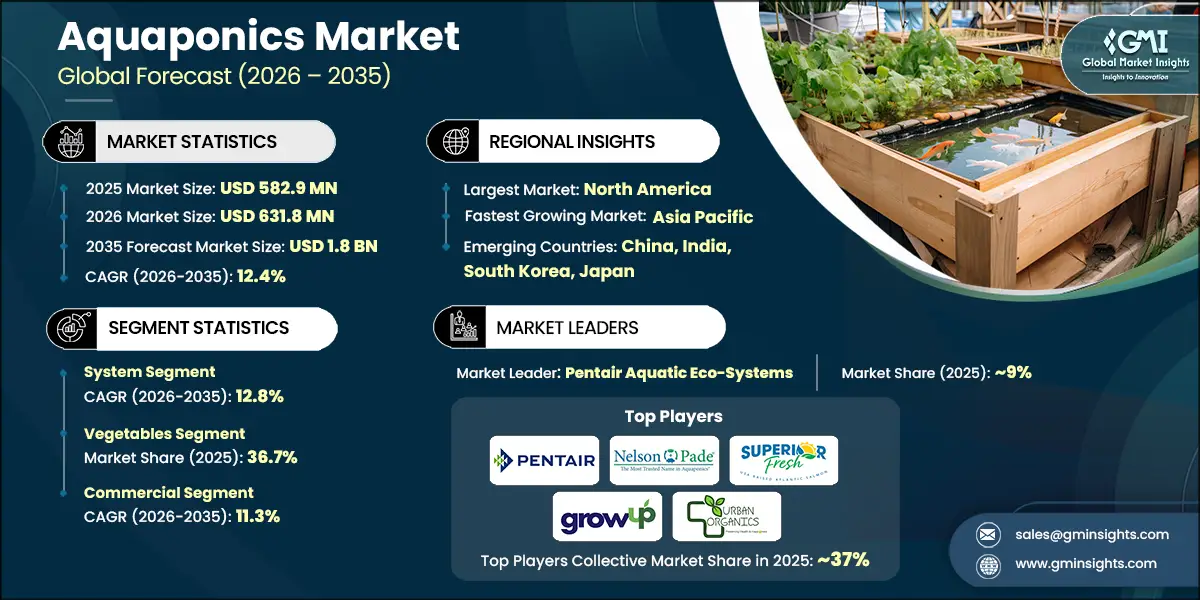
Aquaponics Market Key Takeaways
Market Size & Growth
- 2025 Market Size: USD 582.9 Million
- 2026 Market Size: USD 631.8 Million
- 2035 Forecast Market Size: USD 1.8 Billion
- CAGR (2026–2035): 12.4%
Regional Dominance
- Largest Market: North America
- Fastest Growing Region: Asia Pacific
Key Market Drivers
- Rising demand for sustainable and resource-efficient agriculture.
- Increased investment in urban and vertical farming initiatives.
- Growing global food security concerns.
Challenges
- High initial setup and capital costs.
- Technical complexity and knowledge barriers.
Opportunity
- Integration of renewable energy to lower operating costs.
- Expansion into underserved and remote regions.
Key Players
- Market Leader: Pentair Aquatic Eco-Systems led with over 9% market share in 2025.
- Leading Players: Top 5 players in this market include Pentair Aquatic Eco-Systems, Nelson and Pade, Inc., Superior Fresh, GrowUp Urban Farms, Urban Organics, which collectively held a market share of 37% in 2025.
Get Market Insights & Growth Opportunities
To get key market trends
Aquaponics Market Trends
- The growth in the number of growers looking for sustainable alternatives to traditional agricultural systems is driving growth in the market. Aquaponics is the combination of growing fish and hydroponically grown plants to provide an environment that uses less water than conventional farming methods. This allows producers in areas with limited freshwater resources such as arid and urban environments to manage their freshwater resources more effectively. Growing consumer awareness of sustainable food systems is driving implementation of aquaponic systems around the world.
- The increased number of urban and indoor farming projects has led to greater interest in aquaponic systems. Many urban areas do not have arable land and therefore use aquaponics to grow fresh fruits and vegetables as well as fish closer to their consumers. The controlled environment in which aquaponics are operated gives producers the ability to produce all year long, regardless of the season. Consequently, aquaponics contributes to food security locally by reducing the transportation costs associated with long supply chains.
- The emergence of commercial aquaponics facilities demonstrates that there is a growing number of entrepreneurs looking for profitable, integrated farming systems. Aquaponics provides a facility with two streams of revenue by allowing producers to sell their produce and fish at the same time. Careful planning is required for optimal nutrient recycling, which improves overall production efficiency. As producers see increased profits, they attract new investment opportunities as well as long-term commitments from stakeholders in agriculture.
- Improvements in technology, such as sensors, water filtration and automation, are increasing aquaponics system efficiency. Growers are now able to track real-time data of water quality and nutrient levels to ensure that plants and fish achieve ideal environmental conditions. Additionally, the use of automating equipment allows for less manual labour and thus reduces human error in the operating of the system, errors in the operation of the system impact total yield production from both fish and plants. Increasing system reliability will allow for further growth of the aquaponics industry.
- Several research has been done by educational institutions to develop new aquatic and terrestrial species combinations and to make system designs more efficient than they currently are. There are therefore a wide range of best practice guidelines available for growers now because of this type of research. By developing these guidelines, it has helped growers develop their technical skills and helped growers that are new to the aquaponics industry enter the market.
Aquaponics Market Analysis
Learn more about the key segments shaping this market
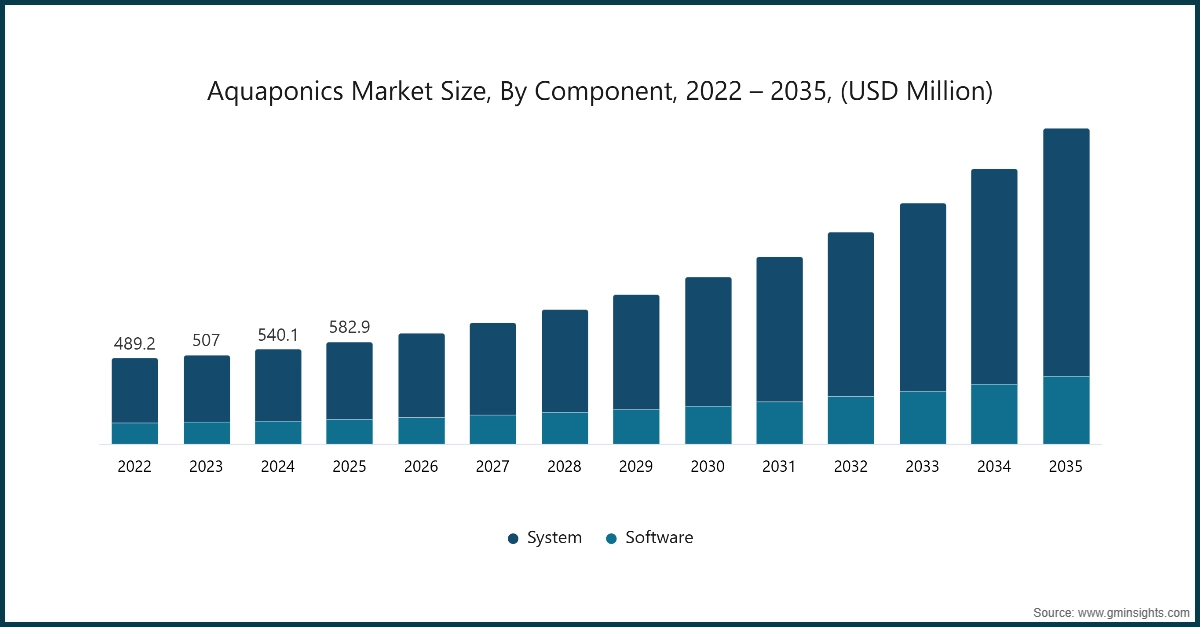
Based on component, the aquaponics market is categorized into system and software. The system segment accounted for revenue of around USD 443.4 million in 2025 and is anticipated to grow at a CAGR of 12.8% from 2026 to 2035.
- Systems dominate the market by component due to integrated operational functionality. Complete system setups combine tanks, grow beds, pumps, and filtration units efficiently. Commercial operators prefer full systems to ensure synchronized fish and plant production cycles. Pre-designed configurations reduce installation complexity and operational errors.
- Scalable system models support expansion across small farms and commercial facilities. Technological integration improves water circulation, nutrient management, and monitoring accuracy. Rising demand for sustainable food production strengthens adoption of comprehensive aquaponics systems globally.
Based on produce, of aquaponics market consists of fish, vegetables, fruits, and others. The vegetables emerged as leader and held 36.7% of the total market share in 2025 and is anticipated to grow at a CAGR of 7.2% from 2026 to 2035.
- Vegetables lead the market based on produce due to high consumer demand. Leafy greens such as lettuce, spinach, and herbs grow efficiently in aquaponic systems. Short growth cycles enable multiple harvests, improving productivity and revenue generation. Controlled environments ensure consistent quality and reduced pesticide usage.
- Restaurants and retail outlets prefer fresh, locally grown vegetables from sustainable sources. Lower cultivation risk compared to fruiting crops increases farmer adoption. Rising preference for organic and chemical-free produce strengthens vegetable segment dominance globally.
Learn more about the key segments shaping this market
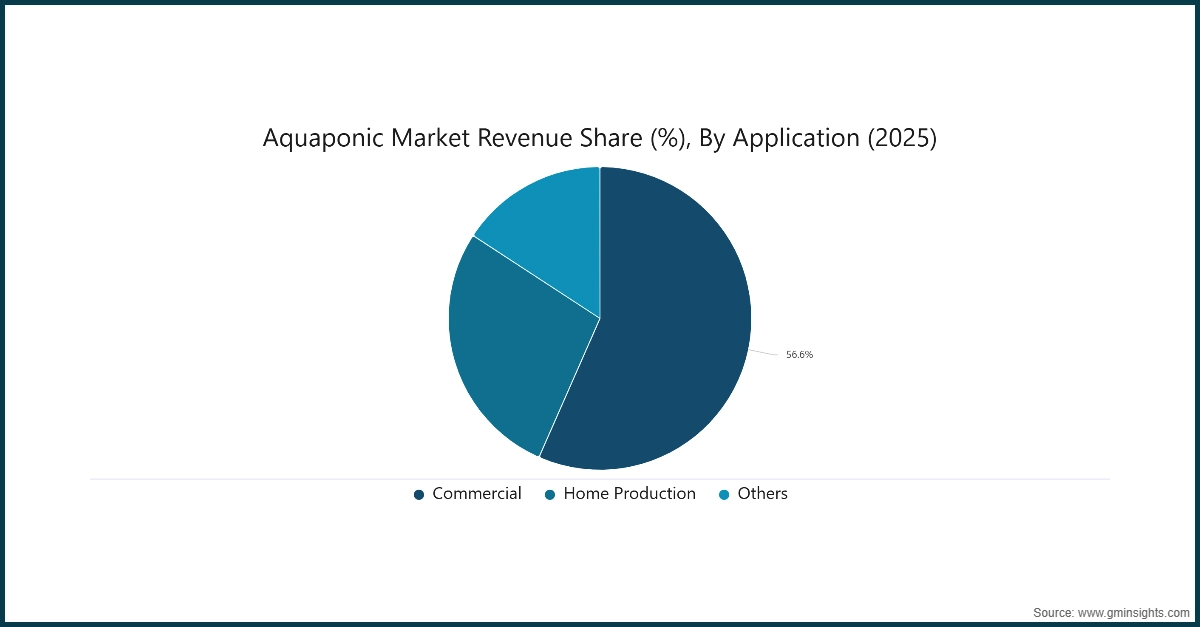
Based on application, aquaponics market consists of commercial, home production, and others. The commercial segment emerged as leader and held 56.62% of the total market share in 2025 and is anticipated to grow at a CAGR of 11.3% from 2026 to 2035.
- Commercial applications lead the market due to increasing demand for large-scale sustainable food production. Restaurants, supermarkets, and urban farms rely on aquaponics for consistent supply of fresh vegetables and fish. Controlled systems enable higher yields and efficient resource utilization compared to traditional farming.
- Commercial operators benefit from reduced water consumption and minimized environmental impact. Scalability and modular designs support expansion of production capacity. Growing focus on eco-friendly and locally sourced produce strengthens adoption in commercial settings. Continuous technological advancements reinforce commercial segment leadership in the global market.
North America Aquaponics Market
Looking for region specific data?
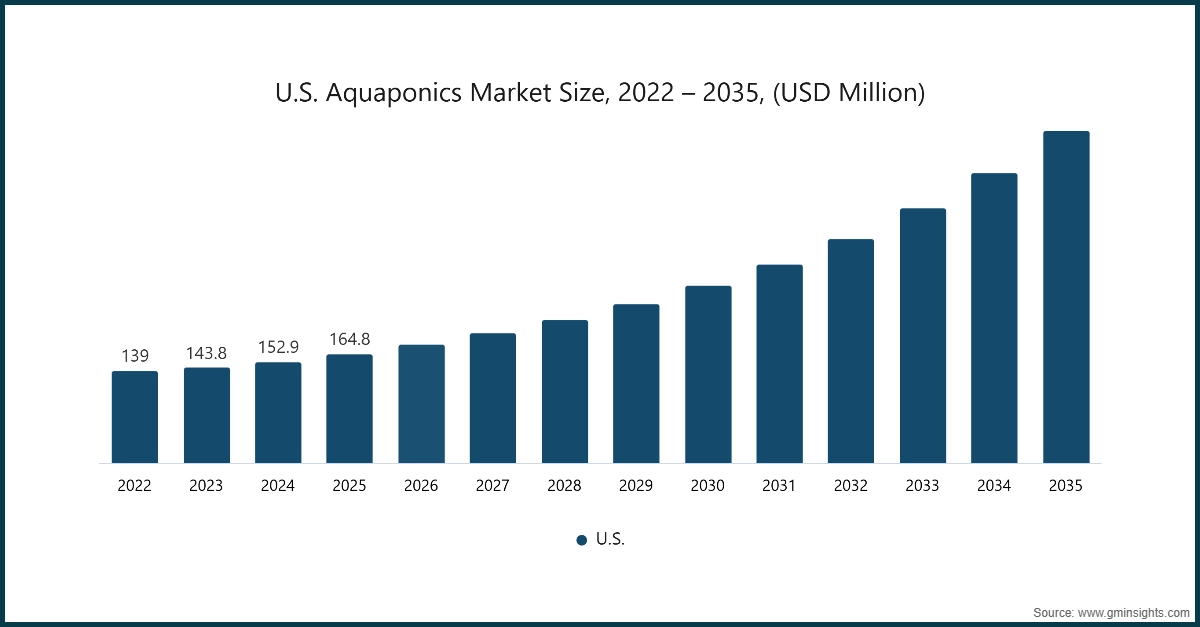
The U.S. dominates an overall North America aquaponics market and valued at USD 164.8 million in 2025 and is estimated to grow at a CAGR of 12.2% from 2026 to 2035.
- The U.S. aquaponics industry is growing steadily due to rising interest in sustainable food production. Urban farming initiatives support adoption of compact aquaponic systems for local produce. Rising consumer awareness of organic and pesticide-free food drives demand for aquaponic vegetables and fish. Research institutions and universities invest in aquaponics for educational and experimental purposes. Expansion of specialty farms increases commercial-scale system installations.
- Government programs promoting sustainable agriculture provide financial incentives and technical support. Integration of hydroponics and aquaculture technologies improves efficiency and yield. Growing farm-to-table trends encourage direct-to-consumer sales channels. Continuous innovation supports development of energy-efficient and automated aquaponic solutions.
Europe Aquaponics Market
In the Europe market, Germany is expected to experience significant and promising growth from 2026 to 2035.
- The Europe aquaponics industry grows through strong demand for locally sourced and organic food. Urban farming initiatives in countries like Germany and the Netherlands drive compact system adoption. Government sustainability programs encourage investment in eco-friendly agriculture technologies. Research institutions support pilot projects integrating aquaculture and hydroponics.
- Specialty restaurants and farmers’ markets increase commercial aquaponic produce consumption. Focus on water conservation promotes efficient and recirculating systems. Technological innovation supports sensor-based monitoring for optimal growth. Consumer preference for traceable food sources sustains long-term market demand.
Asia Pacific Aquaponics Market
In the Asia Pacific market, China held 32.01%market share in 2025 and is anticipated to grow at a CAGR of 12.4% from 2026 to 2035.
- The Asia Pacific market expands due to rising population and food security concerns. Urban farming in countries such as China, Japan, and Singapore drives small-scale system adoption. Government initiatives promote sustainable agriculture to reduce water and land usage. Commercial-scale aquaponics gains traction in vegetable and fish production sectors.
- Rising middle-class income supports demand for fresh and chemical-free produce. Integration of IoT and automation improves yield and operational efficiency. Export-oriented production sustains market growth in select economies. Growing awareness of environmental sustainability encourages adoption of energy-efficient systems.
Middle East and Africa Aquaponics Market
In the Middle East and Africa market, UAE held a significant market share in 2025 promising growth from 2026 to 2035.
- The Middle East and Africa market develops through water-efficient farming solutions. Arid climate conditions increase reliance on recirculating aquaponic systems. Government-backed agricultural modernization projects support commercial adoption. Urban agriculture initiatives in countries like UAE and South Africa drive localized food production.
- High demand for organic and fresh produce encourages investment in aquaponics. Limited arable land boosts adoption of vertical and compact system designs. Educational and research institutions promote technology transfer and skill development. Export opportunities for specialty crops sustain long-term market potential.
Aquaponics Market Share
- In 2025, the prominent manufacturers in aquaponics industry are Pentair Aquatic Eco-Systems, Nelson and Pade, Inc., Superior Fresh, GrowUp Urban Farms, and Urban Organics collectively held the market share of ~42%.
- Pentair Aquatic Eco-Systems is one of the most established suppliers of aquaculture and aquaponics equipment globally. The company provides filtration systems, pumps, tanks, and water management technologies essential for integrated fish and plant production. Pentair focuses on scalable and energy-efficient solutions for commercial aquaponic farms. Its broad product portfolio, global distribution network, and engineering expertise support its strong presence in professional aquaponics installations.
- Nelson and Pade, Inc. specializes in commercial aquaponic system design, training, and turnkey farm solutions. The company offers greenhouse-integrated aquaponics systems suited for leafy greens and fish production. It emphasizes standardized system models, education programs, and consulting services. Nelson and Pade’s structured approach to farm implementation and technical training has helped establish it as a recognized provider in North America and selected international markets.
Aquaponics Market Companies
Major players operating in the aquaponics industry include:
- Aquaculture Technology Group
- Aquaponic Lynx, LLC
- Aquaponic Solutions
- AquaSprouts
- Backyard Aquaponics
- Bright Agrotech
- EZ-Aquaponics
- FarmTek
- Greentrees International Pty Ltd.
- GrowUp Urban Farms
- Nelson and Pade, Inc.
- Pentair Aquatic Eco-Systems
- Superior Fresh
- Symbiotic Systems
- Urban Organics
Superior Fresh operates one of the largest commercial aquaponics farms in the United States. The company integrates salmon production with leafy green cultivation in controlled greenhouse environments. Superior Fresh focuses on sustainability, water efficiency, and year-round production. Its vertically integrated farming model and retail partnerships strengthen its position in premium sustainable food markets.
GrowUp Urban Farms combines aquaponics with vertical farming techniques to supply fresh produce in urban areas. The company emphasizes local food production, resource efficiency, and reduced transportation emissions. Its operations focus on supplying supermarkets and foodservice channels with pesticide-free greens. GrowUp’s integration of technology-driven climate control and aquaponic systems supports its presence in sustainable urban agriculture.
Urban Organics has been recognized for developing large-scale indoor aquaponic farms focused on leafy greens and fish production. The company emphasizes controlled environment agriculture and sustainable production methods. Urban Organics integrates water recirculation systems and greenhouse technologies to optimize yield. Its participation in urban redevelopment projects highlights the potential of aquaponics within metropolitan food supply chains.
Aquaponics Market Report Attributes
| Key Takeaway | Details |
|---|---|
| Market Size & Growth | |
| Base Year | 2025 |
| Market Size in 2025 | USD 582.9 Million |
| Market Size in 2026 | USD 631.8 Million |
| Forecast Period 2026-2035 CAGR | 12.4% |
| Market Size in 2035 | USD 1.8 Billion |
| Key Market Trends | |
| Drivers | Impact |
| Rising demand for sustainable and resource-efficient agriculture | Aquaponics uses significantly less water and land than traditional farming, making it attractive for sustainability-focused producers and consumers. |
| Increased investment in urban and vertical farming initiatives | Governments and private investors support urban food systems, driving adoption of aquaponic farms in cities where space and resources are limited. |
| Growing global food security concerns | Urbanization and population growth strain conventional agriculture; aquaponics offers scalable, high-yield systems that can help bridge food supply gaps. |
| Pitfalls & Challenges | Impact |
| High initial setup and capital costs | Aquaponic systems require significant upfront investment for infrastructure, technology, and training, slowing adoption among small and mid-sized growers. |
| Technical complexity and knowledge barriers | Effective aquaponics requires integrated expertise in both aquaculture and hydroponics, creating a steep learning curve that can hinder successful operation. |
| Opportunities: | Impact |
| Integration of renewable energy to lower operating costs | Using solar, wind, or waste-to-energy systems to power aquaponics can significantly reduce long-term costs and boost sustainability credentials. |
| Expansion into underserved and remote regions | Deploying modular aquaponics in areas with limited fresh produce access presents new market demand and social impact potential. |
| Market Leaders (2025) | |
| Market Leader |
Market share of ~9% |
| Top Players |
Collective market share of ~37% |
| Competitive Edge |
|
| Regional Insights | |
| Largest Market | North America |
| Fastest growing market | Asia Pacific |
| Emerging countries | China, India, South Korea, Japan |
| Future outlook |
|
What are the growth opportunities in this market?
Aquaponics Industry News
- In September 2025, Nelson and Pade launched new Aquaponics Consulting & Training Programs for commercial growers focused on business scalability and automated systems integration. These expanded programs include online modules and field‑based modules to support high‑yield aquaponic farm operations in the U.S. and abroad.
- In August 2025, Pentair Aquatic Eco‑Systems announced the R&D Release of Next‑Gen Aquaponic Filtration Systems that integrate advanced biofiltration media and remote monitoring for water quality optimization. These systems are designed to improve fish health and plant productivity in commercial setups.
- In 2025, Superior Fresh expanded its production capacity with a new, larger aquaponics facility in Wisconsin capable of producing more sustainable leafy greens and Atlantic salmon using closed‑loop systems. The expansion reflects increased demand for locally produced aquaponic products.
- In March 2025, Backyard Aquaponics updated its Home Aquaponics Starter Kit lineup with redesigned modular grow beds and automated nutrient dosing options to simplify system setup for beginners and hobbyists.
The aquaponics market research report includes in-depth coverage of the industry, with estimates & forecast in terms of revenue (USD Million) and volume (Thousand Units) from 2022 to 2035, for the following segments:
Market, By Component
- System
- Grow Lights
- Pumps and Valves
- Water Heaters
- Aeration Systems
- Monitoring and Control Systems
- Others
- Software
Market, By Framing Technique
- Nutrient Film Technique (NFT)
- Media-Filled Growbeds
- Deep Water Culture (DWC)
- Others
Market, By Produce
- Fish
- Vegetables
- Fruits
- Others
Market, By Application
- Commercial
- Home Production
- Others
The above information is provided for the following regions and countries:
- North America
- U.S.
- Canada
- Europe
- Germany
- UK
- France
- Italy
- Spain
- Asia Pacific
- China
- Japan
- India
- South Korea
- Australia
- Latin America
- Brazil
- Mexico
- Argentina
- MEA
- Saudi Arabia
- UAE
- South Africa
Frequently Asked Question(FAQ) :
What is the market size of the aquaponics market in 2025?
The market size was USD 582.9 million in 2025, with a CAGR of 12.4% expected through 2035 driven by rising demand for sustainable agriculture and resource-efficient food production systems. Growing investment in urban farming and controlled environment agriculture is strengthening overall industry expansion.
What is the projected aquaponics market size in 2026?
The market is projected to reach USD 631.8 million in 2026. Continued adoption of integrated aquaculture and hydroponic farming solutions across commercial and urban farming sectors supports steady market growth.
What is the projected value of the aquaponics market by 2035?
The market is expected to reach USD 1.8 billion by 2035, supported by rapid commercialization of vertical farming and increasing consumer preference for organic and pesticide-free produce. Technological advancements in monitoring, automation, and modular system designs are accelerating long-term industry development.
How much revenue did the system segment generate in aquaponics industry in 2025?
The system segment generated USD 443.4 million in 2025 and dominated the market by component. Strong demand for turnkey aquaponic systems integrating tanks, filtration units, grow beds, and monitoring technologies reinforces its leadership across commercial farming operations.
What was the market share of the vegetables segment in 2025?
The vegetables segment held 36.7% of the total aquaponics market share in 2025. High consumer demand for leafy greens, short harvest cycles, and preference for locally grown sustainable produce contribute to segment dominance within the industry.
What was the market share of the commercial application segment in 2025?
The commercial application segment held 56.62% of the total aquaponics industry share in 2025. Increasing reliance on large-scale sustainable food production by restaurants, supermarkets, and urban farms continues to drive strong industry adoption.
How much was the U.S. aquaponics market valued at in 2025?
The U.S. market was valued at USD 164.8 million in 2025. Growth is driven by rising urban farming adoption, expanding commercial greenhouse installations, and increasing consumer demand for organic, locally produced fish and vegetables.
What are the upcoming trends in the aquaponics industry?
Key trends include expansion of vertical and indoor farming projects, integration of IoT-based monitoring systems, increasing commercialization of modular aquaponic setups, and growing use of renewable energy solutions to improve sustainability and reduce operating costs across the market.
Who are the key players in the aquaponics industry?
Key players in the market include Pentair Aquatic Eco-Systems, Nelson and Pade, Inc., Superior Fresh, GrowUp Urban Farms, and Urban Organics. These companies focus on integrated system development, automation technologies, and commercial-scale sustainable farming solutions to strengthen their industry position.
Aquaponics Market Scope
Related Reports