Summary
Table of Content

Aquaculture Equipment Market
Get a free sample of this report
Form submitted successfully!
Error submitting form. Please try again.
Thank you!
Your inquiry has been received. Our team will reach out to you with the required details via email. To ensure that you don't miss their response, kindly remember to check your spam folder as well!
Request Sectional Data
Thank you!
Your inquiry has been received. Our team will reach out to you with the required details via email. To ensure that you don't miss their response, kindly remember to check your spam folder as well!
Form submitted successfully!
Error submitting form. Please try again.
Aquaculture Equipment Market Size
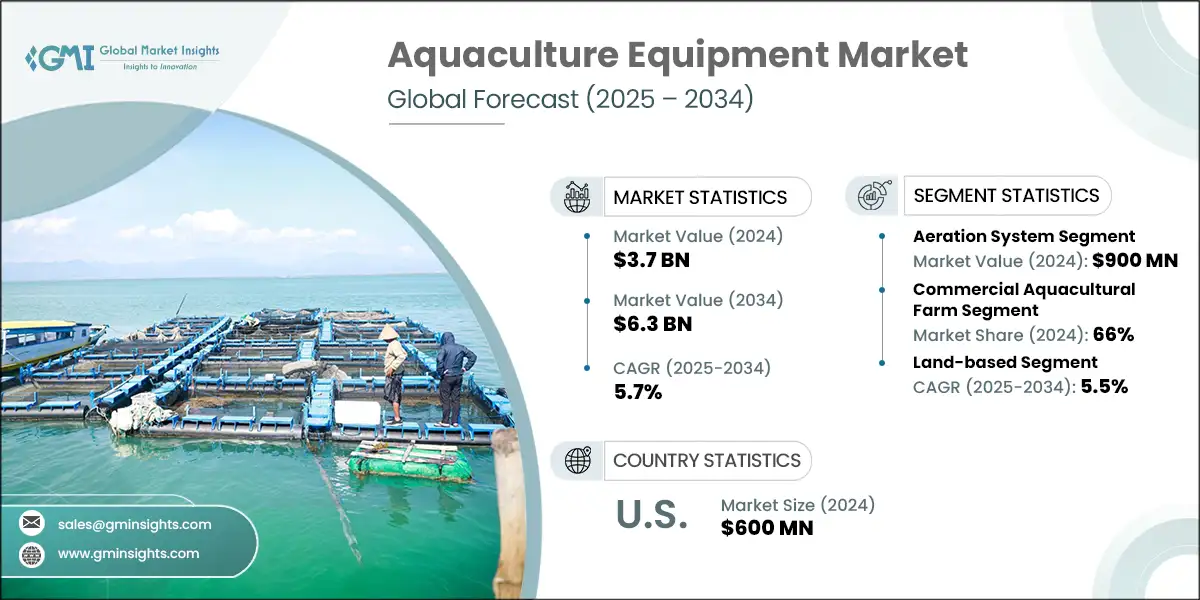
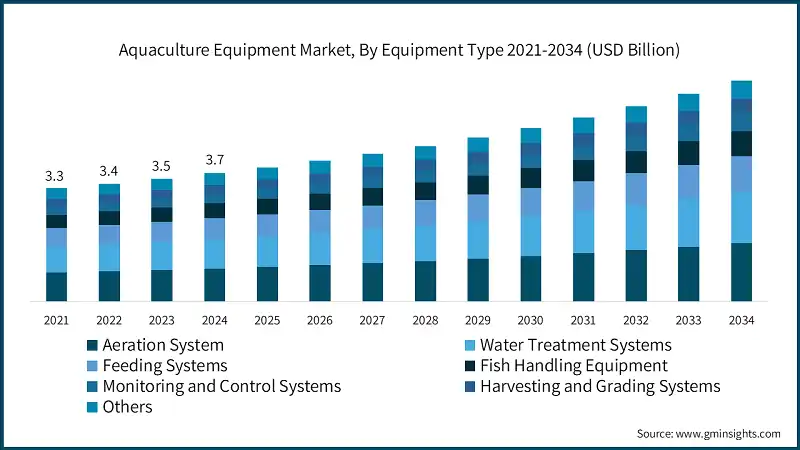
The global aquaculture equipment market size was estimated at USD 3.7 billion in 2024. The market is expected to grow from USD 3.8 billion in 2025 to USD 6.3 billion in 2034, at a CAGR of 5.7%.
Aquaculture Equipment Market Key Takeaways
Market Size & Growth
- 2024 Market Size: USD 3.7 Billion
- 2034 Forecast Market Size: USD 6.3 Billion
- CAGR (2025–2034): 5.7%
Key Market Drivers
- Growing global seafood demand.
- Technological advancements in aquaculture systems.
Challenges
- High capital investment requirements.
- Lack of technical expertise in developing regions.
Opportunity
- Expansion of Recirculating Aquaculture Systems (RAS).
- Rising seafood demand in emerging economies.
Key Players
- Market Leader: LINN Geratebau led with over 2% market share in 2024.
- Leading Players: Top 5 players in this market include Blue Ridge Aquaculture, Frea Aquaculture Solutions, INVE Aquaculture, LINN Geratebau, Asakua, which collectively held a market share of 6% in 2024.
Get Market Insights & Growth Opportunities
- The market for aquaculture equipment is expanding rapidly as global demand for sustainable seafood production continues to increase. As consumers in many parts of the globe continue to adopt healthier eating patterns that include protein from seafood, these products have become increasingly prevalent and are now part of even routine meals. As fish consumption continues to increase, fish farmers must scale up quickly to meet demand. Fish farmers require reliable, advanced aquaculture equipment that enhances productivity without harming the environment.
- According to the Enviroliteracy team, the fisheries and aquaculture industries play a significant economic role, supporting the livelihoods of millions worldwide. It is reported that about 10-12 percent of the world’s population, which is over 870 million people, depends on fisheries and aquaculture.
- An important trend in the aquaculture equipment market is the move to innovation along with smart farming. Farmers are implementing automatic feeders, sensors, and other monitoring devices, and recirculating aquaculture systems (RAS), which increase efficiency, reduce the need for labour, and maintain water quality. These technologies do not just create maximum yields, but they can maintain fish health and minimize environmental impact and continue to increase the market for these more advanced types of equipment.
- A key driver is the growing emphasis on sustainability and lowering the environmental impact of production. Consumers, regulators, and investors want to know how seafood is produced, and the industry has responded by leveraging sustainable feed alternatives, waste management, low-impact farming practice management, and more, all reliant on specialized equipment designed for sustainable aquaculture.
- A need for food security and rural development is driving heavy investment in aquaculture by governments and private players alike. Changing climate in many parts of the world renders traditional agriculture untenable, whereas aquaculture offers a way to fulfil nutritional needs in a controlled, scalable, and resilient manner. This is accompanied by targeted initiatives and substantial funding directed at aquaculture and strategic investments that spur demand for modern equipment to establish new farms and refurbish old ones, with a focus on developing countries.
- Asia-Pacific leads the aquaculture equipment market due to its strong production base, established farming infrastructure, and supportive government policies. Countries like China, India, and Vietnam have long-standing aquaculture industries, which continue to expand with rising seafood demand and modernization efforts.
- North America, on the other hand, is the fastest-growing region in this market. The growth is driven by a shift toward sustainable and locally sourced seafood, increasing use of advanced technologies like recirculating aquaculture systems, and growing investment in smart and land-based fish farming solutions.
To get key market trends
Aquaculture Equipment Market Trends
- The aquaculture sector is experiencing an immense transformation due to increasing global consumption of seafood, overfishing issues, labour shortages, and efforts toward sustainable food systems. With fish stocks in very poor condition and the world population still growing, aquaculture is emerging as a critical solution to addressing food security, pressing aquaculture farmers and technology innovators to embrace new methods that efficiently scale and are environmentally responsive.
- The sector is adopting smart technologies in a leading-edge way to maximize productivity and sustainability. Automation systems are already helping to manage core operations like feeding and water quality management, as well as essential environmental control. Additionally, IoT technology-based sensors track real-time data issues such as temperature, pH, salinity, dissolved oxygen, etc. User algorithms built into AI-based technologies are pulling these data streams to be analyzed and acted on so that farmers can optimize farm systems. With no need for additional manual handling of many operations, we are developing more repeatable production parameters while positively benefiting the health and well-being of the aquatic environment.
- The emerging trend in aquaculture is digital transformation. With artificial intelligence, machine learning, and big data analytics, farmers can collect, analyze, and synthesize extensive data to help them make better, faster decisions. Cloud-based and interactive monitoring and management platforms allow for remote management of farms, while blockchain systems are beginning to support traceability objectives and transparency through the seafood supply chain. Digital transformations can also help with regulatory compliance and respond to evolving consumer needs for responsible seafood sourcing.
- Smart aquaculture is another emerging trend, and the growth of investments in technology-enabled farming systems is gaining popularity. Intelligent tools are deployed for recognizing and diagnosing early disease issues, optimizing feed conversion ratios, or creating efficiencies with energy use. Solutions include tools such as underwater robotics that can routinely survey fish stocks, reduce stress for farm fish, and increase productivity and site controls. Additionally, aquaculture is moving rapidly to deeper water and more controllable farm environments.
- Biosecurity and sustainability are now interwoven into aquaculture development. The industry players are taking action by implementing materials and practices that have a lesser impact on the environment. Recirculating aquaculture systems, ultraviolet-light-based water sterilization, and bio-degradable cages will help to mitigate water consumption and the disposal of any waste products to the environment. Monitoring health smartly can thus lead to quick interventions for animal welfare and reduced antibiotic use. The focus is on promoting good health and, at the same time, protecting aquatic environments, engaging in sustainable development, and ethical food production.
Aquaculture Equipment Market Analysis
Learn more about the key segments shaping this market
Based on the equipment type, the aquaculture equipment market is divided into aeration systems, water treatment systems, feeding systems, fish handling equipment, monitoring, and control systems, harvesting and grading systems, and others. In 2024, the aeration system dominated the market generating revenue of USD 900 million and expected to grow at a CAGR of 6% during the forecast period.
- Aeration systems are the primary category in the aquaculture equipment market because they respond to a critical biological need, such as the requirement of dissolved oxygen in the water. Oxygen is important to fish survival, growth, and health, and thus any aquaculture operation must include aeration systems from day one. Other equipment includes systems that could be upgraded to larger or new operational models, or systems that may be considered optional at some future date based on the farm's size or operational goals, but there is not such an option for aerators; if a farm does not have aeration, the fish are stressed, and they die within hours if the aeration is not established.
- Also, the reason for the dominance of aeration systems is their universal application across all scales and species of aquaculture. Whether it is a small inland pond farm or a large industrial offshore facility, whether it is shrimp, salmon, or tilapia, whatever the type of system or aquaculture species, all production systems rely on aerated water. Aquaculture's reliance on aeration systems across species and scales guarantees that these systems reach a large customer base.
- Due to the ongoing operation of aeration systems, there is a sustainable source of revenue from a maintenance and replacement cycle. These systems are always on and subject to very high mechanical and operational stress, whereas feeders and monitoring systems function periodically. This leads to increased equipment failure and frequency upgrades and replacements. Additionally, the increasing demand for energy efficiency and integration of advanced technologies into these new products, such as IoT and automated monitoring, fueled demand and increased the price per unit for advanced aeration technologies.
Learn more about the key segments shaping this market
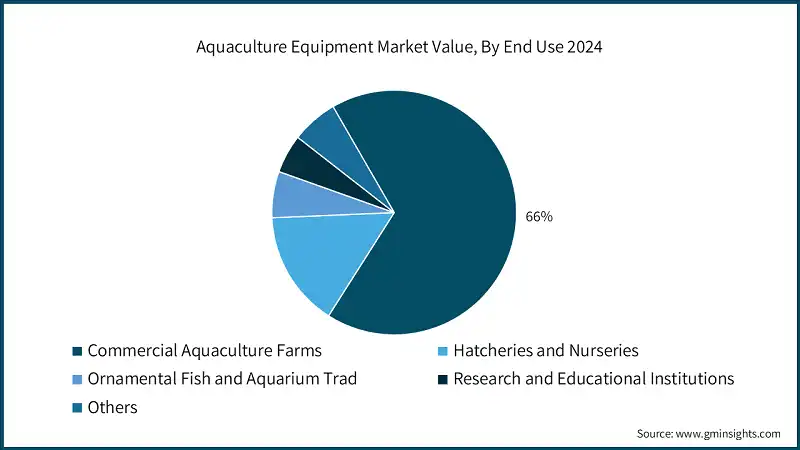
Based on end use, the aquaculture equipment market is segmented into commercial aquaculture farms, hatcheries and nurseries, ornamental fish and aquarium trad, research and educational institutions, and others. In 2024, the commercial aquacultural farm segment dominates the market with 66% market share, and the segment is expected to grow at a CAGR of 5.9% from 2025 to 2034.
- The commercial segment dominates, primarily thanks to the growing global demand for seafood and increased pressure on wild fish stocks. Commercial operations scale up in response to increasing demand, leading to considerable investment in specialized aquaculture equipment such as aeration systems, feeding systems, water quality testing equipment, and fish grading equipment.
- Commercial aquaculture operations typically involve large-scale operations with continuous production, intensive stocking densities, and, as a result, require reliable, automated equipment to look after the health of the fish and optimize feed conversion and water quality. As a profit-making venture, commercial farms are more likely to invest in innovative technologies that maximize yield and productivity while reducing costs, feeding expected and continued strong demand for aquaculture equipment.
Based on application, the aquaculture equipment market is segmented into land-based and sea-based. In 2024, the land-based segment dominates the market and is expected to grow at a CAGR of 5.5% from 2025 to 2034.
- Land-based aquaculture is achieving considerable momentum in the market because of its ability to exert better control of environmental conditions. The industry now has relatively precise control over certain water quality parameters including temperature, oxygen, and salinity, and is demanding higher levels of equipment and monitoring for more equipment input per facility. Therefore, accountability of production is greater, and the risk of issues caused by outside environmental factors decreases.
- These very systems also provide better biosecurity, as fish can now be completely isolated from wild fish populations, leading to less stress and disease outbreaks. More species are generally farmed now that there is heavy investment in water treatment and filtration, and water quality monitoring and management technologies. Land-based farms have less regulatory burden than traditional farms and more options of being in proximity to a market with reduced transport costs and selection of site, from a myriad of logistical considerations, for development purposes.
- Land-based farms are more resilient to climate change and operational disruptions, making them increasingly attractive as sea-based operations face stricter environmental restrictions. Their ease of access also supports greater automation and technology integration. As costs drop and demand for sustainable solutions rises, land-based aquaculture is becoming a key driver of equipment investment in the aquaculture equipment market.
- With proven resilience to climate change and issues of operation, land-based farms are becoming more attractive as sea-based operations face more environmental restraints and limitations. Better access also allows for a greater degree of automation and technology. With declining costs and rising consumer expectations for sustainability, land-based farms are quickly becoming one of the largest generators of equipment investments in aquaculture.
Looking for region specific data?
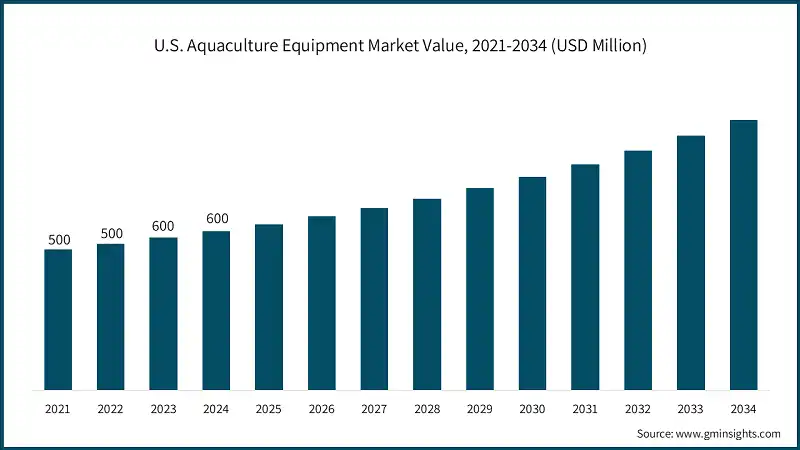
In terms of country, the United States led the aquaculture equipment market with 78% of the North American market share and estimated USD 600 million in revenue during 2024.
- The U.S. aquaculture equipment market is expanding because of a combination of federal supportive policy, increasing domestic seafood demand, and strong technological capacity. Federal support for aquaculture policy, including the National Aquaculture Act and NOAA’s regulation and science support, has created a policy space for aquaculture and a business climate for investment in sustainable and high-tech aquaculture. The recently modernized national aquaculture plan complements that policy framework by supporting consumption, food security, environmental sustainability, and climate resiliency, providing further policy strength to the sector.
- Another important aspect driving growth in aquaculture equipment is the difference between the seafood consumption and the seafood production gap. Most seafood consumed in the United States is imported, thus, one pathway to expand U.S. aquaculture is, at the same time, the federal dietary guidelines call for greater seafood consumption. As aquaculture moves to large-scale, more aquaculture systems for equipment are needed to support the expansion efforts. This includes aquaculture systems for aeration and water treatment, automatic feeders, and systems for environmental monitoring, which will further increase the aquaculture equipment market demand.
- According to a report by NOAA Fisheries, high-value seafood products coming from aquaculture have contributed to 24% of the value of domestic seafood products. Americans spend an average of $102 billion each year on seafood. According to a study, it was found that 35% of the money was spent on seafood at home and 65% at restaurants or away from home sources.
- With significant funds invested in research and development, U.S. companies and universities are developing advanced land-based systems, smart feed options, and energy-efficient equipment. These innovations are relevant to the U.S. market and provide opportunities for exports. Furthermore, the U.S. continues to have some of the best infrastructure available, further promotes demand with high competitiveness and purchasing power, and possesses strict environmental and regulatory constraints.
The Europe aquaculture equipment market was valued at USD 700 million in 2024 and is projected to grow at a CAGR of 5.1% between 2025 and 2034.
- Europe’s aquaculture equipment market is growing, reflecting the maturity and innovation of the market. Cost of food and premium species like salmon in Norway and sea bass in Scotland or the Mediterranean are yielding a steady demand through existing operations, given species have already matured.
- In Europe, aquaculture business operators are constrained by environmental regulations and sustainability goals established by regulatory bodies, including the Green Deal and the Farm to Fork Strategy. Consequently, operators are looking at investing in better water treatment, water waste management, carbon footprint reduction, and emerging technologies to reduce their energy footprint. With high labour costs and the trend towards automation and the introduction of smart technologies, the entire supply chain is allowing these systems to be applied to aquaculture, from feeding systems, greenhouse monitors, to intelligent remote monitoring systems for fish farmers.
The Asia Pacific aquaculture equipment market was valued at USD 1.7 billion in 2024 and is projected to grow at a CAGR of 6.1% between 2025 and 2034.
- The Asia Pacific aquaculture equipment market reflects its globally dominant position in aquaculture production and rapid modernization in aquaculture equipment systems. The need for continued equipment and system upgrades, replacements, and expansions is constant from the tens of thousands of farms that are operated under their national aquaculture system. As small-scale operators move towards more industrialized aquaculture practices, the need for aquaculture equipment becomes even greater.
- Growing seafood demand, stricter food safety regulations, increased environmental regulations, and the expansion of aquaculture production have pushed the modernization of aquaculture practices to the forefront. Governments and national aquaculture sectors continue to assist in the transformation of aquaculture through government subsidies and modernization programs. Producers are increasingly investing in aeration systems, water treatment, automated feeding, and smart monitoring systems in a quest to increase operational efficiencies and meet the requirements of export markets, along with governmental regulations.
- According to the Ministry of Fisheries, Animal Husbandry & Dairying, India is the 3rd largest fish-producing and 2nd largest aquaculture-producing nation in the world. The Blue Revolution in India demonstrated the importance of the Fisheries and Aquaculture sector.
- According to World Population Review, fish consumption by country, Overall, China is by far the world’s largest consumer of fish, with 60,541 tons annually, as of 2022. That is more than four times greater than the next biggest consumer.
- In addition to modernization pressures, Asia Pacific aquaculture is experiencing demographic changes such as labour shortages due to rural migration, climatic changes, and industry consolidation. These pressures all accelerated the use of automation, biosecurity systems, and climate-resilient infrastructure. As many operators have leapfrogged technologies and gone from extremely low technology systems to high technology systems, Asia Pacific is very quickly changing into a conduit for high-tech aquaculture systems. Furthermore, as Asia Pacific is increasingly affected by export market demand pressures and has strong government support through aquaculture, it is the key growth and driving force in the world market.
The Middle East and Africa aquaculture equipment market was valued at USD 300 million in 2024.
- The Middle East and Africa aquaculture equipment market is an emerging and has high latent potential market segment. Most players are in a transitional stage from normal agricultural methods to an intensive system with foundational demand for basic aquaculture equipment, and require significant basic equipment, including but not limited to aerators, pumps, and feeders.
- Key growth drivers include severe water scarcity and food security concerns, prompting productive investment and encouraging the adoption of water-efficient systems such as recirculated aquaculture systems (RAS) and government-backed aquaculture investment plans, especially in Egypt, Nigeria, and the UAE.
- Although a small market, the aquaculture equipment market is strengthening as the region diversifies its economy around aquaculture and has developed emerging urban aquaculture projects. The region presents opportunities for long-term equipment suppliers prepared to offer sustainably adapted or sustainably installed equipment to meet growing ecosystemic considerations and transfer technology within viable local frameworks.
Aquaculture Equipment Market Share
- The top 7 companies in the aquaculture equipment industry are Blue Ridge Aquaculture, Frea Aquaculture Solutions, INVE Aquaculture, LINN Geratebau, Asakua, Grundfos Holding A/S, PentairAES collectively holding a share of 6% in the market.
- These companies continue to acquire and merge with others, expand facilities, and make various collaborations to increase their product offerings, access customer bases, and secure their market positions.
- AKVA Group gains market share based on its focus on sea-based aquaculture systems, which resulted in significant revenues for 2024. They offer complete, integrated solutions, from cages to advanced sensors. They are also pioneers in deep-water and post-smolt solutions, which shows they see the future of industry in high-technology offshore farming.
- Xylem gains market share through partnerships built over decades in aquaculture, combined with its global market leadership in pumps. Xylem has a strong historical relationship within its science-based, water technology platform, to create integrated systems, from design to maintenance, for fish farms, OEMs, and processors. Their applications in other fields strengthen their reliability and efficiency for aquaculture, along with their long history in that industry.
- Blue Ridge Aquaculture, Inc. gains market share because they are both a producer and equipment supplier. They are an innovator in land-based recirculating aquaculture systems (RAS) in addition to developing equipment based on their own experiences in operations.
Aquaculture Equipment Market Companies
Major players operating in the aquaculture equipment industry are:
- ABB
- AKVA
- Asakua
- Blue Ridge Aquaculture
- CPI Equipment
- eWater Aquaculture Equipment Technology
- Frea Aquaculture Solutions
- Grundfos Holding A/S
- Innovasea
- INVE Aquaculture
- LINN Geratebau
- Merck & Co.
- PentairAES
- Pioneer
- Xylem
To improve the product and market share key players are constantly investing in technological activities and are also entering into partnerships to provide improved and better solutions for the customers. These investments are benefiting both companies and customers as they help develop and offer solutions as per the changing technological trends and thus the customer requirements.
AKVA Group is a global supplier of aquaculture technology and services, with its headquarters in Norway, with a focus on sea-based and land-based fish farming systems. AKVA has been operating for decades, providing a complete portfolio of feeding systems, cages, nets, and advanced digital monitoring products. AKVA regularly collaborates with clients in over 60 countries.
Xylem Inc is a global water technology company with headquarters in the U.S. that offers an extensive portfolio of pumps, treatment systems, and analytical instruments. Xylem provides integrated water management solutions for aquaculture that help enable sustainable and efficient fish farming, by leveraging their leadership across several water-intensive industries.
Innovasea is an end-to-end aquaculture technology company, with origins in the U.S., which offers a complete suite of solutions ranging from fish tracking, biomass monitoring, and smart feeding systems. Innovasea has a strong presence in North America, and they are rapidly creating a global footprint. Innovasea's main objective is to enable sustainable aquaculture by offering connected, data-driven platforms.
Aquaculture Equipment Market Report Attributes
| Key Takeaway | Details |
|---|---|
| Market Size & Growth | |
| Base Year | 2024 |
| Market Size in 2024 | USD 3.7 Billion |
| Forecast Period 2025 - 2034 CAGR | 5.7% |
| Market Size in 2034 | USD 6.3 Billion |
| Key Market Trends | |
| Drivers | Impact |
| Growing global seafood demand | Increases pressure on production capacity, driving investment in efficient equipment |
| Technological advancements in aquaculture systems | Enables precision farming, reduces losses, and boosts operational efficiency |
| Pitfalls & Challenges | Impact |
| High capital investment requirements | Slows down adoption, especially among small-scale farmers |
| Lack of technical expertise in developing regions | Limits effective use and maintenance of advanced equipment |
| Opportunities: | Impact |
| Expansion of Recirculating Aquaculture Systems (RAS) | Drives demand advanced water treatment, filtration, and monitoring equipment |
| Rising seafood demand in emerging economies | Encourages new facility setups, boosting equipment sales |
| Market Leaders (2024) | |
| Market Leaders |
2% Market Share |
| Top Players |
Collective market share in 2024 is 6% |
| Competitive Edge |
|
| Regional Insights | |
| Largest Market | Asia Pacific |
| Fastest growing market | North America |
| Emerging countries | India, USA, Germany |
| Future outlook |
|
What are the growth opportunities in this market?
Aquaculture Equipment Industry News
- In February 2025, ABB won a significant contract to supply automation and control systems for a new, 25,000-ton land-based salmon plant in Nordland, Norway. The contract includes control rooms, instrumentation, frequency converters, and lighting systems, all intended to monitor water quality and fish welfare.
- In April 2025, Innovasea hired RAS expert Miguel Martin to enhance its team and capabilities in designing large-scale recirculating aquaculture systems for worldwide markets.
- In November 2024, Innovasea released an algorithm for sea bream, which is the sixth species supported by its AI-driven system, BiomassPro (primarily a biomass tracking tool).
- In December 2024, Innovasea renewed its global framework agreement with Mowi, one of the world's largest seafood companies, further cementing the position of Innovasea as a major technology provider for Mowi's aqua operation worldwide, confirming its leadership role in cutting-edge monitoring, biomass tracking, and aquaculture system solutions.
The aquaculture equipment market research report includes in-depth coverage of the industry with estimates & forecasts in terms of revenue (USD Billion) and volume (Million Units) from 2021 to 2034, for the following segments:
Market, By Equipment type
- Aeration system
- Water treatment systems
- Feeding systems
- Fish handling equipment
- Monitoring and control systems
- Harvesting and grading systems
- Others (pumps, lights, etc.)
Market, By Application
- Land based
- Sea based
Market, By End Use
- Commercial aquaculture farms
- Hatcheries and nurseries
- Ornamental fish and aquarium trad
- Research and educational institutions
- Others (recreational fishing, fisheries, and aquaculture departments, etc.)
Market, By Distribution Channel
- Direct
- Indirect
The above information is provided for the following regions and countries:
- North America
- U.S.
- Canada
- Europe
- Germany
- UK
- France
- Spain
- Italy
- Netherlands
- Asia Pacific
- China
- Japan
- India
- Australia
- South Korea
- Latin America
- Brazil
- Mexico
- Argentina
- MEA
- South Africa
- Saudi Arabia
- UAE
Frequently Asked Question(FAQ) :
What is the market size of the aquaculture equipment in 2024?
The market size was USD 3.7 billion in 2024, with a CAGR of 5.7% expected through 2034. The growth is driven by increasing demand for sustainable seafood production and advancements in aquaculture technologies.
What is the projected value of the aquaculture equipment market by 2034?
The market is poised to reach USD 6.3 billion by 2034, fueled by the adoption of smart technologies, digital transformation, and environmentally sustainable practices.
How much revenue did the aeration system segment generate in 2024?
The aeration system segment generated approximately USD 900 million in 2024 and is expected to witness 6% CAGR during the forecast period.
What was the market share of the commercial aquacultural farm segment in 2024?
The commercial aquacultural farm segment dominated the market with a 66% share in 2024 and is set to expand at a CAGR of 5.9% till 2034.
What is the growth outlook for the land-based aquaculture segment from 2025 to 2034?
The land-based aquaculture segment is likely to showcase around 5.5% CAGR between 2025 and 2034.
Which country leads the aquaculture equipment sector?
The U.S. holds 78% of the regional market share, generating $600 million in 2024, led by supportive policies, higher seafood demand, and tech advancements.
What are the emerging trends in the aquaculture equipment market?
Emerging trends include smart tech, AI and IoT adoption, blockchain for transparency, biosecurity, and sustainable practices like recirculating systems and biodegradable cages.
Who are the key players in the aquaculture equipment industry?
Key players include ABB, AKVA, Asakua, Blue Ridge Aquaculture, CPI Equipment, Grundfos Holding A/S, Innovasea, INVE Aquaculture, LINN Geratebau, Merck & Co., PentairAES, Pioneer, and Xylem.
Aquaculture Equipment Market Scope
Related Reports