Summary
Table of Content

Anti-graffiti and Self-cleaning Coatings Market
Get a free sample of this report
Form submitted successfully!
Error submitting form. Please try again.
Thank you!
Your inquiry has been received. Our team will reach out to you with the required details via email. To ensure that you don't miss their response, kindly remember to check your spam folder as well!
Request Sectional Data
Thank you!
Your inquiry has been received. Our team will reach out to you with the required details via email. To ensure that you don't miss their response, kindly remember to check your spam folder as well!
Form submitted successfully!
Error submitting form. Please try again.
Anti-graffiti & Self-cleaning Coatings Market Size
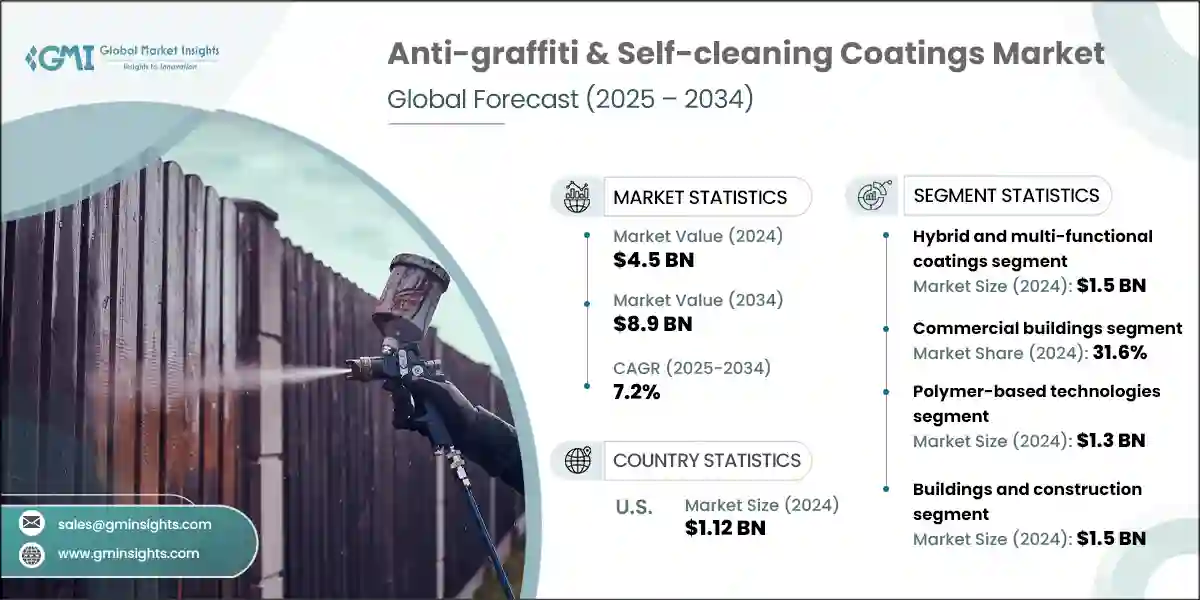
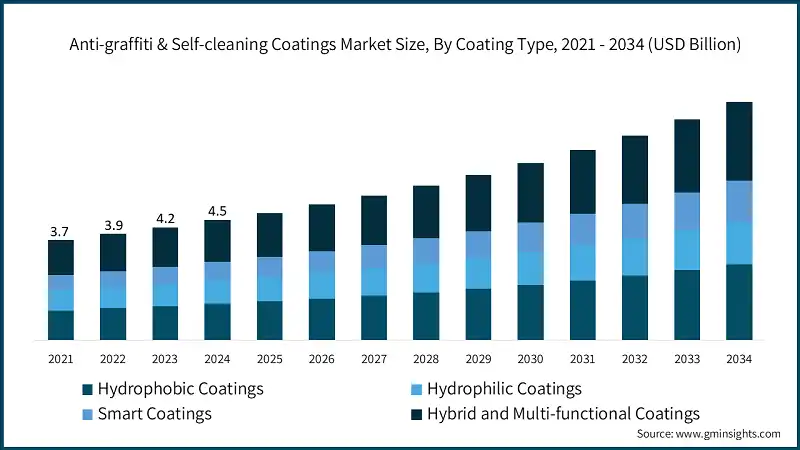
The global anti-graffiti & self-cleaning coatings market was estimated at USD 4.5 billion in 2024. The market is expected to grow from USD 4.7 billion in 2025 to USD 8.9 billion by 2034, growing at a CAGR of 7.2%.
Anti-graffiti and Self-cleaning Coatings Market Key Takeaways
Market Size & Growth
- 2024 Market Size: USD 4.5 Billion
- 2034 Forecast Market Size: USD 8.9 Billion
- CAGR (2025–2034): 7.2%
Regional Dominance
- Largest Market: Asia Pacific
- Fastest Growing Region: Middle East and Africa
Key Market Drivers
- Rising urbanization and infrastructure development.
- Increasing graffiti vandalism costs.
- Maintenance cost reduction demands.
- Solar panel efficiency enhancement needs.
Challenges
- High initial investment costs.
- Durability and performance concerns.
Opportunity
- Nanotechnology advancements.
- Multi-functional coating development.
- Sustainable and eco-friendly solutions.
- Smart city initiatives.
Key Players
- Market Leader: 3M Company led with over 10.2% market share in 2024.
- Leading Players: Top 5 players in this market include 3M Company, The Sherwin-Williams Company, BASF SE, AkzoNobel N.V., PPG Industries, Inc., which collectively held a market share of 49.5% in 2024.
Get Market Insights & Growth Opportunities
- Anti-graffiti coatings and self-cleaning coating market is expanding, as the result of increasing urbanization and infrastructure development levels in Asia-Pacific and the Middle East. To ensure longer life and less maintenance, advanced coatings are being increasingly employed to cover buildings and other resources that the government and developers have to look after.
- Self-cleaning coatings are also accepted in solar energy, e.g., to keep panel efficiency. These coatings can enhance the energy output and limit the cleaning frequency due to the prevention of the build-up of dust and debris so, it is recommended by experts in dry or polluted settings.
- The market share of North America is 28.8 % as the region has a well-developed technological base and an increased level of applying new means of construction.
- According to coating types, hydrophobic coatings are the majority holder in market with share of 30.5% due to their great water-repellent properties and use across urban infrastructure.
- By technology, polymer-based technologies have a larger market share of 29.3% because of the various options, durability, and cost permeability of surface protection technology.
- In application segment, buildings and construction have the largest market share due to the increasing demand for durable and low-maintenance surfaces for use in urban infrastructure and commercial real estate and it has a market share of 35.2%.
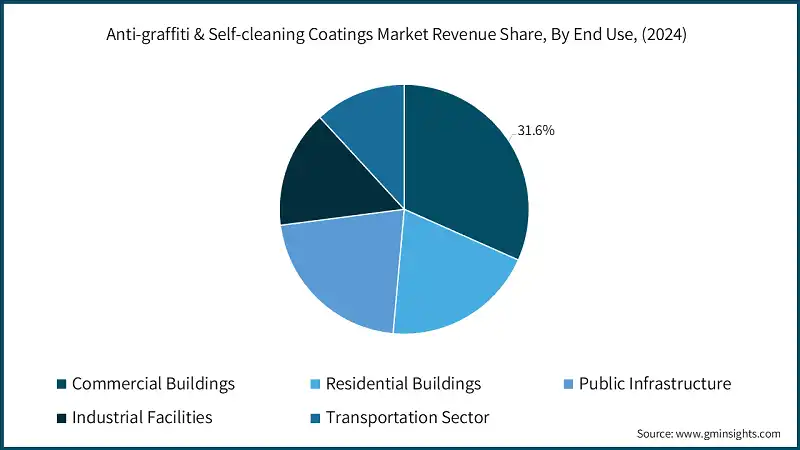
- By end use, commercial buildings are the largest sector at a market share of 31.6% due to usage of protective coatings, aesthetic preservation, and lowered maintenance costs.
To get key market trends
Anti-graffiti & Self-cleaning Coatings Market Trends
- There is a notable change in the market, partly driven by the need by consumers to repaint very often and so there is a big move to multifunctional coatings that means self-cleaning, anti-graffiti, UV resistance, and antimicrobial. End users are opting to use consolidated solutions which minimize the product layering and make applications simple particularly in large volume commercial and infrastructure projects. This trend is playing upon product innovation and demanding superior advance features of material formulations.
- Green building and sustainability certifications are influencing the purchasing behavior resulting in the fast uptake of low-VOC/water-based/environmentally-friendly coatings. The Regulatory compliance of Europe and North America is forcing manufacturers towards re-packaging of the same old products with new safer ingredients and eco-certified coating is thus being competitive in this market.
- Coatings value chain as smart monitoring and digitalization are causing disruption, with some manufacturers investigating coating or app-connected systems that monitor the performance of the surface. Even though it remains a niche, the technology-driven phenomenon is gaining prominence in high-value infrastructure, and defense programs where performance surveillance is vital.
- Due to labor shortages and increased maintenance cost, there is also an upsurge in durable and long life coatings. Products with a longer reapplication period and increased ability to resist urban pollutants are becoming more popular among clients of various industries. This demand is promoting a high strength nano and hybrid coatings.
Anti-graffiti & Self-cleaning Coatings Market Analysis
Learn more about the key segments shaping this market
The market based on coating type segmented into hydrophobic coatings, hydrophilic coatings, smart coatings, hybrid and multi-functional coatings. The hybrid and multi-functional coatings were valued at USD 1.5 billion in 2024, and it is anticipated to expand to 6.7% of CAGR during 2025-2034.
- The largest market share is in the hybrid and multi-functional coating, because of combining self-cleaning, anti-graffiti and UV protection in one coating. They are permanent and utilized in all areas of the structure due to their general applicability whether it is in infrastructure, business premises or industrial installation. The increasing need for limited maintenance high performance solutions further drives the use of these solutions.
- Smart and hydrophobic coatings are increasing continuously. Hydrophobic coatings are also popular in solar panels and facades due to their water-repelling feature and the effect of this requires less maintenance cleaning. This small market, smart coatings, is becoming of interest in the electronics field and the new lightweight constructions. The two segments are backed by knowledge of nanotechnology and material science
Learn more about the key segments shaping this market
The commercial buildings segment valued at USD 1.4 billion in 2024 and gained 8% CAGR from 2025 to 2034 with a market share of 31.6%.
- Commercial buildings hold the highest part of the end-users due to the desire to have limited maintenance, and ornamental surfaces in office complexes, malls, and institutional buildings. Self-cleaning and anti-graffiti coatings find their application as developers try to minimize maintenance costs and retain property value in the long-term. This is especially the case in major cities and high traffic zones.
- The sector of transportation and public infrastructure are also experiencing increased adoption. Bridges, subways, public bathrooms, and vehicle transportations are getting to coat to help with vandalism and reduce housecleaning. And in the meantime, residential structures and industrial plants are slowly embracing such solutions, particularly where the issues of efficiency in maintenance and protection of the surfaces are of concern.
Anti-graffiti & self-cleaning coatings market based on technology segmented nanotechnology-based coatings, polymer-based technologies, sol-gel technology, advanced material technologies. The polymer-based technologies segment was valued at USD 1.3 billion in 2024, and it is anticipated to expand to 6.3% of CAGR during 2025-2034.
- The demand for polymer-based technologies in the market is the biggest because of their low cost, ease of application and good overall performance out of many surfaces. The coatings find compulsive applications in facades, transport and industry with impressive opportunities of self-cleaning and anti-graffiti performance. Their ability to attain compatibility with a water based system and not being harmful to the environment adds to their popularity.
- Coatings resulting in nanotechnology and sol-gel are taking the lead as they have better functionality. The nanotech coating provides added durability, UV treatment, and dirt resistance, making it suitable in the context of high-performance (Example solar panel and electronics). The sol-gel technology which is highly specialized is appreciated to have optical clarity and scratch resistance. High technology in materials is still developing, displaying second-generation coatings multifunction to responsive characteristics.
Anti-graffiti & self-cleaning coatings market based on application segmented into buildings and construction, transportation infrastructure, solar energy systems, automotive applications, textiles and fabrics, electronic and optical devices. The buildings and construction segment were valued at USD 1.5 billion in 2024, and it is anticipated to expand to 7.4% of CAGR during 2025-2034.
- The constructions and buildings segment has the highest market share due to the high use of the self-cleaning and anti-graffiti interior on the facades, windows, and the exterior surfaces. These paints make the houses long lasting, less maintenance, and aesthetic. Lack of time and maintenance, increasing urbanization and more demand in smart cost effective building structures are again adding to the growth of this segment.
- Others such as solar energy systems and transportation infrastructure are growing remarkably. Self-cleaning in solar panels is used to ensure energy efficiency as dust is minimized. In the transport sector, the coating serves to protect the graffiti and facilitate washing of seating apparatus of the public. The automotive, textile and electronic use areas are smaller but building up traction with the use of advanced, functional coatings adapted to the requirements of the sectors.
Looking for region specific data?
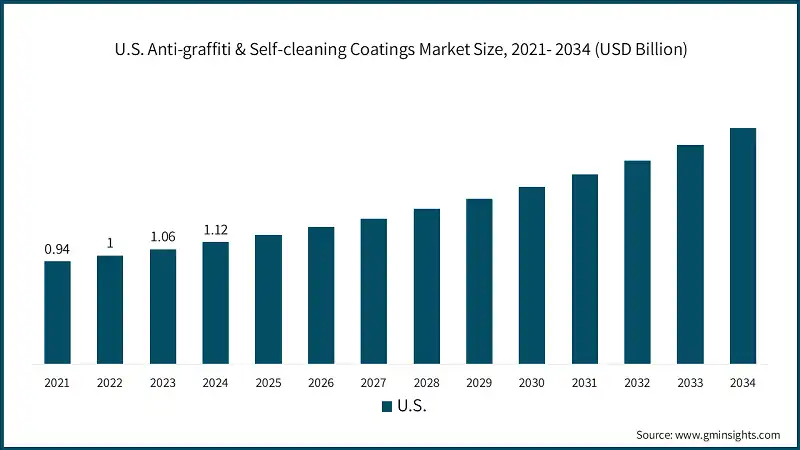
U.S. anti-graffiti & self-cleaning coatings market was valued at USD 1.12 billion in 2024 and expected to grow at a 6.9% CAGR from 2025-2034.
- U.S. and Canada are the North American leaders in the market for anti-graffiti and self-cleaning coatings due to their well-developed infrastructure, established urban maintenance regulations, and strong public awareness. The U.S. has the highest uptake across public transport systems, commercial buildings, and municipal infrastructure. The use of coatings is driven by a need to reduce long-term maintenance costs and results in cities maintaining urban aesthetics.
- Canada is also emerging, with smart city initiatives and sustainability indicating a preference for the use of more eco-friendly coatings. Both countries benefit from advanced research and development and early adoption of nanotechnology-related solutions. Mexico is developing into a new growth market as several factors, including rapid urbanization, increased investment in public infrastructure, and awareness of protective coatings are supported. While regulatory frameworks are still developing there is a growing interest in the protective coatings segments and increasingly cost-effective and durable surface solutions, particularly in urban settings.
Europe had a significant market share in 2024 and is expected to increase at a steady rate from 2025 to 2034.
- Germany, France, and the UK together dominate the European market, due to their established GB regulations, contractor awareness of industry best practices, and focus on sustainable urban built environments. Germany got the leadership in nanotech and surface engineering, with self-cleaning coatings prevalent in civic buildings, transport hubs, and retail space renovations. France and the UK are experiencing high rates of adoption, thanks to beautification programs, and provincial efforts to preserve heritage architecture. These countries have developed supply chains and a materially aware user-base.
- Poland and the Czech Republic are also becoming noteworthy occurrences in the space, due to EU-funded infrastructure construction programs and lower demand for durable, low-maintenance coatings in industries, public spaces, and domicile applications. In conclusion, the European market is characteristic of a strong push for green building standards, as well as innovative approaches in coating technologies, which further contribute to the building momentum across Western and Eastern Europe.
Asia-Pacific in the anti-graffiti & self-cleaning coatings market is expected to experience significant growth from 2025 to 2034.
- China, Japan, and South Korea are the major countries in the Asia Pacific market, driven by rapid urbanization, technological advancement, and ongoing infrastructure development. China is a dominate player with its massive investments in public transport, smart cities, and commercial real estate contributing dramatically to the growth of demand for anti-graffiti and self-cleaning coatings. Both Japan and South Korea are focusing on high-performance, sustainable coatings for public infrastructure and modern architecture.
- India, Vietnam and Indonesia are growing extremely quickly, with government-led smart city initiatives, booming construction sectors, and a growing awareness regarding surface protection technology. The range of climate conditions in the region also supports demand for weather-resistant, self-cleaning coatings. The Asia Pacific region is expected to retain its position as the largest and most dynamic market in the world, with the growing middle-class population, increasing urban footprint, and a rise in awareness of environmental issues and sustainability.
The anti-graffiti & self-cleaning coatings market in Latin America is expected to experience promising growth from 2025 to 2034.
- In Latin America Brazil and Mexico are leading where emerging urban centers and tourism development are creating more public investment to expand infrastructure. Brazil has graffiti issues that are creating a paradigm shift for the implementation of anti-graffiti coatings in both public transport vehicles and public buildings alike, (and even school walls). Mexico is modernizing and beautifying existing infrastructure which is resulting in market expansion. There is increasing synergy for both of these countries and international coating manufacturers, and more awareness of sustainable maintenance options for architectural coatings.
- Colombia and Chile are growth markets where urban renewal programs, property expansion and government initiatives promoting the improvement of public spaces are occurring. The region also suffers from consistency related to enforcement of response to regulations, access to public funding, and historical lack of budgetary commitment. There is promising growth in the demand for affordable, long lasting, and aesthetic enhancing coatings across the region, resulting in positive growth for Latin America.
The anti-graffiti & self-cleaning coatings market in MEA is expected to experience significant and promising growth from 2025 to 2034.
- The UAE and Saudi Arabia lead the Middle East & Africa market driven by mega-projects like NEOM, Expo City Dubai, and Vision 2030, they all embody innovation, sustainability, and urban design. There are huge investments in smart cities and tourism infrastructure as well as public transport systems, creating healthy and strong demand for advanced coatings that assists reducing maintenance and creating appealing appearances.
- South Africa, Egypt, and Kenya are developing key markets with urban regeneration projects and other infrastructure upgrades, alongside an increasing understanding of graffiti prevention and surface protection. These countries are adopting modern techniques for construction and green technology slowly, often with international partners.
Anti-graffiti & Self-cleaning Coatings Market Share
- The top 5 companies in the market are 3M Company, The Sherwin-Williams Company, BASF SE, AkzoNobel N.V., PPG Industries, Inc. contributing around 49.5% of the market in 2024.
- The market is determined by these players that are using their good research and development abilities, their product line varied abilities and their worldwide distribution capacity to be at the top of the race.
- These businesses have engaged in constant investment in innovation to produce coatings that are more durable and environmentally compliant and offer multifunctional capabilities to match the changing customer demands.
- Their capacity to upscale production and adhere to regionally applicable regulations helps them to acquire large construction projects in the infrastructure sector, construction sector, and those by the government.
- These companies are trying hard to remain at the top and for this, they are participating actively in strategic alliances, product launches and sustainability efforts. They can meet this growing market by providing consumers with low-VOC, easy-to-use application, and high-performance coating capable of delivering low-maintenance and energy-efficient alternatives.
- They hold their position in this market through economies of scale, high-brand recognition, wide-range of technical support and use of the most advanced technologies such as nanotechnology and hybrid material science-establishing industry scales and commercializing markets (things such as commercial, industrial, and municipal).
Anti-graffiti & Self-cleaning Coatings Market Companies
Major players operating in the anti-graffiti & self-cleaning coatings industry are:
- 3M Company
- BASF SE
- PPG Industries, Inc.
- The Sherwin-Williams Company
- AkzoNobel N.V.
- Wacker Chemie AG
- DuPont de Nemours, Inc.
- Arkema S.A.
- Evonik Industries AG
- Nippon Paint Holdings Co., Ltd.
- PURETi Inc.
- NanoSlic Coatings
- EMD Group (Merck KGaA)
- Axalta Coating Systems Ltd.
- Hempel A/S
- Jotun A/S
- Kansai Paint Co., Ltd.
- RPM International Inc.
- Tikkurila Oyj
- NanoVa care Coat
- Specialist Coatings International
- Urban Restoration Group
- The 3M Company is constantly innovating in self-cleaning and anti-graffiti products, high-efficiency coatings and films, specializing in urban infrastructure. It has a good brand name and has invested in nanotechnology which has enabled it to focus on large scale projects of the general populace and commerce.
- The Sherwin-Williams Company is a significant player that has a wide product scope and a deep network in the North American area that provides hard, low-maintenance covers that are applicable to areas in the public and business locations. The relevance of infrastructure projects in this case is that it embraces sustainability and regulatory standards.
- The level of chemical expertise incorporated by BASF SE in its upgraded coating solutions that have multifunctional qualities helps maintain its market leader position. The company focuses on the durability of its products and environment-friendly formulae that suit the requirements of smart cities and green buildings.
- AkzoNobel N.V. is also dedicated to sustainable innovation and provides hybrid and multifunctional paints in accordance with the environmental regulations. Having an international presence and focusing on low-VOC products means that it plays a significant role in large infrastructure and urban renewal.
- PPG Industries, Inc. has maintained its position in the competitive market through the technologies of advanced material and a comprehensive set of self-cleaning solutions and anti-graffiti properties. Its smart acquisitions and investment in R and D allow it to meet emerging demands in the industry and go internationally.
Anti-graffiti and Self-cleaning Coatings Market Report Attributes
| Key Takeaway | Details |
|---|---|
| Market Size & Growth | |
| Base Year | 2024 |
| Market Size in 2024 | USD 4.5 Billion |
| Forecast Period 2025 - 2034 CAGR | 7.2% |
| Market Size in 2034 | USD 8.9 Billion |
| Key Market Trends | |
| Drivers | Impact |
| Rising urbanization and infrastructure development | Boosts demand for protective coatings to maintain aesthetics and reduce cleaning costs in expanding cities |
| Increasing graffiti vandalism costs | Drives adoption of anti-graffiti coatings to minimize restoration expenses |
| Maintenance cost reduction demands | Encourages investment in self-cleaning coatings to lower long-term upkeep costs |
| Solar panel efficiency enhancement needs | Expands market scope as self-cleaning coatings improve energy yield by keeping panels clean |
| Pitfalls & Challenges | Impact |
| High initial investment costs | Slows market penetration due to budget constraints, especially in developing regions |
| Durability and performance concerns | Limits adoption where long-term reliability and harsh environmental resistance are critical |
| Opportunities: | Impact |
| Nanotechnology advancements | Enables development of more effective and durable coatings with enhanced functionalities |
| Multi-functional coating development | Opens new market segments by combining anti-graffiti, self-cleaning, and other protective features |
| Sustainable and eco-friendly solutions | Aligning with green building trends, increasing appeal among environmentally conscious buyers |
| Smart city initiatives | Accelerates market growth through integration of advanced coatings in urban planning and infrastructure |
| Market Leaders (2024) | |
| Market Leaders |
10.2% Market Share |
| Top Players |
Collective Market Share in 2024 is 49.5% |
| Competitive Edge |
|
| Regional Insights | |
| Largest Market | Asia Pacific |
| Fastest growing market | Middle East and Africa |
| Emerging countries | India, Vietnam, UAE, Saudi Arabia, and South Africa |
| Future outlook |
|
What are the growth opportunities in this market?
Anti-graffiti & Self-cleaning Coatings Industry News
- On May 20, 2025, PPG Industries introduced ENVIROLUXE Plus powder coatings that contain up to 18% post-industrial recycled plastic (rPET) and have no PFAS. This eco-friendly powder coating contains 30 percent less carbon footprint, which answered the need in eco-friendly and durable coatings, which can be used in self-cleaning purposes.
- April 21, 2025, BASF SE sold its joint-venture interests in China and transferred them in order to focus strategically on innovation in specialty surface solutions. Such reallocation of capital helps BASF to target high-value added coatings such as anti-graffiti and self-cleaning technology.
- On August 29, 2024, PPG is growing its plant in Malaysia, increasing its capacity in non-stick and low-friction coatings. The additional capacity facilitates the spillover of innovation into permanent, simple-to-clean paints that are applied in transportation and other construction infrastructure.
The anti-graffiti & self-cleaning coatings market research report includes in-depth coverage of the industry with estimates & forecasts in terms of revenue (USD Billion) and volume (Kilo Tons) from 2021 to 2034, for the following segments:
Market, By Coating Type
- Hydrophobic coatings
- Superhydrophobic coatings
- Fluoropolymer-based coatings
- Silicone-based hydrophobic coatings
- Wax-based hydrophobic systems
- Hydrophilic coatings
- Photocatalytic TiO2 coatings
- Water-based hydrophilic systems
- Sol-gel hydrophilic coatings
- Smart coatings
- Thermochromic coatings
- Ph-responsive coatings
- Self-healing coatings
- Multi-stimuli responsive systems
- Hybrid and multi-functional coatings
- Anti-graffiti + self-cleaning combinations
- Anti-corrosion + self-cleaning systems
- Antimicrobial + self-cleaning coatings
- UV-protective + self-cleaning formulations
Market, By Technology
- Nanotechnology-based coatings
- Titanium dioxide (TiO2) nanoparticle coatings
- Silicon dioxide (SiO2) nanocoatings
- Zinc oxide (ZnO) nanoparticle systems
- Carbon nanotube enhanced coatings
- Polymer-based technologies
- Polyurethane coatings
- Fluoropolymer coatings
- Silicone polymer systems
- Acrylic polymer coatings
- Sol-gel technology
- Silica sol-gel coatings
- Titania sol-gel systems
- Hybrid organic-inorganic sol-gels
- Advanced material technologies
- Graphene-enhanced coatings
- Polysilazane-based systems
- Biomimetic surface technologies
- Plasma-polymerized coatings
Market, By Application
- Buildings and construction
- Exterior building facades
- Windows and glass surfaces
- Roofing systems
- Interior surfaces
- Historic building preservation
- Transportation infrastructure
- Railway rolling stock
- Public transit systems
- Highway infrastructure
- Airport facilities
- Marine vessels
- Solar energy systems
- Photovoltaic panel coatings
- Solar thermal collectors
- Concentrated solar power systems
- Automotive applications
- Vehicle exterior surfaces
- Windshields and windows
- Mirrors and optical components
- Textiles and fabrics
- Outdoor textiles
- Technical fabrics
- Protective clothing
- Electronic and optical devices
- Display screens
- Optical lenses
- Electronic housings
Market, By End Use
- Commercial buildings
- Office buildings
- Retail centers
- Hotels and hospitality
- Healthcare facilities
- Educational institutions
- Residential buildings
- Single-family homes
- Multi-family housing
- Luxury residences
- Public infrastructure
- Government buildings
- Public transportation facilities
- Bridges and tunnels
- Parks and recreation facilities
- Industrial facilities
- Manufacturing plants
- Warehouses and distribution centers
- Chemical processing facilities
- Power generation plants
- Transportation sector
- Automotive industry
- Aerospace industry
- Marine industry
- Railway industry
The above information is provided for the following regions and countries:
- North America
- U.S.
- Canada
- Europe
- UK
- Germany
- France
- Italy
- Spain
- Rest of Europe
- Asia Pacific
- China
- India
- Japan
- South Korea
- Australia
- Rest of Asia Pacific
- Latin America
- Brazil
- Mexico
- Argentina
- Rest of Latin America
- MEA
- UAE
- Saudi Arabia
- South Africa
- Rest of Middle East and Africa
Frequently Asked Question(FAQ) :
What was the market size of the anti-graffiti and self-cleaning coatings in 2024?
The market size was USD 4.5 billion in 2024, with a CAGR of 7.2% expected through 2034, driven by urbanization and infrastructure development in regions like Asia-Pacific and the Middle East.
What is the projected value of the anti-graffiti and self-cleaning coatings market by 2034?
The market is expected to reach USD 8.9 billion by 2034, fueled by the adoption of advanced coatings for longer durability and reduced maintenance.
How much revenue did the commercial buildings segment generate in 2024?
The commercial buildings segment generated USD 1.4 billion in 2024, accounting for a 31.6% market share.
What was the valuation of the U.S. anti-graffiti and self-cleaning coatings market?
The U.S. market was valued at USD 1.12 billion in 2024, with a projected CAGR of 6.9% from 2025 to 2034.
What are the upcoming trends in the anti-graffiti and self-cleaning coatings industry?
Key trends include the shift towards multifunctional coatings with self-cleaning, anti-graffiti, UV resistance, and antimicrobial properties.
Who are the key players in the anti-graffiti and self-cleaning coatings market?
Key players include 3M Company, BASF SE, PPG Industries, Inc., The Sherwin-Williams Company, AkzoNobel N.V., Wacker Chemie AG, DuPont de Nemours, Inc., and Arkema S.A.
Anti-graffiti and Self-cleaning Coatings Market Scope
Related Reports