Summary
Table of Content

Ammonium Sulphate Market
Get a free sample of this report
Form submitted successfully!
Error submitting form. Please try again.
Thank you!
Your inquiry has been received. Our team will reach out to you with the required details via email. To ensure that you don't miss their response, kindly remember to check your spam folder as well!
Request Sectional Data
Thank you!
Your inquiry has been received. Our team will reach out to you with the required details via email. To ensure that you don't miss their response, kindly remember to check your spam folder as well!
Form submitted successfully!
Error submitting form. Please try again.
Ammonium Sulphate Market Size
The global ammonium sulphate market was estimated at USD 3.6 billion in 2024, and it is expected to grow at a CAGR of 3.5% from 2025 to 2034, owing to the increased undertaken food production agricultural activities coupled with rising demand towards servicing food supply for the growing population. The market for the ammonium sulphate is growing considerably, with an in-depth attributed to its application as a high nitrogen fertilizer as well as its use in various industrial processes.
Ammonium Sulphate Market Key Takeaways
Market Size & Growth
- 2024 Market Size: USD 3.6 Billion
- 2034 Forecast Market Size: USD 5 Billion
- CAGR (2025–2034): 3.5%
Key Market Drivers
- Rising global food demand and agricultural intensification.
- Expansion of industrial applications in water treatment and emission control.
- Government initiatives promoting sustainable farming practices.
Challenges
- Environmental concerns over nitrogen runoff and soil degradation.
- Fluctuations in raw material prices and supply chain disruptions.
Get Market Insights & Growth Opportunities
Ammonium sulphate has important improvements in the primary consumer fertilizers for over 75% of the global usage, the compound ammonia salt high solubility maximum efficiency for alkaline soils makes it useful when for crops such as rice, wheat and maize. We have also modules for developed economy with Asia pacific supported China and India is greatly on the rise with increased of fertilizer demand linked to growing agricultural area, coupled with government policies supporting better farming practices.
Ammonium sulphate is used in industries such as water treatment, pharmaceuticals, and food processing. Its use in flue gas desulfurization is becoming more important, particularly in areas with strict environmental policies. Also, MARPOL Annex VI is actively used which increases emission control technology utilization within the shipping sector, which in turn increases the use of ammonium sulphate aimed at emission reduction.
Moreover, there are problems with this market such as lack of sufficient nitrogen raw materials due to high prices and soil pollution. Solving these problems requires the implementation of sustainable innovations and development of environmentally friendly substitutes. Nonetheless, other enduring capitals for utilization of ammonium sulphate in various government sectors with tech innovations show a bright future for this industry.

To get key market trends
Ammonium Sulphate Market Trends
- Latest technologies in sustainable production: The production ammonium sulphate is undergoing a change towards more sustainable methods of production. Newer technologies like electrocatalytic nitrogen reduction utilizing ionic liquids are greener alternatives to the old style of production, Considered the Haber-Bosch process which is energy intensive. Innovation focuses on reducing carbon emissions as well as improving energy use in manufacturing fertilizers.
- Resolving environmental issues and gaps in literature: Ammonium sulphate and other nitrogen-based fertilizers have raised environmental problems such as soil acidification as well as eutrophication of water bodies. There is a need for precision farming, as well as controlled release fertilizers which requires combating these environmental issues. Also, some studies are looking into other forms of plasma-ice interactions for the synthesis of urea which forges a more sustainable nitrogen fertilizer production pathway.
- Governing policies affecting the ammonium sulfate market: Government policies have a great impact on the ammonium sulphate market. There are some regions that have placed the ban on the use of ammonium sulfate because of its possible use in missiles and explosives therefore placed restriction on its use and availability. These offset the policy supporting green agricultural activities and environmental conservation that increased demand on the use eco-friendly fertilizers have shifted the market direction and consumer demand.
- Adoption of circular economy standards: By recovering ammonia from waste streams, the industry is adopting circular economy practices more rigorously. Emerging methods such as flow electrode capacitive deionization with MXenes have efficiently removed and recovered ammonia from wastewater, showcasing a more sustainable approach to resource utilization. This helps resolve environmental issues while simultaneously enhancing the economic sustainability of fertilizer production.
Ammonium Sulphate Market Analysis

Learn more about the key segments shaping this market
Based on production method, the market is divided into synthetic production, and by-product production. By-product production segment generated a revenue of USD 2.4 billion in 2024 and USD 3.4 billion in 2034 at a CAGR of 3.5%.
- The by-product production method captures the ammonium sulfate market with a 68.4% share due to its affordability and environmentally beneficial waste management. This category obtains ammonium sulfate as a secondary product from the synthesis of caprolactam (nylon), purification of coke oven gas, and the flue gas from coal power plants scrubbed for sulfur (FGD). Since these methods utilize waste streams, production costs are lower in comparison to synthetic approaches which makes it favorable for bulk fertilizer use. Moreover, enhanced environmental policies such as the EU’s Industrial Emissions Directive creates a need for industries to convert waste sulfur into ammonium sulfate, increasing the available supply.
- Furthermore, adoption of flue gas desulfurization in Asia (China, India) and North America increases the supply of by-products. Additionally, the nylon industry drives the production of caprolactam, persisting demand for engineered plastics.
Learn more about the key segments shaping this market
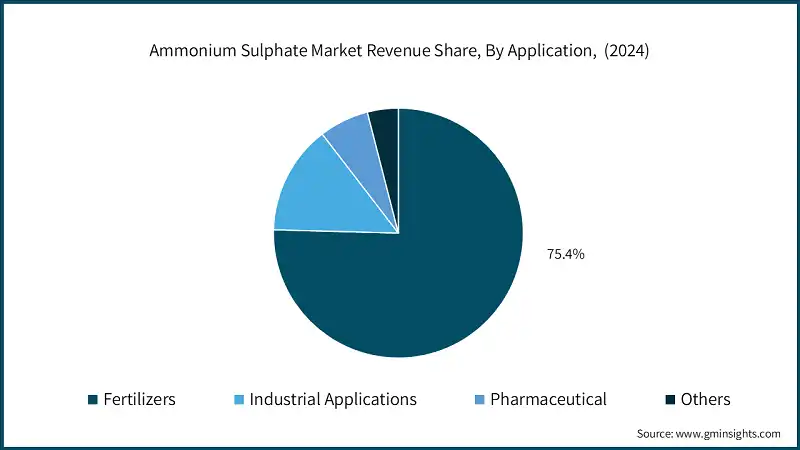
Based on application, the market is divided into fertilizers, industrial applications, pharmaceutical, and others. In 2024, fertilizers segment held major market share, accounted for 75.4% share.
- Fertilizers segment remains the leader in the ammonium sulphate market. Used extensively as a nitrogen fertilizer, ammonium sulphate is particularly effective in alkaline soils by improving nutrient absorption as well as regulating soil acidity. It is used both at the subsistence and commercial farming level for downstream crops like rice, wheat, maize and other cereals due to its low cost and ease of use with other fertilizers.
- Recent trends show an increasing consumption of ammonium sulphate fertilizers in developing countries as well as in Asia Pacific and Latin America, which due to increased subsidization are seeing an agriculturally focused spending increase. Furthermore, a rising acceptance of Precision Agriculture is optimizing its application efficiency reinforcing dominance in this segment.

Looking for region specific data?
China ammonium sulphate market generated a revenue of USD 671.1 million in 2024. China market is projected to grow at a CAGR of 3.6% reaching USD 953.9 million by 2034 as it is driven by increased the consumption.
- This growth stems from China’s enormous agricultural industry which, even though it makes up less than 10% of the world’s arable land, sits as the world’s breadbasket producing 25% of global grain. There is a strong supply of ammonium sulfate because it is especially useful for soil improvement in the cultivations of rice, which is grown on over 25% of China’s arable land.
- In addition, China’s industrial development such as the joint venture of Lucky Grace International and Hexagon Group AG to manufacture one million tons of compacted ammonium sulfate by the middle of 2025 greatly boosts the economy.
Ammonium sulphate market in the U.S. is expected to experience promising growth from 2025 to 2034 due to growth of increasing consumption within the country.
- Given the healthy agricultural profile of the country, ammonium sulfate is extensively employed for improving crop yield, and thus, the U.S. market is indeed a mature one. Recently, there has been a marked movement towards more sustainable agriculture, as farmers strive to lessen their environmental footprint through more exact nutrient application methods and other nutrient alternatives.
- In addition, policy support like the USDA's Fertilizer Production Expansion Program that gave AdvanSix a USD 12 million grant toward more sustainable ammonium sulfate production illustrates the efforts toward greater within-border fertilizer manufacturing.
Ammonium Sulphate Market Share
Top 5 companies in the ammonium sulphate industry are BASF SE, Evonik Industries AG, Lanxess AG, UBE Corporation, and OCI Nitrogen. The market of ammonium sulphate is moderately consolidated. The industry’s top five players dominate the ammonium sulphate revenue stream. These firms together control 35-40% of the market as of 2024, mainly because these companies have vertically integrated production systems as well as strong global distribution systems and large portfolios of applications. For example, BASF benefits from the economies of scale from the integrated production of caprolactam whilst Evonik makes use of innovation and strong European and Asian presence.
The market is characterized by competition based on pricing, innovation on sustainable production processes, other forms of product competition, and alliances. There is a definite move towards mergers or joint ventures aimed at boosting production capacity and penetrating fast-growing markets. For instance, Hexagon Group AG’s joint venture in China seeks to achieve a target of 1 million tons/year of compacted ammonium sulphate by 2025. AdvanSix seems to be following a self-sufficient domestic supply model through their sustainably backed expansion projects funded by the USDA. Investment in research also plays a critical role, especially with competitors developing low-emission and environmentally friendly alternatives due to stricter regulatory policies, thereby providing them with a competitive advantage in the global marketplace.
Ammonium Sulphate Market Companies
BASF SE: As one of the largest ammonium sulfate producers in the world, BASF SE is a German multinational company which leverages its fully integrated chemical production and logistics network for a reliable supply of the compound. The Bayer corporation primarily synthesizes caprolactam to ammonium sulfate. With emphasis on sustainable agriculture, the company aims to precision farming advanced technologies.
Evonik Industries AG: Operating in an ammonium sulfate manufacturing segment under a diversified portfolio of specialty chemicals, within a structured and diversified portfolio of specialty chemicals, Evonik generates ammonium sulfate via the reaction of sulfuric acid and caprolactam. An innovation leader in the field, the company focuses on developing sustainable fertilizer products. Nitrogen and fertilizer management are also key focus areas for Evonik, that greatly emphasize agriculture digitalization.
Lanxess AG: Lanxess AG has integrated ammonium sulfate production facilities with Chemical intermediates division of the company. In addition to agricultural uses, the company supplies phosphamic acid for industrial applications particularly in water purification. Linzess is focusing these days on boundaries of the Cyclic economy and carbon neutrality concepts which comply international eco-friendly policies.
UBE Corporation: Through nylon production, UBE Corporation located in Japan, generates ammonium sulphate as a byproduct. The company primarily serves the Asian markets, placing a strong emphasis on customer trust, product and service quality, strict adherence to supply chain timelines, and high-grade product purity. UBE is also increasing its focus on environmental compliance and sustainable production technologies.
OCI Nitrogen: OCI Nitrogen, located in Netherlands, is one of the largest producers of nitrogen fertilizers in Europe and makes ammonium sulphate. It has a well-established logistics system and serves both the agriculture and industrial sectors. OCI is pursuing growth through energy-efficient production methods, as well as a focus on lowering greenhouse gas emissions to remain competitive in the marketplace.
Ammonium Sulphate Market Report Attributes
| Key Takeaway | Details |
|---|---|
| Market Size & Growth | |
| Base Year | 2024 |
| Market Size in 2024 | USD 3.6 Billion |
| Forecast Period 2025 – 2034 CAGR | 3.5% |
| Market Size in 2034 | USD 5 Billion |
| Key Market Trends | |
| Growth Drivers |
|
| Pitfalls & Challenges |
|
What are the growth opportunities in this market?
Ammonium Sulphate Industry News
- In December 2024, BASF expanded the production of ammonium chloride at its Ludwigshafen site, increasing capacity by 50% and improving product quality.
- In September 2024, Evonik's attempt at industrial scaling of valorization of salts to important raw materials using electrodialysis had been made with this latest update. It promoted energy/resource conservation, CO2 mitigation, and commitment to sustainable chemical operations, which was a hallmark for the corporation.
- In July 2024, BASF had planned to cease production of the active ingredient glufosinate-ammonium (GA) at the Knapsack and Frankfurt sites in Germany by the end of 2024 due to economic reasons.
- In July 2022, Evonik entered into an agreement to supply blueSulfate, a liquid ammonium sulfate (8-0-0-9) solution from its site in Mobile, Alabama, to Interoceanic Corporation (IOC). This agreement had supported Evonik’s strategy to focus on its core business in Animal Nutrition by marketing high-value co-products of its methionine production network for fertilizing crops via IOC.
Ammonium sulphate market research report includes in-depth coverage of the industry, with estimates & forecast in terms of revenue (USD Billion) & volume (Tons) from 2021 to 2034, for the following segments:
Market, By Production Method
- Synthetic production
- By-product production
- Caprolactam production
- Coke oven operations
- Methyl methacrylate production
- Other by-product sources
Market, By Product Form
- Solid
- Granular
- Crystalline
- Liquid
Market, By Purity Grade
- Standard grade (≤99%)
- High purity grade (>99%)
Market, By Application
- Fertilizers
- Straight fertilizers
- Compound fertilizers
- Specialty fertilizers
- Industrial applications
- Textile industry
- Water treatment
- Food additives
- Flame retardants
- Chemical manufacturing
- Others
- Pharmaceutical
- Others
The above information is provided for the following regions and countries:
- North America
- U.S.
- Canada
- Europe
- Germany
- UK
- France
- Spain
- Italy
- Asia Pacific
- China
- India
- Japan
- Australia
- South Korea
- Latin America
- Brazil
- Mexico
- Argentina
- Middle East and Africa
- Saudi Arabia
- South Africa
- UAE
Frequently Asked Question(FAQ) :
How big is the ammonium sulphate market?
The market for ammonium sulphate was valued at USD 3.6 billion in 2024 and is expected to reach around USD 5 billion by 2034, growing at a CAGR of 3.5% through 2034.
What is the size of the fertilizers segment in the ammonium sulphate industry?
The fertilizers segment accounted for 75.4% of the total market share in 2024.
How much ammonium sulphate market revenue was generated by China in 2024?
The China market generated approximately USD 671.1 million in 2024.
Who are the key players in the ammonium sulphate industry?
Some of the major players in the industry include BASF SE, AdvanSix Inc., CF Industries Holdings, Inc., Domo Chemicals GmbH, Domo Engineering Plastics US, EuroChem Group AG, Evonik Industries AG, Grupa Azoty S.A., and Helm AG.
Ammonium Sulphate Market Scope
Related Reports