Summary
Table of Content

Ambient Light Sensor Market
Get a free sample of this report
Form submitted successfully!
Error submitting form. Please try again.
Thank you!
Your inquiry has been received. Our team will reach out to you with the required details via email. To ensure that you don't miss their response, kindly remember to check your spam folder as well!
Request Sectional Data
Thank you!
Your inquiry has been received. Our team will reach out to you with the required details via email. To ensure that you don't miss their response, kindly remember to check your spam folder as well!
Form submitted successfully!
Error submitting form. Please try again.
Ambient Light Sensor Market Size
The growth of the market is attributed to the expanding integration of ALS in smart and IoT‑connected devices, which heightens demand for adaptive displays and energy‑efficient systems in consumer electronics and industrial automation. The increased demand for ALS for display brightness control, power optimization, and user comfort in smartphones, tablets, and laptops is driving the growth of the market.
Ambient Light Sensor Market Key Takeaways
Market Size & Growth
- 2025 Market Size: USD 1 Billion
- 2026 Market Size: USD 1.1 Billion
- 2035 Forecast Market Size: USD 3 Billion
- CAGR (2026–2035): 11.2%
Regional Dominance
- Largest Market: North America
- Fastest Growing Region: Asia Pacific
Key Market Drivers
- Smart device sensor integration rising global demand.
- Multispectral and AI‑enabled sensing advancements.
- Automotive adaptive lighting and safety tech uptake.
- IoT and connected smart home lighting expansion.
- Miniaturization and low‑power sensor innovation.
Challenges
- Complex integration/miniaturization engineering hurdles.
- Sensor performance limits in mixed light conditions.
Opportunity
- Smart city / energy‑efficient building installations.
- Healthcare & wearable device ambient sensing.
Key Players
- Market Leader: AMS AG led with over 17.3% market share in 2025.
- Leading Players: Top 5 players in this market include AMS AG, Texas Instruments Incorporated, STMicroelectronics, ON Semiconductor Corporation, Vishay Intertechnology, which collectively held a market share of 56.4% in 2025.
Get Market Insights & Growth Opportunities
The ambient light sensors market is driven by the demand for smart device integrations in smartphones, tablets, and laptops, allowing automatic adjustments of the display brightness, increasing the energy efficiency of the products, and hence improving the user experience. In June 2025, the European Commission has initiated energy labelling and ecodesign regulations that require smartphones and tablets, when sold in the European Union, to display energy efficiency rating information, as well as adhere to durability and battery performance requirements. This is forcing the smartphone and tablet manufacturers to improve their power management technologies, including the Ambient Light Sensors-based automatic brightness adjustments, thereby increasing the demand for Ambient Light Sensors.
Additionally, the ALS market is driven by the developments in multispectral and AI-enabled sensing which goes beyond traditional brightness adjustment, thus allowing for intelligent display adaptation, advanced camera optimization, and contextual device behavior. In February 2026, the Government of India, through the Ministry of Electronics and Information Technology (MeitY), introduced the India AI Governance Guidelines, which set up a guiding framework for the development of AI innovation in the region. This, in turn, encourages companies to build in responsible AI and advanced analytics for sensors, thus encouraging investment in AI-driven light sensing technology.
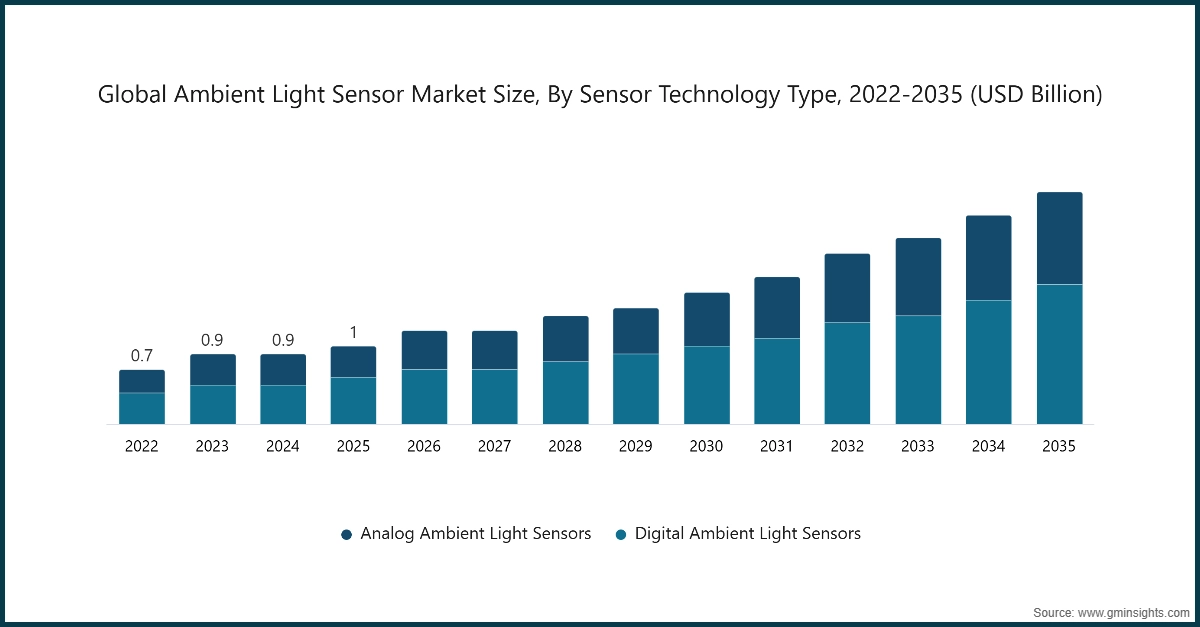
The ambient light sensor market increased steadily from USD 0.7 billion in 2022 and reached USD 0.9 billion in 2024, as global shipments of smart devices and adaptive lighting systems expanded, pushing demand for ALS modules across applications. Tighter industry focus on energy efficiency and user experience contributed to this growth phase, with manufacturers standardizing sensor‑based automatic brightness and power management across devices. The adoption of smart home, smart building and industrial IoT systems brought a rapid increase in ALS usage as it evolved into a fundamental element of connected sensing platforms which strengthened its presence in the market.
The global ambient light sensor market was valued at USD 1 billion in 2025. The market is expected to grow from USD 1.1 billion in 2026 to USD 1.9 billion in 2031 & USD 3 billion in 2035, at a CAGR of 11.2% during the forecast period according to the latest report published by Global Market Insights Inc.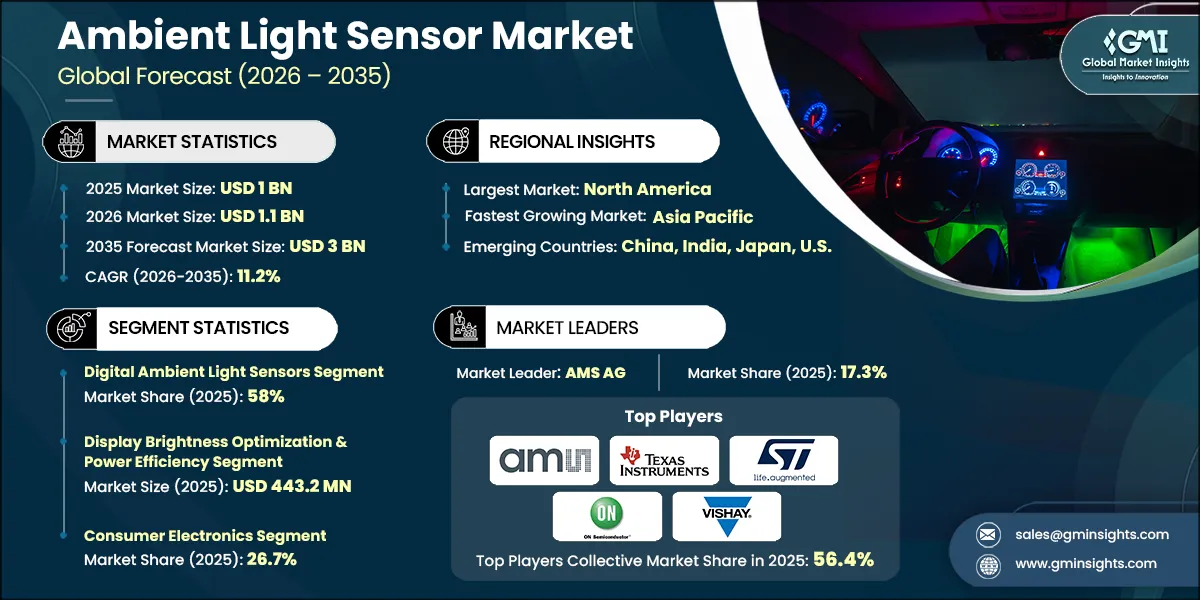
To get key market trends
Ambient Light Sensor Market Trends
- The use of ambient light sensors is growing at a rapid pace in AR and VR mixed reality devices which allow users to experience virtual environments through realistic lighting changes. The demand for gaming, training and industrial simulation started rising in 2021. The global market for headsets will drive virtual environments until 2032 because it will make visual experiences more realistic while reducing eye strain and increasing user interest in virtual spaces.
- The adoption of ALS in building energy management systems has increased because it helps to save energy by controlling both lighting and HVAC systems. The trend started in 2020 when commercial real estate and smart building projects began pursuing sustainability certifications. The year 2030 will see almost all large commercial buildings implement ALS automation which will decrease energy expenses and carbon emissions while helping green building standards.
- ALS technology for automated agriculture lighting control systems is increasingly being deployed, allowing for the optimization of lighting for specific crops in vertical farming and greenhouses. Initial projects were introduced in 2019 as indoor farming took off in Asia and Europe. Widespread application is set to take place by 2030, promoting healthy plant growth, electricity savings, and sustainable agriculture through precision lighting management.
- Use of ALS for adaptive public transportation displays and vehicle interiors is increasing, providing passengers with optimal visibility and energy efficiency. This trend took off in 2021 as smart mobility initiatives and EV adoption accelerated. By 2030, most urban transit and automotive fleets will utilize adaptive ALS, improving passenger comfort, reducing energy consumption, and enabling dynamic, context-aware vehicle interfaces.
Ambient Light Sensor Market Analysis
Learn more about the key segments shaping this market
Based on the sensor technology type, the global ambient light sensor market is divided into analog ambient light sensors and digital ambient light sensors.
- The digital ambient light sensors segment segment led the market in 2025, holding a 58% share. Digital sensors lead the market owing to their precision, in-house ADC, and direct compatibility with MCUs as well as display drivers. These are commonly used in smartphones, tablets, laptops, and automotive display devices, wherein precise lux sensing and timely control of display brightness is essential. The ability of digital sensors to function under varying dynamic range of lights and dark cover glass makes them an essential component of modern OLED and high-resolution display technologies.
- The analog ambient light sensors segment is anticipated to grow at a CAGR of 10.6% over the forecast period. The growth is attributed to low power consumption, cost-effectiveness, as well as simple design architecture, making this segment suitable for various wearable devices, consumer electronics, as well as industrial devices. The ease with which this segment is able to integrate with compact devices makes it significant in various applications that do not focus on precision but rather on power consumption, driving adoption in emerging and price-sensitive markets.
Learn more about the key segments shaping this market
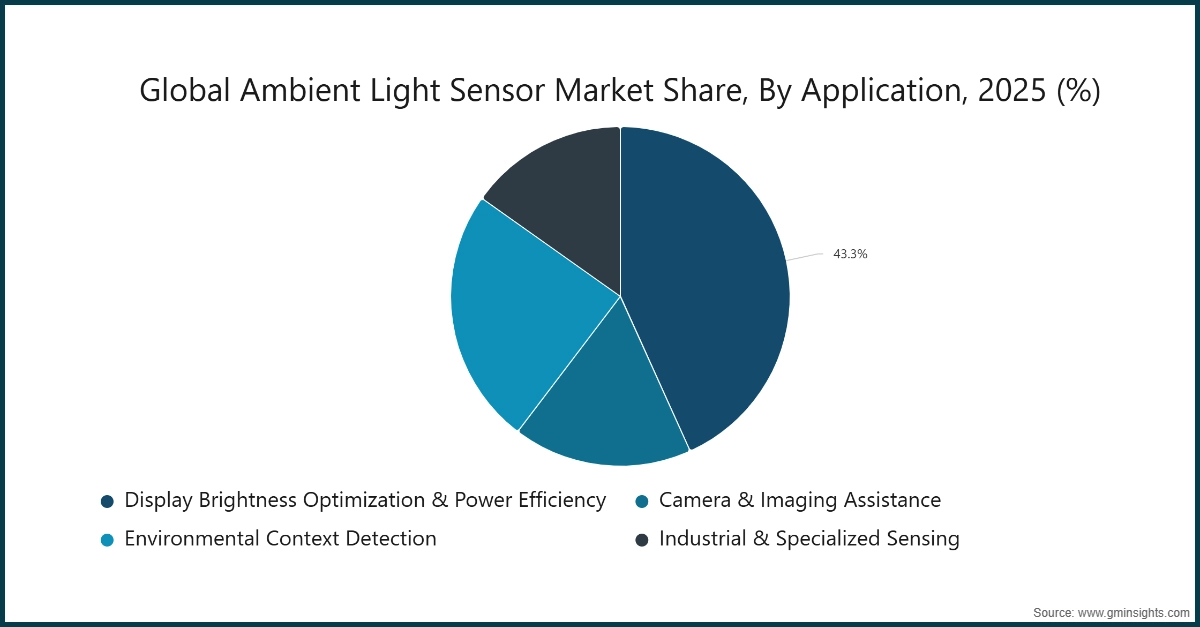
Based on the application, the global ambient light sensor market is divided into display brightness optimization & power efficiency, camera & imaging assistance, environmental context detection, and industrial & specialized sensing.
- The display brightness optimization & power efficiency segment dominated the market in 2025 and valued at USD 443.2 million. This is because this type of application has widespread usage in smartphones, laptops, TVs, and infotainment systems used in automobiles. The increasing trend of using OLED, mini-LED, and high refresh displays has led to an increase in the demand for ambient light sensors, as the displays require the automatic control of brightness.
- The environmental context detection segment is expected to witness growth at a CAGR of 12.9% during the forecast period. This growth is driven by the increasing use of ambient light sensors in sensor fusion systems, where they work alongside proximity, motion, and color sensors to enable context-aware functionalities. Applications such as adaptive user interfaces, AR/VR devices, and smart wearables rely on real-time environmental light data to enhance user interaction and device responsiveness.
Based on the end-user industry, the global ambient light sensor market is divided into consumer electronics, automotive, industrial, manufacturing, healthcare, commercial, and others.
- The consumer electronics segment led the market in 2025 with a market share of 26.7%, driven by the widespread integration of ambient light sensors in smartphones, tablets, laptops, smart TVs, and wearables. These sensors are essential for enabling automatic brightness adjustment, screen power optimization and enhanced display visibility which are critical features in modern devices. The high volume production of consumer electronics together with its rapid innovation cycles creates ongoing market demand which makes this segment the main driver of market growth.
- The automotive segment is expected to grow at a CAGR of 14.6% during the forecast period. The market expansion occurs because ambient light sensors find increasing use across digital cockpits, infotainment systems, head-up displays and advanced driver assistance systems. The shift toward electric vehicles and connected cars with large display panels is further accelerating adoption, positioning automotive as a key high-growth segment in the sensor market.
Looking for region specific data?
North America Ambient Light Sensor Market
North America held a share of 31.3% of ambient light sensor industry in 2025.
- The market for ambient light sensors in North America shows continuous growth because consumer electronics, automotive cockpits and smart building systems are adopting adaptive display technologies at a rapid pace. The growing popularity of smart home systems and connected lighting solutions drives the need for automatic illumination control systems that use ALS technology in both residential and commercial spaces.
- The combination of top semiconductor and consumer electronics companies along with their research activities create rapid progress in technology development. The evolution of automotive HMI systems together with the digital transformation of EV cockpits are creating valuable new business opportunities. North America will keep its position as the main market for technology adoption as consumer electronics, automotive displays and smart infrastructure setups are expected to create ongoing market growth until 2035.
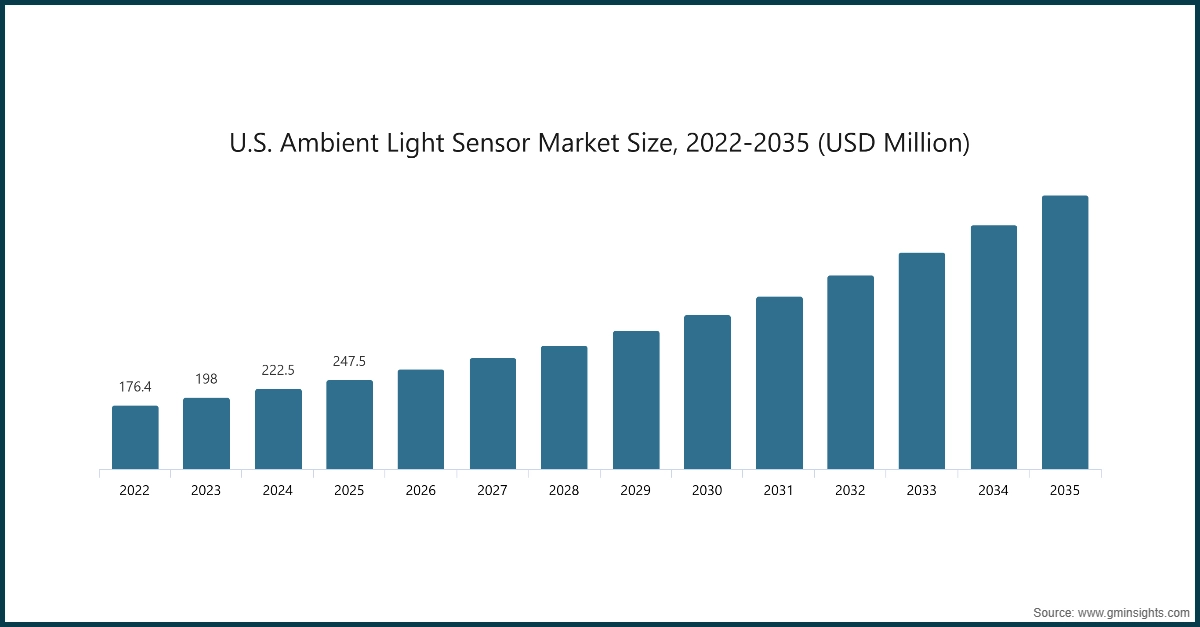
The U.S. ambient light sensor market was valued at USD 176.4 million and USD 198 million in 2022 and 2023, respectively. The market size reached USD 247.5 million in 2025, growing from USD 222.5 million in 2024.
- The growth of the market in the United States is particularly strong due to the high penetration of premium consumer electronics and advanced automotive display systems. The country accounts for a significant share of high-end smartphone and laptop shipments, where ambient light sensors are standard components for adaptive brightness and power optimization.
- The expansion of smart building initiatives and energy efficiency standards, including frameworks from organizations such as the U.S. Department of Energy, is further supporting the adoption of ambient light sensors in automated lighting control systems. Combined with strong R&D investments in optical sensing technologies and human-centric lighting systems, these factors are positioning the U.S. as the leading market for ambient light sensors in North America.
Europe Ambient Light Sensor Market
Europe ambient light sensor market accounted for USD 232.3 million in 2025 and is anticipated to show lucrative growth over the forecast period.
- In Europe, ambient light sensor industry is advancing with strong momentum due to the region’s focus on energy-efficient building systems, automotive display innovation, and human-centric lighting standards. The implementation of frameworks such as the Energy Performance of Buildings Directive (EPBD) is accelerating the deployment of daylight-responsive lighting controls, where ambient light sensors are integrated into commercial offices, healthcare facilities, and educational infrastructure to reduce electricity consumption.
- Countries including Germany, France, and United Kingdom are prioritizing adaptive lighting systems in smart buildings and transport infrastructure, supported by investments in DALI-2 and KNX-based lighting control networks. The combination of regulatory-driven efficiency targets and advanced lighting ecosystems is ensuring sustained adoption of ambient light sensing technologies across Europe through 2035.
Germany dominates the Europe ambient light sensor market, showcasing strong growth potential.
- Germany leads the European market due to its strong base in automotive electronics manufacturing and industrial lighting automation. The country is home to major automotive OEMs and Tier-1 suppliers integrating ambient light sensors into digital instrument clusters, infotainment systems, and head-up displays, where precise brightness adaptation is essential for driver safety and visibility.
- Furthermore, Germany’s stringent workplace lighting standards (ASR A3.4) are pushing companies to implement sensor-based adaptive lighting solutions to maintain compliance and reduce energy consumption. The integration of ALS within connected lighting networks and automotive HMI systems positions Germany as a key high-value market for ambient light sensors in Europe.
Asia Pacific Ambient Light Sensor Market
The Asia Pacific ambient light sensor industry is anticipated to grow at the highest CAGR of 12.9% during the forecast period.
- In Asia Pacific, ambient light sensor market currently experiences strong expansion because the region functions as a major center for manufacturing consumer electronics and display panel production systems. Countries such as China, South Korea, and Japan together control a major portion of the worldwide OLED and LCD panel production market, which requires ambient light sensors to provide adaptive brightness and color calibration features for their final products.
- Manufacturers need to develop high dynamic range ALS systems that can function during multiple light situations because of the increasing demand for foldable smartphones, OLED TVs and high-refresh-rate displays. The rising popularity of mini-LED backlighting together with power-efficient display technologies for smartphones, tablets and laptops creates a need for accurate ambient light sensing which makes Asia Pacific the fastest expanding market for ALS manufacturing until 2035.
China ambient light sensor market is estimated to grow with a significant CAGR, in the Asia Pacific market.
- China represents a high-growth market for ambient light sensors due to its vertically integrated ecosystem spanning display manufacturing, smartphone assembly, and semiconductor packaging. The country leads in high-volume smartphone production, where ambient light sensors are embedded as standard components for automatic brightness control and battery optimization.
- Furthermore, China’s leadership in smart consumer device exports and display innovation (including BOE and TCL CSOT production lines) is increasing demand for advanced ALS with higher sensitivity and lower power consumption. These factors collectively position China as a production-driven and innovation-led growth hub for ambient light sensors in the Asia Pacific region.
Middle East and Africa Ambient Light Sensor Market
Saudi Arabia ambient light sensor industry to experience substantial growth in the Middle East and Africa.
- The Saudi Arabia experiences continuous growth in the market because of multiple smart city initiatives and digital infrastructure development projects which Saudi Arabia implements through its Vision 2030 program. The NEOM and The Red Sea Project mega-developments utilize intelligent lighting systems together with automated building controls which require ambient light sensors to achieve optimal indoor lighting through natural daylight detection.
- The country experiences increasing demand for ambient light sensors used in smartphones, luxury vehicles and infotainment systems because of its fast-growing market for high-end consumer electronics and premium automotive imports. The combination of rising investments in smart infrastructure, energy-efficient technologies and existing market conditions leads to increased use of ambient light sensors throughout the urban and commercial sectors of Saudi Arabia.
Ambient Light Sensor Market Share
The ambient light sensor industry is led by players such as ams AG, Texas Instruments Incorporated, STMicroelectronics, ON Semiconductor Corporation, and Vishay Intertechnology. These companies collectively held market share of 56.4% in 2025. These companies have strong business foundations in terms of diversified sensor portfolios, advanced semiconductor capabilities, and global supply chain presence across consumer electronics, automotive, and industrial sectors. Their broad offerings in ambient light sensing, proximity sensing, and integrated optical sensor solutions enable them to maintain a dominant position in the market.
These firms provide a competitive advantage through precision sensing, miniaturized sensors, and integration with display and power management systems. Further, constant investment in R&D, sensor fusion (ALS + Proximity + Color), and AI-based sensing algorithms also helps these firms gain significant market share, especially with the rising need for adaptive display technologies, automotive digital cockpits, and power-saving smart devices in the global market.
Ambient Light Sensor Market Companies
Prominent players operating in the ambient light sensor industry are as mentioned below:
- AMS AG
- Broadcom Inc.
- Everlight Electronics Co., Ltd.
- Honeywell International Inc.
- LITEON Technology
- Maxim Integrated (Now Analog Devices)
- Melexis NV
- Microchip Technology Inc.
- OmniVision Technologies, Inc.
- ON Semiconductor Corporation
- Panasonic Corporation
- Renesas Electronics Corporation
- ROHM Semiconductor
- Samsung Electronics Co., Ltd.
- Sharp Corporation
- Silicon Labs
- Sony Semiconductor Solutions Corporation
- STMicroelectronics
- Texas Instruments Incorporated
- Vishay Intertechnology
- ams AG
ams AG provides advanced optical sensing solutions through its high-performance ambient light sensors that find applications in smartphones, wearable devices and automotive systems. The company develops sensor fusion technologies that combine ambient light detection with proximity detection and color detection to create systems which automatically adjust display brightness while reducing power usage. The company's focus on miniaturization, low power consumption and high sensitivity at dark glass display elements enables the development of future consumer electronics products and automotive human-machine interface systems.|
Texas Instruments has a wide range of ambient light sensors that are used in consumer electronics, industrial equipment, and smart infrastructure. The company has been able to provide ultra-low-power consumption, wide dynamic range, and signal processing capabilities, ensuring accurate ambient light sensing in various environments. The company has developed products that are commonly used in various applications, including display brightness control, smart lighting, and IoT products.
STMicroelectronics develops advanced ambient light sensors which include flicker detection, proximity sensing and digital output interfaces for mobile devices, automotive displays and industrial automation systems. The company develops high-accuracy sensing technology which operates under multiple light conditions and compact designs enabling efficient use of limited space.
ON Semiconductor (onsemi) specializes in ambient light sensing solutions that are optimized for automotive, industrial, and consumer electronics markets. The company combines ambient light sensing with intelligent sensing platforms, thereby facilitating various application opportunities such as display adaptation in vehicles, advanced driver interfaces, as well as energy-saving lighting solutions. The company’s focus on delivering robust solutions with automotive-grade reliability has positioned it favorably in rapidly growing markets.
Vishay Intertechnology provide a broad range of ambient light sensors that cater to various markets such as consumer electronics, automotive, and industrial markets. The company’s focus on delivering ambient light sensors with high sensitivity, compact size, as well as cost-effectiveness has positioned it favorably in various markets, thereby facilitating various application opportunities such as display, smart devices, and control panels.
Ambient Light Sensor Market Report Attributes
| Key Takeaway | Details |
|---|---|
| Market Size & Growth | |
| Base Year | 2025 |
| Market Size in 2025 | USD 1 Billion |
| Market Size in 2026 | USD 1.1 Billion |
| Forecast Period 2026-2035 CAGR | 11.2% |
| Market Size in 2035 | USD 3 Billion |
| Key Market Trends | |
| Drivers | Impact |
| Smart device sensor integration rising global demand | Drives 24% growth by embedding ambient light sensors in smartphones, tablets, and laptops, enabling automatic brightness adjustment, power savings, and enhanced user experience, fueling consumer electronics adoption worldwide. |
| Multispectral and AI‑enabled sensing advancements | Contributes 21% growth as AI-enhanced ALS allows devices to distinguish light types and optimize performance for displays, cameras, and smart systems, increasing adoption in premium electronics and industrial applications. |
| Automotive adaptive lighting and safety tech uptake | Supports 20% growth by enabling vehicles to automatically adjust interior and exterior lighting based on ambient conditions, improving driver safety and compliance with smart mobility standards. |
| IoT and connected smart home lighting expansion | Adds 18% growth as ALS integration in smart bulbs, home automation systems, and IoT lighting solutions allows energy-efficient, adaptive lighting control, boosting smart building deployments. |
| Miniaturization and low‑power sensor innovation | Accounts for 17% growth by reducing device size and energy consumption, facilitating integration into wearables, portable devices, and IoT endpoints without compromising performance. |
| Pitfalls & Challenges | Impact |
| Complex integration/miniaturization engineering hurdles | Restrains market growth as reducing sensor size while maintaining sensitivity demands advanced packaging, microfabrication, and circuit design expertise. High engineering costs and longer development cycles slow adoption in consumer and industrial devices. |
| Sensor performance limits in mixed light conditions | Limits growth because ALS can struggle to differentiate natural, artificial, and colored lighting accurately. Performance inconsistencies reduce reliability in adaptive displays, automotive lighting, and IoT applications, delaying large-scale deployment. |
| Opportunities: | Impact |
| Smart city / energy‑efficient building installations | Presents significant growth potential by enabling adaptive lighting in streets, offices, and public spaces. ALS integration reduces energy consumption, supports daylight harvesting, and contributes to sustainability initiatives, helping cities meet energy efficiency goals. |
| Healthcare & wearable device ambient sensing | Offers opportunity as ambient light sensors enhance wearable devices and hospital equipment, supporting circadian rhythm tracking, eye protection, and personalized lighting. Rising demand for health-focused smart devices drives sensor adoption in consumer and medical markets. |
| Market Leaders (2025) | |
| Market Leader |
17.3% market share in 2025 |
| Top Players |
Collective market share in 2025 is 56.4% |
| Competitive Edge |
|
| Regional Insights | |
| Largest Market | North America |
| Fastest growing market | Asia Pacific |
| Emerging countries | China, India, Japan, U.S. |
| Future outlook |
|
What are the growth opportunities in this market?
Ambient Light Sensor Industry News
- In November 2025, ams-OSRAM AG highlighted its continued expansion in optical sensing solutions for smart mobility and consumer electronics during its Annual Optical Technology Forum 2025. The company emphasized advancements in intelligent sensing (including ambient light sensing integration) to support applications such as smart cockpits, energy-efficient displays, and adaptive lighting systems across Asia-Pacific markets.
- In June 2025, ams-OSRAM AG showcased advanced sensing technologies including ambient light sensing capabilities at Sensors Converge 2025, highlighting integration with vision processors for next-generation imaging and adaptive display systems. The development emphasizes sensor fusion combining ambient light detection with optical sensing for improved real-time environmental adaptation in consumer and industrial devices.
- In May 2025, Vishay Intertechnology, Inc. launched an AEC-Q100 qualified ambient light sensor in a compact 4.38 mm × 1.45 mm × 0.6 mm package, specifically designed for automotive applications. The sensor enables accurate light detection behind dark cover glass and supports adaptive display brightness in cockpit systems, improving driver visibility and safety under dynamic lighting conditions.
The ambient light sensor market research report includes in-depth coverage of the industry with estimates and forecast in terms of revenue (USD Million) from 2022 - 2035 for the following segments:
Market, By Sensor Technology Type
- Analog ambient light sensors
- Legacy consumer electronics applications
- Low-cost industrial HMI panels
- Digital ambient light sensors
- Standard digital ALS (lux measurement only)
- Advanced digital ALS (multi-spectral, color, flicker detection)
Market, By Application
- Display brightness optimization & power efficiency
- Camera & imaging assistance
- Environmental context detection
- Industrial & specialized sensing
Market, By End-User Industry
- Consumer electronics
- Automotive
- Industrial
- Manufacturing
- Healthcare
- Commercial
- Others
The above information is provided for the following regions and countries:
- North America
- U.S.
- Canada
- Europe
- Germany
- UK
- France
- Spain
- Italy
- Netherlands
- Asia Pacific
- China
- India
- Japan
- Australia
- South Korea
- Latin America
- Brazil
- Mexico
- Argentina
- Middle East and Africa
- South Africa
- Saudi Arabia
- UAE
Frequently Asked Question(FAQ) :
What was the market size of the ambient light sensor in 2025?
The market size was USD 1 billion in 2025, with a CAGR of 11.2% expected through 2035. The growth is driven by the increasing integration of ALS in smart and IoT-connected devices, as well as the rising demand for adaptive displays and energy-efficient systems.
What is the projected value of the ambient light sensor market by 2035?
The market is poised to reach USD 3 billion by 2035, fueled by advancements in consumer electronics, industrial automation, and smart building systems.
What is the expected size of the ambient light sensor industry in 2026?
The market size is projected to reach USD 1.1 billion in 2026, supported by the growing adoption of ALS in various applications such as smartphones, tablets, and laptops.
How much revenue did the digital ambient light sensors segment generate in 2025?
The digital ambient light sensors segment generated approximately 58% of the market share in 2025. This dominance is attributed to their precision, in-house ADC, and compatibility with MCUs and display drivers, making them essential for modern display technologies.
What was the valuation of the display brightness optimization & power efficiency segment in 2025?
The display brightness optimization & power efficiency segment was valued at USD 443.2 million in 2025, led by its widespread application in smartphones, laptops, TVs, and automotive infotainment systems.
Which region led the ambient light sensor sector in 2025?
North America led the market with a 31.3% share in 2025, propelled by the rapid adoption of adaptive display technologies in consumer electronics, automotive cockpits, and smart building systems.
What are the upcoming trends in the ambient light sensor market?
Trends include ALS in AR/VR, smart energy systems, automated agri-lighting, adaptive transport displays, and efficient vehicle interiors.
Who are the key players in the ambient light sensor industry?
Key players include AMS AG, Broadcom Inc., Everlight Electronics Co., Ltd., Honeywell International Inc., LITEON Technology, Maxim Integrated, Melexis NV, Microchip Technology Inc., OmniVision Technologies, Inc., ON Semiconductor Corporation, and Panasonic Corporation.
Ambient Light Sensor Market Scope
Related Reports