Summary
Table of Content

Aluminum Cans Market
Get a free sample of this report
Form submitted successfully!
Error submitting form. Please try again.
Thank you!
Your inquiry has been received. Our team will reach out to you with the required details via email. To ensure that you don't miss their response, kindly remember to check your spam folder as well!
Request Sectional Data
Thank you!
Your inquiry has been received. Our team will reach out to you with the required details via email. To ensure that you don't miss their response, kindly remember to check your spam folder as well!
Form submitted successfully!
Error submitting form. Please try again.
Aluminum Cans Market Size
The growth of the market is attributed to the strong demand from carbonated soft drinks and beer, increasing consumer preference for highly recyclable beverage packaging, the high recycling efficiency of aluminum materials within circular packaging systems, the expansion of ready-to-drink and functional beverage categories, and the rising focus of beverage companies on lightweight and sustainable metal packaging solutions.
Aluminum Cans Market Key Takeaways
Market Size & Growth
- 2025 Market Size: USD 53.7 Billion
- 2026 Market Size: USD 55.6 Billion
- 2035 Forecast Market Size: USD 86.5 Billion
- CAGR (2026–2035): 5%
Regional Dominance
- Largest Market: North America
- Fastest Growing Region: Asia Pacific
Key Market Drivers
- Strong demand from carbonated soft drinks and beer segments.
- Rising consumer preference for recyclable beverage packaging.
- High recycling efficiency of aluminum can materials.
- Lightweight packaging reducing beverage transportation costs.
- Rapid urbanization increasing packaged beverage consumption.
Challenges
- Aluminum price volatility affecting can manufacturing costs.
- High electricity consumption in aluminum smelting processes.
Opportunity
- Expansion of energy drink and functional beverage packaging.
- Increasing recycled aluminum content in can manufacturing.
Key Players
- Market Leader: Ball Corporation led with over 16.7% market share in 2025.
- Leading Players: Top 5 players in this market include Ball Corporation, Canpack, CCL Industries, Crown Holdings, Silgan Containers, which collectively held a market share of 58.5% in 2025.
Get Market Insights & Growth Opportunities
The market is driven by the strong demand from carbonated soft drinks and beer segments. Aluminum cans are widely preferred in these beverage categories due to their ability to preserve carbonation, maintain flavor stability, and support convenient beverage distribution. In January 2026, the Government of India extended the deadline for mandatory quality standards on aluminum beverage cans to prevent supply shortages for beer and soft drink manufacturers ahead of peak summer demand. This policy highlights the rapidly rising consumption of canned beverages and supports stable supply chains for beverage producers, strengthening aluminum can demand in the packaging market.
Additionally, the growth of the aluminum cans market is supported by the high recycling efficiency of aluminum materials. Recycling aluminum requires far less energy than producing primary metal from bauxite, making it both economically and environmentally advantageous for beverage packaging. In November 2025, the International Aluminium Institute reported that global aluminum beverage can recycling reached about 75%, the highest among major beverage containers. This milestone highlights aluminum’s strong circular economy potential and encourages beverage brands to increase recycled content in cans, reducing emissions and strengthening sustainable packaging adoption across global markets.
The market increased steadily from USD 49.2 billion in 2022 and reached USD 52 billion in 2024, as beverage manufacturers increasingly shifted toward metal packaging formats for improved product protection and sustainability benefits. Rising consumption of canned beverages across North America, Europe, and Asia-Pacific significantly supported market expansion during this period. Other factors contributing to market growth included investments in new beverage can production facilities, increasing use of recycled aluminum content, and the growing popularity of canned energy drinks, flavored sparkling waters, and ready-to-drink alcoholic beverages.
The global aluminum cans market was valued at USD 53.7 billion in 2025. The market is expected to grow from USD 55.6 billion in 2026 to USD 68.8 billion in 2031 & USD 86.5 billion in 2035, at a CAGR of 5% during the forecast period according to the latest report published by Global Market Insights Inc.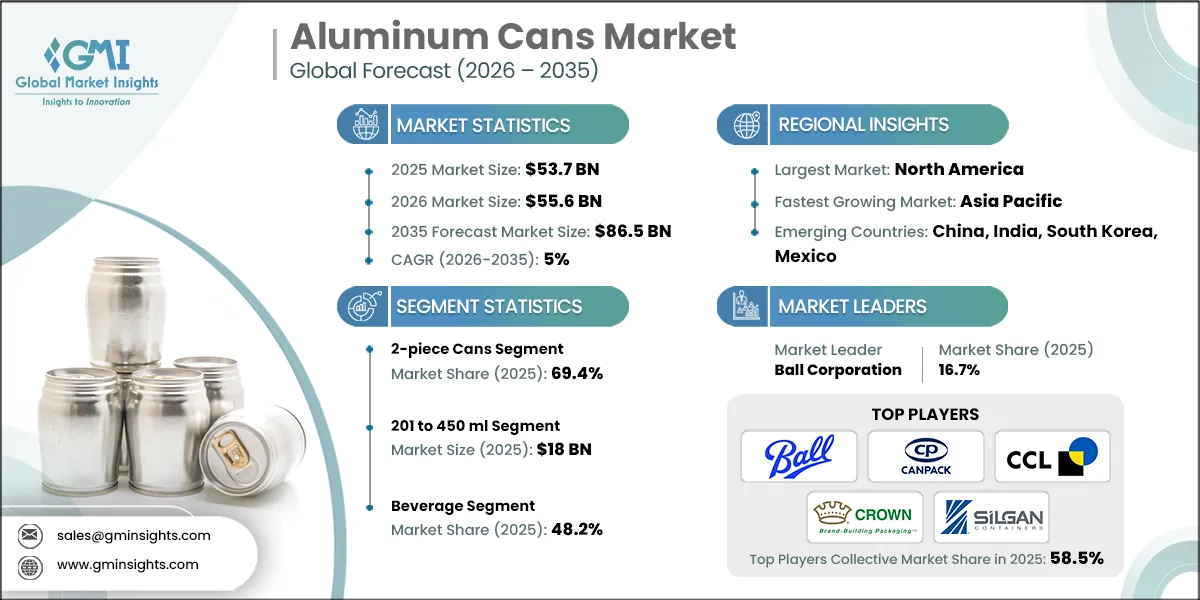
To get key market trends
Aluminum Cans Market Trends
- The adoption of lightweight aluminum can designs is becoming a major trend in the beverage packaging industry. The trend accelerated around 2021 as manufacturers focused on reducing raw material usage and transportation emissions. It is expected to continue through 2032 as sustainability targets and cost-efficiency initiatives remain central to packaging strategies. This shift improves supply chain efficiency and lowers carbon footprints for beverage producers.
- The growing use of sleek and slim aluminum can formats is reshaping product positioning in premium beverage categories. Adoption increased significantly after 2020 as energy drinks, craft beverages, and ready-to-drink cocktails sought distinctive packaging formats. The trend is projected to continue until at least 2030 due to strong demand for premiumized beverage packaging. This development enhances shelf differentiation and supports brand identity.
- The digital printing and advanced decoration of aluminum cans is emerging as an important packaging innovation. The trend gained traction around 2019 as beverage brands began using short production runs for seasonal launches and limited-edition products. It is expected to expand through 2030 as digital printing technology improves and marketing strategies focus on customization. This enables faster product launches and stronger consumer engagement.
- The rise of refillable and reusable aluminum beverage packaging systems is gradually influencing sustainability strategies. This trend started gaining attention around 2022 as beverage companies explored circular packaging models to reduce packaging waste. It is expected to expand through 2032 as governments and brands prioritize closed-loop packaging systems. The shift strengthens recycling ecosystems and supports long-term environmental commitments across the beverage industry.
Aluminum Cans Market Analysis
 Learn more about the key segments shaping this market
Learn more about the key segments shaping this market
Based on product type, the aluminum cans market is divided into 1-piece cans, 3-piece cans, and 2-piece cans.
- The 2-piece cans segment led the market in 2025, holding a 69.4% share. Two-piece cans dominate the market due to their widespread use in beverage packaging, particularly for carbonated soft drinks, beer, and ready-to-drink beverages. Their seamless structure improves strength, reduces material usage, and enables high-speed manufacturing. These advantages make them highly cost-efficient for large-scale beverage producers, supporting their strong adoption across North America, Europe, and Asia-Pacific beverage industries.
- The 3-piece cans segment is anticipated to grow at a CAGR of 4.5% over the forecast period. Growth is driven by their versatility in packaging food products, powders, and industrial liquids. Their design allows flexibility in height and diameter, making them suitable for diverse packaging requirements. Increasing demand from processed food, specialty products, and industrial applications supports the expansion of 3-piece cans, particularly in emerging markets with expanding packaged goods industries.
Based on capacity, the aluminum cans market is divided into up to 200 ml, 201 to 450 ml, 451 to 700 ml, 701 to 1000 ml, and more than 1000 ml.
- The 201 to 450 ml segment dominated the market in 2025 and valued at USD 18 billion as it represents the most widely used capacity for beverages such as carbonated soft drinks, beer, energy drinks, and flavored sparkling waters. This capacity range provides convenient single-serve packaging that aligns with consumer consumption habits and retail distribution formats. High demand from beverage manufacturers and strong adoption in supermarkets, convenience stores, and vending channels continue to sustain its leading position.
- The up to 200 ml segment is expected to witness growth at a CAGR of 4.7% during the forecast period. This growth is driven by increasing demand for mini cans and portion-controlled beverage packaging among health-conscious consumers. Beverage brands are introducing smaller cans for premium soft drinks, energy shots, and specialty beverages to support portion moderation and premium product positioning, particularly in North America and Asia-Pacific markets.
Learn more about the key segments shaping this market
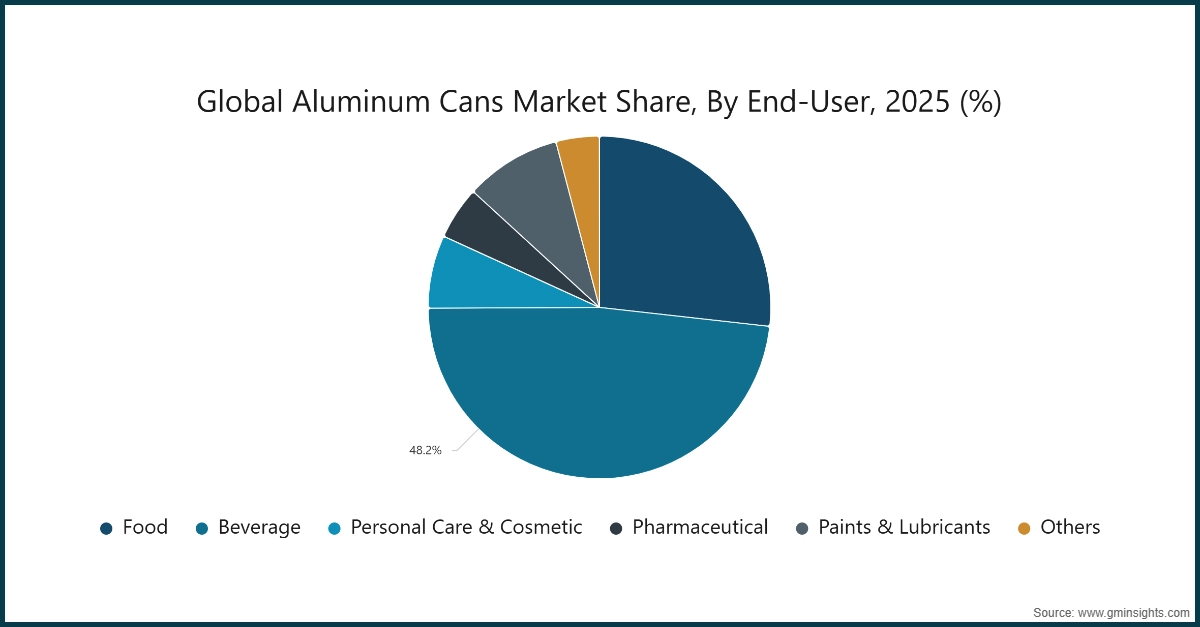
Based on end-user, the aluminum cans market is divided into food, beverage, personal care & cosmetic, pharmaceutical, paints & lubricants, and others.
- The beverage segment led the market in 2025 with a market share of 48.2% as aluminum cans are extensively used for packaging carbonated soft drinks, beer, energy drinks, and ready-to-drink beverages. Their superior barrier properties protect beverages from light and oxygen while maintaining carbonation and freshness. High consumption of canned beverages and the expansion of beverage manufacturing capacities across North America, Europe, and Asia-Pacific continue to drive strong demand for aluminum cans in this segment.
- The paints & lubricants segment is expected to grow at a CAGR of 8% during the forecast period. Growth is supported by increasing demand for durable metal packaging for industrial fluids that require protection against contamination and leakage. Aluminum cans provide corrosion resistance and product stability, making them suitable for specialty coatings, lubricants, and maintenance products. Expanding industrial production and automotive maintenance activities are further supporting the growth of this segment.
Looking for region specific data?
North America Aluminum Cans Market
North America held a share of 34.1% of market in 2025.
In North America, the market is expanding due to strong demand for canned beverages, particularly carbonated soft drinks, beer, and ready-to-drink alcoholic beverages. Beverage companies across the U.S., Canada, and Mexico are increasingly shifting toward aluminum cans because of their high recyclability and lower carbon footprint compared with alternative packaging formats.
- Additionally, packaging manufacturers are investing in new beverage can production facilities and capacity expansions to meet growing consumption across retail and foodservice channels. The region is expected to maintain steady growth through 2035 as beverage brands continue adopting sustainable metal packaging solutions and expanding canned beverage portfolios.
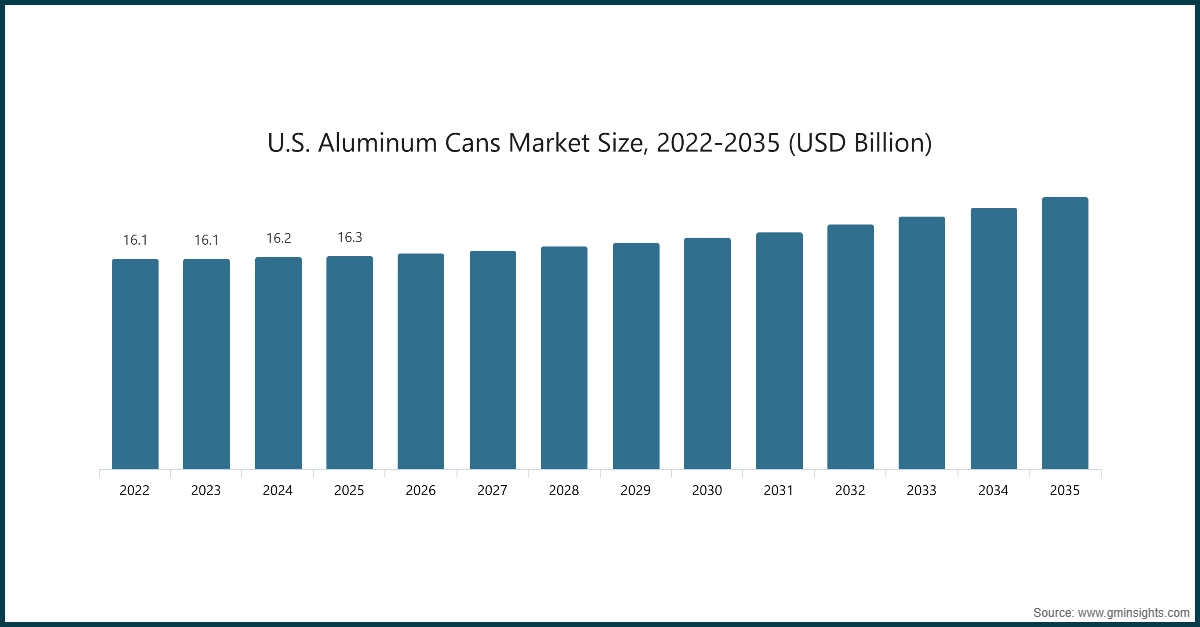
The U.S. aluminum cans market was valued at USD 16 billion and USD 16.1 billion in 2022 and 2023, respectively. The market size reached USD 16.3 billion in 2025, growing from USD 16.2 billion in 2024.
- The growth of the market in the United States is particularly strong due to the country’s well-established beverage industry and the widespread adoption of canned packaging across carbonated soft drinks, beer, energy drinks, and ready-to-drink beverages.
- Major beverage companies and packaging manufacturers are continuously expanding domestic can production facilities and strengthening supply agreements to meet rising demand. In addition, increasing sustainability commitments from beverage brands and retailers are accelerating the shift toward recyclable aluminum packaging, positioning the United States as the leading market in North America.
Europe Aluminum Cans Market
Europe market accounted for USD 14.9 billion in 2025 and is anticipated to show lucrative growth over the forecast period.
Europe’s market is expanding due to strong policy support for circular packaging and high consumer acceptance of recyclable beverage containers. The region has a well-established beverage can recycling infrastructure and strict packaging waste directives that encourage the use of infinitely recyclable materials such as aluminum.
- Beverage producers and packaging manufacturers are increasingly adopting lightweight aluminum cans and higher recycled-content materials to comply with sustainability targets. Countries including France, Spain, and the Netherlands are witnessing rising adoption of canned formats for craft beverages, sparkling water, and ready-to-drink cocktails, which is strengthening aluminum can demand across European retail and hospitality sectors.
Germany dominates the Europe aluminum cans market, showcasing strong growth potential.
- Germany leads the market in Europe due to its advanced recycling infrastructure and strong beverage manufacturing sector. The country’s deposit return system (Pfand) encourages high recovery of beverage containers, supporting a stable supply of recycled aluminum for packaging production.
- German beverage brands and breweries are increasingly shifting toward aluminum cans for craft beer, flavored sparkling beverages, and ready-to-drink cocktails to improve logistics efficiency and shelf differentiation. In addition, strong domestic packaging technology expertise and well-developed retail distribution networks make Germany a key market for aluminum beverage can consumption and innovation in Europe.
Asia Pacific Aluminum Cans Market
The Asia Pacific market is anticipated to grow at the highest CAGR of 8% during the forecast period.
The Asia Pacific market is expanding rapidly due to rising consumption of ready-to-drink beverages and the growing shift toward metal packaging in emerging economies. Beverage manufacturers across the region are increasingly adopting aluminum cans to support high-volume distribution through modern retail, convenience stores, and vending channels.
- Regional packaging producers are investing in new can manufacturing facilities and advanced production lines to meet rising demand from energy drinks, canned coffee, and flavored sparkling beverages. Strong growth of beverage manufacturing hubs in countries such as Japan, South Korea, and Thailand continues to strengthen the aluminum cans supply ecosystem across the Asia Pacific region.
India aluminum cans market is estimated to grow with a significant CAGR, in the Asia Pacific market.
- India is witnessing growing adoption of aluminum cans due to the rapid expansion of the ready-to-drink beverage industry and increasing preference for convenient, portable packaging formats. Domestic and international beverage companies are introducing canned formats for dairy drinks, fruit-based beverages, and craft beer to cater to urban consumers and modern retail channels.
- The country is also seeing rising investments in beverage can manufacturing capacity and supply chain development to support increasing demand from beverage producers. Growth in organized retail, quick-commerce platforms, and expanding foodservice outlets further strengthens aluminum can consumption in India’s beverage packaging sector.
Middle East and Africa Aluminum Cans Market
Saudi Arabia market to experience substantial growth in the Middle East and Africa market.
Saudi Arabia is witnessing growing adoption of aluminum cans driven by the rapid expansion of the beverage sector and the country’s increasing focus on modern retail and foodservice distribution channels. Local beverage producers and international brands are increasingly shifting to aluminum cans for carbonated drinks, energy beverages, and malt beverages due to their durability and suitability for hot climate storage and transportation.
- The country is also strengthening domestic beverage can manufacturing capacity through investments in metal packaging production facilities. In addition, the expansion of convenience stores, supermarkets, and entertainment venues under Saudi Vision 2030 is accelerating demand for packaged beverages, further supporting the growth of aluminum cans across Saudi Arabia’s beverage packaging industry.
Aluminum Cans Market Share
The market is led by players such as Ball Corporation, CANPACK, CCL Industries, Crown Holdings, and Silgan Containers. These five companies cumulatively accounted for 58.5% share of the market in 2025. Their leadership is supported by extensive global manufacturing networks, strong supply agreements with major beverage and food brands, and diversified metal packaging portfolios. Their capabilities in high-speed aluminum can production, advanced decoration technologies, and sustainable packaging solutions enable them to maintain a strong position in the market.
Additionally, continuous investments in lightweight can technologies, increased use of recycled aluminum, and expansion of beverage can manufacturing capacity across North America, Europe, and Asia-Pacific strengthen their competitive advantage and allow them to capture rising demand for sustainable metal packaging. Strategic collaborations with beverage companies and investments in new can production facilities further reinforce their market leadership and supply chain resilience.
Aluminum Cans Market Companies
Prominent players operating in the aluminum cans industry are as mentioned below:
- Ajanta Bottle
- Albott Containers
- Baixicans
- Ball Corporation
- CANPACK
- CCL Industries
- Ceylon Beverage Can
- Crown Holdings
- Envases Group
- GZI Industries
- Nampak
- Orora Packaging
- Scan Holdings
- Shiba Containers
- Silgan Containers
- Swan Industries
- Thai Beverage Can
- Toyo Seikan
- Ball Corporation
Ball Corporation is one of the world’s largest manufacturers of aluminum beverage cans, supplying innovative and sustainable metal packaging solutions to global beverage brands. The company focuses on lightweight can technology, increased recycled aluminum content, and expansion of beverage can production facilities to support rising demand for sustainable packaging in carbonated drinks, beer, and ready-to-drink beverages worldwide.
CANPACK is a leading global producer of aluminum beverage cans and metal packaging solutions. The company emphasizes advanced can manufacturing technologies, innovative can formats, and sustainable production practices. Its strong manufacturing footprint across Europe, Asia, and the Americas enables efficient supply to major beverage producers while supporting high-volume production and packaging innovation.
CCL Industries is a global leader in specialty labeling and packaging solutions that enhance branding and decoration for aluminum cans. Through advanced printing technologies and innovative label materials, the company supports beverage manufacturers in improving product visibility, shelf appeal, and consumer engagement across competitive retail markets.
Crown Holdings is a major global supplier of aluminum beverage cans and metal packaging products. The company focuses on high-speed production technologies, lightweight packaging innovations, and sustainable manufacturing practices. Its extensive global production network supports beverage companies with reliable supply while addressing the growing demand for recyclable and environmentally friendly packaging.
Silgan Containers is a leading manufacturer of metal packaging solutions serving food and consumer goods industries. The company leverages strong manufacturing capabilities and strategic partnerships with major consumer product companies to deliver durable, high-quality metal packaging solutions while supporting sustainability initiatives through recyclable packaging materials.
Aluminum Cans Market Report Attributes
| Key Takeaway | Details |
|---|---|
| Market Size & Growth | |
| Base Year | 2025 |
| Market Size in 2025 | USD 53.7 Billion |
| Market Size in 2026 | USD 55.6 Billion |
| Forecast Period 2026-2035 CAGR | 5% |
| Market Size in 2035 | USD 86.5 Billion |
| Key Market Trends | |
| Drivers | Impact |
| Strong demand from carbonated soft drinks and beer segments | Drives 24% growth as global brewers and beverage companies are increasingly shifting toward cans due to their superior product protection, portability, and faster chilling capability, leading to higher consumption in North America and Europe where canned beer penetration exceeds bottled formats. |
| Rising consumer preference for recyclable beverage packaging | Supports 21% growth as aluminum cans are infinitely recyclable without loss of quality, encouraging beverage producers to adopt cans to meet sustainability targets and circular packaging commitments. |
| High recycling efficiency of aluminum can materials | Contributes 20% growth as recycled aluminum requires less energy compared to primary production, prompting beverage brands and packaging manufacturers to increase the use of recycled content in cans to reduce carbon emissions and meet environmental regulations. |
| Lightweight packaging reducing beverage transportation costs | Adds 17% growth because their lower weight compared with glass bottles reduces fuel consumption during distribution and enables higher shipment volumes, making them particularly attractive for large-scale beverage manufacturers and global export operations. |
| Rapid urbanization increasing packaged beverage consumption | Accounts for 18% growth driven by rapid urbanization and rising consumption of packaged beverages in emerging economies such as India, China, and Southeast Asia. |
| Pitfalls & Challenges | Impact |
| Aluminum price volatility affecting can manufacturing costs | Restrains market growth as aluminum price volatility directly impacts production costs for can manufacturers. Fluctuations in global aluminum prices driven by energy costs, geopolitical tensions, and supply disruptions make it difficult for beverage packaging companies to maintain stable margins, often forcing them to renegotiate long-term supply contracts with beverage brands. |
| High electricity consumption in aluminum smelting processes | Limits growth as aluminum smelting and refining processes require extremely high electricity consumption. Rising energy prices in major producing regions such as Europe and China significantly increase production costs for primary aluminum, creating cost pressure across the aluminum can supply chain and affecting capacity expansion plans. |
| Opportunities: | Impact |
| Expansion of energy drink and functional beverage packaging | Presents strong growth potential through expanding demand for energy drinks and functional beverages packaged in aluminum cans. The rapid rise of sports drinks, energy beverages, and fortified ready-to-drink products among younger consumers is encouraging beverage companies to adopt slim and sleek aluminum can formats that enhance shelf appeal, portability, and brand differentiation in global retail markets. |
| Increasing recycled aluminum content in can manufacturing | Offers opportunity through increasing use of recycled aluminum content in beverage cans. Major packaging producers and beverage companies are investing in closed-loop recycling systems and high recycled-content cans to reduce carbon footprints, comply with sustainability regulations, and meet corporate ESG commitments, accelerating innovation in low-carbon aluminum can manufacturing. |
| Market Leaders (2025) | |
| Market Leader |
16.7% market share in 2025 |
| Top Players |
Collective market share in 2025 is 58.5% |
| Competitive Edge |
|
| Regional Insights | |
| Largest Market | North America |
| Fastest growing market | Asia Pacific |
| Emerging countries | China, India, South Korea, Mexico |
| Future outlook |
|
What are the growth opportunities in this market?
Aluminum Cans Industry News
- In December 2025, Ball Corporation announced that it entered into agreements to acquire a majority stake in Benepack’s beverage can manufacturing business in Europe, including facilities in Belgium and Hungary. The acquisition strengthens Ball’s beverage can production footprint in Western and Eastern Europe and enhances supply to regional beverage brands.
- In September 2025, CANPACK announced an investment of approximately USD 140 million to build its second aluminum beverage can plant in Colombia, located near Barranquilla. This expansion strengthens CANPACK’s presence in Latin America and enhances supply capacity to meet growing regional demand for sustainable beverage packaging.
- In May 2025, Ball Corporation partnered with Brazilian beverage brand Açaí Motion to launch a new aluminum energy drink can certified by the Aluminum Stewardship Initiative (ASI). This collaboration highlights the growing focus on certified sustainable aluminum packaging solutions and supports wider adoption of recyclable cans in emerging beverage categories.
The aluminum cans market research report includes in-depth coverage of the industry with estimates and forecast in terms of revenue (USD Million) from 2022 – 2035 for the following segments:
Market, By Product Type
1-piece cans
2-piece cans
- 3-piece cans
Market, By Capacity
- Up to 200 ml
- 201 to 450 ml
- 451 to 700 ml
- 701 to 1000 ml
- More than 1000 m
Market, By End-User
- Food
- Beverage
- Personal Care & Cosmetic
- Pharmaceutical
- Paints & Lubricants
- Others
The above information is provided for the following regions and countries:
- North America
- U.S.
- Canada
- Europe
- Germany
- UK
- France
- Spain
- Italy
- Netherlands
- Asia Pacific
- China
- India
- Japan
- Australia
- South Korea
- Latin America
- Brazil
- Mexico
- Argentina
- Middle East and Africa
- South Africa
- Saudi Arabia
- UAE
Frequently Asked Question(FAQ) :
What was the aluminum cans market valuation in 2025?
The global market was valued at USD 53.7 billion in 2025.
What is the projected market size and CAGR by 2035?
The market is expected to reach USD 86.5 billion by 2035, growing at a CAGR of 5% from 2026 to 2035.
Which product type segment led the aluminum cans market in 2025?
The 2-piece cans segment dominated the market, holding a 69.4% share in 2025.
Which capacity segment was most widely used in 2025?
The 201 to 450 ml segment led the market, valued at USD 18 billion, due to its popularity in soft drinks and beer.
What was the market share of the beverage end-user segment in 2025?
The beverage segment held the largest market share at 48.2% in 2025.
Which region held the largest aluminum cans market share in 2025?
North America held the largest share, accounting for 34.1% of the global market in 2025.
Who is the current market leader and what is their share?
Ball Corporation is the market leader with a 16.7% market share in 2025.
Aluminum Cans Market Scope
Related Reports