Summary
Table of Content

Aircraft Platform Market
Get a free sample of this report
Form submitted successfully!
Error submitting form. Please try again.
Thank you!
Your inquiry has been received. Our team will reach out to you with the required details via email. To ensure that you don't miss their response, kindly remember to check your spam folder as well!
Request Sectional Data
Thank you!
Your inquiry has been received. Our team will reach out to you with the required details via email. To ensure that you don't miss their response, kindly remember to check your spam folder as well!
Form submitted successfully!
Error submitting form. Please try again.
Aircraft Platform Market Size
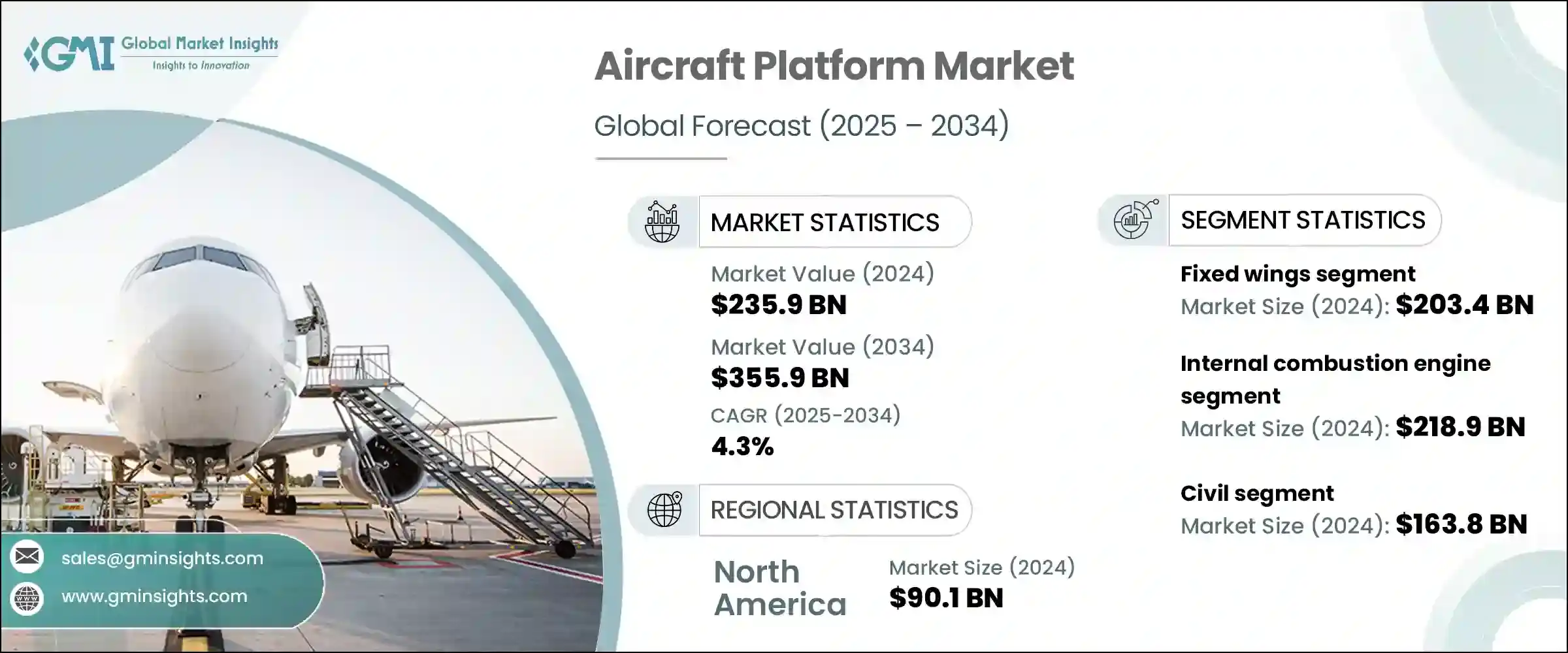
The global aircraft platform market was valued at USD 235.9 billion in 2024. The market is expected to grow from USD 244.6 billion in 2025 to USD 294.7 billion in 2030 and USD 355.9 billion by 2034, at a CAGR of 4.3% during the forecast period of 2025–2034.
Aircraft Platform Market Key Takeaways
Market Size & Growth
- 2024 Market Size: USD 235.9 Billion
- 2034 Forecast Market Size: USD 355.9 Billion
- CAGR (2025–2034): 4.3%
Key Market Drivers
- Increasing air travel demand.
- Fleet modernization.
- Low cost carrier (LCC) expansion.
- Development of space & hypersonic aircraft.
Challenges
- High development and certification costs.
- Supply chain disruptions and component shortages.
Opportunity
- Urban Air Mobility (UAM) Integration.
- Aftermarket Integration and Platform Customization.
Key Players
- Leading Players: Top 5 players in this market include Boeing Co, Airbus SE, Lockheed Martin Corporation., Northrop Grumman Corporation, Embraer S.A., which collectively held a market share of 76% in 2024.
Get Market Insights & Growth Opportunities
- The growth of the aircraft platform market is attributed to increasing air travel demand, fleet modernization, low-cost carrier (LCC) expansion, development of space & hypersonic aircraft, and increasing defense & military spending.
- The increasing air travel demand is a major growth driver for the market. Rising global air passenger traffic, especially in emerging markets, is compelling airlines to expand and modernize their fleets to meet capacity needs, improve fuel efficiency, and comply with environmental regulations. This demand is driving orders for new aircraft platforms across commercial, regional, and low-cost carriers, thereby accelerating production by OEMs and creating sustained growth across the aircraft platform value chain. For instance, the International Air Transport Association (IATA) has witnessed that the demand for international air travel rose by 10.8%, as compared to the previous year in April 2024.
- Several budget airlines such as IndiGo, Southwest, and Ryanair are expanding their fleets to serve cost efficient consumers, which propels the demand for narrow body aircraft such as Boeing 737 Max and Airbus 320 neo. Also, these LCCs are entering new routes that include long haul budget flights, fueling aircraft demand.
- The growing defense budget, which is significantly driven by the increasing geopolitical tensions, modernization programs, and emerging security threats has led to surge in demand for military aircraft platforms. Several countries still operate outdate cold war Era aircrafts such as F-16s and MiG – 29s, that are being replace with several 5th gen fighter aircrafts such as F – 35 ad Su 0 57, which generates significant demand for advanced military aircraft demand.
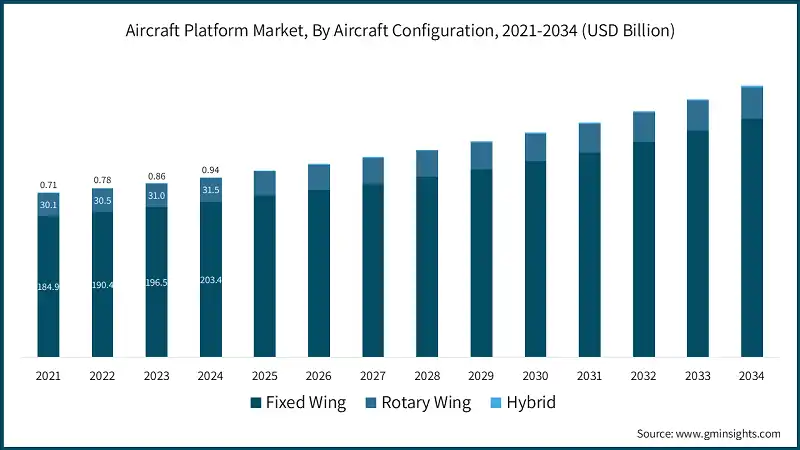
- Based on the aircraft configuration, the market is segmented into fixed wing, rotary wing, and hybrid. In 2024, the fixed wing segment held the largest market share and accounted for 86.2% of the global market share, largely due to the rise in demand for commercial aviation, increasing emphasis on strengthening military and defense, and expansion of e-commerce, all of which generates significant demand for fixed wing aircraft.
- North America dominated the aircraft platform market in 2024 and held a market share of 38.2%. The regional growth is fueled by the surge in defense spending, rapid expansion of cargo and logistics aircraft, and along with increasing emphasis on fleet renewal by U.S. airlines.
To get key market trends
Aircraft Platform Market Trends
- The growing emphasis towards short urban and suburban flights has led to a surge in demand for electrical vertical takeoff and landing (eVTOL) aircraft that reduces traffic congestion and offers emission free and on demand air mobility. Several companies such as Joby Archer, Boeing, and Airbus are investing heavily in battery tech, avionics, and autonomous systems, which has led to increasing demand for specialized platforms. This trend was on the testing phase in 2021 and has achieved several certifications such as EASA SC VTOL and FAA Part 23 and will witness major roll out by 2030 in several major cities such as Dubai, Los Angeles, and Singapore.
- The increasing focus of development on advanced air traffic management system (ATM) such as AI, satellite based ADB – B, and unmanned traffic management, to handle the growing air traffic, automate airspace coordination, and reducing delay and collisions is emerging as a significant trend. This trend enables high density operations and supports more flights in the crowded airspace, fueling the demand for newer aircraft with advanced avionics that facilitates the fleet modernization. This trend started with early UTM deployments in 2022 – 2024 and will currently undergo AI/ML dynamic routing trials for the next few years. However, by 2030, this trend will witness major traction with fully automated and high-density airspace management.
- The rapid expansion of e-commerce along with supply chain disruptions has led to a surge in demand for freighters and converted passenger jets. Several major companies such as Amazon Air, FedEx, and DHL are now expanding their fleets with several conversions, repurposing their commercial aging jets into freighters. This trend peaked during the 2020 – 2022 year timeline, with cargo shipping at its peak. Post 2023, the e-commerce stabilized, while generating high demands and this trend will remain prominently strong, fueling the demand for next generation aircraft to enter the service.
Aircraft Platform Market Analysis
Learn more about the key segments shaping this market
Based on the aircraft configuration, the market is segmented into fixed wings, rotary wings, and hybrids.
- The fixed wings segment was valued at USD 203.4 billion in 2024. This growth is fueled by the rising air passenger traffic coupled with the increasing demand for commercial aviation. For instance, according to the International Air Transport Association (IATA), the global air passenger traffic is expected to double by 2037, reaching a value of 8.2 billion passengers.
- The dominance of this segment is further fueled by advancement in aircraft technology such as efficient engines and light weight material, that further reduce operational cost and environmental impacts.
- Manufacturers should focus on the investment in sustainable aviation, electric propulsion systems, and digital maintenance solutions, to gain competitive advantage while reducing their environmental footprint.
- The hybrid wings segment is the fastest growing market and is anticipated to grow with a CAGR of 9.1% during the forecast period. The increase in demand for versatile and efficient aircraft designs, that combines benefit of fixed wing aircraft along with the maneuverability of rotorcraft aircraft. These are thus gaining rapid adoption in urban air mobility applications, due to their faster travel times and reduced noise pollution.
- For instance, Urban Air Mobility is expected to become a reality in Europe within 3-5 years with the development of new technologies such as electric propulsions and enhanced battery systems, as stated by EASA. Also, the advancement in material science and aerodynamics has further led to the development of more efficient hybrid wing designs, that further fuels growth in this segment.
- Manufacturers must invest in R&D to overcome the challenges associated with the hybrid wing design such as stability and control issues. They should also enter into strategic collaboration with startups and academics for help to further accelerate in this area of innovation.
Learn more about the key segments shaping this market
On the basis of the aircraft propulsion type, the aircraft platform market is categorized into internal combustion engine (ICE), electric, and hybrid electric.
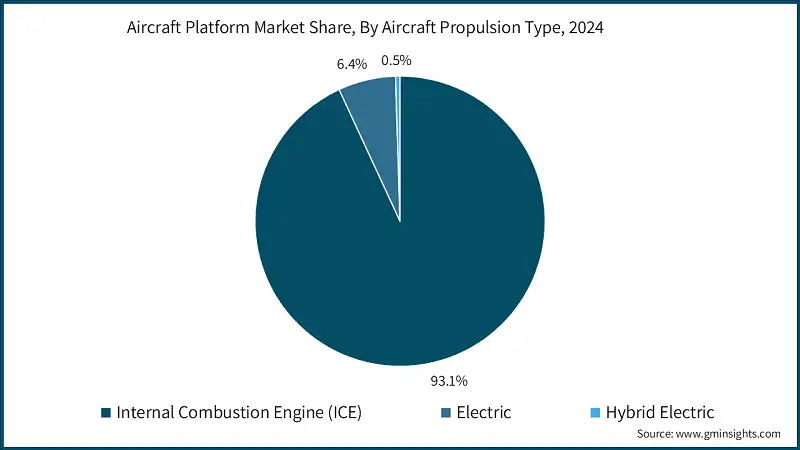
- The internal combustion engine segment dominated the market and was valued at USD 218.9 billion in 2024. This growth is fueled by the widespread adoption of this engine in various industries such as automotive, aerospace, and marine. Despite the ongoing trend towards electrification, ICE engines continue to offer advantages in terms of power density range, and infrastructure support.
- Manufacturers should emphasize towards optimizing engine performance, emission reduction, and improving fuel efficiency that meets the increasing regulatory standards. Moreover, the development of aftermarket solutions and retrofit kits for existing ICE vehicles will be a lucrative revenue stream that supports the transition to cleaner technologies.
- The hybrid electric segment is the fastest growing market and is anticipated to grow with a CAGR of 13.6% during the forecast period. The growing demand for fuel efficient and environmentally friendly solutions is propelling the demand for this segment, that is being adopted across various industries and applications.
- Furthermore, advancement in battery technology and power electronics are improving the efficiency and affordability of hybrid electric systems, that further drives growth in this segment.
- Manufacturers should collaborate with government and regulatory bodies to develop incentives and standards for hybrid electric adoption, that drive market growth and accelerate the transition towards cleaner technologies.
On the basis of end use, the aircraft platform market is bifurcated into civil, and military.
- The civil segment dominated the market and was valued at USD 163.8 billion in 2024. Growing demand for air travel, driven by rising incomes and urbanization, is fueling the need for more aircraft, driving growth in the civil segment. According to IATA, global air passenger traffic is expected to double by 2037.
- Additionally, Innovations in materials, design, and propulsion are enabling the development of more efficient, comfortable, and environmentally friendly civil aircraft, driving demand and growth in the segment. Electric and hybrid-electric propulsion are key areas of research.
- The military segment is anticipated to grow with a CAGR of 3% during the forecast period. Rising global security threats and the need for advanced military capabilities are driving defense spending and demand for modern aircraft platforms, including fighter jets, transport planes, and UAVs.
- Further, the growing adoption of UAS for surveillance, reconnaissance, and combat operations is driving growth in the military segment. Advances in autonomy, AI, and sensor technologies are enabling more sophisticated UAS capabilities and applications.
- Manufacturers must focus on developing cutting edge technologies such as stealth capabilities, advanced sensors, and AI powered systems to stay competitive edge technologies. Additionally, companies must focus on prioritizing partnerships and collaboration with government and other industry players to drive innovation, reduce development costs, and meet the growing need of modern militaries.
Looking for region specific data?
North America dominated the global aircraft platform market and was valued at USD 90.1 billion in 2024 and is projected to grow with a CAGR of 4% during the forecast period. This growth is driven by the presence of major manufacturers and a strong demand for commercial and military aircraft.
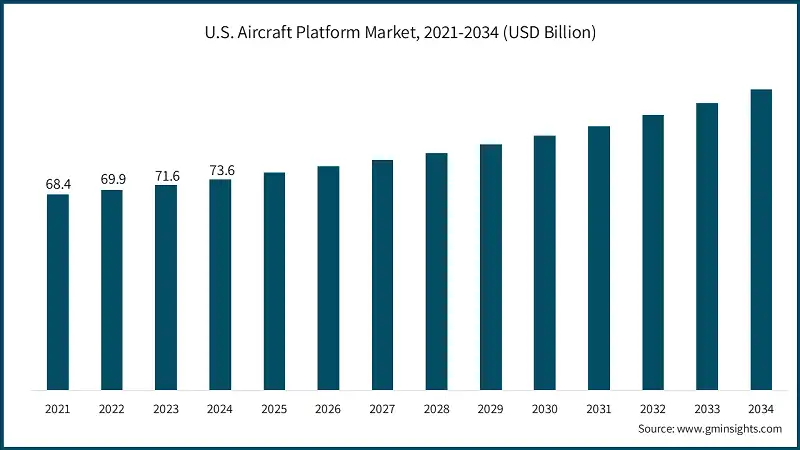
- The aircraft platform market in the U.S. was valued at USD 73.6 billion in 2024 and is anticipated to grow with a CAGR of 3.7% during the forecast period, due to high defense spending and advanced aerospace infrastructure. For instance, the U.S. accounted for over 38% of global military expenditure, driving significant demand for next-gen fighter jets (e.g., F-35) and UAVs in 2024, as stated by SIPRI. NASA’s renewed focus on space platforms and urban air mobility projects like AAM (Advanced Air Mobility) further diversify platform needs. Boeing and Lockheed Martin dominate commercial and defense segments respectively, supported by a robust supply chain ecosystem.
- Defense OEMs should prioritize AI-enabled autonomous systems integration, while commercial players must align with FAA’s UAM certification timelines to capture emerging airspace opportunities.
- Canada aircraft platform market is anticipated to grow with a CAGR of 5.3% during the forecast period. Canada’s market is driven by defense modernization programs and growing investments in Arctic surveillance and sovereignty. For instance, according to the Aerospace Industries Association of Canada (AIAC), the aerospace industry contributed USD 29 billion in GDP to the Canadian economy in 2023.
- OEMs should align with Canada’s industrial and regional benefits (IRB) policy by partnering with local firms like CAE, Leonardo Canada, or Viking Air to secure procurement contracts. Emphasizing AI-enabled sensor fusion and cold-weather operability will differentiate platform bids in Canada’s unique operational environment.
Europe market is anticipated to grow with a CAGR of 3.5% during the forecast period. The growth in the region is fueled by the collaborative defense programs and green aviation mandates.
- The aircraft platform industry in the Germany is anticipated to surpass USD 13.5 billion by 2034. The aircraft platform market in Germany is driven by the defense rearmament initiatives and participation in multinational combat aircraft programs. The country witnessed growing procurement of Eurofighter Typhoon upgrades, F-35A fighters, and MQ-9A drones and leads the Future Combat Air System (FCAS) program with France and Spain, aiming to field a next-gen air combat platform by 2040. For instance, according to the German Aerospace Industries Association (BDLI), the domestic aerospace revenues rose 8.2% in 2023, which is supported by digital cockpit retrofits and AI-enabled mission systems integration.
- Manufacturers must align with FCAS roadmap and offer dual-use platforms that meet both NATO interoperability standards and EU defense industrial policy goals. Prioritizing local content partnerships with Airbus Defense, Diehl Aerospace, or Hensoldt will enhance bid competitiveness under new national security vetting protocols.
- UK aircraft platform market was valued at USD 7.7 billion in 2024 and is anticipated to grow with a CAGR of 4% during the forecast period. The regional growth is fueled by the increasing demand for defense modernization and sustainable aviation solutions. For instance, UK's Jet Zero Council aims to achieve net-zero emissions by 2050, which is driving significant demand for sustainable aviation technologies.
- Manufacturers should prioritize on developing cutting-edge technologies, such as advanced materials and digital engineering, for defense modernization, while also investing in sustainable aviation solutions, such as electric and hybrid-electric propulsion systems, to meet the UK's net-zero emissions targets.
Asia Pacific market is the fastest growing market in the global aircraft platform market and is anticipated to grow with a CAGR of 6.3% during the forecast period. The growth in the region is fueled by the rising regional tensions and indigenous manufacturing initiatives.
- The aircraft platform market in the China is anticipated to surpass USD 36.8 billion by 2034. The Chinese government is investing heavily in airport infrastructure with plans to deploy over 400 local airports by 2035, which fuels consistent demand for aircraft platforms. Additionally, the rapid urbanization along with the rising disposable income has led to growing demand for domestic and international air travel.
- Manufacturers should collaborate with Chinese companies such as COMAC and AVIC to capture the growing domestic market and leverage their expertise in aircraft manufacturing. Also, they must target the growing middle class population by developing aircraft platforms that caters both domestic and international air travel demand.
- Japan aircraft platform market is anticipated to grow significantly with a CAGR of 5.6% during the forecast period. The growth in the market is fueled by the growing investment towards its defense capabilities, including air force. In addition, the region is partnering with several international companies such as Textron Aviation Defense to modernize its pilot training program.
- Manufacturers must emphasize towards developing aircraft platforms that caters to the Japan defense sector, including advanced fighter jets and pilot training programs. In addition, Japanese manufacturer should prioritize the development of unmanned aerial vehicles and other unmanned systems, that further caters to the defense and civilian needs.
- The aircraft platform market in India is projected to surpass USD 21 billion by 2034 with a CAGR of 6.8% during the forecast period. The growing economy and rising middle class are driving demand for air travel along with the increasing investment from government towards airport infrastructure. Moreover, the aviation industry of India is growing rapidly, along with the presence of several major players, which has established helicopter assembly facilities. Also, India is emphasizing towards modernization of its defense capabilities including the air force along with the growing investment in indigenous aircraft development and procurement.
- Manufacturers should invest in indigenous aircraft development including design, manufacturing and testing, further supported by the Make in India initiative. Furthermore, OEMs must invest in maintenance, repair, and overhaul (MRO) capabilities to gain competitive edge.
The aircraft platform market in Latin America was valued at USD 10.1 billion in 2024 and is expected to surpass USD 12.1 billion by 2034. This growth is fueled by the growing emphasis towards fleet renewal and defense modernization.
MEA market is anticipated to surpass USD 25.3 billion by 2034, supported by the dominance of wide body aircraft, with Emirates leading order for long haul routes. In addition, the region is also investing in sustainable aviation with UAE and Saudi Arabia pioneering SAF adoption and hydrogen ready infrastructure, that further aligns with ICAO 2050 net zero goals.
- South Africa aircraft platform market is projected to grow with a CAGR of 4.3% during the forecast period. The market is fueled by the increasing demand for business and private aviation, supported by the strong economy of the country and increasing number of high net worth individuals.
- Manufacturers must focus on developing and marketing aircraft models that caters to the specific need of the African market such as long range jets with larger cabins. In addition, Manufacturers must also invest in maintenance, repair, and overhaul (MRO) service to support the growing fleet of aircraft, which will be crucial for industry players to establish a strong presence in the market.
- Saudi Arabia aircraft platform market is projected to surpass USD 2.6 billion by 2034. The growth in the market is fueled by the growing emphasis towards domestic aerospace and defense manufacturing. Moreover, the rapid expansion of Red Sea Air mobility infrastructure coupled with the growth in Hajj and Umrah air traffic further drives the demand for both commercial and military aircraft platforms.
- The aircraft platform market in UAE accounted for USD 808.9 million in 2024. The UAE region is witnessing market growth due to its defense localization strategy, that aims to manufacture 50% of the military equipment domestically by 2030. In addition, the ongoing collaboration with global OEMs and indigenous MRO development are further some major growth drivers, that positions UAE as a key player in the aerospace industry.
Aircraft Platform Market Share
- The top 5 companies in the aircraft platform industry are Boeing Co, Airbus SE, Lockheed Martin Corporation, Northrop Grumman Corporation, and Embraer S.A., together held 76.2% of the market share in 2024. This shows the high level of consolidation of the market.
- Boeing Co remains a global leader in the aircraft platform market with a market share of 29.9% in 2024. It invests heavily in innovation, automation, and digital twin technologies to improve aircraft efficiency and lifecycle performance. Boeing is also expanding its services business, including MRO and training, to provide value-added solutions across the aircraft platform lifecycle. Strategic partnerships and defense contracts globally, particularly for fighter jets and autonomous platforms, remain core to its growth outlook.
- Airbus SE holds a major position in the market, accounting for a market share of 25.7% in 2024. It focuses on developing next-generation aircraft platforms like the A321XLR and hydrogen-powered zero-emission concepts. In defense, Airbus emphasizes multilateral cooperation (e.g., Eurofighter, A400M) and integrated unmanned systems.
- Lockheed Martin Corporation has maintained a competitive position in the aircraft platform market with a market share of 13.1% in 2024. Lockheed Martin’s core strategy revolves around its dominance in advanced military platforms such as the F-35 fighter jet, C-130J transport aircraft, and integrated unmanned aerial systems. It focuses on high-margin defense contracts, strategic government partnerships, and multirole platforms that support joint operations. The company invests in AI, autonomy, and mission system upgrades to enhance operational superiority.
- Northrop Grumman Corporation maintained a 5.3% share of the market in 2024. Northrop Grumman’s strategy in the aircraft platform market is centered around advanced military systems, particularly stealth, ISR, and autonomous platforms. It leads in next-gen programs like the B-21 Raider stealth bomber and high-altitude UAVs (e.g., Global Hawk). The company prioritizes mission-ready, survivable platforms integrated with network-centric warfare capabilities.
- Embraer SA holds a major position in the market, accounting for market share of 2.2% in 2024. Embraer’s strategy focuses on regional and defense aircraft platforms, with strong market presence in the 70–130 seat segment. It continues to invest in fuel-efficient E-Jet E2 series and hybrid-electric regional aircraft. In defense, Embraer capitalizes on multi-mission platforms like the KC-390 Millennium, targeting emerging markets.
Aircraft Platform Market Company
List of prominent players operating in the aircraft platform industry include:
- Boeing Co
- Airbus SE
- The Commercial Aircraft Corporation of China, Ltd.
- Embraer S.A.
- Lockheed Martin Corporation.
- Northrop Grumman Corporation
- Dassault Aviation SA
- SAAB
- Sukhoi
- BAE Systems
- Hindustan Aeronautics Limited
- United Aircraft Corporation
- Boeing Co, Airbus SE, Lockheed Martin Corporation, Northrop Grumman Corporation are the market leader in the global aircraft platform market with expansive portfolios spanning commercial, military, and UAV segments. Boeing and Airbus lead in commercial aviation with wide-body, narrow-body, and next-gen sustainable aircraft. Lockheed and Northrop drive the military segment with platforms like the F-35 and B-21 Raider. Their leadership is sustained by massive R&D budgets, long-term government contracts, strong supply chains, and unmatched global delivery capabilities.
- Embraer S.A., Dassault Aviation SA, BAE Systems are positioned as a challenger in the market, as these players offer strong, technically sophisticated platforms across regional, business, and military aircraft categories. Embraer leads in the 70–130 seat segment and offers multi-role transport platforms, while Dassault and BAE focus on defense (e.g., Rafale, Eurofighter). They demonstrate high engineering capability, growing export footprints, and frequent innovation in avionics and airframe materials.
- The Commercial Aircraft Corporation of China, Ltd. (COMAC), Hindustan Aeronautics Limited (HAL), United Aircraft Corporation (UAC), SAAB, as placed under the follower segment in the market and shows growing ambition in both domestic and export markets, supported by strong government backing. COMAC is challenging duopoly dominance with the C919, while HAL and UAC cater to strategic military and civil demands in India and Russia respectively.
- Sukhoi and other regional platform integrators are positioned as niche players in the market with a focus primarily on domestic military markets with limited international outreach. Their aircraft platforms, while capable are often restricted by export control issues, regional politics, and certification barriers.
Aircraft Platform Market Report Attributes
| Key Takeaway | Details |
|---|---|
| Market Size & Growth | |
| Base Year | 2024 |
| Market Size in 2024 | USD 235.9 Billion |
| Forecast Period 2025 – 2034 CAGR | 4.3% |
| Market Size in 2034 | USD 355.9 Billion |
| Key Market Trends | |
| Drivers | Impact |
| Increasing air travel demand | 2x passengers drives demand for efficient aircraft platform expansion globally. |
| Fleet modernization | 85% of current fleets will be replaced, creating massive platform demand for next-gen aircraft. |
| Low cost carrier (LCC) expansion | LCC expansion multiplies regional aircraft demand across emerging air routes. |
| Development of space & hypersonic aircraft | Hypersonic R&D drives breakthrough military and high-speed travel platforms. |
| Pitfalls & Challenges | Impact |
| High development and certification costs | These costs represent up to 20–30% of total program budgets, causing significant capital lock-up and financial risk for OEMs. |
| Supply chain disruptions and component shortages | Component shortages, especially for semiconductors and composites, have caused production slowdowns reducing aircraft output by 15–25% in affected OEMs |
| Opportunities: | Impact |
| Urban Air Mobility (UAM) Integration | Creates demand for specialized lightweight, electric vertical takeoff and landing (eVTOL) platforms, opening new revenue streams for OEMs and suppliers in cabin, avionics, and propulsion technologies. |
| Aftermarket Integration and Platform Customization | Enhanced platform customization improves customer retention and drives recurring revenue by offering modular upgrades and tailored avionics solutions. |
| Market Leaders (2024) | |
| Market Leaders |
29.9 market share |
| Top Players |
Collective market share in 2024 is 76% |
| Competitive Edge |
|
| Regional Insights | |
| Largest Market | North America |
| Fastest Growing Market | Asia Pacific |
| Emerging Countries | India, South Korea, Mexico, Argentina, Italy |
| Future outlook |
|
What are the growth opportunities in this market?
Aircraft Platform Industry News
- In April 2025, Airbus signed a Memorandum of Understanding (MoU) with Panasonic Avionics to explore a strategic partnership for the future Connected Aircraft platform. Subject to a definitive agreement expected later this year, both parties intend to leverage Panasonic Avionics’ next-generation in-flight entertainment (IFE) hardware and software server platform, Converix, to co-develop the new on-board architecture.
The aircraft platform market research report includes an in-depth coverage of the industry with estimates and forecast in terms of revenue (USD Billion) from 2021 – 2034 for the following segments:
Market, By Aircraft Configuration
- Fixed wing
- Rotary wing
- Hybrid
Market, By Aircraft Type
- Commercial aircraft
- Narrow-body
- Wide-body
- Regional jets
- Business jets
- Military aircraft
- Fighter jets
- Transport aircraft
- Special mission aircraft
- Military helicopters
- Unmanned aerial vehicles (UAVs)
Market, By Aircraft Propulsion Type
- Internal Combustion Engine (ICE)
- Turboprop
- Turboshaft
- Turbojet
- Turbofan
- Electric
- Hybrid electric
Market, By End Use
- Civil
- Business & private aviation
- General aviation & utility
- Urban air mobility (UAM)
- Emergency & public services
- Others
- Military
- Combat & strike missions
- Transport & logistics
- Intelligence, surveillance & reconnaissance (ISR)
- Training & simulation
- Command & control / communications
- Others
The above information is provided for the following regions and countries:
- North America
- U.S.
- Canada
- Europe
- Germany
- UK
- France
- Spain
- Italy
- Netherlands
- Asia Pacific
- China
- India
- Japan
- Australia
- South Korea
- Latin America
- Brazil
- Mexico
- Argentina
- Middle East and Africa
- Saudi Arabia
- South Africa
- UAE
Frequently Asked Question(FAQ) :
What is the market size of the aircraft platform in 2024?
The market size was USD 235.9 billion in 2024, with a CAGR of 4.3% expected through 2034 driven by fleet modernization, LCC expansion, and rising defense spending.
What is the projected value of the aircraft platform market by 2034?
The aircraft platform industry is expected to reach USD 355.9 billion by 2034, supported by increasing air travel demand, eVTOL adoption, and hypersonic aircraft development.
How much revenue did the fixed wing segment generate in 2024?
The fixed wing segment generated USD 203.4 billion in 2024, dominating the market with 86.2% share.
What was the valuation of internal combustion engine segment in 2024?
The internal combustion engine segment was valued at USD 218.9 billion in 2024.
What is the growth outlook for hybrid electric propulsion from 2025 to 2034?
Hybrid electric propulsion is projected to grow at a 13.6% CAGR till 2034.
Which region leads the aircraft platform market?
North America led the market with USD 90.1 billion in 2024. Growth is fueled by strong defense spending and a robust aerospace supply chain.
What are the upcoming trends in the aircraft platform industry?
Key trends include urban air mobility, AI-based air traffic management, cargo aircraft conversions, and hydrogen-powered aviation platforms.
Who are the key players in the aircraft platform market?
Key players include Boeing Co, Airbus SE, Lockheed Martin Corporation, Northrop Grumman Corporation, Embraer S.A., Dassault Aviation SA, BAE Systems, COMAC, HAL, and UAC.
Aircraft Platform Market Scope
Related Reports