Summary
Table of Content

Air Traffic Management Market
Get a free sample of this report
Form submitted successfully!
Error submitting form. Please try again.
Thank you!
Your inquiry has been received. Our team will reach out to you with the required details via email. To ensure that you don't miss their response, kindly remember to check your spam folder as well!
Request Sectional Data
Thank you!
Your inquiry has been received. Our team will reach out to you with the required details via email. To ensure that you don't miss their response, kindly remember to check your spam folder as well!
Form submitted successfully!
Error submitting form. Please try again.
Air Traffic Management Market Size
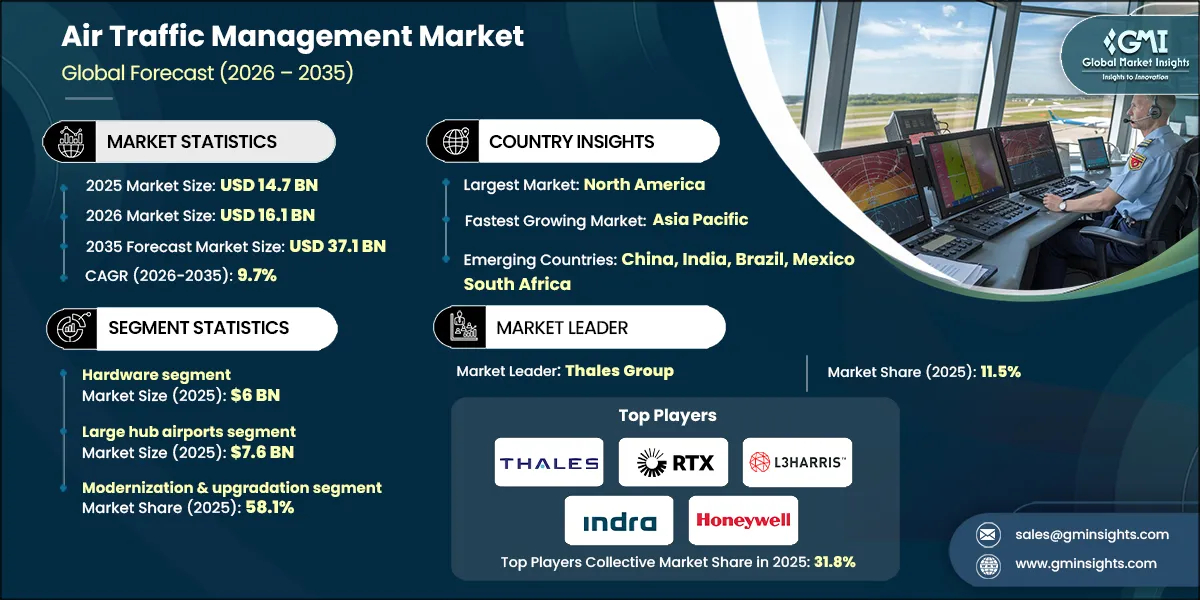
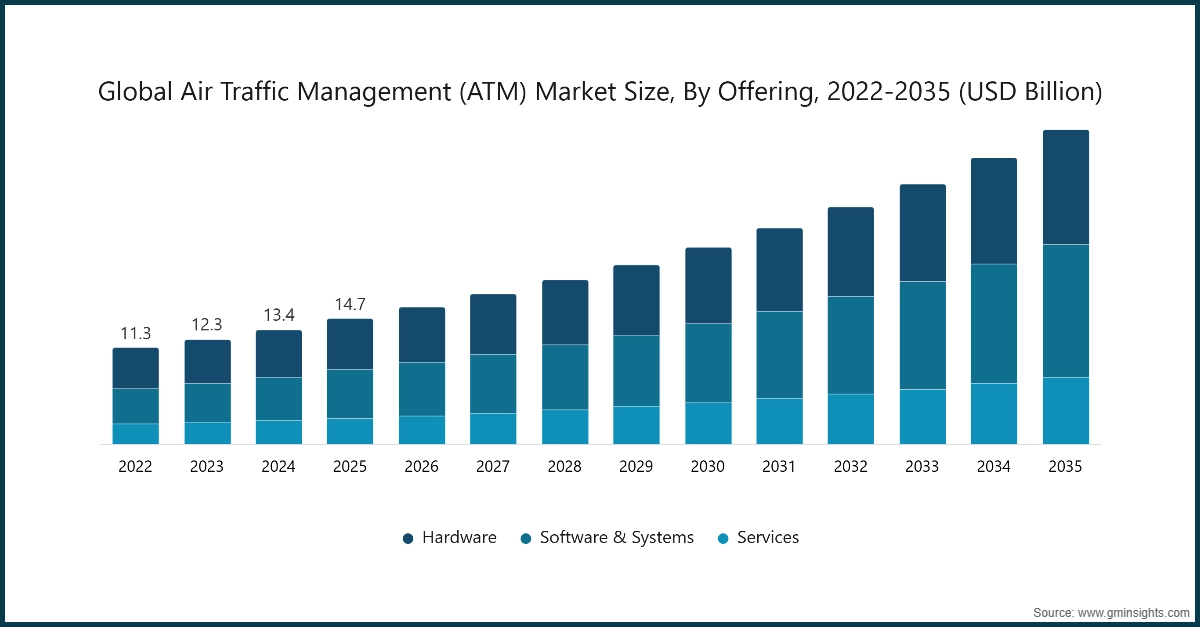
The global air traffic management market was valued at USD 14.7 billion in 2025. The market is expected to grow from USD 16.1 billion in 2026 to USD 37.1 billion in 2035, at a CAGR of 9.7% during the forecast period according to the latest report published by Global Market Insights Inc.
Air Traffic Management Market Key Takeaways
Market Size & Growth
- 2025 Market Size: USD 14.7 Billion
- 2026 Market Size: USD 16.1 Billion
- 2035 Forecast Market Size: USD 37.1 Billion
- CAGR (2026–2035): 9.7%
Regional Dominance
- Largest Market: North America
- Fastest Growing Region: Asia Pacific
Key Market Drivers
- Post-Pandemic Air Traffic Recovery.
- Modernization of ATM Infrastructure.
- Integration of Unmanned Aircraft Systems (UAS).
- Demand for Enhanced Safety and Efficiency.
- Global Airport Capacity Expansion.
Challenges
- Cybersecurity Risks & System Interoperability Issues.
- High Implementation Costs & Legacy System Integration.
Opportunity
- Adoption of AI-Driven and Automated ATM Solutions.
- Expansion of UTM and Advanced Air Mobility Integration.
Key Players
- Market Leader: Thales Group led with over 11.5% market share in 2025.
- Leading Players: Top 5 players in this market include Thales Group, RTX Corporation (Raytheon Technologies), L3Harris Technologies, Inc., Indra Sistemas, S.A., Honeywell Inc., which collectively held a market share of 31.8% in 2025.
Get Market Insights & Growth Opportunities
The air traffic management market is being propelled by the expansion of advanced aviation operations across both commercial and military airspace. ATM systems play a pivotal role in overseeing and regulating diverse functions from trajectory planning and traffic flow management to communication, surveillance, and navigation services that ensure the safe, efficient movement of aircraft across complex global airspace environments. As air traffic volume and complexity continue to grow, from various stakeholders, there has been an increasing investment into systems that provide real-time situational awareness for all phases of flight while allowing reliable coordination among those involved in the flight operations.
As the aviation industry moves toward more advanced operations due to increased reliance on digital technology, there has been an increase in the number of requests from the industry for precision ATM systems. Not only do these technological systems need to provide highly reliable and accurate information, they also must be able to operate under the increasing pressures of growing volumes of congested airspace. Increased emphasis on safety, operational performance and efficiency has significantly driven this growing demand for ATM technology in the aviation sector. For instance, the European ATM master plan includes a comprehensive scope of the digitization of ATM in Europe, including a roadmap that enables the development of ATM systems based on data-driven decision-making, cloud-based service delivery models, and improved interoperability between providers of aeronautical services who operate in the geographical areas of their associated countries.
The trend towards increased safety and regulatory compliance for unmanned air systems (UASs), urban air mobility vehicles, and other non-traditional airspace users continues to evolve. Thus, increasing the focus on improved safety and regulatory compliance through advanced ATM solutions for conventional and emerging airspace users. The FAA's UTM Initiative is indicative of a shift to develop a collaborative environment for ensuring safe UAS operations within the traditional traffic environment in the low-altitude airspace. This will occur through enhanced flight planning, authorization, surveillance, and conflict management systems to ensure safety.
Moreover, the ATM market will continue growing due to technological advancements that enable digital transformation and automation. Digital Sky Demonstrators by SESAR are modern solutions currently undergoing testing for crossing borders and enhancing the Air Traffic Management System's (ATM) ability to supply ample airspace capacity as well as safety and environmental performance through connected sensors, remote towers, and a single shared digital asset across borders. High-profile examples include operation Zenith in the UK, which has demonstrated how unmanned aerial vehicles (UAVs) can be integrated into controlled airspace real-time and highlight the potential for the integration or synergy of ATM and UAS towards managing the airspace in complex scenarios.
To get key market trends
Air Traffic Management Market Trends
Air traffic management continues to develop rapidly, mainly through the transition to digitalization, automation and data-based operations. One of the largest growing trends is remote/digital towers that allow air traffic control (ATC) for multiple airports from one central remote location, which also provides ATC with more flexibility to perform operations.
- Additionally, the introduction of satellite-based surveillance and performance-based navigation (PBN) technologies has changed the air traffic management market by allowing for more accurate tracking of aircrafts and the ability to have expanded coverage to areas that would have previously not had coverage.
- Another key trend within ATM that continues to grow is trending towards predictive analytics and real-time data sharing. With the increased availability of both predictive analytics and real-time data sharing, air traffic controllers and airlines are using these methods to calculate optimal flight paths and predict/avoid congestion and conflicts, resulting in increased efficiency and enhanced safety.
- NextGen has transformed the air traffic control system to enhance safety, efficiency, and flexibility by enabling technological advancements such as trajectory-based operations. The NextGen initiative will also enable the development of non-traditional aviation, including commercial space flight and advanced air mobility, while encouraging cooperation between nations to improve airspace safety and mobility worldwide.
- The development of unmanned aircraft systems (UAS) and urban air mobility (UAM) has led to the development of ATM systems to enable the management of low-altitude airspace, including the integration of new airspace users and safety and regulatory compliance. In addition, there are increased levels of collaboration between airports, airlines, and air navigation service providers (ANSPs), enabling more effective data-driven decision making throughout the airspace network.
Air Traffic Management Market Analysis
Learn more about the key segments shaping this market
Based on offering, the market is segmented into hardware, software & systems, and services. The hardware segment reached USD 6 billion in 2025.
- The hardware segment has the largest share of the market because of its importance in supporting the infrastructure for air traffic control, radar, communication, navigation, and surveillance. These elements are vital for the safe and efficient use of airspace by the commercial and defense aviation industries.
- Hardware solutions have the reliability, long lifespan in harsh environments, and compatibility with existing ATM infrastructure that make them a necessity for the real-time monitoring of aircraft for the safe management of their trajectories. This segment has the advantage of already being deployed at airports and ANSPs, has proven scalability, and has strong adoption within government bodies and defense forces.
- The rise in air traffic, modernization in air traffic control systems, and investments in advanced surveillance and communication systems would further strengthen the hardware segment's position in the ATM market.
- The software & systems segment is the fastest-growing and is expected to register a high CAGR of 10.7% during the forecast period. The segment growth is driven by increasing demand for sophisticated air traffic management solutions, such as predictive analytics, trajectory-based operations, conflict resolution, and airspace optimization.
- Technologies such as cloud-based systems, AI, and real-time data processing are helping in the efficient running of operations, eliminating delays, and providing safety in the skies. The use of digital towers, unmanned aircraft systems management software, and collaborative decision-making systems is resulting in the increased growth of the software & systems segment.
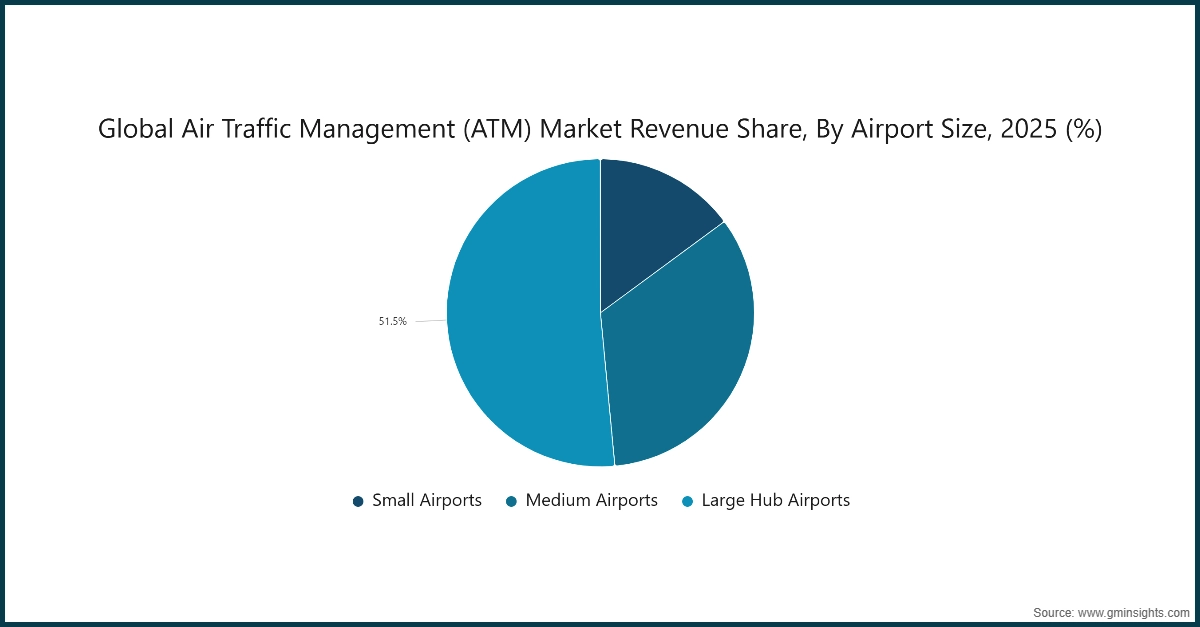
Based on airport size, the air traffic management market is segmented into small airports (<2m passengers annually), medium airports (2–15m passengers annually), and large hub airports (>15m passengers annually). The large hub airports segment accounted for over USD 7.6 billion in 2025.
- The large hub airports segment has the largest market share, given the high air traffic and associated complexities, which in turn demand high-end ATM solutions. These airports need high-end radars, communication systems, digital towers, and software solutions to manage thousands of flights on a daily basis. These airports need high-reliability air traffic management solutions to manage peak air traffic, ensuring continuity of operations and incorporating multiple airspace management technologies.
- The market is further supported by the established usage of advanced air traffic control technology, government and airline investment, and modernization initiatives to ensure the widespread adoption of technology worldwide. Increasing passenger traffic, airspace congestion, and investment in airport expansion are further driving the dominance of Large Hub Airports in the ATM market.
- The medium airports business is growing with a CAGR of 8.6% because of the increasing number of flights, advancements in airport infrastructure, and the adoption of digital towers, remote monitoring systems, and predictive analytics platforms.
- Medium airports are increasingly using software, automation, and networked surveillance systems to enhance the efficiency of operations, reduce delays, and ensure the safety of airspace.
Learn more about the key segments shaping this market
On the basis of installation type, the air traffic management market is segmented into new installation and modernization & upgradation. The modernization & upgradation segment accounted for the largest market share of 58.1% in 2025.
- The modernization segment holds the largest market due to the ongoing need to replace legacy air traffic control infrastructure with advanced radar systems, digital towers, surveillance technologies, and integrated airspace management platforms. Upgrading existing systems ensures improved operational efficiency, enhanced safety, and compliance with evolving regulatory standards. These projects are typically driven by government agencies, defense aviation authorities, and major airports to support high air traffic volumes.
- The new installation segment is the growing significantly and is expected to register 8.8% CAGR during the forecast period. The new installation segment is driven by increasing airport construction projects, new regional hubs, and the establishment of air traffic management systems in emerging markets.
- Deployment of state-of-the-art hardware, software, and service solutions enables real-time monitoring, automated operations, and enhanced predictive analytics from the outset, improving airspace efficiency and safety.
North America Air Traffic Management Market
The North American dominated the global air traffic management industry with a share of 47.1% in 2025.
- The North American ATM market is witnessing a steady growth rate due to the rising demand for digital tower solutions, remote monitoring systems, and advanced automation technologies. Airports and air navigation service providers are investing more in data sharing technologies, predictive analytics, and trajectory-based operations to increase the efficiency and safety of the system.
- The use of IoT, AI, and smart airspace management technologies across the aviation and defense industries is also contributing to the deployment of ATM systems. Increasing emphasis on environmental sustainability, congestion management, and regulatory compliance is also contributing to the growth of the ATM system market.
Looking for region specific data?
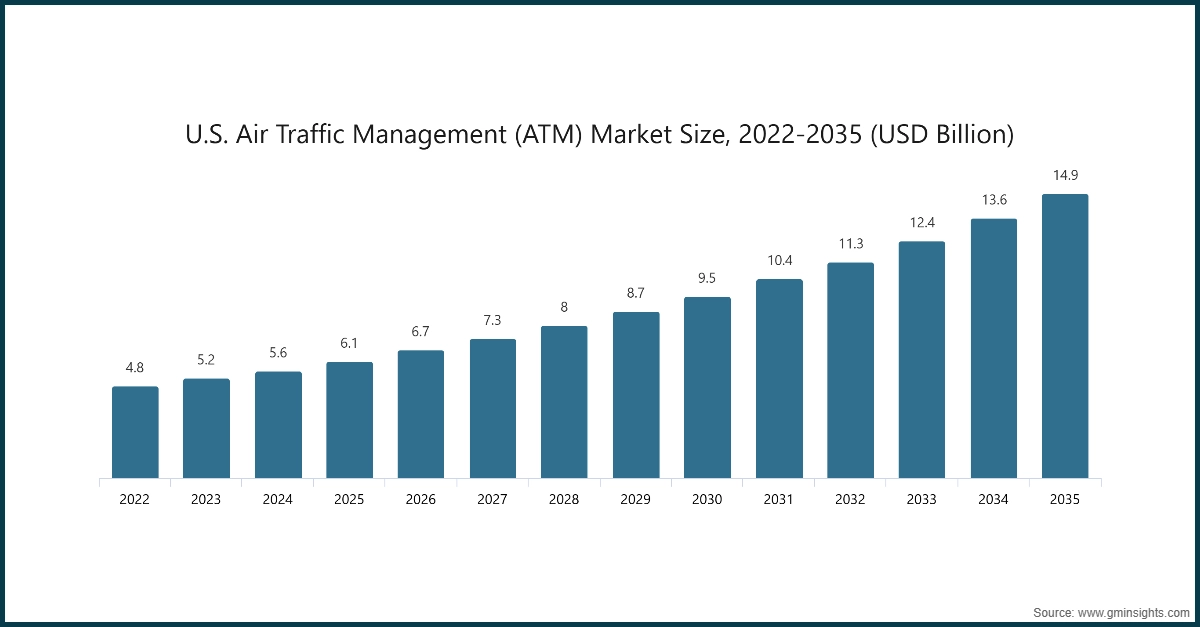
The U.S. air traffic management market was valued at USD 4.8 billion and USD 5.2 billion in 2022 and 2023, respectively. The market size reached USD 6.1 billion in 2025, growing from USD 5.6 billion in 2024.
- The U.S. market is growing due to robust investments in airport modernization, defense aviation, and sophisticated air traffic control solutions. In addition, the demand for digital towers, predictive analytics solutions, and real-time airspace solutions is increasing, which is fueling the market.
- The major upgrade of the US national air traffic system has been achieved with new trajectory-based operations (TBO) and advanced automation solutions. The initiative has shown the growth potential of ATM technology.
Europe Air Traffic Management Market
Europe air traffic management industry accounted for USD 3.4 billion in 2025 and is anticipated to show lucrative growth over the forecast period.
- The European ATM industry is experiencing the positive effects of strict safety, security, and environmental regulations. The use of digital towers, satellite-based surveillance, and trajectory-based operations is increasing among airports, airlines, and air navigation service providers.
- Investments in cutting-edge air traffic solutions, airspace management, and the integration of AI-based automation are opening up new avenues for growth. The industry is also getting support from efforts to address congestion, improve efficiency, and ensure airspace safety with the help of advanced ATM solutions.
Germany dominates the Europe air traffic management market, showcasing robust growth potential.
- Germany accounts for a market share of 18.8% in 2025, due to its well-developed airspace infrastructure and emphasis on digital towers, automated traffic management, and satellite-based surveillance. Advanced ATM systems are being increasingly used to ensure safety, efficiency, and compliance.
- Government incentives for smart airspace, environmental sustainability, and next-generation air traffic technology, as well as the increasing aerospace operations, are propelling the adoption of ATM. The emphasis on the integration of AI, IoT, and automation in air traffic management is expected to fuel the growth of the market in the coming years.
Asia Pacific Air Traffic Management Market
Asia Pacific market is witness about 11% CAGR during the forecast period.
- The growth is likely to be driven by airport infrastructure expansion, rising air traffic volumes, and increasing aerospace and defense investments. Advanced air traffic technologies and predictive analytics are becoming critical for operational efficiency and safety.
- The region is also focusing on developing an integration of IoT, AI, and smart airspace management systems to improve real-time monitoring. Investments in modernized airports, digital towers, and urban air mobility solutions are increasing the adoption of ATM in the region.
China air traffic management market is estimated to grow with a significant CAGR of 12% in the Asia Pacific region.
- A new market is emerging in China due to modernization in airports, smart air traffic management, and government policies for advanced ATM solutions. Digital towers, satellite surveillance, and trajectory-based operations are increasingly being used in various airport and airspace sectors.
- The emphasis on operational safety, efficiency, and predictive airspace management in commercial aviation, defense, and urban air mobility applications is creating growth opportunities. The expansion of airport infrastructure, the incorporation of AI and IoT technologies, and the modernization of air traffic control systems also contribute to market growth.
Latin American Air Traffic Management Market
The growth of the ATM industry in Brazil is aided by the increasing investment in airport infrastructure and the adoption of cutting-edge air traffic control systems. Airports, airlines, and the defense industry are increasingly adopting real-time airspace surveillance and predictive analytics to improve operational safety.
The regulatory emphasis on airspace safety, sustainability, and efficiency is opening up opportunities for the adoption of cutting-edge ATM solutions. The convergence of digital towers, automated traffic management, and trajectory-based operations is expected to fuel further growth.
Middle East and Africa Air Traffic Management Market
South Africa and other regional markets are experiencing gradual ATM market growth as airports and air navigation providers adopt advanced air traffic technologies. The focus on predictive airspace management, safety monitoring, and congestion reduction is creating momentum in the adoption of ATM.
More investment in smart airports, urban air mobility, and airspace modernization initiatives is providing opportunities in the market. The market is also likely to benefit from the focus on operational reliability, regulatory compliance, and sustainable air traffic management.
Air Traffic Management Market Share
The air traffic management industry is primarily competitive and technology-focused. Additionally, it has a competitive structure characterized by a moderate degree of concentration. These firms place a strong emphasis on the provision of safe, precise or accurate air traffic management solutions in real time. There are five primary ones responsible for most of the sales of products or services to this industry: Thales Group, RTX Corporation (Raytheon Technologies), L3Harris Technologies, Inc., Indra Sistemas, SA, and Honeywell Inc. Together these firms accounts for almost 31.8% market share of the global air traffic management market, and therefore, it creates a semi-consolidated market for many large manufacturers of aerospace and defense-related technology. This further creates a cut-throat competition with several small, specialized manufacturers producing ATM solutions.
The key competitive factors among the market participants are reliability, accurate navigation and surveillance solutions, strong integration capability, and support for real-time operations. Many of the leading companies continue to develop new types of radar systems, communication networks, flight data processor systems, navigation aids, and decision-support software products that provide enhanced support to civil aviation authorities, airports, and military applications in both air traffic management and other aeronautical operational areas.
The major companies are also investing heavily in R&D and large-scale system integration capabilities, as well as simulation-based testing in order to achieve high levels of accuracy, resilience, and regulatory compliance. The companies have a strong focus on establishing strategic partnerships with civil aviation authorities, airports, airlines, and aerospace manufacturers in order to achieve enhancements to the interoperability of systems, increased efficiency levels within the airspace, and faster adoption rates of next-generation ATM systems.
Air Traffic Management Market Companies
Prominent players operating in the air traffic management industry are as mentioned below:
- Adacel Technologies Limited
- Aireon LLC
- BAE Systems plc
- Frequentis AG
- Honeywell International Inc.
- Indra Sistemas, S.A.
- L3Harris Technologies, Inc.
- Leonardo S.p.A.
- NATS Holdings Limited
- Nav Canada
- Northrop Grumman Corporation
- Raytheon Technologies Corporation
- Saab AB
- SITA
- Thales Group
Honeywell International Inc. is a leading player in the global air traffic management market with a market share of approximately 10.1%. The company specializes in high-precision vibration, temperature, and pressure sensors for aeroderivative turbines, industrial gas turbines, and aerospace applications. Honeywell focuses on reliability, accuracy, and real-time monitoring capabilities, enabling predictive maintenance and enhanced turbine performance. Continuous investments in R&D, advanced sensor technologies, and collaborations with turbine OEMs strengthen its position as a market leader in innovative and high-performance sensor solutions.
RTX Corporation (Raytheon Technologies)
RTX Corporation holds a market share of around 10% in the air traffic management market. The company provides high-precision radar, communication, and flight data processing systems that support safe and efficient air traffic operations. RTX emphasizes reliability, real-time data integration, and scalable solutions for both civil and defense applications. Aerospace partnerships with aviation authorities, airports, and aerospace manufacturers allow the company to expand its global presence and maintain a competitive edge in cutting-edge ATM technologies.
L3Harris Technologies commands approximately 4.4% of the air traffic management market. The company delivers integrated ATM solutions including radar systems, communication networks, and decision-support software for air traffic control and monitoring. L3Harris focuses on accuracy, system resilience, and seamless integration across heterogeneous airspace environments. Investments in advanced R&D, simulation-based testing, and collaborations with aviation authorities enhance their ability to provide innovative, high-performance ATM solutions that improve safety, efficiency, and airspace management worldwide.
Air Traffic Management Market Report Attributes
| Key Takeaway | Details |
|---|---|
| Market Size & Growth | |
| Base Year | 2025 |
| Market Size in 2025 | USD 14.7 Billion |
| Market Size in 2026 | USD 16.1 Billion |
| Forecast Period 2026-2035 CAGR | 9.7% |
| Market Size in 2035 | USD 37.1 Billion |
| Key Market Trends | |
| Drivers | Impact |
| Post-Pandemic Air Traffic Recovery | Drives demand for scalable and resilient air traffic management systems capable of handling rising flight volumes, restoring route capacity, and reducing congestion as global air travel rebounds. |
| Modernization of ATM Infrastructure | Accelerates adoption of digital, automated, and interoperable ATM platforms that replace legacy systems, enabling real-time data sharing, improved traffic flow management, and enhanced operational reliability. |
| Integration of Unmanned Aircraft Systems (UAS) | Creates demand for advanced ATM and UTM solutions that enable safe integration of drones into controlled and uncontrolled airspace through automated surveillance, flight authorization, and conflict management. |
| Demand for Enhanced Safety and Efficiency | Increases deployment of high-precision surveillance, communication, and decision-support tools that improve situational awareness, reduce human error, and optimize airspace utilization. |
| Global Airport Capacity Expansion | Drives investment in advanced ATM systems to support increased runway operations, terminal movements, and airspace coordination, enabling airports to accommodate higher traffic volumes without compromising safety. |
| Pitfalls & Challenges | Impact |
| Cybersecurity Risks & System Interoperability Issues | Impacts operational reliability and safety by exposing ATM networks to cyber threats and data-sharing challenges across fragmented, multi-stakeholder airspace environments. |
| High Implementation Costs & Legacy System Integration | Impacts adoption by increasing capital expenditure and deployment timelines, particularly for airports and ANSPs transitioning from aging ATM infrastructure. |
| Opportunities: | Impact |
| Adoption of AI-Driven and Automated ATM Solutions | Creates opportunities for improved traffic flow optimization, predictive conflict management, and reduced controller workload through intelligent automation. |
| Expansion of UTM and Advanced Air Mobility Integration | Enables new revenue streams and system deployments by supporting drone operations and future air taxi services within existing airspace frameworks. |
| Market Leaders (2025) | |
| Market Leader |
11.5% market share in 2025 |
| Top Players |
Collective market share in 2025 is 31.8% |
| Competitive Edge |
|
| Regional Insights | |
| Largest Market | North America |
| Fastest growing market | Asia Pacific |
| Emerging countries | China, India, Brazil, Mexico, South Africa |
| Future outlook |
|
What are the growth opportunities in this market?
Air Traffic Management Industry News
- In January 2026, RTX’s Collins Aerospace was awarded a USD 438 million contract by the FAA to deploy next-generation surveillance radars under the Radar System Replacement program, part of U.S. air traffic control modernization. The systems, including Condor Mk3 and ASR-XM radars, provide cooperative and non-cooperative aircraft tracking, improving safety, efficiency, and interoperability while replacing legacy infrastructure. With over 550 RTX radar systems already operational, the company emphasized rapid deployment, cost-effective architecture, and readiness for future airspace demands.
- In August 2025, Thales highlighted its long-standing role in supporting U.S. Air Traffic Control (ATC) modernization. The company emphasized its TopSky ATC system, deployed in over 85 countries covering 40% of global airspace, alongside primary and secondary radar systems and navigation aids installed worldwide. Thales showcased its local U.S. footprint, R&D investments, and integrated solutions designed for civil, military, and emerging airspace operations, reinforcing its readiness to support FAA modernization efforts.
The air traffic management market research report includes in-depth coverage of the industry with estimates and forecast in terms of revenue in (USD Million) from 2022 – 2035 for the following segments:
Market, By Offering
- Hardware
- Radars & Surveillance
- Communication & Navigation
- Controller Working Positions & Displays
- Meteorological Hardware
- Others
- Software & Systems
- ATC Automation
- Air Traffic Flow Management (ATFM)
- Airspace Management (ASM)
- Aeronautical Information Management (AIM)
- Others
- Services
- Integration & Deployment Services
- Managed & Support Services
- Training & Simulation Services
Market, By Airspace Type
- Terminal Area
- En-Route
- Oceanic & Remote
Market, By Airport Size
- Small Airports (<2M Passengers Annually)
- Medium Airports (2-15M Passengers Annually)
- Large Hub Airports (>15M Passengers Annually)
Market, By Application
- Communication Management
- Navigation Support
- Surveillance & Monitoring
- Automation Support
Market, By Installation Type
- New Installation
- Modernisation & Upgradation
Market, By End-User
- Commercial Aviation
- Military & Government
- Urban Air Mobility (UAM) Operators
The above information is provided for the following regions and countries:
- North America
- U.S.
- Canada
- Europe
- Germany
- UK
- France
- Spain
- Italy
- Netherlands
- Asia Pacific
- China
- India
- Japan
- Australia
- South Korea
- Latin America
- Brazil
- Mexico
- Argentina
- Middle East and Africa
- South Africa
- Saudi Arabia
- UAE
Frequently Asked Question(FAQ) :
What is the market size of the air traffic management in 2025?
The market size was USD 14.7 billion in 2025, with a CAGR of 9.7% expected through 2035 driven by post-pandemic air traffic recovery and modernization of ATM infrastructure.
What is the projected value of the air traffic management market by 2035?
The air traffic management market is expected to reach USD 37.1 billion by 2035, propelled by integration of unmanned aircraft systems, AI-driven automation, and global airport capacity expansion.
What is the current air traffic management market size in 2026?
The market size is projected to reach USD 16.1 billion in 2026.
How much revenue did the hardware segment generate in 2025?
The hardware segment generated USD 6 billion in 2025, accounting for the largest market share due to its importance in supporting infrastructure for air traffic control, radar, communication, navigation, and surveillance.
What was the market share of the modernization & upgradation segment in 2025?
The modernization & upgradation segment held the largest market share of 58.1% in 2025, driven by the need to replace legacy air traffic control infrastructure with advanced systems.
What is the growth outlook for the software & systems segment during the forecast period?
The software & systems segment is expected to register a high CAGR of 10.7% during the forecast period, driven by increasing demand for predictive analytics, trajectory-based operations, and cloud-based systems.
Which region leads the air traffic management market?
North America held the largest market share of 47.1% in 2025, driven by robust investments in airport modernization, defense aviation, and sophisticated air traffic control solutions.
What are the upcoming trends in the air traffic management market?
Key trends include transition to remote and digital towers, adoption of satellite-based surveillance and performance-based navigation, integration of predictive analytics and real-time data sharing, development of UAS and UAM management systems, and enhanced collaboration between airports, airlines, and ANSPs.
Who are the key players in the air traffic management market?
Key players include Adacel Technologies Limited, Aireon LLC, BAE Systems plc, Frequentis AG, Honeywell International Inc., Indra Sistemas S.A., L3Harris Technologies Inc., Leonardo S.p.A., NATS Holdings Limited, Nav Canada, Northrop Grumman Corporation, Raytheon Technologies Corporation, Saab AB, SITA, and Thales Group.
Air Traffic Management Market Scope
Related Reports