Summary
Table of Content

AI-Powered Industrial Robot Market
Get a free sample of this report
Form submitted successfully!
Error submitting form. Please try again.
Thank you!
Your inquiry has been received. Our team will reach out to you with the required details via email. To ensure that you don't miss their response, kindly remember to check your spam folder as well!
Request Sectional Data
Thank you!
Your inquiry has been received. Our team will reach out to you with the required details via email. To ensure that you don't miss their response, kindly remember to check your spam folder as well!
Form submitted successfully!
Error submitting form. Please try again.
AI-Powered Industrial Robot Market Size
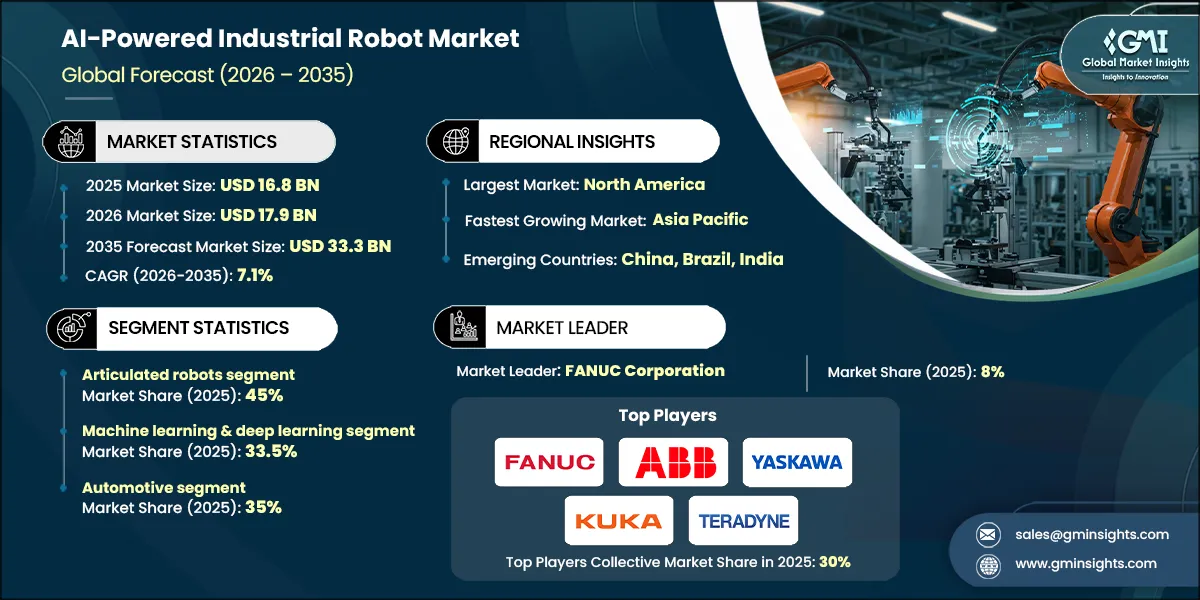
The global AI-powered industrial robot market was estimated at USD 16.8 billion in 2025. The market is expected to grow from USD 17.9 billion in 2026 to USD 33.3 billion in 2035, at a CAGR of 7.1% according to latest report published by Global Market Insights Inc.
AI-Powered Industrial Robot Market Key Takeaways
Market Size & Growth
- 2025 Market Size: USD 16.8 Billion
- 2026 Market Size: USD 17.9 Billion
- 2035 Forecast Market Size: USD 33.3 Billion
- CAGR (2026–2035): 7.1%
Regional Dominance
- Largest Market: North America
- Fastest Growing Region: Asia Pacific
Key Market Drivers
- Labor shortages & reshoring.
- Generative AI & LLM Integration.
Challenges
- High integration complexity.
- Increasing risk for Data Privacy & Cybersecurity.
Opportunity
- Increasing demand of Robot-as-a-Service (RaaS).
- Humanoid General-Purpose Robots.
Key Players
- Market Leader: FANUC Corporation led with over 8% market share in 2025.
- Leading Players: Top 5 players in this market include FANUC Corporation, ABB Ltd, Yaskawa Electric Corporation, KUKA SE & Co. KGaA, Teradyne Inc., which collectively held a market share of 30% in 2025.
Get Market Insights & Growth Opportunities
Major demand for advanced AI-powered industrial robots comes mainly due to innovations in software-defined automation. This demand also increases, essentially due to a surge in strategic mergers and acquisitions among robotics leaders, hence the need to enhance operational throughput. Market consolidation among major players translates into enormous breakthroughs, expanded technology portfolios, and a more robust presence in the global manufacturing landscape. The basis of conventional fixed-automation solutions, such as basic hard-coded articulated arms or standard non-integrated sensors, is finding major replacement from high-performance AI-driven autonomous systems.
"Agentic AI" robots and generative-modeled systems represent a more data-driven method of production since they digitally and physically track motion metrics and environmental data in real time to optimize even the most complex cells in a very short period. The utilization of this advanced technology is in line with the industrial sector's drift toward personalized, high-mix manufacturing; hence, it's a huge contributor to market growth.
The growing demand for reshoring and smart factories in the North American region and the rise in labor and automation budgets in the European and Asia-Pacific markets are the major drivers that have led to the commercial feasibility of this equipment. Factory owners as well as systems engineers are ready to choose an efficient and technology-upgraded process for their productions.
Among the most important drivers for the market for high-performing industrial machinery is the application of multi-modal sensor fusion and AI-based modeled motion planning, which has gained popularity for its verified advantages such as faster cycle time and zero possibility of mechanical collision. However, it is a market that is largely driven by its dependence on the knowledge of the long-term beneficial role of digital twin integration and edge engineering, resulting in increased adoption of these powerful tools. Also, human robot interaction for safety and ease will be further improved by developments in tactile sensation and vibration-damping materials.
These combined factors are the reason behind the market's positive financial performance, in addition to increasing adoption rates, industrywide progression toward IT/OT convergence, and demand for performance of high efficiency. The gradual transformation of basic industrial tools into highly durable professional-grade autonomous machinery is vastly dependent on advancements in material science. The industry is now set to witness a significant changeover in favor of lightweight alloys, carbon composites, and high-resilience polymers that not only will increase the lifecycle of a product but improve the energy transfer across a wide range of payloads and environmental conditions.
The manufacturers are eager to improve the user experience by integrating features such as IoT-enabled diagnostics, which enable real-time health analytics, and variable control systems that allow better maneuverability on the factory floor. The largest factors driving the AI-powered robotics market include increased interest from Small and Medium Enterprises (SMEs), the proliferation of "dark warehouses" at a rapid pace, and, professionally, data-backed process improvement.
Its effectiveness has attracted both casual manufacturers who want quick returns on investments, as well as high-tech car manufacturing plants demanding utmost consistency. This adoption of the technology has had a significant effect on the composition found in the market, whereby the Articulated Robots and Software as a Service (SaaS) segment has been registering the highest revenue, contributing the most significant part of the entire equipment market share. A major part of this segment entails products whose accuracy lies directly in computational capability, long cycle, and high customization, thus making it a perfect fit for the flexible and quickly adaptable nature required in today’s industrial environment.
To get key market trends
AI-Powered Industrial Robot Market Trends
The industrial robotics industry is during a paradigm shift, fuelled by the convergence of Information Technology and Operational Technology, as well as rapid advancement in Artificial Intelligence. Concretely, this market is being transformed by companies introducing next-generation autonomous systems capable of Agentic AI decision-making, 3D vision-language models, 5G-enabled edge computing, and tactile sensor integration, among other breakthrough technologies. In sum, these are targeted at changing manufacturers who need agile, "zero-code" solutions to manage high-mix, low-volume production. Their response to the trends within the industry is a commitment to further innovation that arms factories with state-of-the-art tools to increase productivity without "downtime penalties" and help bring about a self-correcting, resilient ecosystem in manufacturing.
- Generative AI and Natural Language Programming: The shift, mainly about intuitive robot-human interaction, came forward with LLM-based interfaces that can let non-specialists’ program complex tasks through simple voice commands. To make robots more adaptable to unstructured environments, manufacturers are busily developing VLA models that enable a robot to "understand" a scene and perform a task without pre-defined coordinates.
- Growth in humanoid and “Physical AI” Labor: The demand has been driven by the shift from prototype development to pilot production for humanoid robots. The Articulated Robot market is still the dominant one, accounting for almost 53% of the market, but there is growing application for general-purpose humanoids in “brownfield” factories for human-type movement, such as in narrow aisles and stairs.
- Sustainable and circular automation: Sustainable manufacturing and the circular economy model have now emerged as a serious factor, since manufacturers have begun to harness energy recovery systems whereby energy generated by braking is fed back into the power grid, and robots have been developed with modular materials that could be recycled easily. Such trends will be in line with world-wide integration of ESG and the imperative of "Green Robotics."
- Digital Twins and "Simulate-then-Procure" focus: Professional management of industrial performance is growingly proactive, which means entire work cells are regularly simulated in a Digital Twin environment prior to physical deployment. The need for precision and risk mitigation leads to ongoing demand for virtual commissioning services and real-time "Sim-to-Real" transfer learning, enabling robots to train in a digital space and then be deployed instantly in the physical world.
AI-Powered Industrial Robot Market Analysis
Learn more about the key segments shaping this market
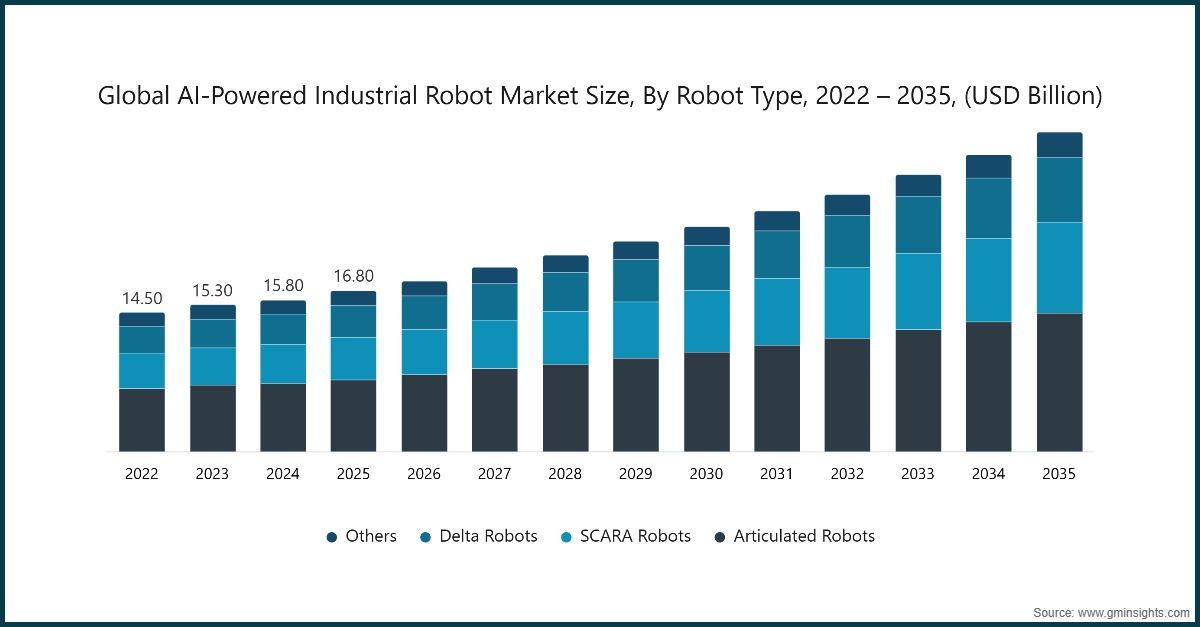
Based on the robot type, the market is divided into articulated robots, SCARA robots, delta robots, and others. The articulated robots segment held the largest share, accounting for 45% of the global AI-powered industrial robot market in 2025.
- The need for high-performance motion control, multi-axis flexibility, and AI-driven path planning is encouraging segment growth.
- Articulated robots hold a significant portion of the market value and exhibit steady growth, indicating a continued industrial preference for versatile, high-payload applications in automotive and heavy manufacturing.
- The SCARA robots and delta robots' segments show healthy growth rates of 8.0% and 7.6% respectively, suggesting consistent demand from high-speed electronics assembly and food-packaging sectors.
- Specialized and high-tech, modern delta robots are ideal for enhancing the pick-and-place experience. Manufacturers appreciate the convenience of AI-integrated hardware for specialized, high-repetition performance tracking.
Learn more about the key segments shaping this market
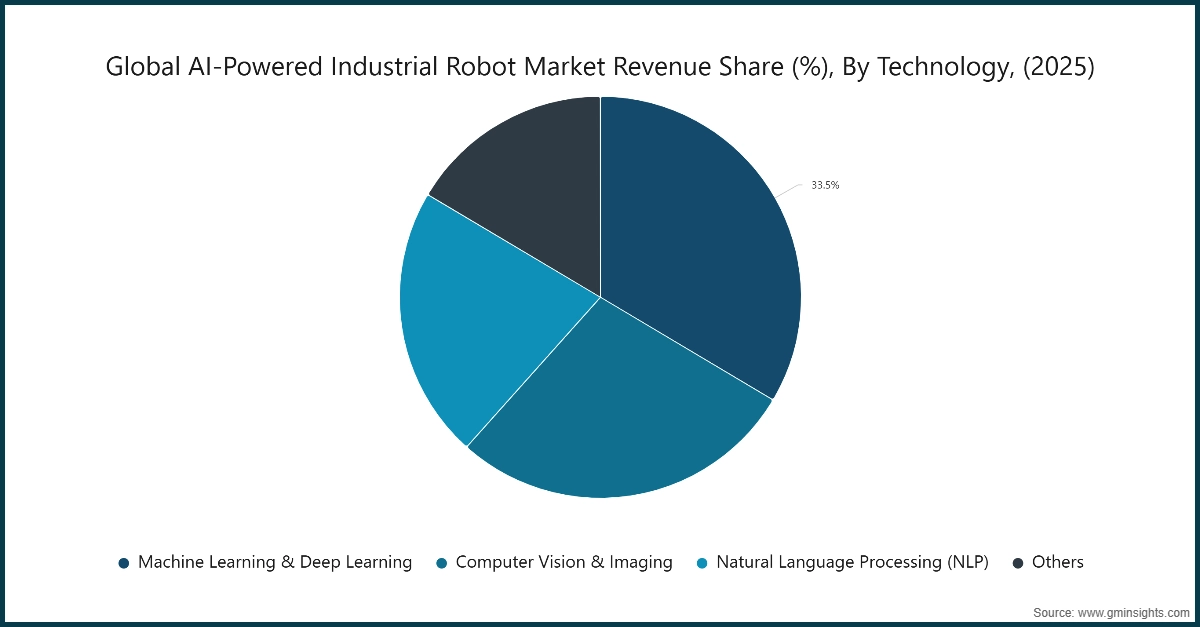
Based on technology, the AI-powered industrial robot market is segmented into machine learning & deep learning, computer vision & imaging, Natural Language Processing (NLP), and others. In 2025, the machine learning & deep learning segment held a major market share of 33.5%, generating a revenue of USD 5.6 billion.
- The machine learning & deep learning segment represents the largest portion of the market, driven by the shift toward autonomous decision-making and predictive maintenance in smart factories.
- The computer vision & imaging segment, while currently slightly smaller in share, is a critical area with a CAGR of 6.9%, reflecting a shift where robots use advanced optics to identify and handle irregular objects.
- This trend is consistent with a market that is increasingly prioritizing autonomous problem-solving and process optimization, gradually increasing the intelligence-driven sector's contribution to the total market value.
Based on the end user, the AI-powered industrial robot market is segmented into automotive, electronics & electrical, food & beverage, pharmaceuticals & healthcare, consumer goods, logistics & warehousing, and others. In 2025, automotive held the major market share of 35%, reflecting the industry’s reliance on high-precision autonomous assembly.
- Automotive represents the largest portion of the market, though logistics & warehousing shows the highest projected growth rate of 8.5% through 2035.
- This dominance is driven by the critical role of precision welding and the "heavy-duty" factor. For high-value production lines, end-users often prefer AI-integrated articulated systems for localized technical efficiency and the ability to adapt to multiple vehicle models.
- Online orchestration and AI-driven fleet management typically involve transactions through cloud platforms and robotic-operating systems. This channel is primarily utilized for repeat logistics tasks or by tech-savvy consumers using digital twin tools for specialized performance tracking.
North America AI-Powered Industrial Robot Market
 Looking for region specific data?
Looking for region specific data?
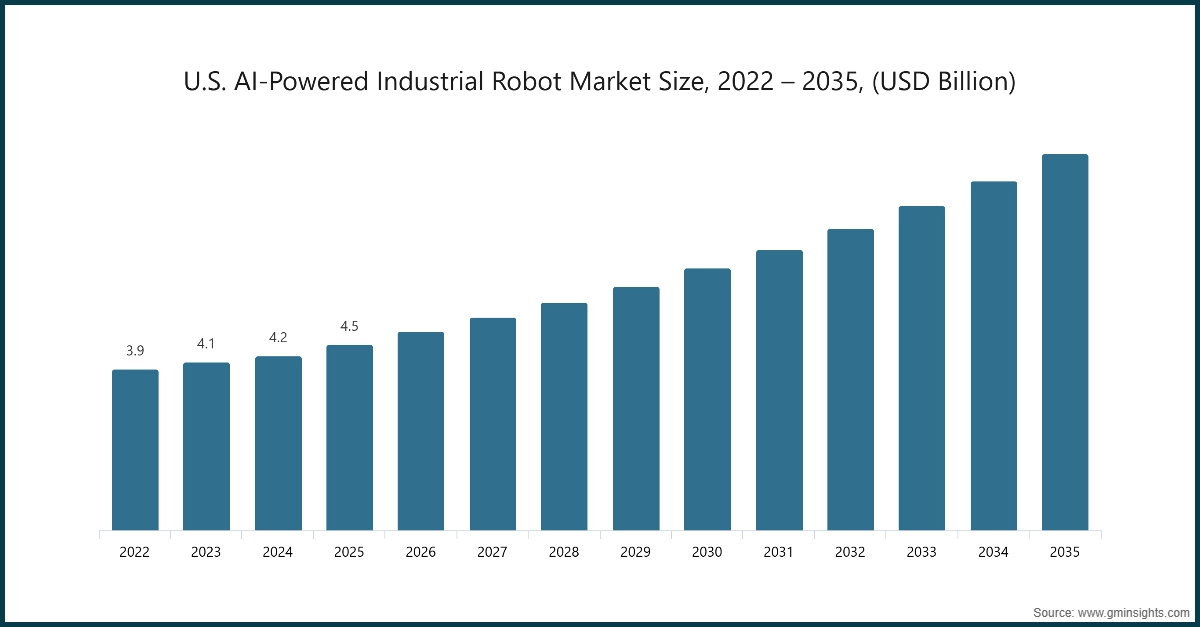
In 2025, North America is the largest market for AI-powered industrial robots. It has an estimated market value of USD 5.3 billion in 2025 with a projected growth rate of 7.3% through 2035.
- The U.S. leads the region, showing a strong growth rate and representing over 84% of the regional value. This growth is fueled by a mature manufacturing sector and a major push toward "reshoring" production to reduce supply chain dependencies.
- Premium AI software and Agentic AI integration are essential tools for manufacturers looking to gain a competitive edge through predictive maintenance and autonomous path planning.
- The North American market meets this need by offering various high-performance solutions that support both heavy automotive production and the rapidly growing Logistics & Warehousing segment.
Europe AI-Powered Industrial Robot Market
Europe is a significant market, estimated at USD 4.1 billion in 2025 with a projected growth rate of 6.8%. Germany leads the region with a sub-regional growth rate of 7.4% and a market value of USD 1 billion in 2025, followed by the UK and Italy.
- The European market benefits from a tradition of high-quality engineering and a focus on Industry 4.0 standards, encouraging the adoption of collaborative robots (cobots) that work safely alongside human operators.
- These efforts make Europe a competitive landscape for sustainable manufacturing practices, with a strong emphasis on energy-efficient robotic systems and open-source ecosystems like ROS 2.
- The larger European market benefits from a growing interest in high-tech automation to combat labor shortages and high operational costs in Western European industrial hubs.
Asia Pacific AI-Powered Industrial Robot Market
Asia Pacific is the second largest and fastest-growing regional market. It has an estimated market value of USD 4.6 billion in 2025 with a projected growth rate of 7.7% from 2026 to 2035.
- China has the highest sub-regional growth rate of 8.2%, holding the largest share in the region valued at USD 1.5 billion in 2025, while India follows as a rapid adopter with a growth rate of 7.8%.
- The rapid growth in Asia Pacific results from massive investments in electronics assembly and the "Made in China 2025" initiatives, alongside a surge in robot density per employee across the region.
- Rising awareness about the benefits of AI-driven precision and the status associated with "Lights-Out" factories significantly influence growth, promoting innovation in high-speed SCARA and Delta robot technology.
Latin America AI-Powered Industrial Robot Market
Latin America represents a smaller segment of the global market, expected to reach USD 1.4 billion in 2025, growing at a rate of 5.6% from 2026 to 2035.
- Brazil is the main driver in the region, projecting a growth rate of 6.0% with a market value of USD 0.7 billion in 2025, followed by Mexico.
- Overall growth is steady, largely supported by the automotive sector in Mexico and Brazil, where global manufacturers are integrating AI robots to maintain international export standards.
- Market players are focusing on expanding distribution networks to take advantage of the increasing industrialization in urban centers and the demand for automated handling in the food and beverage industry.
AI-Powered Industrial Robot Market Share
FANUC Corporation is leading the market with approximately 8% market share. Top players including FANUC Corporation, ABB Ltd, Yaskawa Electric Corporation, KUKA SE & Co. KGaA, and Teradyne Inc. collectively hold around 30%, indicating a moderately consolidated yet competitive landscape. These prominent players are proactively involved in strategic endeavors, such as mergers & acquisitions, facility expansions, and collaborations, to expand their product portfolios, extend their reach to a broad customer base, and strengthen their market position.
FANUC Corporation continues to solidify its leadership by embracing open-source ecosystems. In a major strategic shift, FANUC recently announced support for the ROS 2 (Robot Operating System) platform, allowing developers to use Python for industrial robot programming. This move, combined with their collaboration with NVIDIA, aims to unlock "Physical AI" capabilities, making high-precision industrial hardware more accessible to a new generation of software engineers.
ABB Ltd is undergoing a massive structural transformation, announcing the spin-off of its Robotics & Discrete Automation division into a standalone public entity by Q2 2026. This "pure-play" robotics company will focus on high-growth areas like AI-driven logistics and autonomous mobile robots (AMRs). To lower adoption barriers, ABB recently launched AppStudio, a no-code platform that allows even non-specialists to create complex robot control interfaces, effectively democratizing automation for SMEs.
AI-Powered Industrial Robot Market Companies
Major players operating in the AI-powered industrial robot industry are:
- ABB Ltd
- Agility Robotics, Inc.
- Boston Dynamics, Inc.
- FANUC Corporation
- Figure AI, Inc.
- Kawasaki Heavy Industries Ltd.
- Keyence Corporation
- KUKA SE & Co. KGaA
- NVIDIA Corporation
- Omron Corporation
- Standard Bots
- Symbiotic Inc.
- Teradyne, Inc.
- Tesla, Inc.
- Yaskawa Electric Corporation
Teradyne’s Universal Robots (UR) has aggressively targeted the "Physical AI" sector with the launch of its AI Accelerator toolkit at NVIDIA GTC 2025. This toolkit integrates NVIDIA Isaac libraries into UR’s PolyScope X platform, enabling cobots to perform tasks like bimanual assembly and LLM-driven programming. In December 2025, Teradyne also announced the opening of a new U.S. Operations Hub in Michigan for 2026 to support the massive reshoring trend in North American manufacturing.
AI-Powered Industrial Robot Market Report Attributes
| Key Takeaway | Details |
|---|---|
| Market Size & Growth | |
| Base Year | 2025 |
| Market Size in 2025 | USD 16.8 Billion |
| Market Size in 2026 | USD 17.9 Billion |
| Forecast Period 2026-2035 CAGR | 7.1% |
| Market Size in 2035 | USD 33.3 Billion |
| Key Market Trends | |
| Drivers | Impact |
| Labor shortages & reshoring | Demographic declines in manufacturing hubs are driving a transition from manual labor to "Agentic AI" robots that require minimal human supervision. |
| Generative AI & LLM Integration | The move from "rule-based" to "intent-based" programming allows non-technical staff to control robots via natural language, lowering the barrier to entry. |
| Pitfalls & Challenges | Impact |
| High integration complexity | Retrofitting legacy factory floors with AI sensors and ensuring interoperability between different robot brands remains a significant technical hurdle. |
| Increasing risk for Data Privacy & Cybersecurity | As robots become IoT-enabled and cloud-connected, the risk of industrial espionage and cyber-attacks on production lines increases. |
| Opportunities: | Impact |
| Increasing demand of Robot-as-a-Service (RaaS) | Subscription-based models allow SMEs to deploy advanced AI robotics without the massive upfront capital expenditure (CapEx). |
| Humanoid General-Purpose Robots | Advancements in "Physical AI" (like Tesla’s Optimus or Figure AI) offer the potential for robots to perform multi-purpose tasks in human-centric environments. |
| Market Leaders (2025) | |
| Market Leader |
8% market share |
| Top Players |
Consolidate market share of 30% |
| Competitive Edge |
|
| Regional Insights | |
| Largest Market | North America |
| Fastest growing market | Asia Pacific |
| Emerging countries | China, Brazil, India |
| Future outlook |
|
What are the growth opportunities in this market?
AI-Powered Industrial Robot Market News
- In November 2025, Yaskawa Electric and SoftBank Corp. announced a strategic collaboration to implement "Physical AI" on a social scale. The partnership combines Yaskawa’s MOTOMAN NEXT autonomous robots with SoftBank’s AI-RAN communication infrastructure to enable real-time, low-latency decision-making for robots operating in unpredictable human environments.
- In July 2025, KUKA unveiled its iiQWorks Copilot at the Automatic trade fair. Developed in collaboration with Microsoft, this generative AI assistant allows operators to program robots using natural language prompts, automatically generating complex code to reduce setup times for automotive and electronics assembly lines.
- In July 2025, Universal Robots launched the UR15 cobot, its fastest and most AI-ready model to date. Featuring OptiMove motion control technology, the unit delivers a 30% cycle time improvement for pick-and-place applications, utilizing AI-driven path optimization to ensure smooth movement even at a maximum speed of 5 meters per second.
- In September 2025, Cobra Golf (Industrial Automation Division) introduced a redesigned 3D-printed internal lattice structure for robotic end-effectors. This "Stage V" inspired design uses AI-modeled weighting to provide high-throughput feedback with significantly reduced vibration, addressing the need for high-speed precision in delicate electronics handling.
- In 2024, ABB and Cloudworx partnered to advance "Smart Drive" technology. Using AI-powered 3D visualization, the system creates digital twins of entire production lines, allowing for real-time monitoring and simulation that optimizes energy efficiency and robot motor performance without manual intervention.
The AI-powered industrial robot market research report includes in-depth coverage of the industry with estimates & forecasts in terms of revenue (USD Billion) and volume (Thousand Units) from 2022 to 2035, for the following segments:
Market, By Robot Type
- Articulated Robots
- SCARA Robots
- Delta Robots
- Others
Market, By Technology
- Machine Learning & Deep Learning
- Computer Vision & Imaging
- Natural Language Processing (NLP)
- Others
Market, By Application
- Assembly & Material Handling
- Welding & Machining
- Packaging & Palletizing
- Quality Inspection & Vision Systems
- Logistics & Warehousing
- Painting & Coating
- Others
Market, By End User
- Automotive
- Electronics & Electrical
- Food & Beverage
- Pharmaceuticals & Healthcare
- Consumer Goods
- Logistics & Warehousing
- Others
The above information is provided for the following regions and countries:
- North America
- U.S.
- Canada
- Europe
- Germany
- UK
- France
- Italy
- Spain
- Asia Pacific
- China
- India
- Japan
- Australia
- South Korea
- Latin America
- Brazil
- Mexico
- Argentina
- Middle East and Africa
- South Africa
- Saudi Arabia
- UAE
Frequently Asked Question(FAQ) :
What was the market size of the AI-powered industrial robot market in 2025?
The market size was USD 16.8 billion in 2025, with a CAGR of 7.1% expected through 2035, driven by advancements in AI technologies and the integration of IT and OT in industrial robotics.
What is the projected value of the AI-powered industrial robot market by 2035?
The market is expected to reach USD 33.3 billion by 2035, fueled by innovations such as Agentic AI, 3D vision-language models, and 5G-enabled edge computing.
What is the projected size of the AI-powered industrial robot market in 2026?
The market is projected to reach USD 17.9 billion in 2026.
How much revenue did the machine learning & deep learning segment generate in 2025?
The machine learning & deep learning segment generated USD 5.6 billion in 2025, accounting for 33.5% of the market share.
What was the market share of articulated robots in 2025?
Articulated robots held the largest share, accounting for 45% of the AI-powered industrial robot market in 2025.
Which region led the AI-powered industrial robot market in 2025?
North America was the largest market in 2025, with an estimated value of USD 5.3 billion and a projected growth rate of 7.3% through 2035. The region's dominance is attributed to strong technological adoption and industrial automation.
What are the upcoming trends in the AI-powered industrial robot industry?
Key trends include the adoption of generative AI and natural language programming for intuitive robot-human interaction, the rise of humanoid and
Who are the key players in the AI-powered industrial robot market?
Key players include ABB Ltd, Agility Robotics, Inc., Boston Dynamics, Inc., FANUC Corporation, Figure AI, Inc., Kawasaki Heavy Industries Ltd., Keyence Corporation, KUKA SE & Co. KGaA, NVIDIA Corporation, and Omron Corporation.
AI-Powered Industrial Robot Market Scope
Related Reports