Summary
Table of Content

AI-Powered In-Vehicle Cockpit & Assistant Market
Get a free sample of this report
Form submitted successfully!
Error submitting form. Please try again.
Thank you!
Your inquiry has been received. Our team will reach out to you with the required details via email. To ensure that you don't miss their response, kindly remember to check your spam folder as well!
Request Sectional Data
Thank you!
Your inquiry has been received. Our team will reach out to you with the required details via email. To ensure that you don't miss their response, kindly remember to check your spam folder as well!
Form submitted successfully!
Error submitting form. Please try again.
AI-Powered In-Vehicle Cockpit & Assistant Market Size
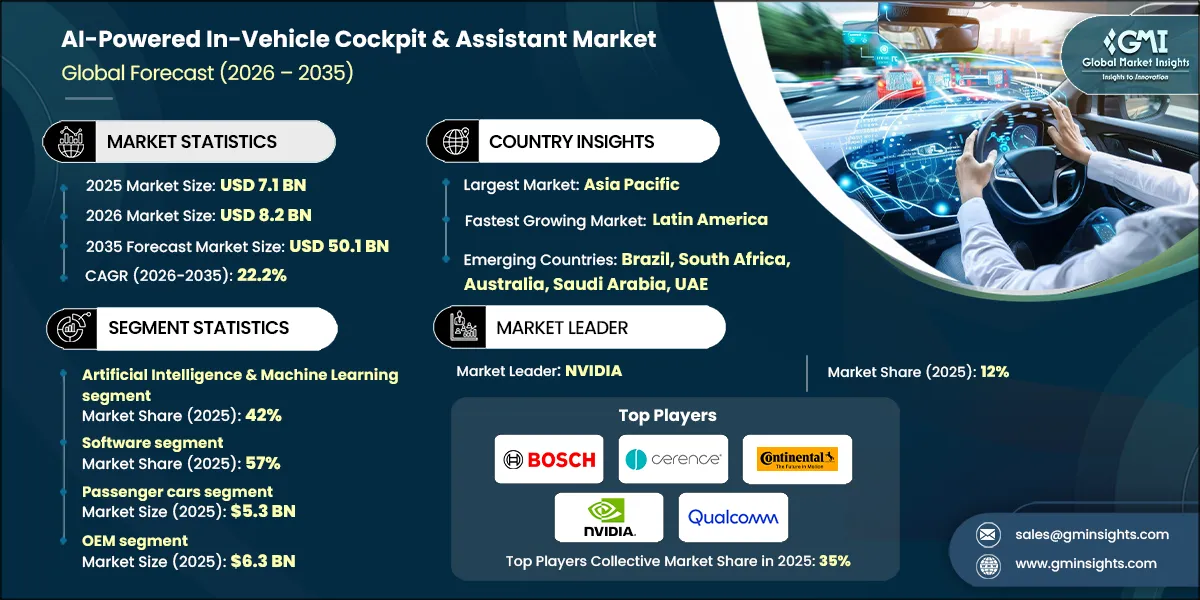
The global AI-powered in-vehicle cockpit & assistant market was estimated at USD 7.1 billion in 2025. The market is expected to grow from USD 8.2 billion in 2026 to USD 50.1 billion in 2035, at a CAGR of 22.2% according to latest report published by Global Market Insights Inc.
AI-Powered In-Vehicle Cockpit & Assistant Market Key Takeaways
Market Size & Growth
- 2025 Market Size: USD 7.1 Billion
- 2026 Market Size: USD 8.2 Billion
- 2035 Forecast Market Size: USD 50.1 Billion
- CAGR (2026–2035): 22.2%
Regional Dominance
- Largest Market: Asia-Pacific
- Fastest Growing Region: Latin America
Key Market Drivers
- Growing adoption of connected and software-defined vehicles.
- Rising consumer demand for personalization and hands-free operation.
- Expansion of EV and autonomous vehicle segments.
- Increasing aftermarket and software upgrade opportunities.
Challenges
- High OEM integration cost.
- Privacy and data security concerns.
Opportunity
- AI-driven predictive and generative assistants.
- Multimodal HMI adoption.
Key Players
- Market Leader: NVIDIA led with over 12% market share in 2025.
- Leading Players: Top 5 players in this market include Bosch, Cerence, Continental, NVIDIA, Qualcomm, which collectively held a market share of 35% in 2025.
Get Market Insights & Growth Opportunities
AI-powered Assistant and cockpit in-vehicle markets continue to grow at an incredible rate due to an ever-growing demand from consumers for better experiences in their vehicles, voice-based interface options, and driver support systems that are intelligent. OEMs and Tier 1 suppliers are heavily investing in AI technology, Machine Learning tech, and Natural Language Processing technologies to create personalized and context-aware cockpit experiences that will integrate Navigation, entertainment, communication, and vehicle control capability into one integrated cockpit experience.
The trend toward Software Defined Vehicles and modular, scalable cockpit platforms is facilitating the adoption of AI technology enabling OEMs to deploy new cockpit technologies much quicker. For instance, in January 2026 the Visteon Corporation located in Van Buren Township launched its Next Generation AI-ADAS Compute Module powered by NVIDIA's processing platform located in Ann Arbor, Michigan. This innovative offer enables automakers to deploy Intelligent Cockpit Experiences and Advanced Driver Assistance Systems (ADAS) on a "Single, Scalable Platform" demonstrating how leading suppliers are combining AI compute power and flexible architectures to accelerate the adoption of In-Vehicle AI.
The COVID-19 pandemic disrupted the AI Powered in Vehicle Cockpit and Assistant market by causing supply chain delays, semiconductor shortages, and temporary shutdowns of Global Automotive Manufacturing production facilities. As a result, Tier 1 Suppliers experienced slower deployment of their new cockpit technologies due to OEMs focusing on producing essential vehicles before being able to integrate advanced features.
The Asia-Pacific (APAC) region is also experiencing rapid growth in AI-based in-vehicle cockpits due to growth in car production; rapid growth in the digital economy; and significant capital investments in AI and connectivity product solutions. In March 2025, Alibaba Group announced a partnership with BMW, the German luxury automotive manufacturer, to improve the driving experience through AI-based cockpit technology. Alibaba will use technology developed by Banma, part of the Alibaba Group, to leverage large AI language models and intelligent voice interaction devices to improve the future of BMW.
North America is the largest market due to the rapid growth of connected mobility, including increased automation of driving, there has been greater interest in and demand for advanced in-vehicle cockpits and assistants that are powered by artificial intelligence (AI). North America to lead the market in innovation and deployment of AI-powered in-vehicle cockpits is the joint presentation of an AI-powered "intelligent cockpit" vision by P3 Digital Services and VicOne as an AI-powered informant. The presentation demonstrated how suppliers in North America are working together to combine AI compute resources, cybersecurity, and intelligent cockpit experience to be the leaders in providing innovative solutions to this growing market.
To get key market trends
AI-Powered In-Vehicle Cockpit & Assistant Market Trends
The rise of intelligent media management and personalized infotainment experiences due to Artificial Intelligence (AI) is becoming a bigger focus in the AI-powered cockpit industry. Automakers and Tier 1 suppliers are starting to integrate AI agents who can curate content, predict user preferences and give relevant recommendations to improve the in-vehicle experience and increase passenger engagement.
A example of this trend is the introduction of Cinemo ICO MediaMind in Dec 2025. This system combines Agentic AI and media management systems so that drivers and passengers can search, find, and consume various types of media all in one seamless way. This illustrates how the use of AI has changed the definition of in-car infotainment into a more intelligent/adaptive type of system.
Similarly, AI is further impacting the industry, using scalable, high-performance AI-compute modules for both intelligent cockpits and Advanced Driver Assist Systems (ADAS) - allowing OEMs to rollout AI-based features faster, simplifying the development process and making vehicles more future-ready as the industry continues to advance with software defined capabilities.
For instance, Visteon Corporation recently launching its next generation AI-ADAS Compute Module in January 2026 using NVIDIA technology to enable Automakers to build either AI-enabled cockpit systems or ADAS on a single platform. This instance showing the working mechanism of modular AI compute which pushing forward the acceleration for intelligent in-vehicle system deployments.
The market is shifting towards driver assistance systems that are enhanced with AI and voice interactions. Mid and high-end vehicles are becoming prevalent for these technologies, which ultimately create a safer, easier to use, and more personalized experience. An example is the 2026 MG7 from SAIC Group's MG brand. The 2026 MG7 is a mid-size coupe with an NGP (Navigation Guided Pilot) that utilizes advanced intelligent assisted driving technology, as well as an AI large language model for voice interaction.
AI-Powered In-Vehicle Cockpit & Assistant Market Analysis
Learn more about the key segments shaping this market
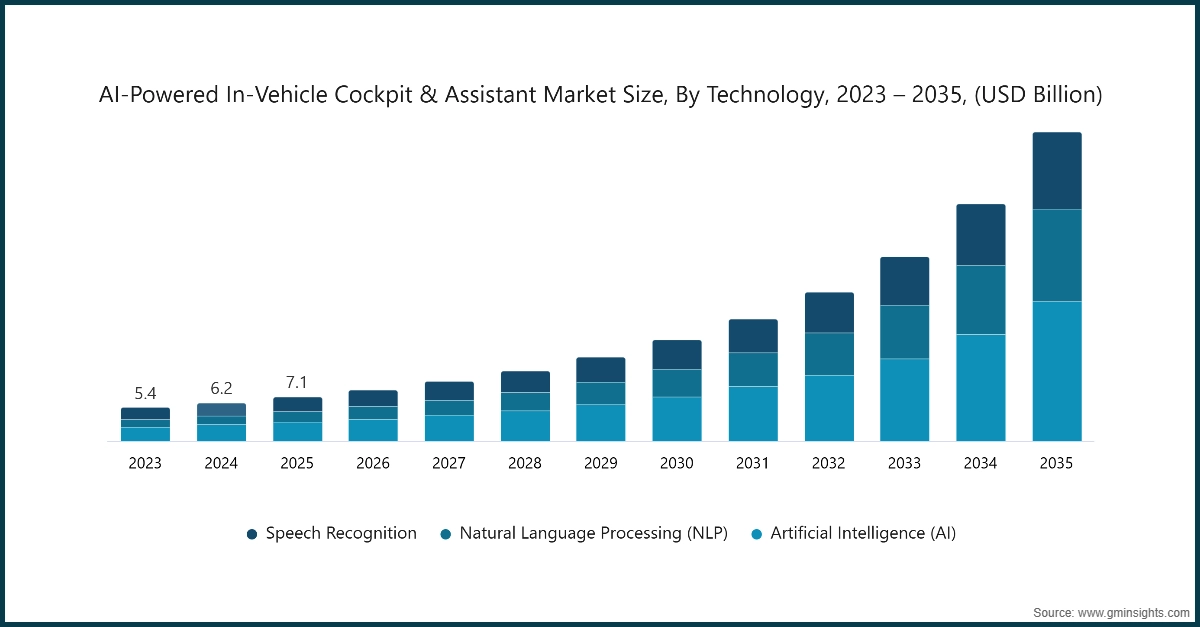
Based on technology, the AI-powered in-vehicle cockpit & assistant market is divided into Speech Recognition, Natural Language Processing (NLP), and Artificial Intelligence & Machine Learning. Artificial Intelligence & Machine Learning segment dominated the market accounting for 42% in 2025 and is expected to grow at a CAGR of 23.2% from 2026 to 2035.
- Speech recognition technology has become a cornerstone of AI-powered in-vehicle cockpits. Advancements in speech recognition technology allow users to issue natural language commands to their vehicles using real-time speech recognition technology. The trend towards the use of speech recognition is being driven primarily by increasing consumer demand for hands-free, distraction-free interactions, especially in luxury and mid-tier vehicle segments where user experience is a key differentiating factor.
- For instance, BMW’s next-generation Intelligent Personal Assistant, scheduled to launch in the U.S. and Germany in the latter half of 2026, which has been developed on the Amazon Alexa+ architecture. The new Intelligent Personal Assistant will allow for seamless and fluid speech recognition, empowering users to provide their vehicle with function requests, such as controlling vehicle functions, media, and navigation systems, via a conversation with their vehicle.
- NLP significantly enhances the capabilities of AI-based in-vehicle cockpits by enabling vehicles to interpret and understand context, intent, and nuances in spoken language. When combined with speech recognition capabilities, NLP can support conversational-based AI systems, predictive assistance, and multiple turns in the conversation, which will further enhance the user experience in connected vehicles.
Learn more about the key segments shaping this market
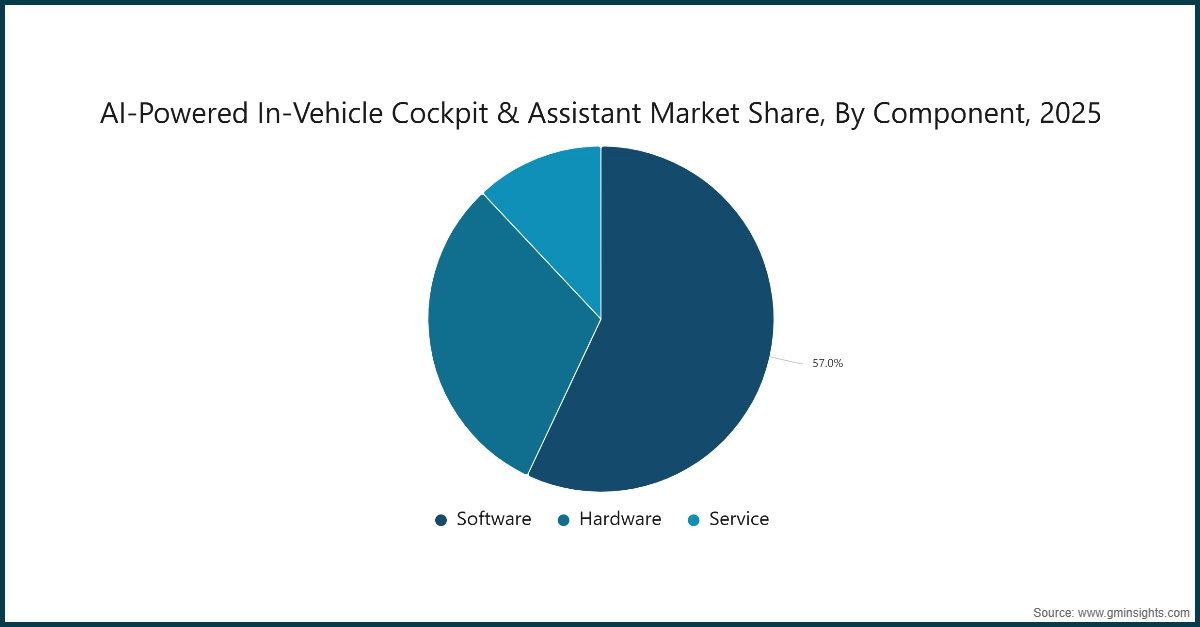
Based on components, the AI-powered in-vehicle cockpit & assistant market is categorized into software, hardware, and service. Software segments dominated the market with 57% share in 2025, and the segment is expected to grow at a CAGR of 23.8% between 2026 to 2035.
- The software for AI driven in-vehicle cockpits is the primary enabler of providing intelligent, connected, and adaptive vehicle-related experiences. More automakers are beginning to use modular, service-oriented software architectures that will facilitate much faster deployment of AI features via OTA updates and allow seamless interaction between all vehicle systems.
- For instance, in 2024, Stellantis launched STLA Brain, which is a digital foundation for vehicles. The STLA Brain creates a separation between software and hardware so that OTAs can be delivered securely and vehicle innovation can occur continuously. Similarly, Stellantis’s SmartCockpit system has been built onto STLA Brain, it provides all types of multimodal interface access (voice, touch, gesture, glance) that use AI and allow for seamless access to navigation, entertainment, and vehicle functionality.
- The hardware segment complements software by providing the physical and electronic infrastructure required for AI-powered cockpits. This includes domain controllers, processors, sensors, displays, microphones, and camera systems that collect, process, and deliver real-time data for intelligent vehicle interactions. High-performance hardware is critical to support AI computation, multi-modal interfaces, and low-latency response, enabling applications such as predictive assistance, voice interaction, and ADAS integration.
Based on vehicle, the AI-powered in-vehicle cockpit & assistant market is divided into passenger cars and commercial vehicles. Passenger cars dominate the market and were valued at USD 5.3 billion in 2025.
- Passenger vehicles are leading the way for AI cockpit implementations, especially for high-mid-level SUVs, Sedans or Luxury type cars that are in most demand by consumers, as those consumers want to have smarter, more personalized connected experiences available to them using AI and the internet. Voice assistants, multi-modal HMI’s (Human Machine Interfaces), and predictive intelligence help support the seamless sharing of navigational information, entertainment, communication and controlling the vehicle through AI-powered Cockpits in Passenger Vehicles.
- For example, In July 2025, Geely Auto in partnership with StepFun (an AI start-up) launched their next-generation Agent OS intelligent cockpit on the Geely Galaxy M9 Hybrid SUV for the first time using an end-to-end voice large language model, it marked the first time globally to deploy an AI assistant in Passenger Vehicles at scale.
- AI Cockpits in commercial vehicles such as LCV, MCV and HCV have integrated Cloud Connectivity, predictive AI, and Driver Management System to make routing plans more accurate, to provide voice assistance for operation and to better manage vehicles in real-time. As an example of this activity, in February 2025, Yutong Group announced their “One Cloud, Two Cabins” System that integrates DeepSeek’s AI inference model with the Cloud-based Butler Anruitong, its Smart Driving Cockpit and its Smart Passenger Cabin.
Based on sales channel, the AI-powered in-vehicle cockpit & assistant market is divided into OEM and aftermarket. OEM is the largest segment in market and was valued at USD 6.3 billion in 2025.
- Original equipment manufacturer channel dominates, which reflects OEM strategic prioritization of integrated voice assistant experiences and consumer preference for factory-installed systems with comprehensive vehicle integration. Among the leading OEMs developing integrated voice platforms, the most prominent partnerships are displayed by GM's selection of Google Automotive Services across all 2024+ Chevrolet, GMC, Buick, Cadillac brand offerings, in favor of its proprietary OnStar platform. In using Google Assistant, Google Maps, and Google Play as integrated solutions for voice control.
- The aftermarket channel also has a growing number of retrofit opportunities for existing fleets of vehicles that do not currently feature factory-installed voice assistant capabilities. This channel is being driven by the customer demand for added capabilities, which are not available through OEMs, and by the emerging segment of consumers who are price conscious and therefore seek voice capabilities at an affordable price versus having to purchase a brand-new vehicle. The leading providers of voice assistants in the aftermarket channel include Pioneer's aftermarket head units with both Apple CarPlay and Android Auto, which also offer Siri and Google Assistant voice-control capabilities.
Looking for region specific data?
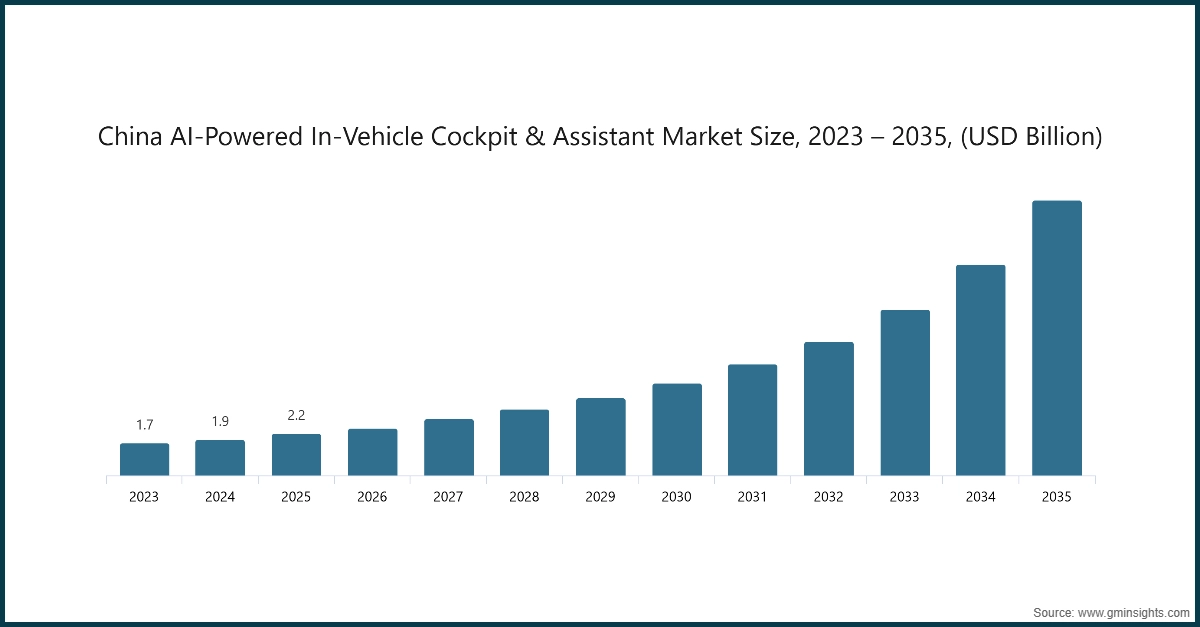
The China dominated Asia-Pacific AI-powered in-vehicle cockpit & assistant market with revenue of USD 2.2 billion in 2025.
- China is the most advanced and dynamic market for AI-powered in-vehicle cockpits, driven by rapid digitalization, strong domestic OEM innovation, and aggressive integration of AI technologies into mass-market vehicles. Numerous Chinese car manufacturers have begun to put AI voice assistants, Large Language Processing (LLP) systems, intelligent navigation, and Multi-Mode Human-Machine Interfaces (HMI) into both premium and mid-range cars.
- With consumers accepting the use of digital ecosystems and strong government support for both AI and "smart" mobility, the intelligence of the cockpit has become one of the main differentiators of vehicles in China. In April 2025, Visteon Corporation collaborated with Volcano Engine, the Cloud Services Platform of ByteDance, to launch an AI-based smart cockpit solution in the automotive market.
- India is quickly becoming a high-growth market for AI-powered cockpits, due to escalating demand for connected vehicles, rapidly increasing digital adoption, and growing localization of automotive electronics in India. In July 2025, Minda Group announced an agreement with Qualcomm Technologies to develop smart cockpit systems for India's next-generation vehicles, emphasizing the increasing significance of AI platforms and domestic tier one suppliers in expediting the implementation of intelligent cockpit systems in the Indian automotive sector.
US AI-powered in-vehicle cockpit & assistant market will grow tremendously with CAGR of 22.5% between 2026 and 2035.
- AI-driven in-vehicle cockpits are expected to experience significant growth in North America due to high adoption rates of connected vehicles, early use of software-defined architectures, and the strong partnerships between OEMs, Tier-1 Suppliers, and Semiconductor Companies. Automakers in North America are focusing on the benefits of AI for infotainment, voice assistants, and integrated cockpit-ADAS systems to improve safety, personalization, and user experience.
- In June 2025 marks the announcement of a strategic partnership between SAIC-GM, Bosch, and Qualcomm Technologies Inc. The partnership will create AI-powered cockpit experiences in the next generation of vehicles by providing the necessary integration of high-performance computing, intelligent software platforms, and advanced connectivity.
- The market in Canada is seen as an emerging complementary growth market for AI-powered in-vehicle cockpits due to increasing growth rates for connected and electric vehicles, the strong automotive R&D infrastructure available within Canada, and the close relationship that Canada shares with the North American automotive supplier ecosystem. Canadian OEMs and Technology Centres are focused on implementing AI into their infotainment systems, voice interaction systems, and cybersecurity-based cockpit systems, as well as supporting Government initiatives that promote innovation, AI technologies and-smart mobility.
The Europe AI-powered in-vehicle cockpit & assistant market in Germany will experience robust growth during 2026-2035.
- The European market had a 14% share of the global market and grew at a rate of 23.6%. Germany continues to be one of the primary European countries where AI based Global Premium OEMs, established automotive engineering competencies, and advanced digital vehicle technology adoption play a key role in developing AI based in-vehicle digital cockpits.
- In addition, as German automobile manufacturers develop AI based technologies such as voice-activated assistants, next-generation infotainment systems, and programmable vehicles, these innovative technologies will enhance interaction, personalization, and safety for the driver. For example, Audi announced the deployment of an AI powered chatbot through the Microsoft Azure OpenAI service in their infotainment systems in June 2024. This implementation will increase the vehicle's voice commands by allowing drivers to interact more conversationally through the vehicle's voice control systems.
- UK automotive marketplace is gaining momentum in the adoption of AI-based digital cockpits with many automotive software development capabilities, connected mobility and AI research and development capabilities. OEMs and technology providers continue to focus on developing intelligent infotainment systems, voice activated systems and cloud-connected digital cockpit systems in premium and electric vehicles. The UK innovation ecosystem remains intact for integration of AI enabled cockpit solutions in both digital and autonomous mobility.
The Brazil will experience robust growth of 26.0% between 2026 and 2035.
- Brazilian OEMs are launching their next generation of vehicles with new integrated connected digital cockpits, including the implementation of AI-integrated infotainment systems, voice control systems, and cloud-based mobile technology within connected cockpits, primarily focusing on high-end and electric vehicle segments, therefore establishing intelligent cockpits as a leading point to differentiate vehicles among consumers within a cost-sensitive marketplace.
- In January 2026, Volvo introduced the all-new EX60, the first vehicle within Volvo's portfolio of electric vehicles and the first electric vehicle within the premium SUV segment in Brazil. The EX60 sets an all-new standard for electric SUVs within Brazil and includes technology developed using Google artificial intelligence and other advanced digital and connected digital cockpit technologies, ultra-rapid charging stations for the EX60, and the longest driving range of any electric vehicle in the world.
- The Argentinian marketplace is still in an early phase of development of AI-enabled cockpits. The incremental movement to electric vehicles, as well as the gradual growth of the number of connected vehicles available in the Argentinian marketplace are consequential contributors to the development of artificial intelligence in-cockpit technologies.
UAE AI-powered in-vehicle cockpit & assistants market will grow tremendously with CAGR of 25.0% between 2026 and 2035.
- Within the Middle East, the resident supply of automotive OEMs has grown substantially over time, and this growth can be directly attributed to each OEM's overarching strategy when it comes to market share. The demand for greater adoption rates of premium/EVs as well as higher levels of AI deployment in the cockpit are becoming increasingly more important.
- Currently, global automotive OEMs are leveraging the UAE's advanced digital infrastructure and tech-savvy consumer base by utilizing advanced technologies such as cloud-connected digital cockpits, AI-enabled voice assistants, and AI-assisted connected vehicle technologies to further enhance the user experience. As OEMs implement these technologies, they will continue to build on the positioning of their individual brands within the UAE.
- With the vast increase in the number of OEMs operating in the UAE, there has also been an increase in the number of OEMs that are in Saudi Arabia. The demand for premium/EVs and large-scale AI deployments that are designed to provide greater personalization for the user experience has also been fueled by the rapidly expanding marketplace. Saudi Arabia's continued investment toward achieving Vision 2030, expanding EV market, and significant investments into smart mobility solutions will further drive this growth, resulting in new innovative automotive OEM solutions.
AI-Powered In-Vehicle Cockpit & Assistant Market Share
The top 7 companies in the market are Bosch, Continental, Qualcomm, Visteon, Harman, NVIDIA, and Cerence. These companies hold around 40% of the market share in 2025.
- Robert Bosch is a worldwide Tier-1 supplier, and a leading manufacturer of automotive electronics. They offer an Artificial Intelligence-powered cockpit solution as part of their Mobility and Cross-Domain Computing portfolio. Bosch supplies OEMs in the premium and mainstream markets with their offerings of AI-driven cockpit solutions, Software Defined Vehicle Architectures, AI Assistants, and integrated infotainment systems.
- Continental is a primary supplier of automotive technology products, including Intelligent Cockpit Systems, Human-Machine Interface (HMI) products, and User Experience Platforms. Continental's AI-Powered Cockpit systems provide integration of voice assistants, high-performance computing, and infotainment, servicing the luxury and volume OEM markets.
- Qualcomm Technologies focuses on providing Digital Cockpit and Connected Car platforms built from Snapdragon processors. Qualcomm's Digital Cockpit and Connected Car solutions are enabled by AI, and provide a platform for the integration of Infotainment, Voice Assistants, Multi-Modal HMI and all compute, connectivity, and cloud Intelligence into a scalable platform.
- Visteon is a pure-play digital cockpit supplier, providing Full Digital AI-Powered Cockpit systems that integrate an instrument cluster, infotainment, domain controllers, and multimodal interfaces into one solution. Visteon's Solutions provide software-first, AI-enablement experience, while allowing OEMs to create cockpit experiences that are personalized, connected, and scalable.
- Harman International provides an extensive Connected Car System, infotainment, and AI cockpit system product line to both luxury and volume OEM customers worldwide. Harman connects various smart devices, using voice assistants and smart displays, to provide a connected car experience that exceeds the expectations of the end user.
- NVIDIA offers AI computing platforms for both cockpit and advanced driver assistance systems (ADAS), including its DRIVE platform for both autonomous and smart vehicles. The company's solutions enable real-time voice assistants, predictions using AI, and intelligent in-car entertainment.
- Cerence is an independent provider of AI voice assistants that specialize in in-vehicle conversational AI and offers connected services to vehicles. Their products include embedded voice recognition, cloud voice services, and natural language processing (NLP). These products enable hands-free, context-sensitive, and multi-pass conversational interactions between drivers and passengers, regardless of whether the interactions.
AI-Powered In-Vehicle Cockpit & Assistant Market Companies
Major players operating in the AI-powered in-vehicle cockpit & assistant market include:
- Aptiv
- Continental
- DENSO
- Harman International Industries
- NVIDIA
- Panasonic Automotive Systems
- Qualcomm Technologies
- Robert Bosch
- Valeo
- Visteon
- The competitive landscape of the AI-powered in-vehicle cockpit market is defined by a mix of diversified Tier-1 suppliers, pure-play cockpit specialists, and AI technology providers. The manufacturers compete in the market with a mix of tier-one suppliers, specialist suppliers and companies producing components or systems for use in an inactive cockpit. Companies like Bosch and Continental are examples of large, diversified suppliers who leverage their broad automotive electronics portfolios and global OEM relationships to provide complete cockpit solutions that include sensors, displays, multi-modal interfaces and AI-based software.
- From a technological perspective, competitors exhibit significant differentiation within the market. For example, Qualcomm and NVIDIA have emerged as dominant players in the AI compute and platform segment, enabling scalable AI processing, predictive assistants, and ADAS integration. However, Harman has a strong focus on offering premium quality infotainment, voice interaction, and connected services; they are supported by Samsung which enhances their cloud and software capabilities.
- In terms of competitive dynamics, suppliers such as Visteon and Cerence, who are characterized as "pure-play" suppliers by virtue of the software that they create and sell, will have a meaningful impact in the areas of software adoption and AI assistant innovation. Conversely, companies such as Bosch, Continental, and Qualcomm utilize their large scale combined with extensive OEM penetration and global supply chains to capture the larger volume markets that they serve.
AI-Powered In-Vehicle Cockpit & Assistant Market Report Attributes
| Key Takeaway | Details |
|---|---|
| Market Size & Growth | |
| Base Year | 2025 |
| Market Size in 2025 | USD 7.1 Billion |
| Market Size in 2026 | USD 8.2 Billion |
| Forecast Period 2026-2035 CAGR | 22.2% |
| Market Size in 2035 | USD 50.1 Billion |
| Key Market Trends | |
| Drivers | Impact |
| Growing adoption of connected and software-defined vehicles | Modern vehicles increasingly support integrated infotainment, AI assistants, and domain controllers, driving AI cockpit deployments. |
| Rising consumer demand for personalization and hands-free operation | Customers seek intelligent voice interaction, gesture control, and contextual services for safer and more convenient driving. |
| Expansion of EV and autonomous vehicle segments | Quieter EV cabins and autonomous driving platforms increase reliance on AI assistants and multi-modal human-machine interfaces. |
| Increasing aftermarket and software upgrade opportunities | OEMs and third-party providers offer AI cockpit upgrades, OTA software, and voice assistant modules for fleet and private vehicles. |
| Pitfalls & Challenges | Impact |
| High OEM integration cost | AI software, domain controllers, sensors, and connectivity increase vehicle cost, limiting adoption in economy segments. |
| Privacy and data security concerns | Regulators and consumers are cautious about voice data collection and cloud-based AI, slowing adoption. |
| Opportunities: | Impact |
| AI-driven predictive and generative assistants | Cockpits increasingly leverage AI/ML models for predictive navigation, personalization, and contextual in-car experiences. |
| Multimodal HMI adoption | Integration of voice, touch, gestures, and visual feedback improves interaction, adoption, and user satisfaction. |
| Market Leaders (2025) | |
| Market Leader |
12% market share |
| Top Players |
Collective market share in 2025 is 35% |
| Competitive Edge |
|
| Regional Insights | |
| Largest Market | Asia-Pacific |
| Fastest growing market | Latin America |
| Emerging countries | Brazil, South Africa, Australia, Saudi Arabia, UAE |
| Future outlook |
|
What are the growth opportunities in this market?
AI-Powered In-Vehicle Cockpit & Assistant Industry News
- In January 2026, Mercedes-Benz stated they will be using the MB. OS operating system to integrate existing Microsoft Azure with Google AI into their electric GLC, slated for release in the United States in H2 2026. This will utilize NVIDIA’s complete stack of driving software and computing power for sophisticated SAE 2+ Driving Assistance Systems in urban areas via OTA upgrades.
- On January 5th, Sony Honda Mobility exhibited to the public the Afeela personal assistant agent at CES 2026, an interactive conversational AI using MS Azure OpenAI, which capable of engaging in personalized dialogue. Reservations for Afeela 1 have been available since January 2025 in California and new delivery hubs for Afeela 1 will be established by Spring 2026.
- In January 2026, Nio began its major 3.3.0 OTA update to the smart cockpit and assisted driving systems in China. The update provided enhancements to the NOMI voice assistance, allowing it to function as an encyclopedia by answering questions using deep thought to create a detailed response.
- In April 2025 Smart Mobility International formed a strategic partnership with IM Motors a China-based electric vehicle manufacturer has launched IM vehicles into the Gulf region, beginning with a collaborative showroom on Sheikh Zayed Road in Dubai, U.A.E and expanding to Saudi Arabia, featuring the IM LS7 with smart panoramic cockpit & AI capabilities.
The AI-powered in-vehicle cockpit & assistant market research report includes in-depth coverage of the industry with estimates & revenue ($Bn) and volume (Units) from 2022 to 2035, for the following segments:
Market By Technology
- Speech Recognition
- Natural Language Processing (NLP)
- Artificial Intelligence (AI)
Market By Component
- Software
- Embedded Software
- Cloud-based Software
- AI-powered Applications
- Others
- Hardware
- Microphones & Speakers
- Display Panels & Screens
- Control Units & Processors
- Sensors & Cameras
- Others
- Services
- Integration & Deployment
- Maintenance & Support
- Consulting Services
Market By Vehicle
- Passenger Cars
- Sedans
- Hatchbacks
- SUVs
- Commercial Vehicles
- Light commercial vehicles (LCV)
- Medium commercial vehicles (MCV)
- Heavy commercial vehicles (HCV)
Market By Application
- Navigation & Mapping
- Entertainment & Media
- Communication
- Vehicle Control & Settings
- Others
Market By Sales Channel
- OEM
- Aftermarket
The above information is provided for the following regions and countries:
- North America
- US
- Canada
- Europe
- UK
- Germany
- France
- Italy
- Spain
- Belgium
- Netherlands
- Sweden
- Russia
- Asia Pacific
- China
- India
- Japan
- Australia
- Singapore
- South Korea
- Vietnam
- Indonesia
- Latin America
- Brazil
- Mexico
- Argentina
- MEA
- South Africa
- Saudi Arabia
- UAE
Frequently Asked Question(FAQ) :
What was the market size of the AI-powered in-vehicle cockpit & assistant in 2025?
The market size was USD 7.1 billion in 2025, growing at a CAGR of 22.2% till 2025. The market is driven by increasing demand for intelligent driver support systems, voice-based interfaces, and enhanced in-vehicle experiences.
What is the projected value of the AI-powered in-vehicle cockpit & assistant market by 2035?
The market is poised to reach USD 50.1 billion by 2035, growing at a CAGR of 22.2%, fueled by advancements in AI, Machine Learning, and Natural Language Processing technologies.
What is the expected size of the AI-powered in-vehicle cockpit & assistant industry in 2026?
The market size is expected to reach USD 8.2 billion in 2026.
What was the market share of the Artificial Intelligence & Machine Learning segment in 2025?
The Artificial Intelligence & Machine Learning segment accounted for 42% of the market in 2025 and is expected to grow at a CAGR of 23.2% through 2035.
What was the market share of the software segment in 2025?
The software segment dominated the market with a 57% share in 2025 and is set to expand at a CAGR of 23.8% till 2035.
What was the valuation of the passenger car segment in 2025?
The passenger car segment was valued at USD 5.3 billion in 2025, due to the high demand for AI-powered cockpits in SUVs, sedans, and luxury vehicles.
Which region dominated the AI-powered in-vehicle cockpit & assistant sector in 2025?
China led the Asia-Pacific market with revenue of USD 2.2 billion in 2025, led by rapid digitalization, domestic OEM innovation, and the integration of AI technologies in mass-market vehicles.
What are the key trends in the AI-powered in-vehicle cockpit & assistant market?
Growth of intelligent media management, personalized infotainment, scalable AI compute for cockpits and ADAS, AI-driven driver assistance, and voice-enabled predictive vehicle intelligence.
Who are the major players in the AI-powered in-vehicle cockpit & assistant industry?
Major players include Aptiv, Continental, DENSO, Harman International Industries, NVIDIA, Panasonic Automotive Systems, Qualcomm Technologies, Robert Bosch, Valeo, and Visteon.
AI-Powered In-Vehicle Cockpit & Assistant Market Scope
Related Reports