Summary
Table of Content

AI Data Center Market
Get a free sample of this report
Form submitted successfully!
Error submitting form. Please try again.
Thank you!
Your inquiry has been received. Our team will reach out to you with the required details via email. To ensure that you don't miss their response, kindly remember to check your spam folder as well!
Request Sectional Data
Thank you!
Your inquiry has been received. Our team will reach out to you with the required details via email. To ensure that you don't miss their response, kindly remember to check your spam folder as well!
Form submitted successfully!
Error submitting form. Please try again.
AI Data Center Market Size
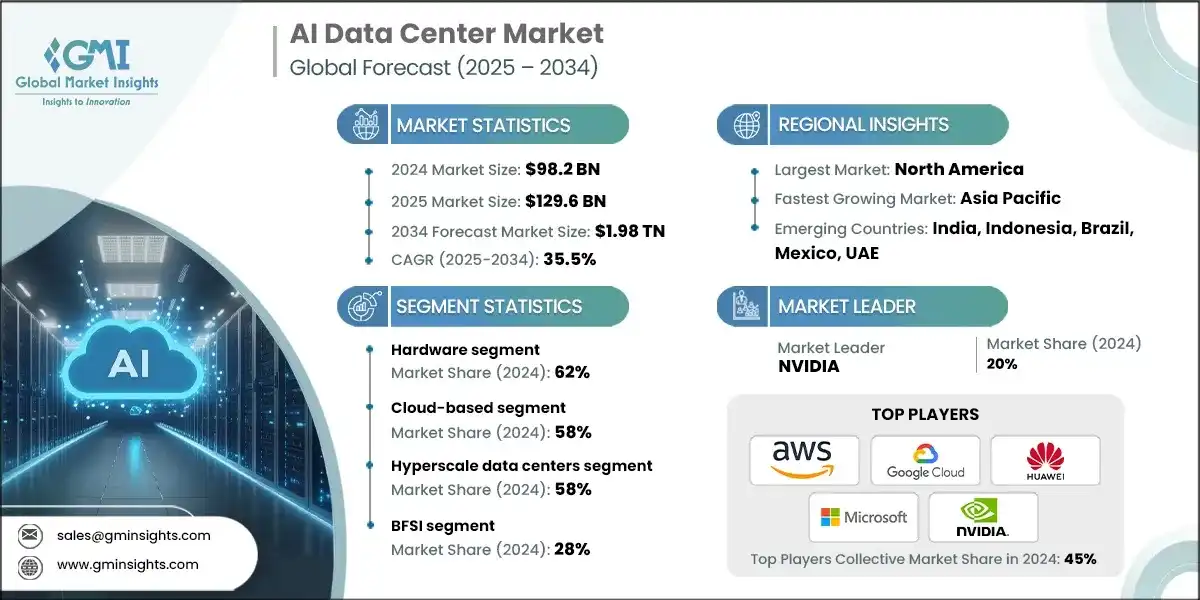
The global AI data center market was valued at USD 98.2 billion in 2024. The market is expected to grow from USD 129.6 billion in 2025 to USD 1.98 trillion in 2034 at a CAGR of 35.5%, according to latest report published by Global Market Insights Inc.
AI Data Center Market Key Takeaways
Market Size & Growth
- 2024 Market Size: USD 98.2 Billion
- 2025 Market Size: USD 129.6 Billion
- 2034 Forecast Market Size: USD 1.98 Trillion
- CAGR (2025–2034): 35.5%
Key Market Drivers
- Adoption of generative AI & machine learning.
- Growth in big data analytics.
- Cloud expansion & hyperscale deployments.
- Advancements in GPU & chip technologies.
Challenges
- High capital & operational costs.
- Energy consumption & sustainability issues.
Opportunity
- Edge AI data centers.
- Liquid cooling & green technologies.
- Ai-as-a-service platforms.
- Emerging markets adoption.
Key Players
- Market Leader: NVIDIA led with over 20% market share in 2024.
- Leading Players: Top 5 players in this market include NVIDIA, Google Cloud, Huawei, Microsoft, NVIDIA, which collectively held a market share of 45% in 2024.
Get Market Insights & Growth Opportunities
The surge in generative AI and machine learning applications demands massive computational power and storage, driving the need for AI-optimized data centers. Advanced AI requires high-performance graphical processing units (GPUs), highly scalable architecture, and low-latency networks to process the more complex AI models and thus support the creation of a differentiated AI data center and a model for businesses working on providing AI-enhanced solutions in various industries, including healthcare, finance, and retail.
Big data analytics provides a large amount of structured and unstructured datasets that require strong data center infrastructure to provide in-memory processing, real time processing, and near-perfect insights. AI-optimized data centers are designed to provide a foundation for computing and storage to process Big Data workloads that demand speed and performance. As businesses continue to leverage predictive analytics and decision-making tools, organizations around the world are increasing demand for AI-optimized data centers.
The rapid growth of cloud computing and hyperscale data centers is also providing strong tailwinds to increased AI adoption. Cloud providers have invested in a variety of AI data infrastructures providing services scalable to enterprise customers as well as to developers. Hyperscale data center facilities integrate new GPU, TPU and AI processors coupled with advanced cooling systems and networking to provide reduced cost to train and inference AI workloads at a scale that serves to incorporate as the backbone to global strategies to deploy AI workloads and solutions.
The appearance of graphical processing units (GPUs) together with tensor processing units (TPUs) and new AI processing focused chips continues to provide substantial increases in processing speed and performance efficiencies by encoding complex AI workloads. More importantly, these cold-water processors provide reductions in latency, continue to increase energy performance efficiencies, and allow for model training to be executed at an unprecedented scale.
To get key market trends
AI Data Center Market Trends
Liquid cooling is the superior technology for thermal management, as AI workloads increases, traditional air-cooling struggles with heat from GPU-intensive servers. Liquid cooling can increase density and performance while also reducing energy costs. The adoption of liquid cooling is trending in hyperscale and enterprise data centers because it can heat surplus thermal loads generated when deploying advanced AI workloads for training or inference, while also improving sustainability and maintaining operational reliability.
Edge AI data centers are becoming mainstream so that AI workloads can be processed nearer to the source of data for reduced latency and bandwidth costs of transporting data to a centralized AI workload. Edge AI supports real-time use cases such as in autonomous vehicles, IoT, and smart cities. Distributing AI-based processing from a centralized deployment architecture will increase speed, security, and scalability while offering new opportunities for localized AI services and rapid decision-making.
There are two main drivers of green technology deployments in AI data centers which are environmental challenges and rising energy costs. AI operators are investing in renewable energy, innovative cooling systems and decarbonization initiatives. Sustainability also lowers ongoing operational costs while supporting ESG goals, making the international trend toward greener AI data centers significant as we seek to maintain long-term competitiveness.
While intelligent AI will continue to demand new, faster, and deeper processing, AI operators will seek specialized chips like tensor processing units (TPUs), field-programmable gate arrays (FPGAs), and personalized application-specific integrated circuits (ASICs) dedicated to processing AI applications. These chips will demonstrate improved speeds, efficiency, and scalability compared to traditional graphics processing units (GPUs) for specific AI programming. This trend accelerates AI hardware innovation and enables data centers to process advanced models and workloads.
AI Data Center Market Analysis
Learn more about the key segments shaping this market
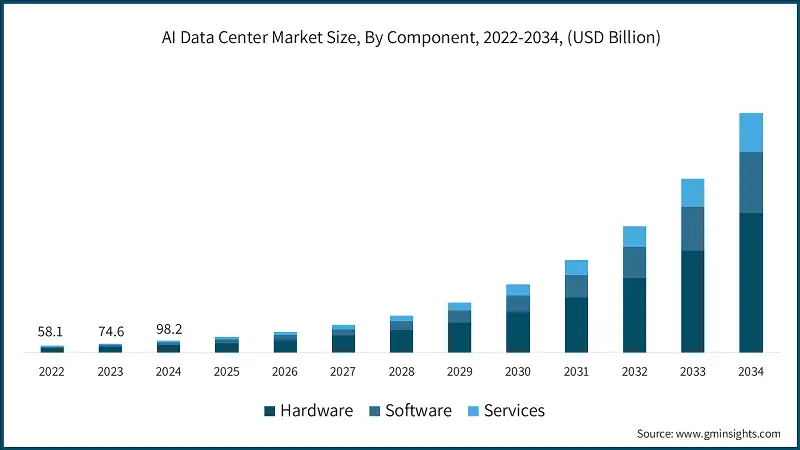
Based on component, the market is divided into hardware, software and services. The hardware segment dominated the market, accounting for share of 62% in 2024 and is expected to grow at a CAGR of over 34% through 2025 to 2034.
- In 2024, the hardware sector accounted for the largest share of the AI data center market, contributing USD 61.1 billion. The hardware segment continues to grow with GPU accelerators, AI chips, liquid cooling, high-density servers and optical networking. The predicted rise in GPU power demands, rack densities in the range of 30–120 kW, and massive deployment initiatives led by AWS, NVIDIA, AMD, and Broadcom are influencing long-term infrastructure investment.
- The software segment is growing with the fastest growth in demand at a CAGR of 38% with requirement of AI workloads in advanced orchestration, inference optimization, digital twins, and multi-accelerator scheduling. Increasing availability of AI-as-a-Service, foundation models, and token-processing platforms are increasing demand for software frameworks, optimization and management tools, and ancillary software that enable efficient, application-driven distribution of the computations which leverage GPUs, TPUs, Trainium, and other custom accelerators.
- The services segment grows steadily due to the rising complexity of the data center infrastructure due to the development of AI workloads. Consulting, integration, managed AI operational, liquid-cooling design, and sustainability services are in demand. Skilled labor shortages and innovations in thermal preparation along with planning around renewable energy deployment, and government enforced sourcing are driving many enterprises to reliance of specialized AI data center service providers.
Learn more about the key segments shaping this market
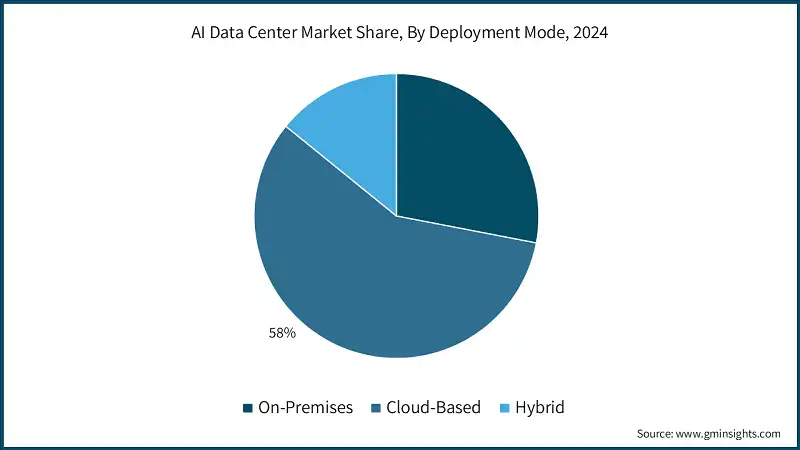
Based on deployment mode, the AI data center market is segmented by cloud-based, on-premises and hybrid. Cloud-based segment dominated the market with 58% share in 2024, and is expected to grow at a CAGR of 35.2% from 2025 to 2034.
- The cloud-based AI data center segment leads the pack in capabilities, as it provides enormous scalability, flexible consumption models, and access to state-of-the-art AI chips without any capital investment. Hyperscale’s such as AWS, Microsoft, Google, Oracle, and even Meta is contributing to unprecedented growth in the market, receiving multi-billion-dollar commitments to enable rapid adoption of AI technologies, along with the AI-as-a-service model, growth in demand for GPUs, TPUs, and specialized application processors.
- On-premises AI data centers are still important to enterprises that prioritize/impose requirements related to data sovereignty, regulatory compliance, and latency for inference applications. Organizations are increasingly comfortable training in the public cloud but have also started to perform inference on-premises using a combination of AI optimized servers and chips. High capex and power consumption are challenges, but enterprises are increasingly adopting AI, upgrading to liquid cooling, and utilizing new specialized inference hardware.
- Hybrid AI data centers combine the scalability advantages of the cloud while using an on-premises environment to retain control of workloads. Hybrid AI data centers offer all the previously listed benefits while also serving as a way for enterprises to maintain the ability to distribute workloads between training and inference on-premises, and on the edge. Hybrid models allow multi-cloud strategies to be employed, along with other real-time AI use cases.
Based on data center, the AI data center market is segmented into hyperscale data centers, enterprise data centers, colocation data centers and edge data centers. The hyperscale data centers segment dominated the market with 58% share in 2024, and the segment is expected to grow at a CAGR of 36.4% from 2025 to 2034.
- Hyperscale data centers dominated the market in 2024, driven by unprecedented cloud investments and processing power. Equipped with millions of GPUs, liquid cooled AI clusters, and high-density racks, hyperscale data centers are critical to generative AI training, as the world adopts trillion-parameter models and hyperscale operators become the fastest growing enterprise segment.
- Enterprise data centers are also ramping up their AI performance. Organizations are increasingly deploying inference workloads on-premises due to security, latency and data sovereignty. While enterprises face challenges such as high capital expense and power consumption, the benefits of liquid cooling, specialized AI servers, and sustainability are motivating enterprises to switch. They continue to grow as enterprises decide how to balance cloud training and on-premises inference workloads.
- Colocation data centers are rapidly growing with high-density liquid cooled capabilities. Colocation supports enterprises wanting to leverage AI without the burden of dedicated space. Demand for hybrid architectures from a growing interest in improved efficiencies and time to market, drives colocation forward. By combining new cooling technologies with renewable energy and multi-cloud capabilities, colocation is the second-fastest growing segment after hyperscale.
Based on industry vertical, the AI data center market is segmented into BFSI, government, healthcare, IT & telecom, automotive, media & entertainment and others. The BFSI segment is expected to dominate the market with a share of 28% in 2024, driven by strong trust, integrated solutions, and extensive capabilities.
- The BFSI sector is still the largest user of AI data center services due to fraud detection, real time transaction processing, risk modeling, and regulatory reporting. Privacy as sovereignty has directed focus toward on-premises and hybrid build. Growing use of AI for credit scoring, automating and cyber security is also contributing to continued data center investment.
- Healthcare will have the largest AI data center growth as workloads advance in demand for precision medical imaging, genomic sequencing, clinical decision support, and drug discovery. Privacy laws create firmly directed privacy as sovereignty in secure on-premises and hybrid in-builds. Continuing reliance on data streaming on real time monitoring, the need for edge analytics and high-performance computing is driving medical care and healthcare sector data infrastructure to continuously expand.
- The IT and telecom sectors will drive massive expansion of AI data center services, and both as a benefactor and consumer of high compute infrastructure. Hyperscale’s will invest heavily in advanced compute cluster services aimed at delivering network automation of service capabilities, predictive maintenance and low latency digital services. Advances in optical interconnects and liquid cooling technologies, as well as edge AI technologies and methods, will enhance scalability, strengthen capability performance and affordable, productive use, across large networks globally.
Looking for region specific data?
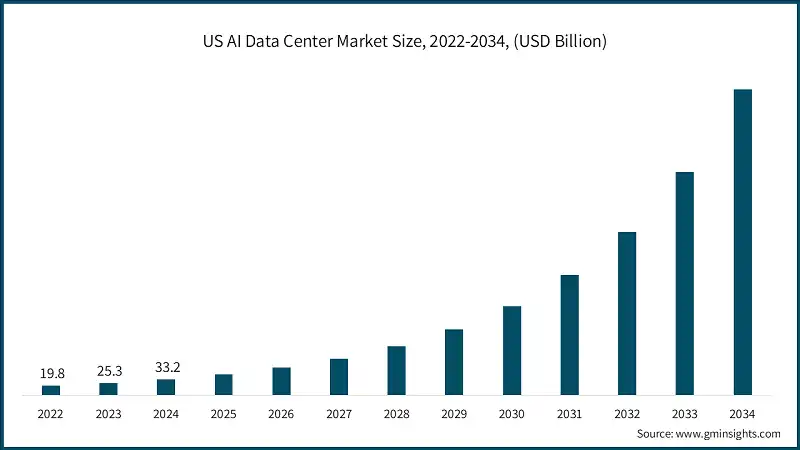
The US market reached USD 33.2 billion in 2024, growing from USD 25.3 billion in 2023.
- In US, AI data center market holds a dominant position driven presence of hyperscale operators including Amazon, Google, Meta and Microsoft. Large-scale investments in GPU clusters, liquid cooling systems, and AI specific infrastructures are accelerating development. Federal incentives, IRA benefits and tax breaks from states are also accelerating builds, establishing the US as the location with the highest capacity for AI computing globally.
- With a rapid surge in demand for generative AI and large language models, US data center operators are accelerating adoption of extremely high-density designs including multi-megawatt GPU pods and advanced immersion cooling. Also, power constraints in primary hubs such as Northern Virginia, Phoenix, and Dallas are transforming site selection strategies and driving significant growth in secondary markets such as Ohio, Iowa, and Oregon.
- US enterprises in every market strand including cloud, healthcare, finance, automotive, and defense require AI specific compute. This helps to drive rapid adoption of AI-as-a-Service, edge AI nodes, and sustainable high-performance data center designs. Additionally, government interest in AI sovereignty and secure computed frameworks has bolstered construction pipelines, which include colocation expansions to support AI-intensive workloads.
North America dominated the AI data center market with a market size of USD 37.9 billion in 2024.
- North America leads the world in the size of an AI data center region, driven by hyperscale growth and the digital-first businesses and companies taking hold, as well as exceptional cloud adoption. The mature data center region allows for a speedy build-out of GPU-dense facilities. Overall, Canada and the US are investing heavily in clean energy in data centers to accommodate sustainable growth as AI workloads become more intensive in energy consumption.
- AI adoption is beginning to accelerate in many industries, including retail, telecom, BFSI, automotive, and healthcare. The AI adoption in these sectors is in turn putting pressure on more real-time analytics and high-performance computing. North America is beginning to shift to hybrid and multicloud architectures to support AI inference at scale. The upgrades to facilities include advanced cooling, automation, and AI for operational optimization.
- North America also benefits from investment incentives and skilled labor force availability, as well as competitive colocation markets. Despite that, grid congestion, land costs, and regulation are becoming barriers to new developments. Regardless of the pressures, hyperscaler construction seems to be in great form for a long-term dominance in AI-based data center capacity.
Europe AI data center market accounted for a share of 26.7% and generated revenue of USD 26.2 billion in 2024.
- Europe's market is accelerating, as companies are speeding up cloud adoption, and governments are investing in sovereign AI infrastructure. The data center markets Amsterdam, Dublin, Frankfurt, and Paris are pushing up their capabilities to host AI workloads. Sustainability is important to the region, with green energy carbon-neutral operations and energy-efficient data centers being developed to support sustainable development of AI.
- AI adoption spans a range of sectors including manufacturing, finance, public sector, and automotive. Europe's digital sovereignty move is driving demand for locally hosted AI training and inference. Colocation providers are providing GPU density, liquid cooling to existing data center offerings and expanding their hybrid cloud offerings. The cybersecurity and data privacy regulations being deployed in many markets ensure that there is significant data governance and privacy regulation.
- The EU and its member states are supportive of various initiatives to fuel AI adoption despite challenges including energy shortages, complicated regulations for application to various market segments for AI, and markets where data center construction is restricted. Investments in facilities with renewable power or backup, along with investments in edge data centers with connectivity at critical locations, and cross-border AI infrastructure projects will assist with AI-enabled capacity and long-term viability in certain member states in the EU.
Germany dominates the AI data center market, showcasing strong growth potential, with a CAGR of 34.4% from 2025 to 2034.
- Germany is a growing focal point for AI-focused data centers in Europe supported by substantial government backing for digital transformation and industrial AI. Frankfurt leads the charge in growing capacity with hyperscaler and colocation expansions which are built to accommodate GPU-dense AI workloads. The country's manufacturing, logistics, and automation industrial sector are adding velocity to the demand for AI-based applications.
- Investment in sustainable data centers, powered by renewable energy and cutting-edge cooling solutions, is on the rise. AI workloads are changing the way infrastructure is designed, encouraging operators to deploy liquid cooling, scalable power systems, and data localization compliance especially for sensitive enterprise workloads. Germany's data protection laws shape the architecture of AI data center.
- Germany's market for AI data center infrastructure does face some challenges, including energy costs, stringent regulatory requirements, and power availability constraints for the major hubs. Nonetheless, strong enterprise investment, good locational attributes, and growth in cloud adoption mean that AI-optimized data center facilities will grow steadily through the decade.
The Asia Pacific AI data center market is anticipated to grow at the highest CAGR of 38.5% from 2025 to 2034.
- AI data center growth in the Asia-Pacific region is growing driven by trends such as digitalization, cloud adoption and AI investments across Southeast Asia, India, Japan and South Korea. The cloud providers in the region and hyperscale’s have been expanding capacity to address AI-intensive workloads for enterprises, fintech, telecom operators and public sector organizations.
- AI demand continues to develop in areas like manufacturing automation, financial services, e-commerce, and smart city projects. Data centers in APAC are adopting advanced cooling techniques, high-density GPU clusters, and a hybrid cloud architecture to address AI workloads. Countries Singapore, Japan, and Australia are taking the lead as compliance with regulators, connectivity, and energy-efficient designs are in place.
- Challenges in APAC are investment pressures due to the power shortage and constraints to land availability while also facing increased pressure for sustainability in the hubs such as Singapore. Despite challenges, investment rates remain strong, and the global AI adoption by enterprises as well as favorable digital-related policies are expected to drive long-term growth in AI data centers across APAC
China market is estimated to grow with a CAGR of 39% from 2025 to 2034.
- The AI data center market in China is experiencing rapid growth fueled largely by national policies encouraging AI usage in almost all industries. National AI strategy, cloud expansion, and associated digital infrastructure funding available to the cities of Beijing, Shanghai, Shenzhen, and Hangzhou have accelerated the implementation of AI-optimized data centers, passing larger computing workloads through advanced graphical processing units (GPUs) clusters spread throughout each city.
- Areas stimulating AI demand include the development of autonomous driving capabilities, smart cities, robotics, and financial technology. Major Chinese cloud-service providers such as Alibaba Cloud, Tencent Cloud, and Huawei Cloud are heavily investing in the advancement of liquid cooling, high-density racks, and truly AI-native data center designs.
- As in other countries, regulatory controls including data localization rules and limits on energy consumption, are important to the expansion of AI data centers in China. Data center operators are beginning to implement renewable energy sources and are using static and distributed architecture as a regular business model for compliance. Despite potential constraints, the growth rate of AI data centers in China is likely to make it one of the fastest growing markets in the world for new AI data centers.
Latin America market shows lucrative growth over the forecast period.
- The AI data center market in Latin America is starting to expand due to the rapid cloud adoption trend and government digitalization funding. Brazil, Mexico, Chile and Colombia are at the forefront of regional development, with new colocation and hyperscale buildings in progress to cater to AI workloads in different sectors.
- AI uses cases in fraud detection, logistics, agricultural technology (aggrotech), and public sector analytics are increasing demand for GPU infrastructure, foreshadowing what is to come from cloud modems that will quickly be integrated into regional cloud providers and telecoms, creating a cyclical race to enhance cooling, connectivity, and edge computing.
- Latin America will benefit from national digital initiatives, which will further fuel cloud services, increase engagement and partnership among hyperscale’s and expand workforce capacity. The emergence of renewable energy-powered data centers and AI programs across government sectors creates possibilities for the sustainable initiation of the market within Latin America.
Brazil AI data center market is estimated to grow with a CAGR of 30.4% from 2025 to 2034 and reach USD 34.7 million in 2034.
- Brazil is emerging as a strategic hub for AI data center deployment in Latin America as cloud adoption rises and enterprise-wide digital transformation accelerates. São Paulo is leading in the area with new hyperscale expansions, additions of colocation capacity and new facilities with an AI-optimized architecture powered by renewable energy sources.
- AI adoption in the banking, e-commerce, agriculture, telecom and logistics sectors are rising and driving demand for high-performance computing, GPU-rich infrastructures and hybrid cloud abilities. Brazilian operators are advancing thermal management and power systems to support AI workloads while maintaining energy-efficiency compliance.
- Brazil has benefitted from expanding regional cloud infrastructure, strong commitment of government digital initiatives, and growing enterprise interest in AI analytics. Partnerships with hyperscale brands and foreign investments are driving opportunities for greater AI-enabled services and capacity development.
The Middle East and Africa AI data center market accounted for USD 3.9 billion in 2024 and is anticipated to show lucrative growth over the forecast period.
- The MEA market is being propelled by investment from countries on digital transformation, cloud adoption and national AI strategies. Significant market hubs are the UAE, Saudi Arabia, South Africa and Kenya. Operators are increasing their interest in hyperscale presence in MEA through new connectivity options and regional cloud zones.
- As demand for AI grows across sectors, including telco, fintech, public sector analytics, mining, and logistics, telecom operators will begin deploying GPU-dense infrastructure, hyper cloud solutions, and edge data centers to facilitate local AI training and real-time analytics. Sustainability commitments are driving the increased adoption of facilities powered by renewable energy as various regions around the world are ushering in new digital corridors.
- MEA's success is predicated on strategic investments in AI-ready infrastructure, growing digital skills, and incubation and innovation hubs backed by government programs. Strategic partnerships and collaborations with global hyperscale’s and associated technology transfer, along with AI-focused programs, are all supporting expansion in MEA resulting in an acceleration of enterprise adoption.
UAE market is expected to experience substantial growth in the Middle East and Africa AI data center market, with a CAGR of 27.5% from 2025 to 2034.
- The UAE is recognized as a prominent Middle Eastern hub for AI data centers, backed by strong government initiatives and an advance in investment for smart cities. The two cities are eager to bring in hyperscale’s and colocation providers deploying AI-focused facilities with an advance cooling system, high-density racks, and strong security compliance.
- AI adoption is growing in the fields of financial services, aviation, logistics/public services, and retail. National strategies under the name of UAE Vision 2031 and the National AI Strategy are accelerating the demand for new AI local training and inference infrastructures. The UAE also invests a great deal in renewable power-related data centers and energy-efficient technologies.
- The UAE has advantageous circumstances, including a great location, high-level digital infrastructure and replicable government incentives to develop significantly advanced AI infrastructure. Public-private relations and expansion initiative of the current cloud environment, along with the increase of international data center investment are creating a new climate of possibilities for the growth and development of AI.
AI Data Center Market Share
- The top 7 companies in the AI data center industry are NVIDIA, Microsoft, AWS, Google, Huawei, HPE and Equinix contributing 48% of the market in 2024.
- NVIDIA’s Blackwell platform launch supports the structural shift to liquid cooling with the latest NVIDIA AI chips consuming three times as much power as their predecessors. NVIDIA's market position is strengthened by the ecosystem it has built around its offering, including the CUDA software, AI frameworks and relationships with all major hyperscale cloud players. The company is participating in several major infrastructure initiatives, including the Stargate Project's USD 500 billion four-year commitment, 10 GW deployment with OpenAI, and investments in Intel for CPU+GPU SoC co-development
- Microsoft has a 9.98% market share, driven by both hyperscale cloud provider position via Azure and being a major investor in AI infrastructure. Microsoft announced it will allocate USD 80 billion to AI datacenter investment for fiscal year 2025, with approximately half anticipated to go to facilities in the US Microsoft Azure is deploying liquid-cooled racks as the exclusive method for AI clusters training advanced models like GPT-Next, keeping Microsoft in a leadership position for the adoption of this technology.
- AWS established a cloud computing partnership with OpenAI worth USD 38 billion. Within AWS, to differentiate its cloud computing offerings against Google Cloud, AWS has custom chips called Trainium and Inferentia which can be used as cost-effective alternatives to NVIDIA GPUs. AWS, a major supplier of cloud services, has positioned itself as sustainability leader through the 2023-2024 commitment of matching 100% of its energy use to renewable energy, achieving a water efficiency of 0.15 liters per kWh and up to 46% reduction in mechanical energy to produce electricity using 35% less embodied carbon through concrete.
- Google is also one of the main partners in the Stargate Project and maintains strategic partnerships with many leading AI developers. Google collectively is well positioned with its TPU technology that is inherently optimized for specific AI workloads, through its leadership in AI research through organizations such as DeepMind and Google Brain, and by embedding AI capabilities in all aspects of its portfolio. Google Cloud is also investing in sustainability and low impact technology initiatives for procuring renewable energy and developing cooling technology.
- Huawei is positioning itself as a viable alternative. China has a total of 21.2 million installed servers, ranking second in the world, while having only 14% of high-end AI compute capacity compared to 74% in the US Huawei's competitive advantages include its position of strength in the Chinese market; its integrated hardware and software capabilities; and the Chinese government's support of domestic technological initiatives.
- Hewlett Packard Enterprise (HPE) has liquid-cooled server SKUs and a full array of AI infrastructure solutions HPE benefits from existing relationships with enterprise customers, on-premises infrastructure expertise, and a broad portfolio of services, which are competitive advantages as HPE recognizes increasing demands for more hyper-scale (cloud) like technology.
- Equinix is a worldwide leader in collocation and interconnection services, allowing data centers ready for AI operation in the most important global hubs. The company provides high-density, GPU-enabled, and collocation facilities for hyperscale’s, cloud providers and enterprises. The data centres, equipped with hybrid cloud connectivity, edge computing and ultra-low latency interconnection services, are optimized for AI workloads, with the focus placed on their energy efficiency design, scalability and redundancy.
AI Data Center Market Companies
Major players operating in the AI data center industry are:
- AWS
- Dell Technologies
- Digital Realty
- Equinix
- HPE
- Huawei
- Lenovo
- Microsoft
- NVIDIA
- AWS has taken the lead in AI data center offerings with GPU accelerated cloud infrastructure, SageMaker AI services, and high-density AI clusters. Dell Technologies has complemented this with enterprise-grade AI servers, storage, and networking solutions. Together, they partner to provide scalable AI training, inference, and hybrid cloud deployments to hyperscale’s, enterprises, and edge machine learning workloads around the globe with high-performance infrastructure that is energy efficient.
- Digital Realty and Equinix dominate the AI colocation and interconnection service offerings. They have jointly developed globally deployed GPU-ready, high density data centers with the best hybrid cloud integration and edge connectivity service offerings. Both have a focus on energy-efficient designs and scalable infrastructure to empower enterprises and hyperscale’s to deploy their AI workloads from those data centers with secure, low-latency, high-performance infrastructure, around the globe and across customer infrastructures and industries.
- Google has built a competitive layer of AI-optimized data centers that integrate TPUs, GPUs, and Vertex AI services to support large-scale AI training and inference workloads. HPE has built out a heavy GPU-accelerated server infrastructure with broad hybrid cloud AI service offerings to support edge computing that would integrate with public cloud AI services. Together, they drive AI workloads for enterprises and hyperscale’s deploying from data centers with scalable, secure, and high-performance infrastructure for a global AI data center strategy.
- Huawei provides AI servers, Atlas AI computing platforms and high-density GPU clusters to enterprises and hyperscale data centers. Lenovo offers AI-ready servers, storage, and networking solutions for AI workloads. Huawei and Lenovo together are helping increase AI data center adoption with energy-efficient designs, expandable infrastructure, and AI acceleration added for training, inference, and hybrid cloud workloads.
- Microsoft Azure provides AI-optimized data center-optimized, GPU clusters, and enterprise-ready AI services for cloud developers. NVIDIA powers AI virtual machines with high-performance GPUs, DGX systems, and an AI software stack. Collectively these three groups provide infrastructure for efficient training and inference for enterprise, and hyperscale users to scale their AI workloads, while making energy efficient, AI-ready infrastructure deployable globally.
AI Data Center Market Report Attributes
| Key Takeaway | Details |
|---|---|
| Market Size & Growth | |
| Base Year | 2024 |
| Market Size in 2024 | USD 98.2 Billion |
| Market Size in 2025 | USD 129.6 Billion |
| Forecast Period 2025 - 2034 CAGR | 35.5% |
| Market Size in 2034 | USD 1.98 Trillion |
| Key Market Trends | |
| Drivers | Impact |
| Adoption of generative AI & machine learning | Acts as the single largest catalyst, fundamentally reshaping data center design toward high-density, GPU-centric architectures. |
| Growth in big data analytics | Sustains steady demand for scalable storage and hybrid processing environments that increasingly incorporate AI acceleration. |
| Cloud expansion & hyperscale deployments | Concentrates investment and innovation in a handful of giant players, setting global standards for AI-ready infrastructure. |
| Advancements in GPU & chip technologies | Continuously raises the performance ceiling, forcing rapid obsolescence of older facilities and driving new builds. |
| Pitfalls & Challenges | Impact |
| High capital & operational costs | Creates a steep entry barrier, largely restricting greenfield AI data centers to Big Tech and well-funded sovereign projects. |
| Energy consumption & sustainability issues | Triggers regulatory scrutiny, public backlash, and prolonged permitting delays, especially in power-constrained regions. |
| Opportunities: | Impact |
| Edge AI data centers | Shifts workload distribution from centralized hyperscales toward distributed, latency-sensitive infrastructure. |
| Liquid cooling & green technologies | Enables dramatically higher rack densities while aligning with corporate and regulatory sustainability mandates. |
| Ai-as-a-service platforms | Democratizes access to advanced computers, allowing smaller organizations and developing countries to participate without owning infrastructure. |
| Emerging markets adoption | Sparks new geographic clusters of AI data centers, gradually reducing dependence on US and Chinese facilities and easing the global compute divide. |
| Market Leaders (2024) | |
| Market Leaders |
20% market share |
| Top Players |
Collective market share in 2024 is 45% |
| Competitive Edge |
|
| Regional Insights | |
| Largest Market | North America |
| Fastest Growing Market | Asia Pacific |
| Emerging Country | India, Indonesia, Brazil, Mexico, UAE |
| Future Outlook |
|
What are the growth opportunities in this market?
AI Data Center Industry News
- In January 2025, Microsoft announced investing 80 billion dollars in AI datacenter investments with approximately half of that investment, about 40 billion dollars, focusing on datacenters located in the United States. The incentive, to support cloud capacity expansion, accelerate AI model training time, and support the deployment of sophisticated AI applications to global markets as Microsoft scales its next-generation infrastructure to support demand for enterprise and consumer AI systems.
- In January 2025, Meta made known some planned datacenter expansions totaling 60-65 billion dollars, including a mammoth 2-Gigawatt datacenter campus project that will be larger than Central Park, with provisions for 1.3 million GPUs. Meta expects to energize 1 GigaWatt for compute capacity in its scaling of Meta AI system projected to service 1 billion users.
- In January 2025, AWS announced an 11-billion-dollar investment in Georgia focused on expanding its datacenter infrastructures to support AI data and cloud services and stimulate economic growth in the region. This followed its previous investments of 10 billion dollars for the same purposes in Ohio and augmented its footing across the nation for high-performance AI, training clusters, and contemporary cloud payloads.
- In January 2025, Stargate Project confirmed its commitment of 500 billion dollars in expanding AI data infrastructures within the United States over four years, with 100 billion dollars expected to be available by Year-1 for the purpose of building a large-scale US-based AI data infrastructure in multiple locations across the US. According to a coalition led by significant technology partners, the primary objective of the initiative is to significantly unify the computer capacity of supercomputers, GPUs across different geographies, and create AI model development at scale, at an unprecedented level in AI history.
The AI data center market research report includes in-depth coverage of the industry with estimates & forecasts in terms of revenue ($ Mn/Bn) and shipments(units) from 2021 to 2034, for the following segments:
Market, By Component
- Hardware
- Servers
- GPUs
- Storage
- Networking equipment
- Software
- AI frameworks
- Orchestration tools
- Management platforms
- Services
- Professional services
- Deployment & Integration
- Consulting
- Support & maintenance
- Managed services
- Professional services
Market, By Deployment Mode
- Cloud-based
- On-premises
- Hybrid
Market, By Data Center
- Hyperscale data centers
- Enterprise data centers
- Colocation data centers
- Edge data centers
Market, By Industry Vertical
- BFSI
- Government
- Healthcare
- IT & telecom
- Automotive
- Media & entertainment
- Others
The above information is provided for the following regions and countries:
- North America
- US
- Canada
- Europe
- Germany
- UK
- France
- Italy
- Spain
- Russia
- Nordics
- Asia Pacific
- China
- India
- Japan
- South Korea
- ANZ
- Vietnam
- Indonesia
- Latin America
- Brazil
- Mexico
- Argentina
- MEA
- South Africa
- Saudi Arabia
- UAE
Frequently Asked Question(FAQ) :
What is the market size of the AI data center industry in 2024?
The AI data center market was valued at USD 98.2 billion in 2024, driven by hyperscale expansion and AI-intensive compute requirements. The industry continues to accelerate as generative AI adoption reshapes high-density GPU infrastructure.
What is the current AI data center market size in 2025?
The market size for AI data center is projected to reach USD 129.6 billion in 2025.
What is the projected value of the AI data center market by 2034?
The AI data center industry is expected to reach USD 1.98 trillion by 2034, expanding at a 35.5% CAGR. This long-term growth is fueled by AI model scaling, liquid cooling adoption, and demand for high-performance compute clusters.
How much revenue did the hardware segment generate in 2024?
The hardware segment generated USD 61.1 billion in 2024, accounting for the largest share of the AI data center market. Growth is led by GPU accelerators, AI chips, optical networking, and rising rack densities.
What is the growth outlook for the cloud-based AI data center segment from 2025 to 2034?
The cloud-based segment is expected to grow at a 35.2% CAGR through 2034. Increasing demand for AI-as-a-Service, GPU clusters, and enterprise cloud transformation drives this trajectory.
Which region leads the AI data center market?
The U.S. market reached USD 33.2 billion in 2024, maintaining its global leadership position. Growth is supported by hyperscaler investments, large-scale GPU deployments, and strong federal incentives accelerating AI infrastructure.
What are the upcoming trends in the AI data center industry?
Key trends include large-scale adoption of liquid cooling, expansion of edge AI data centers, and rapid integration of AI-specific chips such as TPUs, FPGAs, and ASICs. Other emerging trends include sustainability initiatives, hybrid AI architectures, and AI-driven orchestration across data center operations.
Who are the key players in the AI data center market?
Major market participants include NVIDIA, Microsoft, AWS, Google, Huawei, HPE, Equinix, Dell Technologies, Digital Realty, Lenovo, and Google Cloud.
AI Data Center Market Scope
Related Reports