Summary
Table of Content

Agriculture Sensor Market
Get a free sample of this report
Form submitted successfully!
Error submitting form. Please try again.
Thank you!
Your inquiry has been received. Our team will reach out to you with the required details via email. To ensure that you don't miss their response, kindly remember to check your spam folder as well!
Request Sectional Data
Thank you!
Your inquiry has been received. Our team will reach out to you with the required details via email. To ensure that you don't miss their response, kindly remember to check your spam folder as well!
Form submitted successfully!
Error submitting form. Please try again.
Agriculture Sensor Market Size
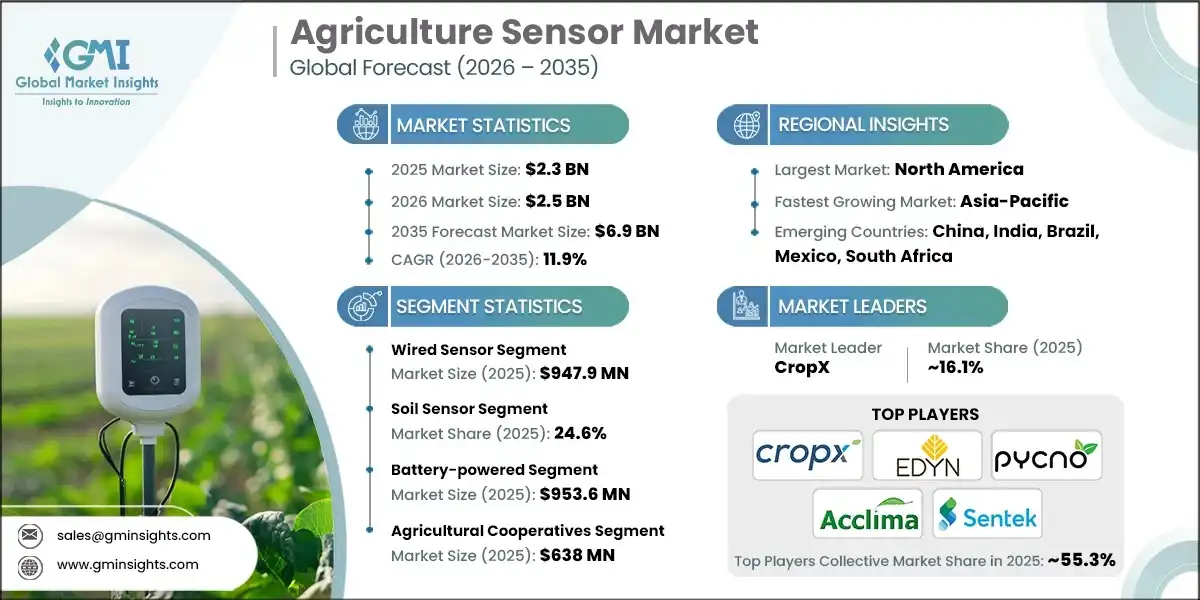
The global agriculture sensor market was valued at USD 2.3 billion in 2025. The market is expected to grow from USD 2.5 billion in 2026 to USD 6.9 billion in 2035, at a CAGR of 11.9% during the forecast period, according to the latest report published by Global Market Insights Inc. The market is getting bigger fast More and more people are using things like precision farming and automated crop systems. We need better crop yields, and ways to save water, so people are using soil, water, and climate sensors.
Agriculture Sensor Market Key Takeaways
Market Size & Growth
- 2025 Market Size: USD 2.3 Billion
- 2026 Market Size: USD 2.5 Billion
- 2035 Forecast Market Size: USD 6.9 Billion
- CAGR (2026–2035): 11.9%
Key Market Drivers
- Rising adoption of precision agriculture and smart farming.
- Government subsidies & policies promoting digital agriculture.
- Growing need for sustainable farming practices.
- Expansion of IoT, AI, and wireless connectivity in rural areas.
Challenges
- High upfront costs and lack of affordability for smallholder farmers.
- Limited digital infrastructure and data literacy in rural economies.
Opportunity
- Integration with AI, big data, and farm management software.
- Growth of vertical farming and controlled-environment agriculture.
Key Players
- Market Leader: CropX led with over 16.1% market share in 2025.
- Leading Players: Top 5 players in this market include CropX, Edyn, Pycno, Acclima, Sentek, which collectively held a market share of 55.3% in 2025.
Get Market Insights & Growth Opportunities
- The expansion of the sensor market in agriculture results from the seamless integration of the Internet of Things (IoT), cloud computing, artificial intelligence (AI), and machine learning (ML), which together are continuously transforming conventional agribusiness into precise, data-centric enterprises. Modern IoT sensors are now more reliable, robust, and economically viable, facilitating uninterrupted, in situ measurement of key agronomic parameters, including soil moisture, ambient temperature, and physiological crop indices. These networks of devices furnish farmers with actionable intelligence delivered to mobile interfaces, thereby enabling remote fine-tuning of practices and swift intervention in the face of stress signals.
- For instance, in December 2022, Astrocast partnered with Avirtech to provide satellite IoT connectivity solution for its BIOTA intelligence farm control system. This includes integrating its technology into Avirtech’s Avirlink this enables plantation owners to make legacy sensors smart by recording and controlling information remotely over long distances.
- Rising global consciousness regarding natural resource limits, particularly with regard to water and soil health, accelerates the uptake of sensor-based solutions designed to embed sustainability into production systems. Precision soil moisture probes, deployed in vulnerable regions, dramatical reduce irrigation volumes by synchronizing water application with actual crop needs, thereby extending soil moisture reserves.
- For instance, in November 2025, Internet Initiative Japan Inc. (IIJ) partnered with Sony Semiconductor Solutions Corporation (Sony) to establish soil moisture sensors and irrigation navigation services for smart agriculture. The aim of this partnership is to to support improvements in work quality and efficiency in agricultural practices, while contributing to sustainable agriculture that is resilient to climate change.
- From 2022 to 2023, the agriculture sensor market really grew, going from $1.6 billion to $1.8 billion. The was due to more people started using tech like precision farming, smart irrigation, and automated crop monitoring. Farmers and businesses are using sensors to check soil, water, weather, and light so they can make better choices based on data. Plus, better wireless, IoT, and energy-saving sensors, government help, and more knowledge about farming that doesn't hurt the environment all helped the market grow faster than. For instance, in July 2025, Pixxel partnered with Coactive Science to provide remote sensing data with real-time sensor and camera feeds to enable year-round monitoring and valuation of permanent crops across Spain.
- In the face of demographic expansion projected to elevate global population to 9–10 billion by the second half of the century, the agro-industrial sector is obliged to elevate output without exceeding finite ecological margins. Sensors provide precision agriculture, facilitating interventions that are calibrated and illustrated by variable-rate irrigation systems and differentiated fertilization schedules, which directly correlate resource application with crop demand as sensed in real time. Such sensors enhance crop yield alongside reductions in both manual inputs and environmental stress.
- Growth in sensor deployment throughout the North America region can be mainly traced to the initial embrace of precision agriculture, the extensive integration of IoT and artificial intelligence in large-scale agricultural enterprises, and the presence of a well-established farming infrastructure. Ongoing investment in research and development, paired with the routine application of sensors for soil, weather, and livestock management, boosting overall productivity and simultaneously lowering resource input expenses.
To get key market trends
Agriculture Sensor Market Trends
- The integration of the IoT, AI, and remote sensing is crafting agriculture’s evolution into a networked, information-centric system. Low-power, wide-area protocols LoRaWAN and NB-IoT form the communication backbone for thousands of sensors spanning large parcels, permitting timely, on-site decisions. Sophisticated algorithms analyze the resultant data streams, yielding forecasts for irrigation, pest control, and yield potential.
- Drones and satellites bearing optical and multispectral payloads extend monitoring geography, reduce the demand for on-foot field checks, and scale the approach to entire regions. Together, these components constitute the base layer of an increasingly fully digital agriculture sector.
- Environmental pressures have become the principal driver behind the broader uptake of precision technologies in agriculture. Sensors enable producers to tailor irrigation intervals, curtail nutrient leaching, and diminish greenhouse gas emissions. Soil moisture and nutrient probes enable irrigation schedules to track the plant’s immediate needs, while variable-rate fertilization applications adjust nutrient delivery to specific soil conditions, thus curtailing surplus use and shielding adjacent ecosystems.
- Policymakers and regional multilateral organizations are supporting these IoT-based platforms with an array of grants, subsidised loans, and coherent regulatory frameworks, thereby ensuring that sensor configurations integrate smoothly with overarching goals of climate-smart agriculture.
- The recent decline in sensor pricing, the expanded availability of solar-powered options, and widespread smartphone penetration are now permitting small and medium farmers to engage in smart agriculture. In various developing regions, producer cooperatives and public digital agriculture initiatives are rapidly distributing basic soil moisture and water-quality sensors.
- Commercial platforms are migrating sensors into all-encompassing farm-management interfaces, tying granular agronomic observations to supply-chain optimisation, and thereby nurturing a transparent, algorithmically informed agronomy that retains relevance across farm sizes.
Agriculture Sensor Market Analysis
Learn more about the key segments shaping this market
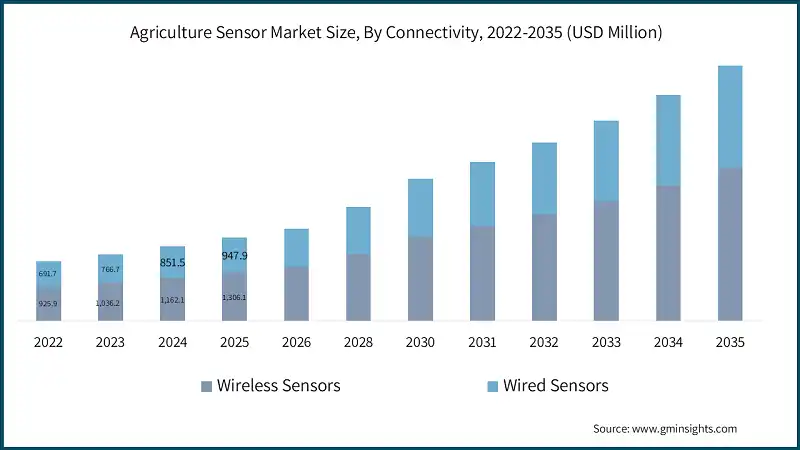
Based on connectivity, the agriculture sensor market is divided into wired sensor, and wireless sensor. The wired sensor segment dominated the market in 2025 with a revenue of USD 947.9 million.
- The wired sensor was the largest market share, driven by reliability, long lifespan, and consistent performance in both indoor and outdoor agricultural applications. Farms, greenhouses, and research institutions prefer wired sensors for precise, real-time monitoring of soil, water, and environmental conditions. Government programs and smart farming initiatives further support adoption.
- Manufacturers should focus on producing durable, energy-efficient wired sensors with high accuracy for soil, water, and climate monitoring. Developing scalable, easy-to-install solutions with real-time data capabilities will support farms, cooperatives, and research centers, helping meet growing precision agriculture demand and expanding market penetration globally.
- The wireless sensor was the fastest growing segment and is anticipated to grow with a CAGR of 12.4% each year and hitting $4.2 billion by 2035, driven by reliability, long lifespan, and consistent performance in both indoor and outdoor agricultural applications. Farms, greenhouses, and research institutions prefer wired sensors for precise, real-time monitoring of soil, water, and environmental conditions. Government programs and smart farming initiatives further support adoption.
- Manufacturers should focus on producing durable, energy-efficient wired sensors with high accuracy for soil, water, and climate monitoring. Developing scalable, easy-to-install solutions with real-time data capabilities will support farms, cooperatives, and research centers, helping meet growing precision agriculture demand and expanding market penetration globally.
Based on sensor type, the agriculture sensor market is divided into soil sensor, water sensor, climate/weather sensor, location sensor, optical sensor, mechanical sensor, biosensors, and others. The soil sensor segment accounted for 24.6% of the market in 2025.
- The soil sensors segment was valued at USD 554.4 million in 2025. Soil sensor remain the largest product segment, driven by the rising adoption of precision agriculture and sustainable farming practices. Farmers increasingly use soil moisture, temperature, and nutrient sensors to optimize irrigation, improve crop yields, and reduce resource wastage. Technological advancements in wireless, IoT-enabled, and energy-efficient sensors allow real-time monitoring and data-driven decision-making. Supportive government initiatives, increasing awareness among farmers, and growing agribusiness adoption further contribute to market growth, making soil sensors an essential tool for modern agriculture.
- Manufacturers should focus on developing accurate, durable, and energy-efficient soil sensors with wireless and IoT capabilities. Enhancing real-time monitoring, predictive analytics, and ease of use will help farmers optimize irrigation, improve yields, and adopt sustainable practices. Collaborations with agribusinesses and government programs can further expand market reach and adoption.
- The optical sensors segment in the agriculture sensor market is anticipated to grow at a CAGR of 14.1% during the forecast period, driven by increasing demand for precision monitoring of crop health, plant growth, and environmental conditions. These sensors enable real-time detection of light intensity, chlorophyll levels, and canopy characteristics, helping farmers optimize irrigation, fertilization, and pest management. Technological advancements in IoT-enabled, wireless, and energy-efficient optical sensors, along with rising adoption in large-scale farms, greenhouses, and research institutions, are fueling significant market expansion globally.
- Manufacturers should focus on developing high-precision, energy-efficient optical sensors with IoT and wireless capabilities. Enhancing real-time monitoring of crop health, light intensity, and canopy characteristics will support precision agriculture, optimize resource use, and increase adoption across large farms, greenhouses, and research institutions, driving market growth globally.
On the basis of power source, the market is divided into battery-powered, solar-powered, and Hybrid. The battery-powered segment dominated the market in 2025 with a revenue of USD 953.6 million.
- The battery-powered segment dominates the agriculture sensor market share due to its portability, ease of installation, and suitability for remote and large-scale farming areas lacking stable power infrastructure. These sensors provide reliable, real-time monitoring of soil, water, and crop conditions without dependence on external electricity. Advancements in long-lasting, energy-efficient batteries and low-power sensor technologies further enhance usability. Rising adoption among smallholder farmers, agribusinesses, and research institutions, combined with increasing precision agriculture initiatives, is driving significant growth for battery-powered agriculture sensors globally.
- Manufacturers should focus on developing battery-powered agriculture sensors with long-lasting, energy-efficient batteries and low-power technologies. Enhancing portability, ease of installation, and real-time monitoring capabilities will support remote and large-scale farms, smallholder farmers, and research institutions, boosting adoption and driving growth in the precision market globally.
- The solar-powered segment is the fastest-growing in the agriculture sensor market, anticipated to grow at a CAGR of 12.9% and reach USD 3 billion by 2035. Growth is driven by increasing demand for sustainable, off-grid, and energy-efficient solutions in large-scale farms, greenhouses, and remote agricultural areas. Solar-powered sensors enable continuous, real-time monitoring of soil, water, and climate conditions without reliance on external electricity. Rising adoption in precision agriculture, supportive government initiatives, and technological advancements in solar efficiency further accelerate market expansion globally.
- Manufacturers should focus on developing efficient, durable, and cost-effective solar-powered agriculture sensors. Enhancing real-time monitoring capabilities for soil, water, and climate conditions, along with off-grid and energy-efficient designs, will support large farms, greenhouses, and remote areas, driving adoption and accelerating growth in the precision market globally.
Learn more about the key segments shaping this market
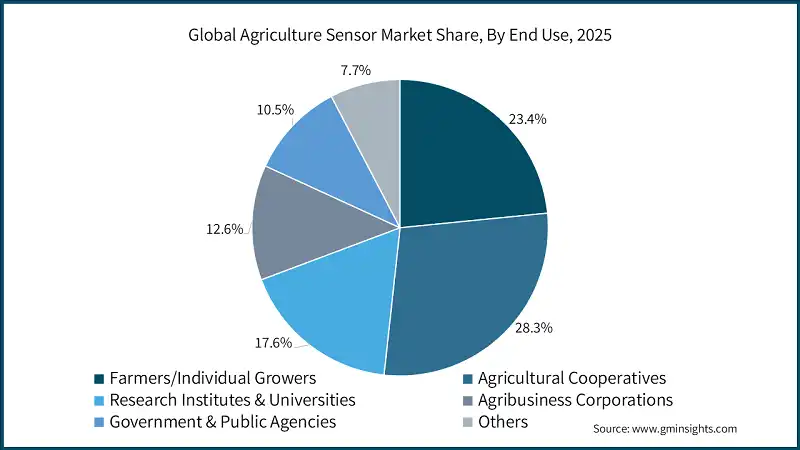
Based on the end-user, the agriculture sensor market is segmented into farmers/individual growers, agriculture corporation research institutes & universities, agriculture corporations, government & public agencies, and others. The agricultural cooperatives segment dominated the market in 2025 with a revenue of USD 638 million.
- The agricultural cooperatives segment dominates the agriculture sensor market due to their strong ability to pool resources, reduce individual farmer costs, and promote collective adoption of precision farming technologies. Cooperatives help small and mid-sized farmers access advanced sensors for soil, water, and crop monitoring through shared investments and bulk purchasing. They also provide training, technical support, and centralized data platforms, improving decision-making and boosting productivity. Government programs and subsidies directed toward cooperative farming further accelerate sensor adoption, strengthening their leadership in the overall market.
- Manufacturers should focus on creating affordable, easy-to-use agriculture sensors tailored for cooperative farming models. Offering bulk pricing, centralized data platforms, and strong training and support services will help cooperatives drive wider adoption. Developing scalable, durable, and high-accuracy sensors will further strengthen market penetration across small and mid-sized farming groups.
- The farmers/individual growers segment is expected to grow at a CAGR of 13.7% during the forecast period, driven by rising awareness of precision agriculture, the need to maximize crop yields, and growing pressure to optimize water and fertilizer use. Affordable, easy-to-install sensors for soil moisture, nutrients, temperature, and crop health are becoming more accessible to small and mid-sized farmers. Government subsidies, digital farming programs, and increasing smartphone and IoT adoption further support sensor usage. Technological advancements and declining sensor costs are accelerating adoption among individual growers globally.
- Manufacturers should focus on developing low-cost, easy-to-install agriculture sensors tailored for small and mid-sized farmers. Offering mobile-friendly, IoT-enabled solutions with simple interfaces will boost adoption. Providing training, after-sales support, and government-backed subsidy integration will help individual growers adopt precision agriculture tools more effectively and improve overall farm productivity.
Looking for region specific data?
The North America agriculture sensor market held 34.3% market share in 2025.
- The market in the North America has been expanding steadily due to the rapid adoption of precision farming, strong investment in smart agriculture technologies, and the presence of advanced agribusiness companies. Farmers increasingly rely on sensors for soil monitoring, irrigation management, and crop health assessment to improve yields and reduce input costs. Government support, rising labor shortages, and the push for sustainable farming practices further accelerate adoption. Continuous innovation in IoT, remote sensing, and automation is strengthening overall market growth.
- Manufacturers should focus on developing highly accurate, easy-to-use, and cost-effective sensors tailored to North America farming needs. Emphasis on IoT integration, long-range connectivity, and automation-ready designs will support large and small farms. Providing durable, data-driven solutions that enhance irrigation, soil management, and crop monitoring will help capture growing market demand.
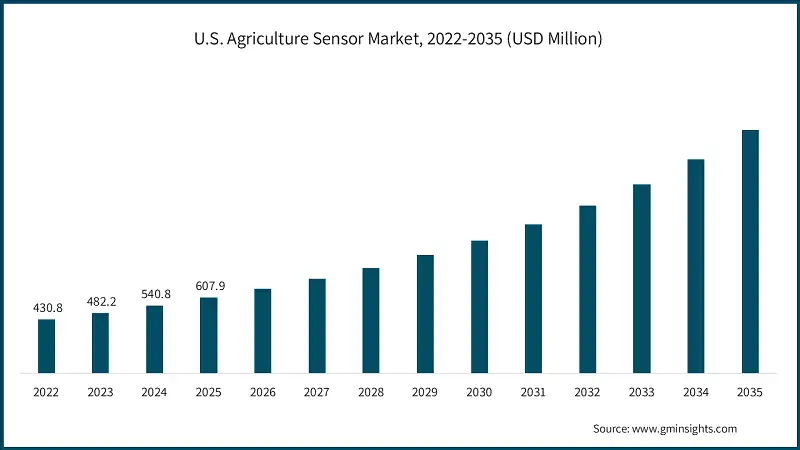
The U.S. agriculture sensor market was valued at USD 482.2 million and USD 540.8 million in 2023 and 2024, respectively. The market size reached USD 676.7 billion in 2026, growing from USD 607.9 billion in 2025.
- The U.S. continues to dominate the agriculture sensor market, supported by advanced farming infrastructure, strong investment in precision agriculture, and widespread adoption of IoT- and AI-based technologies. Large agribusinesses, tech innovators, and research institutions drive continuous development of smart farming tools. Government programs promoting sustainable agriculture, efficient water management, and climate-resilient farming further accelerate sensor usage. High awareness, skilled workforce, and strong digital connectivity also contribute to rapid adoption across large-scale farms, greenhouses, and specialty crop growers, maintaining the U.S. leadership in the market.
- Manufacturers should focus on developing advanced, AI-enabled, and IoT-integrated sensors tailored for large U.S. farms, greenhouses, and high-value crops. Prioritizing accuracy, durability, and seamless data integration with existing farm platforms will boost adoption. Offering scalable, user-friendly solutions aligned with sustainability goals and government programs will strengthen market presence and meet rising demand.
In Europe, the agriculture sensor market accounted for USD 443.7 million in 2025 and is anticipated to show lucrative growth over the forecast period.
- Europe holds a significant share of the market due to strong adoption of precision farming, advanced agricultural machinery, and digital farming solutions. Farmers are increasingly using soil sensors, weather sensors, moisture sensors, optical sensors, and livestock monitoring systems to improve crop yields and resource efficiency. Government support for sustainable agriculture, investments in smart farming technologies, and the rise of climate-resilient farming practices further strengthen the region’s position. The presence of leading agritech companies, research institutions, and large-scale commercial farms continues to drive demand for modern sensor-based agriculture solutions across Europe.
- Manufacturers should focus on developing accurate, durable, and energy-efficient agriculture sensors suitable for Europe’s diverse farming systems. Emphasis on IoT-enabled devices, real-time monitoring platforms, and climate-adaptive technologies will help address sustainability goals and support large farms, greenhouse operations, and livestock facilities. Offering easy integration with existing European digital agriculture tools will enhance adoption.
Germany dominates the agriculture sensor market, showcasing strong growth potential.
- Within Europe, Germany holds a substantial share of the market due to its advanced farming infrastructure, widespread adoption of precision agriculture, and strong presence of agricultural machinery manufacturers. German farms use a wide range of sensors, including soil moisture sensors, nutrient sensors, environmental sensors, and livestock monitoring technologies. The country’s rapid shift toward automated farming systems, smart greenhouses, and data-driven crop management supports steady market growth. Government initiatives promoting sustainable farming, resource efficiency, and AgTech innovation further accelerate sensor adoption across both crop and livestock sectors.
- Manufacturers should focus on producing high-precision, rugged, and IoT-enabled sensors designed for Germany’s large-scale farms, smart greenhouses, and livestock operations. Prioritizing reliability, automation compatibility, and seamless integration with farm management software—while collaborating with leading agricultural machinery companies—will help strengthen Germany’s leadership in modern agriculture technologies.
The Asia-Pacific agriculture sensor market is anticipated to grow at the highest CAGR of 13.6% during the analysis timeframe.
- The Asia-Pacific region is experiencing rapid growth in the agriculture sensor market due to expanding adoption of smart farming, greenhouse automation, and precision agriculture. Demand is rising for soil moisture sensors, weather sensors, irrigation sensors, drones with imaging sensors, and low-cost portable devices. Growing digital transformation in agriculture, expanding food demand, and government programs supporting smart farming in India, China, Japan, and Southeast Asia are accelerating market growth. Large farming areas, rising agritech investments, and the presence of both global and local sensor manufacturers make Asia-Pacific one of the fastest-growing regions for agriculture sensor deployments.
- Manufacturers in Asia-Pacific should focus on developing affordable, robust, and energy-efficient sensors for large farms, greenhouses, fisheries, and plantation agriculture. Prioritizing wireless connectivity, solar-powered solutions, and easy-to-use mobile platforms will help meet rising demand. Leveraging government smart farming initiatives and expanding agricultural modernization will support strong market growth.
China’s agriculture sensor market is estimated to grow at a significant CAGR of 14.7% from 2026 to 2035.
- China dominates the Asia-Pacific market due to large-scale investments in agritech, strong manufacturing capabilities, and rapid modernization of crop and livestock production. The country is widely adopting soil sensors, weather monitoring systems, optical sensors, and IoT-based smart farming devices in greenhouses, orchards, and open fields. Government initiatives focused on digital agriculture, water efficiency, and smart village development are boosting demand. Collaboration between sensor manufacturers, AI companies, and agricultural platforms, along with the growth of domestic agritech startups, supports rapid innovation in precision farming technologies.
- Manufacturers should focus on producing cost-effective, durable, and high-accuracy sensors tailored for China’s diverse farming landscapes. Emphasis on solar-powered systems, remote monitoring solutions, and AI-enabled sensor platforms will meet rising demand. Leveraging government-backed digital agriculture programs and collaborating with local tech companies will help scale production and expand sensor adoption across the country.
In 2025, the Latin America agriculture sensor market is expected to reach USD 190.6 million, driven by growing precision farming adoption, expansion of commercial farms, rising smart irrigation projects, and increasing use of sensors for crop monitoring across major agricultural economies.
The Middle East market is expected to reach USD 317.2 million by 2035. This growth is due to increasing adoption of smart agriculture, water-efficient farming systems, greenhouse automation, and the use of IoT and AI in crop and livestock management.
In Saudi Arabia the agriculture sensor market is set to experience substantial growth in 2025.
- The Saudi Arabia is showing strong growth potential in the market due to major investments in controlled-environment agriculture, smart greenhouses, hydroponic and vertical farming systems, and digital transformation. Demand for sensors that monitor humidity, temperature, soil conditions, nutrient levels, and greenhouse climate is rising rapidly. Government-led initiatives to improve food security, expand sustainable farming, and support AgTech innovation strengthen adoption. Collaboration with global technology firms and rapid expansion of high-tech farming operations further position the UAE as a leading market in the region.
- Manufacturers should focus on delivering highly accurate, durable, and climate-resilient sensors for the Saudi Arabia’s greenhouses, hydroponic farms, and desert agriculture projects. Emphasizing IoT connectivity, real-time monitoring, and energy-efficient solutions while leveraging government-backed food security programs and partnerships is expected to help drive sensor adoption and support the country’s growing smart agriculture ecosystem.
Agriculture Sensor Market Share
- The market is highly competitive, with companies focusing on innovation, strategic partnerships, and advancements in precision farming technologies. Leading players such as CropX, Edyn, Pycno, Acclima, and Sentek account for a significant share 55.3% of the market. These companies specialize in developing high-accuracy, energy-efficient, and durable sensors used for soil moisture monitoring, weather tracking, nutrient measurement, pest detection, and irrigation control. Advances in IoT-enabled sensors, wireless connectivity, AI-based analytics, and long-range communication technologies are improving farm efficiency, data accuracy, and decision-making. Collaboration with agritech firms, government agriculture programs, and digital farming platforms is helping these companies expand adoption across large farms, cooperatives, and greenhouse operations.
- In addition, emerging players are offering affordable, scalable, and easy-to-install sensor solutions suitable for smallholder farmers, niche crop growers, research institutions, and smart irrigation systems. New developments in solar-powered sensors, low-power wide-area networks (LPWAN), compact nutrient sensors, and multi-parameter monitoring devices are enhancing durability, data precision, and real-time field visibility. Working closely with software developers, drone service providers, and farm management system (FMS) startups enables faster integration of sensor data into automated decision-support tools. These advancements help reduce input costs, optimize water and fertilizer use, and expand the adoption of agriculture sensors across diverse applications such as soil health management, livestock monitoring, greenhouse automation, and climate-adaptive farming worldwide.
Agriculture Sensor Market Companies
List of prominent players operating in the agriculture sensor industry include:
- Acclima Inc.
- Acquity Agriculture
- Agsmarts Inc.
- Aker Technology Co., Ltd.
- AquaSpy Inc.
- Auroras (Auroras s.r.l.)
- Bosch Sensortec
- Caipos GmbH
- Changsha Zoko Link Technology Co., Ltd.
- CropX Inc.
- Decagon Devices (METER Group)
- dol-sensors A/S
- Honde Technology Co., Ltd.
- Hunan Rika Electronic Tech Co., Ltd.
- John Deere
- Libelium Comunicaciones Distribuidas SL
- Lindsay Corporation
- Monnit Corporation
- OMRON Electronic Components
- Pycno
- Sensaphone
- Sensoterra
- Sentek Ltd
- Teralytic
- Texas Instruments Incorporated
- Vegetronix Inc.
- Wevolver.
- CropX
CropX is a leading player in the agriculture sensor market, holding an estimated 16.1% share. The company is recognized for its advanced soil, water, and climate sensors, widely used across farms, greenhouses, and research institutions. CropX focuses on precision agriculture solutions, offering wireless, IoT-enabled, and energy-efficient devices that provide real-time monitoring and actionable insights. Strong global distribution, continuous technological innovation, and integration with farm management platforms and cloud-based analytics systems further strengthen CropX’s position and drive widespread adoption of its agriculture sensor products.
Edyn is a prominent player in the agriculture sensor market, known for its expertise in processing technologies, AI-driven analytics, and smart sensor solutions. The company provides high-performance sensors, edge computing modules, and data platforms that monitor soil health, crop growth, water levels, and climate conditions. Intel focuses on enhancing sensor intelligence through real-time analytics, predictive insights, and energy-efficient designs. By collaborating with sensor manufacturers, agritech companies, and farm management solution providers, Intel strengthens intelligent agriculture ecosystems, enabling better resource optimization, improved yields, and broader adoption of smart farming technologies globally.
Pycno holds a significant 10.3% share of the agriculture sensor market, driven by its leadership in advanced sensor innovation and manufacturing. The company specializes in soil, water, optical, and climate sensors used across farms, greenhouses, and agricultural research centers. Pycno focuses on producing high-accuracy, durable, and energy-efficient agriculture sensors. Its large-scale production capabilities, robust supply chain, and continuous investment in next-generation sensor technologies strengthen its global presence. By partnering with agribusinesses, research institutions, and technology providers, Pycno supports growing demand for precision agriculture, smart irrigation, and real-time farm monitoring solutions worldwide.
Agriculture Sensor Market Report Attributes
| Key Takeaway | Details |
|---|---|
| Market Size & Growth | |
| Base Year | 2025 |
| Market Size in 2025 | USD 2.3 Billion |
| Market Size in 2026 | USD 2.5 Billion |
| Forecast Period 2026-2035 CAGR | 11.9% |
| Market Size in 2035 | USD 6.9 Billion |
| Key Market Trends | |
| Drivers | Impact |
| Rising adoption of precision agriculture and smart farming | Precision farming adoption drives about 35% of demand in the agriculture sensor market. Farmers and agribusinesses increasingly use soil, water, climate, and optical sensors for crop monitoring, irrigation management, and yield optimization. Advanced sensor solutions help improve farm productivity, resource efficiency, and sustainability. |
| Government subsidies & policies promoting digital agriculture | Integration with IoT and smart farming technologies accounts for around 30% of market growth. Connected farm management systems rely on wireless and real-time sensor data to optimize irrigation, fertilization, and crop health monitoring. Energy-efficient and automated solutions are preferred for large-scale and remote farms. |
| Growing need for sustainable farming practices | Applications in research, agribusinesses, and government programs contribute roughly 25% of growth. Sensors support agricultural research, cooperative farming initiatives, and public agricultural monitoring. Accurate data improves crop planning, resource allocation, and decision-making efficiency across sectors. |
| Expansion of IoT, AI, and wireless connectivity in rural areas | Innovation and government/industry initiatives represent the remaining 10% of growth. Investments in R&D, AI-enabled sensors, drone-based monitoring, and smart agriculture programs drive the adoption of next-generation sensor technologies, expanding market potential globally. |
| Pitfalls & Challenges | Impact |
| High upfront costs and lack of affordability for smallholder farmers | The adoption of agriculture sensors is constrained by their high initial investment, which many small and marginal farmers cannot afford. Expensive sensor devices, installation, and maintenance costs limit widespread usage, especially in developing regions, slowing market penetration and preventing smallholders from benefiting from precision agriculture technologies. |
| Limited digital infrastructure and data literacy in rural economies | In many rural areas, insufficient internet connectivity, poor network coverage, and low access to digital tools restrict the effective use of smart agriculture sensors. Additionally, limited knowledge and skills in interpreting sensor data hinder farmers from leveraging insights for crop management, reducing adoption rates and impeding market growth. |
| Opportunities: | Impact |
| Integration with AI, big data, and farm management software | The integration of AI, big data, and farm management software offers significant opportunities in the agriculture sensor market. Sensors provide real-time data on soil, water, and crop conditions, enabling predictive analytics and automated decision-making. This enhances farm productivity, resource efficiency, and precision agriculture adoption globally. |
| Growth of vertical farming and controlled-environment agriculture | The rise of vertical farming and controlled-environment agriculture drives demand for advanced agriculture sensors. Sensors monitor light, humidity, temperature, and nutrient levels, ensuring optimal growth conditions. This enables higher yields, resource optimization, and sustainable farming practices, expanding market opportunities for innovative sensor technologies in modern and intensive agricultural setups. |
| Market Leaders (2025) | |
| Market Leaders |
~16.1% market share. |
| Top Players |
Collective market share in 2024 is ~55.3% |
| Competitive Edge |
|
| Regional Insights | |
| Largest Market | North America |
| Fastest Growing Market | Asia-Pacific |
| Emerging Country | China, India, Brazil, Mexico, South Africa |
| Future Outlook |
|
What are the growth opportunities in this market?
Agriculture Sensor Industry News
- In August 2025, OMRON Electronic Components announced the launch of its next-generation Weather Sensor, developed to address the rising demand for accurate and reliable environmental data across agriculture, meteorology, and smart city applications. The release marked a significant step forward in enabling smarter, data-driven decision-making in diverse environmental monitoring scenarios.
- In October 2025, CropX launched a new in field weather station product, Strato 1, offering hyperlocal weather data to complement soil monitoring and support smarter irrigation and planting decisions.
- In February 2025, John Deere launched new planter technologies featuring seed level and fertilizer level sensing, as well as active vacuum automation — enabling real time data feedback and greater precision during planting and fertilization.
- In November 2025, Lindsay finalized acquired Pessl Instruments, broadening its smart irrigation and environmental sensor portfolio under the widely recognized METOS ecosystem.
- In August 2024, Libelium launched Waspmote Plug & Sense! Smart Agriculture Xtreme sensor node optimized for crop monitoring in vineyards, orchards, and greenhouse applications, offering top-tier accuracy for demanding field conditions
The agriculture sensor market research report includes an in-depth coverage of the industry with estimates and forecast in terms of revenue (USD Billion) from 2022 – 2035 for the following segments:
Market, By Connectivity
- Soil sensors
- Water sensors
- Climate/weather sensors
- Location sensors
- Optical sensors
- Mechanical sensors
- Biosensors
- Others
Market, By Connectivity
- Wired sensors
- Wireless sensors
Market, By Power Source
- Battery-powered
- Solar-powered
- Hybrid
Market, By End Use
- Farmers/individual growers
- Agricultural cooperatives
- Research institutes & universities
- Agribusiness corporations
- Government & public agencies
- Others
The above information is provided for the following regions and countries:
- North America
- U.S.
- Canada
- Europe
- Germany
- UK
- France
- Italy
- Spain
- Netherlands
- Asia Pacific
- China
- India
- Japan
- South Korea
- Australia
- Latin America
- Brazil
- Mexico
- Argentina
- Middle East and Africa
- Saudi Arabia
- South Africa
- UAE
Frequently Asked Question(FAQ) :
What was the market size of the agriculture sensor market in 2025?
The market was valued at USD 2.3 billion in 2025, driven by the increasing adoption of precision farming and automated crop systems.
What is the projected value of the agriculture sensor market by 2035?
The market is expected to reach USD 6.9 billion by 2035, growing at a CAGR of 11.9% during the forecast period, fueled by advancements in IoT, AI, and remote sensing technologies.
How much revenue did the battery-powered segment generate in 2025?
The battery-powered segment dominated the market in 2025, generating USD 953.6 million in revenue.
What was the valuation of the agricultural cooperatives segment in 2025?
The agricultural cooperatives segment led the market in 2025, with a revenue of USD 638 million.
What is the projected size of the U.S. agriculture sensor market in 2025?
The U.S. market is expected to reach USD 607.9 billion in 2025.
What are the upcoming trends in the agriculture sensor industry?
Key trends include the integration of IoT, AI, and remote sensing, adoption of low-power communication protocols like LoRaWAN and NB-IoT, and the use of drones and satellites for large-scale monitoring.
Who are the key players in the agriculture sensor market?
Prominent players include Acclima Inc., Acquity Agriculture, Agsmarts Inc., Aker Technology Co., Ltd., AquaSpy Inc., Auroras (Auroras s.r.l.), Bosch Sensortec, Caipos GmbH, Changsha Zoko Link Technology Co., Ltd., CropX Inc., and Lindsay Corporation.
Agriculture Sensor Market Scope
Related Reports