Summary
Table of Content

Agriculture Hand Tools Market
Get a free sample of this report
Form submitted successfully!
Error submitting form. Please try again.
Thank you!
Your inquiry has been received. Our team will reach out to you with the required details via email. To ensure that you don't miss their response, kindly remember to check your spam folder as well!
Request Sectional Data
Thank you!
Your inquiry has been received. Our team will reach out to you with the required details via email. To ensure that you don't miss their response, kindly remember to check your spam folder as well!
Form submitted successfully!
Error submitting form. Please try again.
Agriculture Hand Tools Market Size
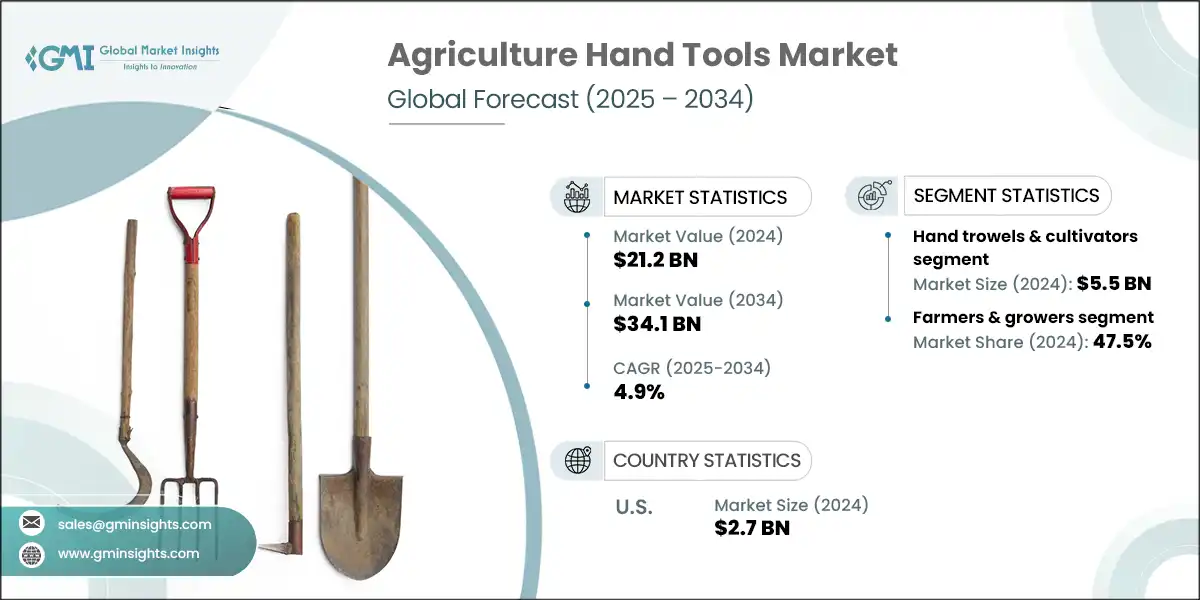
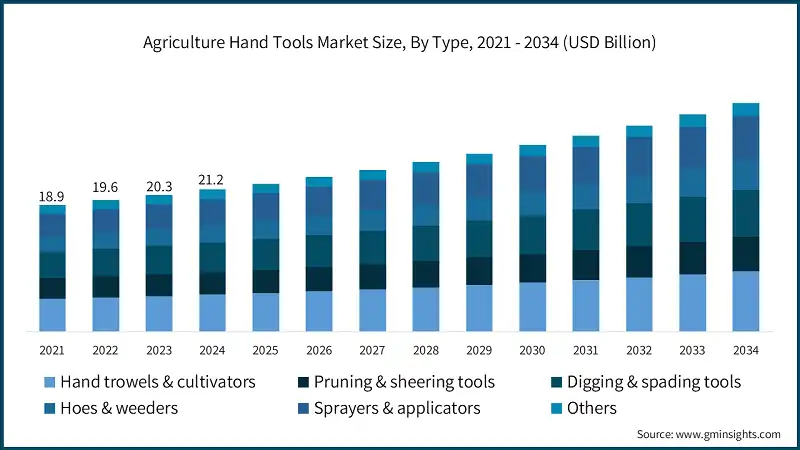
A comprehensive report by Global Market Insights Inc. projects the global agriculture hand tools market was estimated at USD 21.2 billion in 2024. The market is expected to grow from USD 22.1 billion in 2025 to USD 34.1 billion in 2034, at a CAGR of 4.9%.
Agriculture Hand Tools Market Key Takeaways
Market Size & Growth
- 2024 Market Size: USD 21.2 Billion
- 2034 Forecast Market Size: USD 34.1 Billion
- CAGR (2025–2034): 4.9%
Regional Dominance
- Largest Market: Asia Pacific
- Fastest Growing Region: Europe
Key Market Drivers
- Adoption of sustainable farming.
- Rising small-scale and urban farming.
- Cost-effectiveness and versatility of applications.
Challenges
- Competition from mechanized and power tools.
- Market fragmentation and counterfeiting.
Opportunity
- Technological and design innovations.
- Commercial landscaping and horticulture.
Key Players
- Market Leader: Fiskars Group led with over 20% market share in 2024.
- Leading Players: Top 5 players in this market include Ames True Temper, Bahco, Vaughan & Bushnell, JCB Hand Tools, Lowell Corp, which collectively held a market share of 30% in 2024.
Get Market Insights & Growth Opportunities
- The agriculture hand tools market is witnessing consistent growth due to rising worldwide demand for food production and the necessity for economical farming options. Smallholder farmers and agricultural communities depend significantly on manual tools for planting, harvesting, and upkeep tasks.
- Increasing awareness of sustainable agriculture techniques enhances the need for durable and environment-friendly tools developed from recycled materials. Technological innovations, like ergonomic designs and multi-functional tools, also affect the market by enhancing efficiency.
- Major key players in the agriculture hand tools market emphasize product development, strategic partnerships, and geographical growth to enhance their market presence. Manufacturers focus on creating lightweight, ergonomic tools that reduce fatigue and improve productivity.
- The emphasis on eco-friendly products is also notable, as producers provide sustainable alternatives to satisfy customer preferences. The distribution landscape is transforming, with an increase in online platforms and rural retail locations to connect with distant farming communities. Pricing strategies, product longevity, and brand image are essential elements affecting consumer decisions, leading businesses to implement extensive marketing and innovation plans.
- Farmers and growers form the major end user segment in the agriculture hand tools market. They rely on these tools for essential tasks such as planting, harvesting, and soil preparation, especially in regions where mechanization is either limited or prohibitively expensive.
- Hand tools are known for their affordability, portability, and simplicity, making them indispensable for smallholder farmers lacking access to advanced machinery. Many hand tools offer versatile applications such as weeding, digging and soil aeration for small-scale farmers, reducing the need to buy multiple tools or equipment.
- Asia-Pacific region is the largest market, fueled by increasing agricultural endeavors and heightened investments in rural development. Countries such as India, China, and Southeast Asia are experiencing a rise in demand for locally produced tools to aid smallholder farmers. North America and Europe also account for significant market share due to agricultural infrastructure, high disposable incomes, and an emphasis on precision farming.
To get key market trends
Agriculture Hand Tools Market Trends
- The market is growing due to several trends. Manufacturers focus on innovation and ergonomic designs to improve user comfort, reduce fatigue, and increase productivity for farmers and gardeners.
- Tool manufacturers focus on material innovation, developing lightweight options like fiberglass and high-strength plastics to improve handling and reduce user fatigue.
- The incorporation of sensors, Bluetooth connectivity, and digital interfaces in conventional hand tools enables agricultural professionals to track and monitor tool performance effectively. Growing emphasis on sustainability has increased demand for eco-friendly tools manufactured from recyclable and sustainable materials.
- The agricultural sector shows increasing preference for multipurpose tools that reduce both tool quantity requirements and per-item costs. E-commerce platforms have expanded the accessibility of agricultural hand tools, particularly in remote areas and emerging markets.
- Regional patterns indicate higher adoption rates of modern agricultural tools in developing countries, driven by government initiatives promoting advanced farming practices. The market is experiencing increased demand from small-scale farmers and urban gardeners, leading manufacturers to develop products suitable for smaller agricultural operations.
- The agricultural tools market is shifting toward intelligent, sustainable, and user-focused solutions. This transformation creates growth opportunities for manufacturers who adapt their strategies to address technological advancements and evolving consumer preferences.
Agriculture Hand Tools Market Analysis
Learn more about the key segments shaping this market
Based on type, the market is divided into hand trowels & cultivators, pruning & sheering tools, digging & spading tools, hoes & weeders, sprayers & applicators, and others. In 2024, hand trowels & cultivators held the major market share, generating a revenue of USD 5.5 billion.
- Hand trowels and cultivators are the primary agricultural hand tools due to their essential functions in small-scale gardening, landscaping, and precision farming. These tools are necessary for planting, transplanting, weeding, soil aeration, and incorporating fertilizers or soil amendments.
- Amateur gardeners, professional farmers, landscapers, and urban growers rely on these implements for their daily operations. The compact size and ergonomic design of hand trowels and cultivators enable precise work in confined spaces, such as flower beds, vegetable patches, and container gardens, which have gained popularity in urban settings.
- Cultivators perform multiple functions, including soil loosening, clump breaking, and seedbed preparation. They also improve soil aeration, which is crucial for plant health. The growing popularity of home gardening, organic farming, and sustainable agriculture has increased the demand for manual tools, particularly hand trowels and cultivators.
- These tools are cost-effective, require minimal maintenance, and operate without power sources, making them accessible to most consumers. Their lightweight and ergonomic design reduces user fatigue, making them suitable for people across different age groups and physical capabilities.
- The growth of urban farming and community gardens has further increased demand, as these settings typically require manual tools rather than large machinery.
- Recent improvements in tool design, including corrosion-resistant materials and multi-functional features, have improved product durability. The combination of wide applicability, affordability, and ease of use has established hand trowels and cultivators as dominant products in the market.
Learn more about the key segments shaping this market
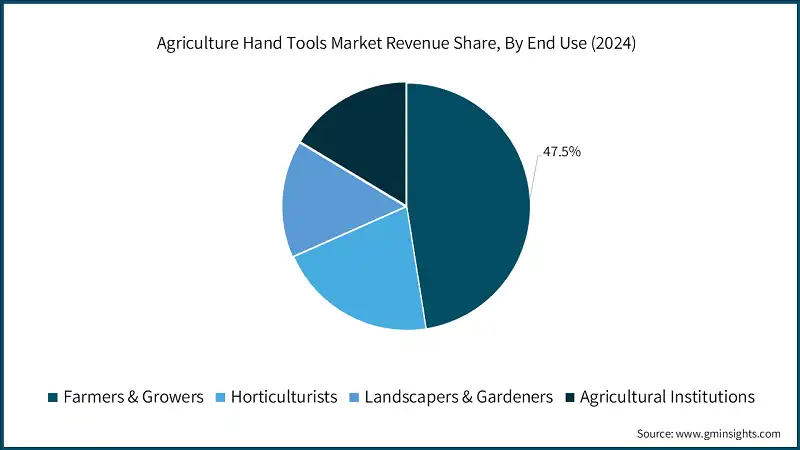
Based on the end use, the agriculture hand tools market is segmented farmers & growers, horticulturists, landscapers & gardeners, and agricultural institutions. The farmers & growers segment held the largest share, accounting for 47.5% of the global market in 2024.
- Farmers and growers represent the largest segment of agriculture hand tools users, as these implements are essential for daily food production activities. Their work encompasses planning, growing, maintaining, and harvesting crops, making efficient hand tools crucial for productivity.
- Small to medium-scale farmers and those implementing sustainable farming practices primarily use manual tools such as hoes, spades, pruning shears, and cultivators. These tools are preferred due to their lower cost, enhanced control, and sustainability compared to mechanized alternatives.
- Hand tools enable farmers to perform specialized tasks like weeding, planting, pruning, and soil preparation with precision, minimizing crop damage and maximizing yields.
- The growing adoption of sustainable and organic farming practices has increased the demand for hand tools, as farmers often avoid mechanized equipment to preserve soil health and reduce environmental impact. These factors continue to drive farmers toward high-quality, reliable hand tools.
Looking for region specific data?
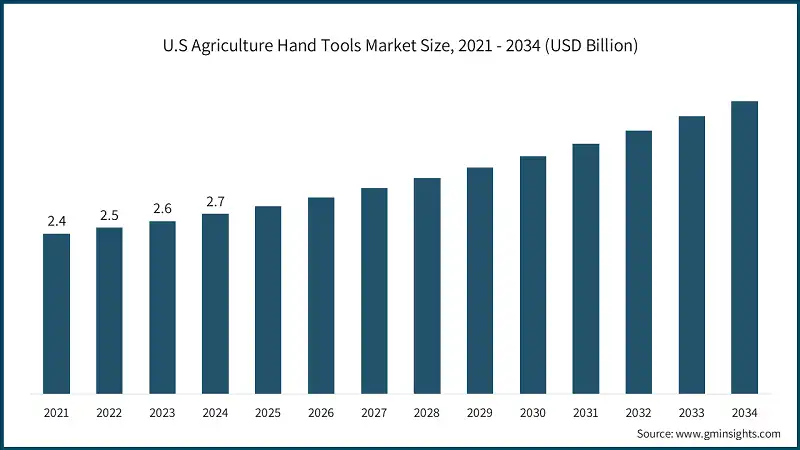
In 2024, the U.S. contributed significantly to the agriculture hand tools market, generating revenue of USD 2.7 billion.
- The U.S. agriculture sector stands as one of the world's most technologically sophisticated and extensive agricultural systems. As a global agricultural leader, the United States ranks as one of the world's largest producers and the primary exporter of agricultural products, including soybeans, corn, wheat, and livestock.
- The market combines traditional farming practices with advanced technologies, incorporating precision agriculture, automation, and data analytics to enhance productivity and environmental sustainability.
- The growth in organic farming and sustainable practices responds to increasing consumer demand for healthier food options. Government policies, subsidies, and research programs significantly influence market operations and development.
- Urban farming initiatives, locally sourced produce, and farm-to-table programs continue to shape the demand for agricultural equipment and tools. The U.S. agriculture sector demonstrates strong investment opportunities while advancing technological integration and environmental sustainability practices.
The Europe agriculture hand tools market holds second largest share in 2024 and is expected to grow at 5.2% during the forecast period, driven by growing sustainability initiatives and precision agriculture.
- The European agricultural sector emphasizes sustainable, organic, and environmentally conscious farming practices. The European Union (EU) implements regulations and policies to minimize environmental impact, support organic farming, and enhance rural development. The market comprises both small-scale family farms and large commercial operations, with an emphasis on quality, food safety, and product traceability.
- Farmers increasingly incorporate technological solutions, including GPS-guided equipment and smart farming systems, to comply with regulations and meet consumer demands. The region maintains extensive research and development initiatives in sustainable agriculture.
- The growing consumer preference for local and organic produce necessitates specialized farming tools and methods for businesses to remain competitive. Additionally, national and EU funding supports the development of advanced farming solutions and precision agriculture technologies while maintaining sustainability standards, strengthening Europe's position in the global agricultural sector.
Asia Pacific agriculture hand tools market is expected to grow at 5% during the forecast period.
- The Asia Pacific agriculture sector is experiencing robust growth, driven by increased food demand from population expansion, urbanization, and rising disposable income. China, India, and Southeast Asian countries present opportunities for agricultural production growth through modern practices and technology integration.
- The regional agricultural landscape consists of small family farms, creating demand for affordable, versatile tools suitable for various terrain types and production methods.
- Government initiatives, coupled with international development funding, support the adoption of mechanization, digital agriculture, and innovative practices to strengthen rural economies. While sustainable and organic farming practices are emerging, traditional farming methods remain prevalent across many areas.
- Market players respond by developing cost-effective, durable, multipurpose tools that address the needs of both small-scale farmers and urban cultivators in the Asia Pacific region. The agricultural market in developing Asia Pacific regions is expected to demonstrate accelerated growth, with emphasis on enhancing productivity and sustainability.
Agriculture Hand Tools Market Share
- The top 5 companies in the market are Fiskars Group, Ames True Temper, Bahco, Vaughan & Bushnell, JCB Hand Tools, and Lowell Corp, contributing around approximately 30% of the market in 2024. These prominent players are proactively involved in strategic endeavors, such as mergers & acquisitions, facility expansions & collaborations, to expand their product portfolios, extend their reach to a broad customer base, and strengthen their market position.
- Fiskars Group maintains its competitive position through brand strength, product innovation, and global operations. The company emphasizes sustainability in its product materials and manufacturing processes to meet market demand for environmentally responsible products.
- Ames True Temper focuses on operational efficiency, product innovation, and distribution channel optimization. The company develops commercial-quality tools at competitive prices to serve both commercial and DIY market segments.
- Bahco specializes in premium tools for agriculture and horticulture markets. The company prioritizes ergonomic design and durability to meet the requirements of professional farmers, commercial landscapers, and horticulturists. Bahco aims to establish itself as a provider of high-performance, precision tools for professional users.
Agriculture Hand Tools Market Companies
Major players operating in the market are:
- A.M. Leonard
- Ames True Temper
- Bahco
- Corona Tools
- Fiskars Group
- GARDENA
- Griffon
- Husqvarna
- JCB Tools
- Lowell Corporation
- Stanley Black & Decker
- Truper
- Vaughan & Bushnell
- Walter Stern Inc
- WOLF-Garten
JCB expanded its portfolio of power tools, hand tools, and construction equipment, focusing on durability and performance for construction and industrial applications. The company introduced cordless power tools with enhanced battery technology to improve operational duration and efficiency.
Lowell strengthened its custom tooling solutions and OEM partnerships, delivering specialized tools that meet specific client requirements across multiple industries.
Stanley Black & Decker developed new cordless and connected tools with Bluetooth monitoring capabilities for maintenance and performance tracking. The company launched new cordless drills, impact drivers, and multi-purpose tools with enhanced features.
Agriculture Hand Tools Market Report Attributes
| Key Takeaway | Details |
|---|---|
| Market Size & Growth | |
| Base Year | 2024 |
| Market Size in 2024 | USD 21.2 Billion |
| Forecast Period 2025 - 2034 CAGR | 4.9% |
| Market Size in 2034 | USD 34.1 Billion |
| Key Market Trends | |
| Drivers | Impact |
| Adoption of sustainable farming | Growing awareness of the environmental impact has prompted farmers to embrace sustainable practices. Eco-friendly farming is increasingly embracing hand tools, including manual implements designed to minimize soil disturbance and promote organic practices. |
| Rising small-scale and urban farming | The rise of small-scale and urban farming projects globally drives the need for lightweight, user-friendly, and compact hand tools. |
| Cost-effectiveness and versatility of applications | Hand tools tend to be less expensive than powered equipment, which makes them more available to a wider variety of farmers, particularly in developing areas. |
| Pitfalls & Challenges | Impact |
| Competition from mechanized and power tools | The growing use of mechanized equipment and power tools poses a major challenge for the hand tools industry. These tools provide efficiency, lowered labor costs, and increased productivity, due to which hand tools less preferred for extensive farming practices. |
| Market fragmentation and counterfeiting | The market for agriculture hand tools is fragmented, featuring many domestic and regional producers that provide comparable products. Such fragmentation may result in varied product quality and challenges in building brand loyalty. |
| Opportunities: | Impact |
| Technological and design innovations | Improvements in materials, ergonomics, and tool design offer considerable prospects for development. Innovations like strong, lightweight materials, ergonomic grips, and multifunctional devices can improve user comfort, efficiency, and productivity. |
| Commercial landscaping and horticulture | The growing commercial landscaping and horticulture industries offer significant opportunities for expansion. These sectors need specialized, high-quality hand tools for planting, trimming, pruning, and upkeep. |
| Market Leaders (2024) | |
| Market Leaders |
20% market share |
| Top Players |
The collective market share in 2024 is 30% |
| Competitive Edge |
|
| Regional Insights | |
| Largest market | Asia Pacific |
| Fastest growing market | Europe |
| Emerging countries | India, South Korea, Japan, Germany |
| Future outlook |
|
What are the growth opportunities in this market?
Agriculture Hand Tools Industry News
- In August 2024, AMES Tools launched cutting and pruning tools, featuring PTFE coating for rust resistance and smooth cutting performance, rubber shock absorbers to prevent jarring of hands, and reinforced nylon fibre handles for comfort.
- In March 2024, Makita launched clean-cutting power-tools for pruning. The newly launched product range includes 18V LXT battery system, the new DUP180 Brushless Pruning Shear and the DUC150 150mm Pruning Saw offer a comfortable and powerful solution to make quick and light work of repetitive or heavy pruning jobs.
The agriculture hand tools market research report includes in-depth coverage of the industry with estimates & forecasts in terms of revenue (USD Billion) and volume (Thousand Units) from 2021 to 2034, for the following segments:
Market, By Type
- Hand trowels & cultivators
- Pruning & sheering tools
- Digging & spading tools
- Hoes & weeders
- Sprayers & applicators
- Others
Market, By Application
- Crop cultivation
- Soil preparation
- Planting & transplanting
- Weeding & pest control
- Harvesting
- Others
Market, By End Use
- Farmers & growers
- Horticulturists
- Landscapers & gardeners
- Agricultural institutions
Market, By Distribution Channel
- Online
- Offline
The above information is provided for the following regions and countries:
- North America
- U.S.
- Canada
- Europe
- Germany
- UK
- France
- Italy
- Spain
- Asia Pacific
- China
- India
- Japan
- Australia
- South Korea
- Latin America
- Brazil
- Mexico
- Argentina
- MEA
- South Africa
- Saudi Arabia
- UAE
Frequently Asked Question(FAQ) :
What is the market size of the agriculture hand tools market in 2024?
The market size was USD 21.2 billion in 2024, with a CAGR of 4.9% expected through 2034 driven by adoption of sustainable farming and rising small-scale agriculture.
What is the projected value of the agriculture hand tools market by 2034?
The market size for agriculture hand tools is expected to reach USD 34.1 billion by 2034, supported by demand for cost-effective, eco-friendly tools and growth in urban farming.
How much revenue did the hand trowels & cultivators segment generate in 2024?
Hand trowels & cultivators segment generated USD 5.5 billion in 2024.
What was the valuation of the farmers & growers end-user segment in 2024?
Farmers & growers segment accounted for 47.5% of the global market in 2024.
What was the U.S. revenue in the agriculture hand tools market in 2024?
The U.S. generated USD 2.7 billion in revenue in the market in 2024. This growth was driven by rising demand for efficient and durable tools in modern farming practices.
What are the upcoming trends in the agriculture hand tools market?
Key trends include adoption of ergonomic and lightweight designs, integration of smart features like sensors and Bluetooth, and growing use of sustainable materials.
Who are the key players in the agriculture hand tools market?
Key players include Fiskars Group, Ames True Temper, Bahco, Vaughan & Bushnell, JCB Hand Tools, Lowell Corporation, Stanley Black & Decker, GARDENA, Husqvarna, and WOLF-Garten.
Agriculture Hand Tools Market Scope
Related Reports