Summary
Table of Content

Agri-bulk Ship Loading and Unloading Equipment Market
Get a free sample of this report
Form submitted successfully!
Error submitting form. Please try again.
Thank you!
Your inquiry has been received. Our team will reach out to you with the required details via email. To ensure that you don't miss their response, kindly remember to check your spam folder as well!
Request Sectional Data
Thank you!
Your inquiry has been received. Our team will reach out to you with the required details via email. To ensure that you don't miss their response, kindly remember to check your spam folder as well!
Form submitted successfully!
Error submitting form. Please try again.
Agri-bulk Ship Loading and Unloading Equipment Market Size
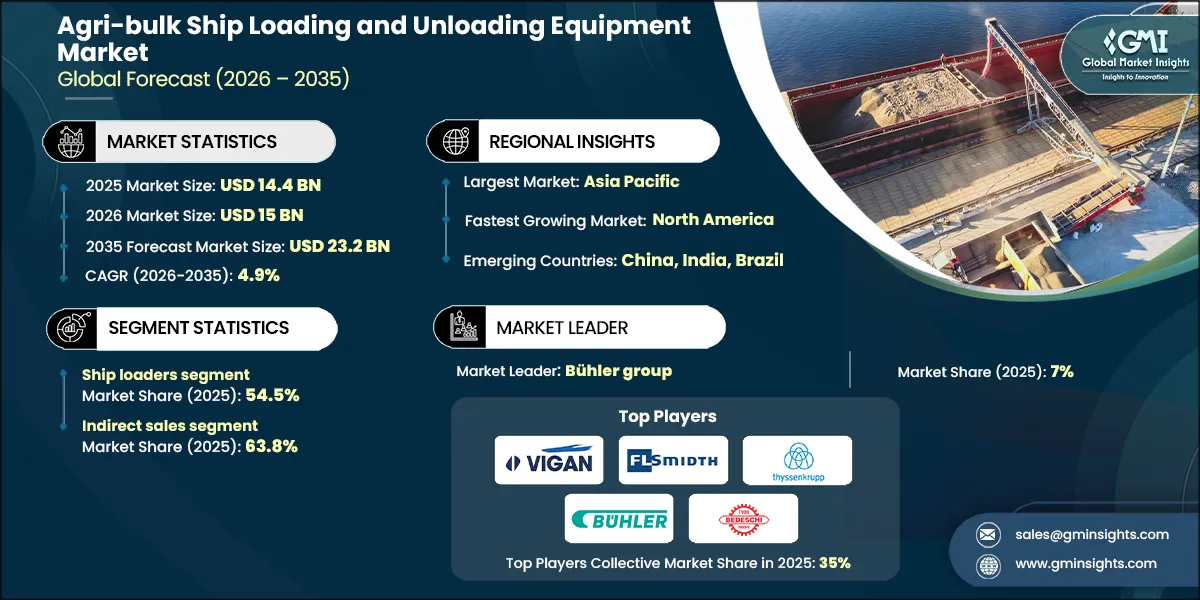
The agri-bulk ship loading and unloading equipment market was estimated at USD 14.4 billion in 2025. The market is expected to grow from USD 15 billion in 2026 to USD 23.2 billion in 2035, at a CAGR of 4.9% according to latest report published by Global Market Insights Inc.
Agri-bulk Ship Loading and Unloading Equipment Market Key Takeaways
Market Size & Growth
- 2025 Market Size: USD 14.4 Billion
- 2026 Market Size: USD 15 Billion
- 2035 Forecast Market Size: USD 23.2 Billion
- CAGR (2026–2035): 4.9%
Regional Dominance
- Largest Market: Asia Pacific
- Fastest Growing Region: North America
Key Market Drivers
- Global food security and grain trade expansion.
- Smart port initiatives and automation.
- Environmental regulations and dust control.
Challenges
- High initial capex and infrastructure costs.
- Complexity of retrofitting existing berths.
Opportunity
- Digital twins and predictive maintenance.
- Digital twins and predictive maintenance.
Key Players
- Market Leader: Bühler group led with over 7% market share in 2025.
- Leading Players: Top 5 players in this market include VIGAN Engineering S.A, FLSmidth, Thyssenkrupp AG, Buhler Group, Bedeschi S.p.a., Bedeschi S.p.a., Bedeschi S.p.a., which collectively held a market share of 35% in 2025.
Get Market Insights & Growth Opportunities
The market for advanced ship loading and unloading systems has expanded because of supply chain sustainability becoming more known and the demand for operational efficiency being market trends that have been intensely stressed. The rise in mergers and acquisitions of industry leaders is claimed to be the main cause of this phenomenon.
The combination of the power forces of major players like Buhler Group, FLSmidth, and Thyssenkrupp AG has led to the increased innovation, expanded product portfolios, and strengthened market presence of the heavyweight maritime bulk handling industry. Meanwhile, conventional methods of manual cargo handling such as grab, based cranes or simple hopper transport are less environmentally friendly and cannot be economically viable for high, volume grain and fertilizer terminals.
Modern continuous ship unloaders (CSUs) are slowly becoming an environmentally friendly method since they have closed, conveyor, dust, suppression technology, and regenerative braking systems that can reduce power consumption by up to 3040%, thus limiting environmental impact. This environmentally friendly technology aligns with the global agricultural trade and food security industries' trend of adopting sustainable practices, thereby becoming the primary factor driving the market's expansion.
The rapid increase in the demand for automated port terminals and heavy, duty agri, logistics hubs can be observed in North America, where the velocity of grain transfers is a prime factor. Furthermore, there is a growing industrial and maritime infrastructure expenditure in Europe and the Asia, Pacific region. A significant shift can be noted in the behavior of grain traders and bulk terminal professionals who are increasingly favoring efficient, mechanized shiploader solutions for high, throughput distribution. As a result, they are phasing out the use of old, time, consuming methods such as manual grab operations or simple gravity, fed chutes.
In most cases, automated pneumatic or mechanical unloading, which enables bulk items to be fulfilled in a continuous, ultra, fast operation, is recognized as a cleaner, faster, and environmentally friendly alternative to traditional diesel, powered mobile transport within facilities. The majority of agri, bulk exporters and third, party logistics (3PL) providers express that they need quicker and less disruptive methods for heavy, load fulfillment. Consequently, the use of mechanical continuous unloaders is gaining momentum as a prevalent decision due to the benefits which are already known, such as the efficiency of berth occupancy and the mitigation of the risk of product degradation resulting from the heavy impact of traditional grabs on delicate crops.
This market is essentially one that is growing as it gets more and more aware of the big benefits of a fully integrated port, silo flow over the long term. This is what is leading to the broader acceptance of these powerful devices. Moreover, the ongoing improvements in the modular boom design will contribute to enhancing the safety and user convenience. The infrastructure support, industry, wide focus on smart port management, and demand for high, efficiency convenience is acting as a synergy.
The Agri, bulk equipment market, is primarily a high, capacity terminal machinery market that will be significantly influenced by a post, pandemic surge in the fulfillment of global food security and global trade. This has caused a demand for the professional and industrial sectors for error, free and high, speed distribution spaces where bulk commodities can be moved quickly. One of the most significant operational differences between traditional transport methods and automated ship unloaders is that the latter perform electrically and automatically while heavy goods are very accurately and effectively handled, thus, handling bottlenecks are eliminated.
In addition to that, data insight generation for terminal optimization is a very felicitous consequence of such effectiveness, and this ensures that the time spent loading and discharging is going the bottom line. Such effectiveness has been embraced by large, scale export terminals and grain milling firms that have a need for a steady and timely supply of the production line.
Continuous Ship Unloaders have been consistently leading in terms of revenue share, thus being the dominant segment in the total market revenue, due to their strength in performance, durability, and compatibility with the modern professional's need for versatility and rapid deployment. Regarding technology, it is gradually becoming a very significant factor, and features such as Internet of Things (IoT) sensors provide a more tailored and accurate material handling experience.
To get key market trends
Agri-bulk Ship Loading and Unloading Equipment Market Trends
The Agri, bulk ship handling industry is witnessing a significant shift of trends due to many new innovative products launched and technological advancements made by the leaders in the industry. These top, tier companies are bringing to the market state, of, the art automated ship loading and high, capacity unloading units that are equipped with attractive features such as smart moisture sensors, ai, driven wear prediction, integrated dust suppression, and high, torque energy, efficient drives.
These improvements are a perfect match for the users who require efficient and easy, to, use solutions for high, throughput maritime logistics and accurate grain or oilseed export manufacturing. The response of the market to these trends shows that the industry is committed to perpetual innovation and, thus, providing the users with advanced tools that raise the performance level, shorten the vessel turnaround and equipment setup times, and make the material handling process more productive and streamlined.
- Technology advancement and product innovation: The machinery is getting more advanced and efficient, which is very clear from the decision to add IoT, enabled remote monitoring and wireless control systems for safety and structural life performance. Companies are investing a lot in the development of more powerful and energy, efficient variable frequency drives (VFDs) as well as the production of durable high, tensile alloy and anti, corrosive stainless-steel components that will increase system uptime and discharge capacity for bulk commodities.
- Expansion of global grain trade and automated terminal services: The international agricultural trade and third, party logistics (3PL) industries were in good shape, and that was the main reason for the market growth. Grain and oil-seed exports together make a very important segment that accounts for nearly 40% of the total ship unloader market share. Therefore, the need for efficient continuous mechanical unloading and pneumatic distribution systems is always increasing due to high, speed vessel fulfillment for bulkier shipments and port, to, silo delivery optimization. This development is leading to the worldwide supply chain expansion as well as regional grain corridors where port authorities are investing heavily in automated high, load maritime infrastructure.
- Sustainable port and environmental management: The correct transport of agri, bulk through closed systems is one of the main reasons for energy conservation and the removal of operational bottlenecks that result mainly from manual grab handling, thus making a significant contribution to the creation of healthier operational ecosystems and facilitating the implementation of green port and warehouse efficiency initiatives. These measures, among them the use of telescopic dust, free chutes to eliminate particulate runoff, are perfectly in line with ESG (Environmental, Social, And Governance) objectives and carbon neutrality programs in different parts of the world.
- Greater incidence of global food supply chain disruptions: Global trade volatility damages global food chains that have become the main reason for local port logistics to focus on resilience and flexibility. Therefore, there is a huge increase in the reconfiguration of modular pneumatic and mechanical ship, to, shore infrastructures. the condition of terminals as being constantly reconfigured and rescaled consequently causes a higher demand for high, capacity ship loaders among agricultural processing hubs, fertilizer plants, and heavy, duty maritime logistics providers.
- Emphasis on industry 4.0 and smart port operations: Terminal managers and maritime planners, as a result of the industry 4.0 focus, are concentrating more on the safety and throughput stability of the automated loading lines by performing proactive maintenance. To achieve this, they carry out equipment health monitoring regularly through predictive diagnostics vibration and motor torque analysis so that they can avoid costly downtime by component failure.
Agri-bulk Ship Loading and Unloading Equipment Market Analysis
Learn more about the key segments shaping this market
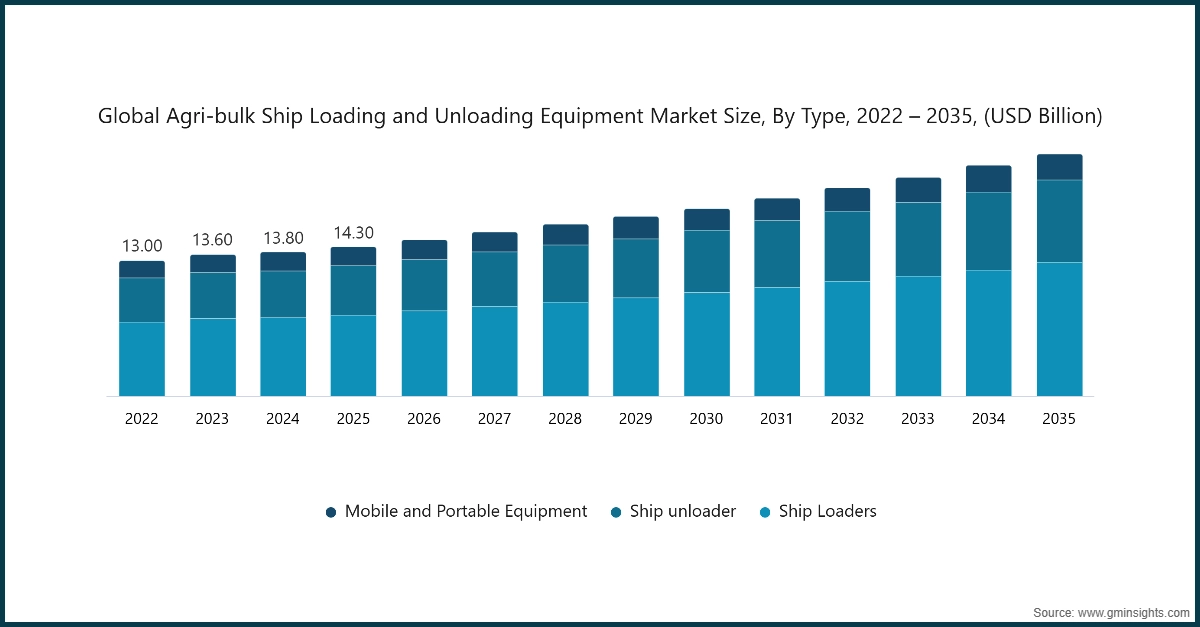
Based on the type, the agri-bulk ship loading and unloading equipment market is segmented into ship loaders, ship unloaders, and mobile and portable equipment. In 2025, the ship loaders segment is projected to hold the largest market share of 54.5%, generating a revenue of USD 7.8 billion.
- Ship loaders offer enhanced productivity, reduced vessel turnaround times, and improved safety. The integration of technologies like telescopic chutes, dust suppression systems, and automated positioning further bolsters their efficiency and reliability.
- The ship loaders segment represents the largest portion of the market, reflecting the industry's shift toward high-capacity export terminals and smart maritime technology that maximizes throughput and minimizes product loss.
- Ship unloader systems maintain a significant market share of approximately 32.8% in 2025, providing essential discharge capabilities for grain, fertilizer, and other bulk commodities at import terminals.
- The mobile and portable equipment segment shows a lower growth rate at 3.2%, as major ports increasingly move toward fixed, high-capacity automated infrastructure to meet the growing demand for faster large-scale maritime operations.
Learn more about the key segments shaping this market
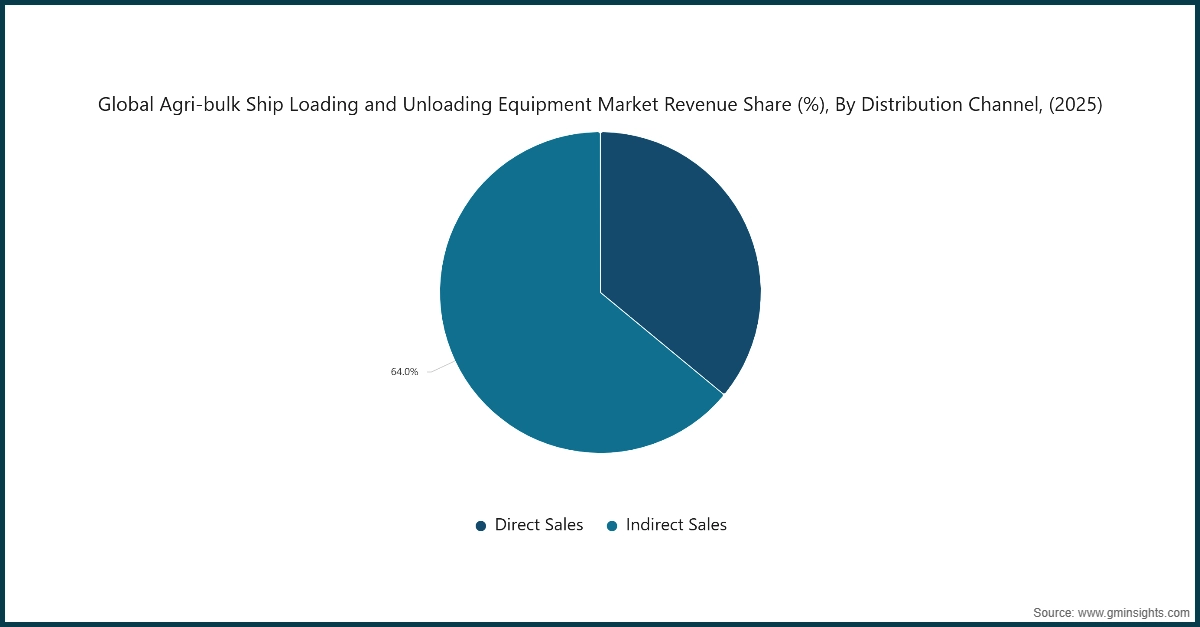
Based on the distribution channel, the agri-bulk ship loading and unloading equipment market is segmented into direct sales and indirect sales. In 2025, indirect sales held the major market share of 63.8%, reflecting the industry’s reliance on specialized engineering distributors and regional port service providers.
- Indirect sales are fueled by the need for localized technical support and aftermarket services. Port operators often prefer these channels for rapid part replacement and on-site maintenance contracts during peak harvest seasons.
- Direct sales generated USD 5.2 billion in 2025. This channel is typically utilized for large-scale, customized infrastructure projects where the manufacturer manages the installation and long-term service directly for major global terminal operators.
- The indirect sales segment also shows a steady CAGR of 5%, as more businesses seek turnkey solutions from specialized integrators to modernize their existing maritime facilities.
North America Agri-bulk Ship Loading and Unloading Equipment Market
Looking for region specific data?
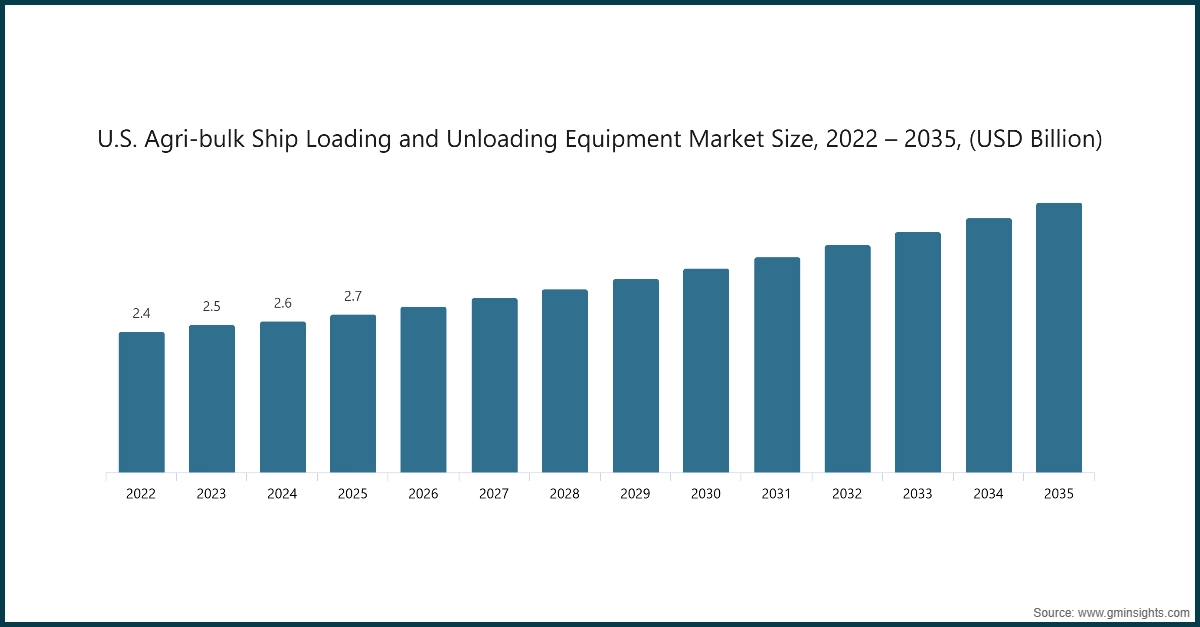
In 2025, North America is a key regional market with an estimated value of USD 4.2 billion and a projected CAGR of 5.3% through 2035.
- The U.S. leads the region, holding a staggering 64.4% of the North American market share in 2025. This is driven by massive investments in grain export terminals and the modernization of maritime logistics networks.
- The demand in this region is further fueled by a focus on environmental compliance and dust control, as companies look to reduce emissions and improve operational efficiency.
- Canada shows steady growth at a 5.1% CAGR, representing a significant market for specialized industrial and agricultural export applications in the Great Lakes and Pacific regions.
Europe Agri-bulk Ship Loading and Unloading Equipment Market
Europe is a significant market estimated at USD 3.4 billion in 2025 with a projected CAGR of 4.5%. Germany leads the region with a growth rate of 5% and a market value of USD 0.8 billion in 2025 due to its advanced machinery sector and strategic port locations.
- Europe is a significant market driven by high-efficiency requirements and environmental standards. The UK follows with a 4.4% CAGR, supported by the modernization of its coastal grain handling infrastructure.
- The German market’s strength is attributed to its advanced engineering and manufacturing sectors, which provide high-tech unloading solutions for regional agricultural trade.
- European growth is increasingly influenced by sustainability initiatives, encouraging the adoption of enclosed, energy-efficient loading systems that align with regional environmental regulations
Asia Pacific Agri-bulk Ship Loading and Unloading Equipment Market
Asia Pacific is the largest and fastest-growing regional market with a projected CAGR of 5.3% through 2035.
- China holds the largest market share with a high growth rate of 5.9% driven by massive port infrastructure projects and increasing food import requirements.
- India is a key player with a 5.1% CAGR, as terminal operators in the region rapidly shift from manual grab systems to automated continuous ship unloaders to increase port efficiency.
- Countries like Japan and South Korea are important for high-tech maritime logistics, where precision material handling and high-speed discharge are required for bulk food commodities
Latin America Agri-bulk Ship Loading and Unloading Equipment Market
Latin America represents a developing segment expected to reach USD 1.2 billion by 2025, growing at a rate of 4.7% through 2035.
- Overall growth is steady as increasing agricultural exports and a growing terminal sector boosts the demand for professional maritime handling services.
- Brazil shows a steady growth rate of 5.0%, benefiting from its role as a global agricultural powerhouse and a leading exporter of soy and corn.
- Mexico shows a growth rate of 4.8%, as the country invests in expanding its port capacities to improve regional competitiveness in global agricultural trade.
Agri-bulk Ship Loading and Unloading Equipment Market Share
Bühler group is leading with a 7% market share. Buhler Group, FLSmidth, Thyssenkrupp AG, Bedeschi S.p.a. and VIGAN Engineering S.A. collectively hold around 35%, indicating a moderately fragmented market concentration with a strong tier of dominant global players. These prominent players are proactively involved in strategic endeavors, such as mergers & acquisitions, facility expansions, and collaborations, to expand their product portfolios, extend their reach to a broad customer base, and strengthen their market position.
- VIGAN Engineering S.A. completed a significant expansion of its Nivelles production facility to double its manufacturing capacity for pneumatic ship unloaders. This strategic move significantly expanded VIGAN’s footprint in the global Agri-bulk terminal sector, specifically enhancing its portfolio of high-capacity NIV 800 continuous ship unloaders. The expansion allowed VIGAN to integrate more advanced steering systems and turbine technologies, reinforcing its commitment to performance, durability, and dust-free handling. The company emphasized that this growth provides a broader range of future-oriented, modular unloading solutions to help port operators tackle evolving maritime logistics challenges.
- FLSmidth unveiled an array of new digital monitoring attachments for its heavy-duty continuous ship loaders catering to the grain, fertilizer, and bulk commodity applications where enclosed conveyors are prevalent. The additions included the latest Mission Zero monitoring tool, a sensor-based system capable of measuring material flow and dust emissions in real-time. This technology features smart sensors for improved visibility into boom health and robust durability for corrosive marine environments. The company highlighted its commitment to enhancing material handling performance by providing operators with a comprehensive set of digital tools for predictive maintenance to prevent structural fatigue and boom failure.
Agri-bulk Ship Loading and Unloading Equipment Market Companies
Major players operating in the agri-bulk ship loading and unloading equipment industry are:
- AGI (Ag Growth International)
- AUMUND Group
- Bedeschi S.p.a.
- Buhler Group
- Cargotec (MacGregor)
- Ems-tech Inc.
- FLSmidth
- Konecranes
- Liebherr-International AG
- NEUERO Industrietechnik GmbH
- PNM Bulk Handling
- Siwertell AB
- Thyssenkrupp AG
- VIGAN Engineering S.A.
- WAMGROUP S.p.A.
VIGAN Engineering S.A. expanded its range of modular ship unloading platforms with the introduction of the NIV 800 series, a system compatible with high-speed automated terminals. engineered for optimal productivity and precise control, this turbine-driven platform offered faster operation compared to older grab cranes or traditional screw unloader designs. Unveiled at global port and terminal exhibitions in 2025, its "smart-flow" function improved control for diverse grain types by using decentralized logic rather than complex manual adjustments. The design's advantage lies in providing better dust containment and eliminating the need for constant operator intervention during peak harvest arrival hours.
Agri-bulk Ship Loading and Unloading Equipment Market Report Attributes
| Key Takeaway | Details |
|---|---|
| Market Size & Growth | |
| Base Year | 2025 |
| Market Size in 2025 | USD 14.4 Billion |
| Market Size in 2026 | USD 15 Billion |
| Forecast Period 2026-2035 CAGR | 4.9% |
| Market Size in 2035 | USD 23.2 Billion |
| Key Market Trends | |
| Drivers | Impact |
| Global food security and grain trade expansion | The rising demand for staple crops and efficient international food corridors requires high-capacity, automated ship loading and unloading. This drives massive demand for continuous mechanical and pneumatic systems in deep-water terminals. |
| Smart port initiatives and automation | Transitioning to fully automated bulk terminals necessitates ship loaders that can synchronize with silo management systems and automated stacking cranes, boosting sales of intelligent, sensor-equipped handling systems. |
| Environmental regulations and dust control | Global maritime regulations and port authorities push companies toward enclosed conveyor systems and advanced dust suppression technologies that reduce airborne particulate matter and product spillage by up to 80%. |
| Pitfalls & Challenges | Impact |
| High initial capex and infrastructure costs | The significant upfront cost for heavy-duty ship-to-shore equipment and the required quay reinforcement acts as a barrier for smaller port operators, often delaying terminal upgrades or resulting in phased implementations. |
| Complexity of retrofitting existing berths | Integrating modern, high-capacity continuous unloaders into older, constrained pier infrastructures often leads to high engineering costs, berth downtime, and structural compatibility issues. |
| Opportunities: | Impact |
| Digital twins and predictive maintenance | Utilizing ai-driven sensors to monitor arm tension, bearing health, and motor temperature reduces unplanned vessel delays by ~30% and opens new revenue streams for remote diagnostic services. |
| Digital twins and predictive maintenance | The rise of secondary ports and seasonal grain hubs creates a need for mobile ship unloaders and flexible harbor equipment that can be reconfigured or moved between different berths. |
| Market Leaders (2025) | |
| Market Leader |
Market share 7% |
| Top Players |
Collective market share around 35% |
| Competitive Edge |
|
| Regional Insights | |
| Largest Market | Asia Pacific |
| Fastest growing market | North America |
| Emerging countries | China, India, Brazil |
| Future outlook |
|
What are the growth opportunities in this market?
Agri-bulk Ship Loading and Unloading Equipment Industry News
- In November 2025, Bühler Group announced a significant business integration with regional engineering partners in Brazil to strengthen its market share in high-performance port terminals. earlier in the year, Bühler also expanded its Southeast Asian manufacturing base by upgrading facilities in Vietnam, specializing in heavy-duty Portalink ship unloaders. These moves aim to accelerate the development of energy-efficient and low-maintenance unloading systems for the global food security era.
- In July 2025, Bedeschi S.p.a. successfully discharged a nearly 700-ton ship unloader at a client's quay, entering the final testing phase before commissioning. in March 2025, the company showcased its latest mobile ship loaders on pneumatic tires at international trade fairs, featuring Eco-hopper and telescopic boom systems. These systems are designed to minimize berth occupancy time and maximize throughput for multi-user terminals, addressing the industry's need for rapid terminal reconfiguration without massive capital overhead.
- In February 2025, FLSmidth announced a significant expansion of its global service center network, including new or expanded facilities in Brazil, Australia, and Saudi Arabia. This facility expansion focuses on providing wear-resistant components and digital monitoring kits for heavy-duty grain loaders and fertilizer handling systems. the expansion is a key part of FLSmidth's CORE'26 strategy to shorten lead times and provide locally engineered solutions for the North American and Global agri-logistics markets.
- In September 2024, NEUERO Industrietechnik introduced the redesigned Multiport ship unloader, tailored for high-volume grain logistics. This new iteration boasted robust performance in suction capacity, utilizing a high-efficiency electric blower and a multi-stage filter system for aggressive intake of diverse seed types. operating at significantly reduced noise levels, the Multiport addressed the needs of port professionals aiming to broaden their discharge capacity in urban-adjacent terminals. The company emphasized its versatility in modern high-speed maritime distribution environments.
- In 2024, Thyssenkrupp AG continued to emphasize its powerful heavy-duty ship loader models, such as the shuttle-type series, which uses a high-performance enclosed design to enhance performance in bulk export. This focuses on meeting strict international environmental standards while providing the flexibility required for rapid vessel changeovers without the need for complex structural modifications or constant manual cleanup.
The agri-bulk ship loading and unloading equipment market research report includes in-depth coverage of the industry with estimates & forecasts in terms of revenue (USD Billion) and volume (Thousand Units) from 2022 to 2035, for the following segments:
Market, By Type
- Ship loaders
- Ship unloader
- Mobile and portable equipment
Market, By Distribution Channel
- Direct sales
- Indirect sales
The above information is provided for the following regions and countries:
- North America
- U.S.
- Canada
- Europe
- Germany
- UK
- France
- Italy
- Spain
- Asia Pacific
- China
- India
- Japan
- Australia
- South Korea
- Latin America
- Brazil
- Mexico
- Argentina
- Middle East and Africa
- South Africa
- Saudi Arabia
- UAE
Frequently Asked Question(FAQ) :
What is the market size of the agri-bulk ship loading and unloading equipment in 2025?
What is the market size of the agri-bulk ship loading and unloading equipment in 2025?The market size was estimated at USD 14.4 billion in 2025, with a CAGR of 4.9% expected through 2035. The growth is driven by increasing demand for advanced systems, supply chain sustainability, and operational efficiency.
What is the projected value of the agri-bulk ship loading and unloading equipment market by 2035?
The market is poised to reach USD 23.2 billion by 2035, fueled by technological advancements, automation, and the expansion of global grain trade.
What is the expected size of the agri-bulk ship loading and unloading equipment industry in 2026?
The market size is projected to reach USD 15 billion in 2026.
How much revenue did the ship loaders segment generate in 2025?
The ship loaders segment generated approximately USD 7.8 billion in 2025, dominating the market with a 54.5% share.
What was the valuation of the indirect sales segment in 2025?
Indirect sales accounted for 63.8% of the market share in 2025, reflecting the industry's reliance on specialized engineering distributors and regional port service providers.
What is the growth outlook for the North American market through 2035?
North America, a key regional market, was valued at USD 4.2 billion in 2025 and is set to grow at a CAGR of 5.3% through 2035.
What are the upcoming trends in the agri-bulk ship loading and unloading equipment market?
IoT-based remote monitoring, AI-driven wear prediction, automated high-capacity unloading, sustainable port management, and Industry 4.0 practices like predictive diagnostics and smart port operations.
Who are the key players in the agri-bulk ship loading and unloading equipment industry?
Key players include AGI (Ag Growth International), AUMUND Group, Bedeschi S.p.a., Buhler Group, Cargotec (MacGregor), Ems-tech Inc., FLSmidth, Konecranes, Liebherr-International AG, NEUERO Industrietechnik GmbH, and PNM Bulk Handling.
Agri-bulk Ship Loading and Unloading Equipment Market Scope
Related Reports