Summary
Table of Content

Africa Electrostatic Precipitator Market
Get a free sample of this report
Form submitted successfully!
Error submitting form. Please try again.
Thank you!
Your inquiry has been received. Our team will reach out to you with the required details via email. To ensure that you don't miss their response, kindly remember to check your spam folder as well!
Request Sectional Data
Thank you!
Your inquiry has been received. Our team will reach out to you with the required details via email. To ensure that you don't miss their response, kindly remember to check your spam folder as well!
Form submitted successfully!
Error submitting form. Please try again.
Africa Electrostatic Precipitator Market Size
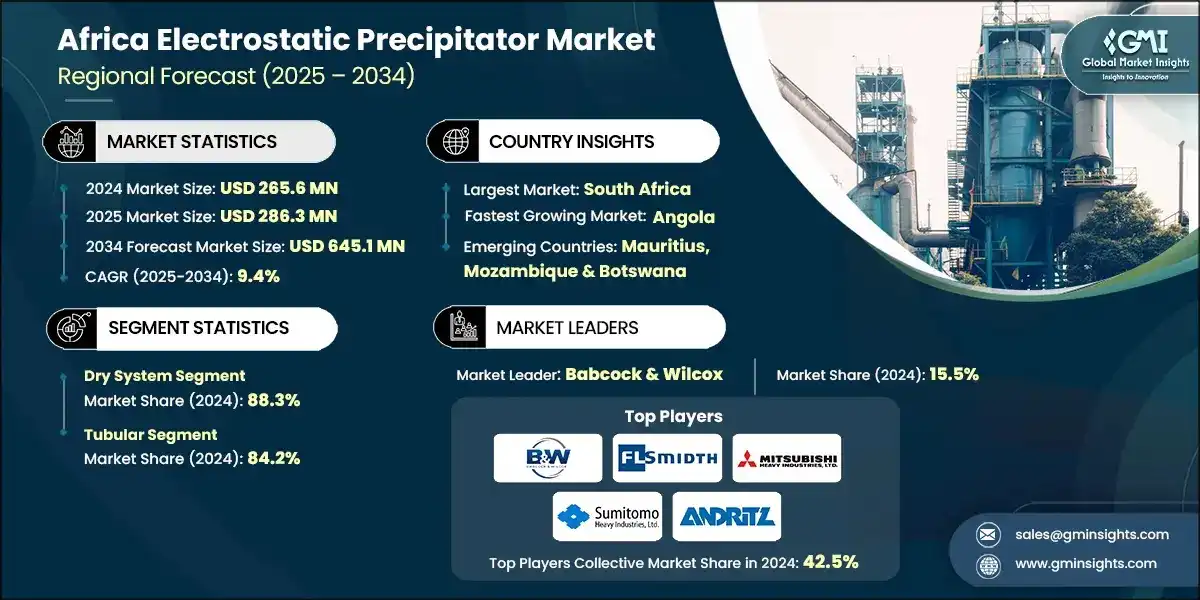
The Africa electrostatic precipitator market was estimated at USD 265.6 million in 2024. The market is expected to grow from USD 286.3 million in 2025 to USD 645.1 million in 2034, at a CAGR of 9.4%, according to Global Market Insights Inc.
To get key market trends
- Rising introduction of stringent norms & regulations to control industrial pollution by the African government is set to stimulate the industry landscape. Authorities, including EPA and IMO, are responsible for supervising numerous programs designed to promote air quality, sustainable growth, energy efficiency, and pollution prevention; thereby accelerating the adoption of ESPs.
- An electrostatic precipitator (ESP) is a device that uses electrical forces to remove particulate matter, such as dust and smoke, from a gas stream. It works by applying a high-voltage charge to ionize particles, which are then attracted to and collected on oppositely charged plates. This highly efficient air pollution control technology is widely used in industries to capture emissions before they are released into the atmosphere.
- Ongoing modernization of the existing equipment, along with continuous industrialization across the emerging economies, will fuel the business growth. Government mandates to reduce air pollution will encourage the retrofitting & upgrading of existing systems to adhere to the underlying directives. For instance, in Egypt, Environmental Law 4 of 1994 (amended by Law 9 of 2009 and Law 105 of 2015) mandates existing industrial plants to control air emissions and regularly monitor compliance.
- The Africa electrostatic precipitator market was valued at USD 210.9 million in 2021 and grow at a CAGR of 8% through 2024. The shifting focus of key industry players toward introducing advanced systems & solutions to comply with stringent regulatory guidelines, coupled with a positive outlook on adopting emission control systems across various industries, will drive business growth. Additionally, ageing power plants, performance degradations, rising maintenance costs, reduced reliability, and strict focus on emission compliance are the key underlined parameters that will stimulate the product penetration.
- South Africa is among the dominant countries, primarily driven by increasing demand for air pollution control in power generation and heavy industries. The country’s reliance on coal-fired power plants and industrial operations has led to heightened regulatory pressure to reduce particulate emissions, boosting ESP deployment to meet environmental standards and improve operational efficiency in sectors such as cement, steel, and petrochemicals.
- Key players' growing expansion in the developing countries will bolster the business scenario. In August 2022, Babcock & Wilcox secured a contract to supply 24 electrostatic precipitators for an African power plant, supporting emission reduction. The deal strengthens its African market presence and expands its electrostatic precipitator portfolio. Additionally, many African countries face chronic water scarcity, making dry pollution control technologies a sustainable alternative for emission control in arid and semi-arid regions. Their low water footprint aligns with national strategies for water conservation and sustainable industrial development.
- Mauritius is the fastest-growing region in the market. Rising country commitment to reducing their greenhouse gas emissions under its Nationally Determined Contributions (NDCs) is encouraging the adoption of cleaner technologies, including ESPs, to reduce particulate emissions from combustion processes. The government's green economy push, backed by climate finance and policy incentives, positions ESPs as viable solutions for industries such as sugar milling, energy generation, and cement manufacturing, aligning with sustainable development goals.
Africa Electrostatic Precipitator Market Report Attributes
| Key Takeaway | Details |
|---|---|
| Market Size & Growth | |
| Base Year | 2024 |
| Market Size in 2024 | USD 265.6 Million |
| Market Size in 2025 | USD 286.3 Million |
| Forecast Period 2025 - 2034 CAGR | 9.4% |
| Market Size in 2034 | USD 645.1 Million |
| Key Market Trends | |
| Drivers | Impact |
| Rising industrial emissions from the power and manufacturing sectors | The growth of coal-based power and industrialization increases particulate emissions, driving a stronger demand for ESP installation and adoption. |
| Stringent government regulations on air quality | Enforcement of emission standards for SOx and PM compels industries to adopt ESP systems, thereby strengthening compliance and driving market growth. |
| Pitfalls & Challenges | Impact |
| High capital and maintenance costs | Elevated initial investment and operational expenses restrict the adoption of ESPs, especially among small-scale industries in cost-effective African markets. |
| Limited technical expertise and infrastructure | Lack of skilled workforce and weak maintenance infrastructure hampers ESP efficiency, reducing adoption rates across developing African regions. |
| Opportunities: | Impact |
| Adoption of cleaner coal technologies in a power plant | Integration of ESPs with advanced coal technologies enhances emission control, creating growth opportunities in Africas expanding power generation sector. |
| Growing investments in industrial infrastructure development | The rising establishment of cement, steel and petrochemical plants across Africa fuels demand for ESPs, ensuring compliance and environmental sustainability. |
| Market Leaders (2024) | |
| Market Leaders |
15.5% |
| Top Players |
Collective market share in 2024 is 42.5% |
| Competitive Edge |
|
| Regional Insights | |
| Largest Market | South Africa |
| Fastest Growing Market | Angola |
| Emerging Country | Mauritius, Mozambique & Botswana |
| Future Outlook |
|
What are the growth opportunities in this market?
Africa Electrostatic Precipitator Market Trends
- Increasing development of advanced technologies and system designs delivering state-of-the-art solutions across a wide variety of applications will augment the business landscape. For instance, in July 2021, Durr Group introduced the next-generation Wet Electrostatic Precipitator. Depending on the gas stream's characteristics, Dürr Megtec's WESPs can eliminate as much as 98% of particulates in just one stage. Alternative configurations can further boost this removal efficiency. In addition, rising inclination to adopt customized & optimized performance systems will stimulate the product adoption.
- Growing number of retrofitting & development activities to increase reliability as well as enhance the efficiency of conventional power plants will favor the business scenario. In coal-heavy countries, including South Africa, Botswana and Zambia, upgradation of ageing ESP fleets and power-supply retrofits will increase the aftermarket demand. Similarly, in cement-heavy or stringent regulatory markets comprising Angola, Egypt and parts of Nigeria, ongoing greenfield projects will create further retrofit opportunities.
- Increasing health risks from air pollution, particularly from fine particulate matter (PM2.5 and PM10), sulfur dioxide (SO2), and nitrogen oxides (NOx), will enhance the demand for advanced pollution control technologies, including ESP. For instance, as per the World Health Organization (WHO) estimates that air pollution causes around 7 million premature deaths annually, prompting stricter regulations and thereby boosting product growth as an essential solution for air pollution emitted from various industries.
- Increasing electricity demand from emerging economies on account of rapid urbanization & industrialization will intensify the establishment of power plants, increasing the product adoption. Growing energy demand & rising emission levels from various sectors has driven policymakers to adopt pollution control solutions across several industrial applications, which will positively impact the adoption of ESPs in the coming years. Growing utilization of industrial power projects with hybrid systems, as regulators tighten enforcement around Lagos and other industrial hubs, will augment the market growth.
- Additionally, key players’ rising efforts in bringing an advanced product line will foster the future projections. For instance, in July 2025, Lesedi Engineering successfully finalized the detailed design of a cutting-edge ESP system for a gold processing plant located in West Africa. This high-performance, five-field ESP is specifically engineered to capture and recover up to 99.8% of gold dust that would otherwise be lost through exhaust emissions during routine operations. Moreover, the ongoing expansion of manufacturing, mining, and energy sectors across the region drives the increasing demand for air pollution control technologies.
Africa Electrostatic Precipitator Market Analysis
Learn more about the key segments shaping this market
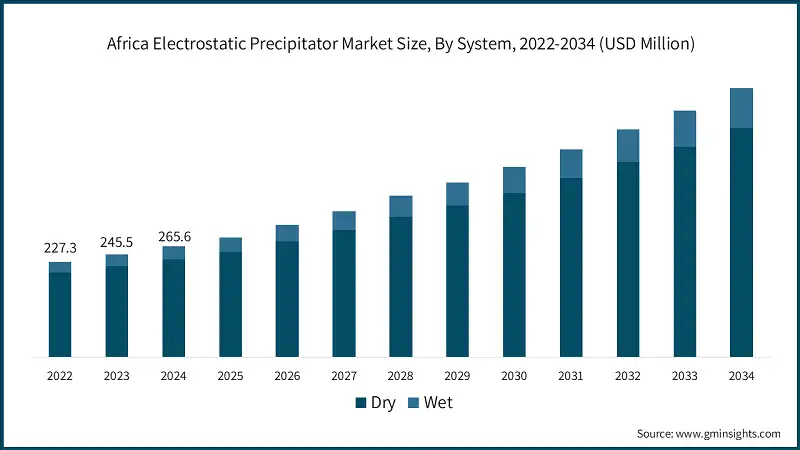
Based on the system, the industry is segmented into wet and dry. The dry system dominated the Africa electrostatic precipitator market, accounting for 88.3% in 2024 and is expected to grow at a CAGR of 9% through 2034.
- Rising focus to align with global environmental standards is encouraging the region to enforce stricter air quality regulations. This regulatory pressure is causing industries to seek more advanced emission control technologies, leading to the uplift dry systems adoption. These systems are becoming essential in the region’s industrial landscape as they effectively manage sticky, corrosive, and high-moisture particulate emissions that traditional systems struggle to handle.
- The wet system market will grow at a CAGR of 12.2% by 2034. Growing strict environmental regulations and increasing awareness of air quality standards are the primary drivers for dry electrostatic precipitators. Governments in South Africa, Nigeria, and Egypt have intensified enforcement of particulate emission norms, especially targeting PM2.5 and PM10 pollutants. For instance, in 2024, South Africa’s Department of Environmental Affairs mandates emission limits for coal-fired power plants, prompting utilities such as Eskom to retrofit aging infrastructure with dry ESPs, thereby improving the Africa electrostatic precipitator market outlook.
- Continuous carbon emissions from steel, cement, and power plants encourage industries across the region to shift toward carbon-neutral technologies, will boost the industry growth. Growing initiatives aimed at motivating steel mills to reduce their carbon emissions will propel the system adoption. Furthermore, dry ESPs are being adopted as a cost-effective and efficient solution for capturing dust and particulates from flue gases. Their ability to operate in high-temperature, dry environments makes them ideal for African industrial conditions.
Learn more about the key segments shaping this market
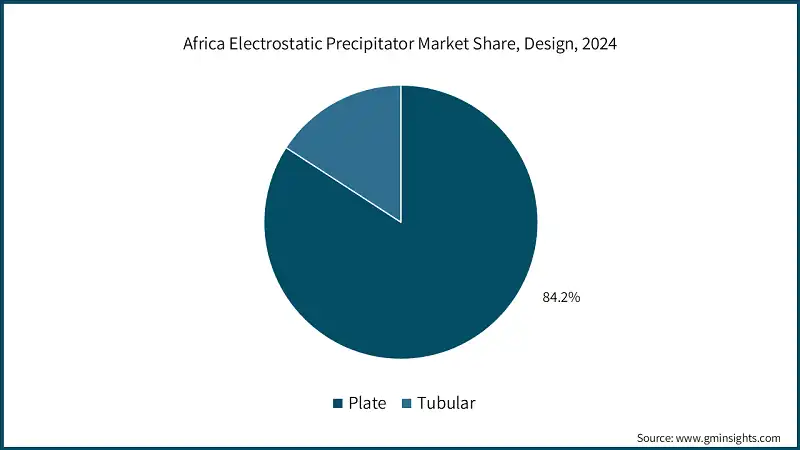
Based on design, the Africa electrostatic precipitator market is segmented into plate and tubular. The tubular dominates the market with an 84.2% share in 2024, and the segment is expected to grow at a CAGR of 9.3% from 2025 to 2034.
- Increasing plate design’s scalability, high efficiency, and adaptability in various industrial applications are making it a preferred choice across Africa. These designs are particularly favored in large-scale operations where parallel flow lanes are essential for handling high volumes of particulate-laden exhaust gases. Plate design allows for multiple collection lanes, which enhances throughput and makes them suitable for continuous, high-load operations, uplifting the business statistics.
- Technological advancements in the product offering and services are further boosting the appeal of plate ESPs in recent years. Companies such as Siemens and Thermax have presented smart ESP plate designs with real-time monitoring and automated rapping mechanisms that improve dust collection and reduce maintenance downtime. These innovations are particularly beneficial in African industries where operational efficiency and cost-effectiveness are critical.
- The Africa electrostatic precipitator market from tubular segment is set to grow at a CAGR of 10.2% by 2034. Rising shift to adopt mist control solutions across the chemical, steel, paper & pulp, marine, and other manufacturing industries will positively impact the adoption of cost-effective solutions. Tubular ESPs potential to remove sticky or wet materials and deliver reduced re-entrainment losses and material leakages, influencing the product demand.
- Growing companies' efforts to comply with government regulations will foster the design adoption. For instance, GEECOM provides Electrostatic Precipitator solutions to support organizations in Southern Africa's mining and other sectors in achieving compliance with air emission regulations. These solutions ensure adherence to legal thresholds, such as those outlined in South Africa's National Environmental Management: Air Quality Act, 2004 (Act No. 39 of 2004), thereby promoting sustainable and environmentally responsible operations.
Looking for region specific data?
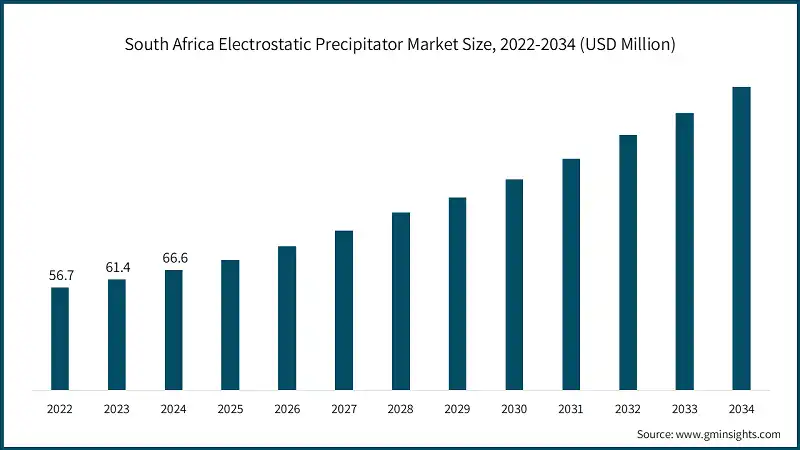
- South Africa dominated the electrostatic precipitator market with around 25.1% share in 2024 and is expected to generate over USD 167 million in revenue by 2034. Growing demand from both local and international investors for robust ESG performance, particularly among companies listed on the Johannesburg Stock Exchange (JSE), is a powerful driver for sustainability initiatives. Strong ESG profile, including proactive investment in emissions reduction through environmental sustainability projects, has become a prerequisite for attracting capital.
- Additionally, South Africa’s carbon tax regime imposes financial penalties on high-emitting operations, creating a direct economic incentive for companies to enhance energy efficiency and reduce pollution, leading to propel ESP penetration.
- In Egypt electrostatic precipitator market is anticipated to grow over USD 102 million by 2034. The country has set various emission-related regulatory standards over the past decade. For instance, the EEAA and its regulations, such as Environmental Law No. 4 of 1994 and its amendments, set progressively stricter standards for industrial emissions, particularly for particulate matter. This regulatory push, along with the government's broader sustainable development strategy (Egypt Vision 2030), incentivizes sectors including cement, manufacturing, and metallurgy to adopt advanced pollution control technologies, creating growth prospects for ESP market.
- Zambia is set to grow at a CAGR of 6.8% by 2034. Expanding copper mining, concentrated in the Copperbelt Province, is a major driver for Zambia's economic growth. Mining and smelting operations emit substantial amounts of particulate matter (PM2.5, PM10) and sulphur dioxide (SO2), frequently exceeding standards in mining towns such as Mufulira. While smelter modernization has reduced SO2 emissions, controlling particulate matter remains challenging. This creates ESPs' demand to capture fine particulate matter, helping minimize the environmental impact of mining activities, leading to boosting the business growth.
- Botswana market is expected to be valued at USD 9.8 million by 2034. The country’s reliance on coal-fired power generation, which produces significant particulate emissions, is a key driver for ESP growth. The product effectively controls dust from boilers and flue gases, ensuring compliance with environmental requirements and improving air quality. Additionally, the growing cement industry and related construction activities, supported by infrastructure development, further bolster the product growth. ESP offers a cost-effective and durable solution to reduce the large volume of dust produced by cement plants, leading to drive the industry projections.
Africa Electrostatic Precipitator Market Share
- The top 5 companies, including Babcock & Wilcox, FLSmidth, Mitsubishi Heavy Industries, Sumitomo Heavy Industries and ANDRITZ GROUP, account for around 42.5% market share. Multinational corporations, including Babcock & Wilcox and FLSmidth, are establishing local offices and manufacturing facilities, particularly in industrial hubs such as South Africa, to be closer to customers, reduce delivery times, and provide dedicated local support. They are leveraging their global expertise to offer high-efficiency, reliable, and often retrofit solutions that help African industries, especially in power generation and mining, comply with increasingly strict emission regulations.
- Furthermore, companies are pursuing strategic alliances to broaden their market reach and leverage local expertise to navigate regional challenges. This approach allows them to address both industrial growth and environmental compliance needs across the continent.
- Instead of focusing solely on new equipment sales, companies are offering comprehensive retrofit and upgrade services for existing ESPs. Many aging industrial facilities in Africa, particularly in the power, cement, and mining sectors, operate with older pollution control systems. By offering retrofits, players are providing a cost-effective path to regulatory compliance and improved performance, avoiding the need for complete system replacement.
- Additionally, new players in the African market are prioritizing a robust after-sales support system, emphasizing comprehensive training and maintenance. Such reliable service is pivotal, ensuring optimal equipment performance and uptime, both vital for industrial operations. By offering local training, these players not only bridge the skills gap but also fortify customer relationships and establish a dependable service network.
Africa Electrostatic Precipitator Market Companies
Eminent players operating in the Africa electrostatic precipitator industry are:
- Alstom
- Actom
- ANDRITZ GROUP
- Babcock and Wilcox Enterprises
- DGC AFRICA
- DUCON
- DURR Group
- DURAG Group
- Enviropol Engineers
- FLSmidth
- GEA Group
- GEECOM
- Hamon
- Hitachi
- Intensiv-Filter Himenviro
- J&C Engineering (Pty) Ltd
- KC Cottrell
- Lesedi
- Mitsubishi Heavy Industries
- Morobi GEECO Power (Pty) Ltd
- Redecam
- Scheuch GmbH
- Siemens Energy
- Sumitomo Heavy Industries
- Thermax
- Valmet
- Wood Plc
- Babcock & Wilcox, offers high-efficiency, reliable ESPs, drawing on a long history of expertise in environmental and energy products. The company focuses on upgrades and retrofit services, leveraging strong after-sales support and advanced control technologies to maintain peak performance for industrial customers across Africa.
- FLSmidth provides highly efficient ESP solutions with a low total cost of ownership, focusing on key industrial sectors such as mining and cement. Its strategy includes offering compact, modular designs and retrofit services to meet stringent emission limits effectively and affordably.
- Mitsubishi Heavy Industries delivers high-performance ESPs, including specialized designs like wet ESPs and Moving Electrode Type ESPs for challenging applications such as high-resistivity dust. MHI leverages its broad industrial background to offer diverse, reliable air pollution control solutions.
- Sumitomo Heavy Industries, offers highly efficient ESPs, utilizing pulse charging for difficult-to-collect dust. Provides comprehensive service offerings, including diagnosis, maintenance, and modification, for industrial facilities like power plants and steel mills.
- ANDRITZ GROUP supplies robust and reliable dry and wet ESP designs for power generation and industrial applications. It emphasizes energy efficiency through technologies including Switched Integrated Rectifiers and provides comprehensive service and retrofit capabilities.
Africa Electrostatic Precipitator Industry News:
- In May 2022, Valmet unveiled a cutting-edge Wet Electrostatic Precipitator (WESP) designed specifically for the marine industry, aiming to significantly enhance emission control capabilities. This innovative solution surpasses the global standards set by the International Maritime Organization (IMO) in 2020, by enabling the effective removal of harmful particulate matter, including black carbon, heavy metals, acid mist, oil mist, and visible plumes from ship exhaust gases.
- In January 2021, GEECOM’s Electrostatic Precipitator solutions were introduced for the mining and industrial organizations across Southern Africa to meet national air emission standards, ensuring their operations remain compliant with environmental regulations
The Africa electrostatic precipitator market research report includes an in-depth coverage of the industry with estimates & forecast in terms of revenue in “(USD Million)” from 2021 to 2034, for the following segments:
Market, By System
- Wet
- Dry
Market, By Design
- Plate
- Tubular
Market, By Emitting Industry
- Power generation
- Chemicals and petrochemicals
- Cement
- Metal processing & mining
- Manufacturing
- Marine
- Others
The above information has been provided for the following countries:
- Botswana
- Nigeria
- Egypt
- South Africa
- Angola
- Mozambique
- Mauritius
- Zambia
Frequently Asked Question(FAQ) :
Who are the key players in the Africa electrostatic precipitator industry?
Key players include Alstom, Actom, ANDRITZ GROUP, Babcock and Wilcox Enterprises, DGC AFRICA, DUCON, DURR Group, DURAG Group, Enviropol Engineers, FLSmidth, GEA Group, GEECOM, and Hamon.
Which country dominated the Africa electrostatic precipitator sector?
South Africa led the market with a 25.1% share in 2024 and is expected to generate over USD 167 million in revenue by 2034.
What are the key trends in the Africa electrostatic precipitator market?
Trends include ESP advancements, power plant retrofitting, air pollution concerns, rising electricity demand, and customized high-performance systems.
What was the market share of the tubular segment in 2024?
The tubular segment held an 84.2% share in 2024 and is anticipated to expand at a CAGR of 9.3% from 2025 to 2034.
How much revenue did the dry system segment generate in 2024?
The dry system segment accounted for 88.3% of the market in 2024 and is expected to witness over 9% CAGR through 2034.
What is the expected size of the Africa electrostatic precipitator market in 2025?
The market size is projected to reach USD 286.3 million in 2025.
What is the projected value of the Africa electrostatic precipitator market by 2034?
The market is poised to reach USD 645.1 million by 2034, fueled by retrofitting activities, increasing electricity demand, and advancements in ESP technologies.
What is the market size of the Africa electrostatic precipitator in 2024?
The market size was USD 265.6 million in 2024, with a CAGR of 9.4% expected through 2034. The growth is driven by stringent regulations to control industrial pollution and the adoption of advanced pollution control technologies.
Africa Electrostatic Precipitator Market Scope
Related Reports