Summary
Table of Content

Aerosol Market
Get a free sample of this report
Form submitted successfully!
Error submitting form. Please try again.
Thank you!
Your inquiry has been received. Our team will reach out to you with the required details via email. To ensure that you don't miss their response, kindly remember to check your spam folder as well!
Request Sectional Data
Thank you!
Your inquiry has been received. Our team will reach out to you with the required details via email. To ensure that you don't miss their response, kindly remember to check your spam folder as well!
Form submitted successfully!
Error submitting form. Please try again.
Aerosol Market Size
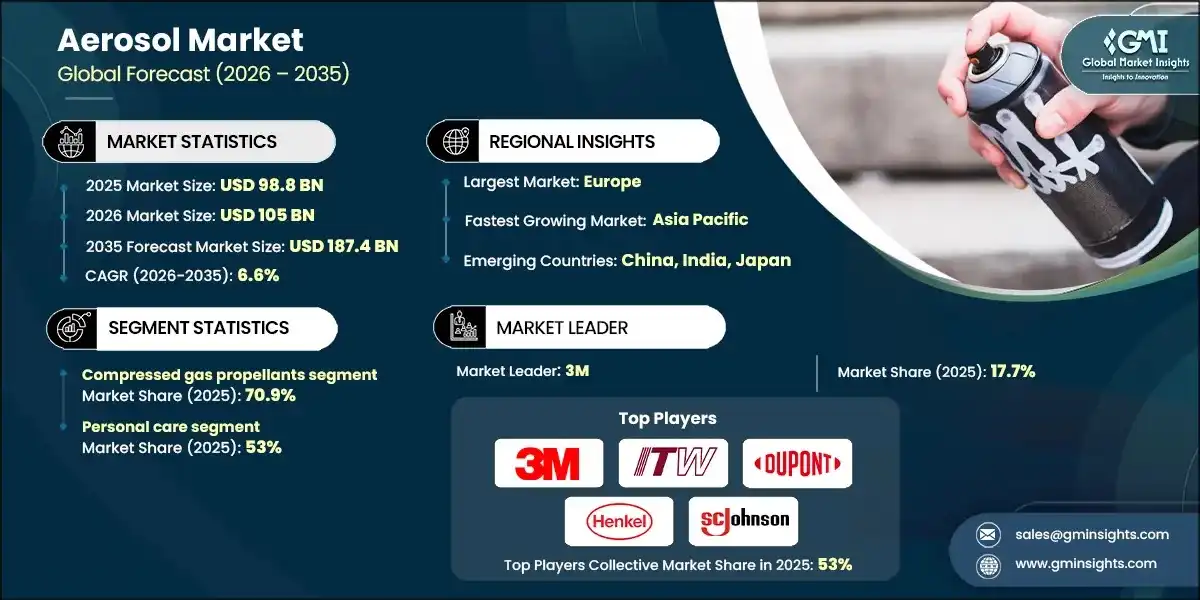
The global aerosol market was valued at USD 98.8 billion in 2025 and is poised to expand from USD 105 billion in 2026 to USD 187.4 billion by 2035, reflecting a 6.6% CAGR over 2026 to 2035 according to the latest report published by Global Market Insights Inc.
Aerosol Market Key Takeaways
Market Size & Growth
- 2025 Market Size: USD 98.8 Billion
- 2026 Market Size: USD 105 Billion
- 2035 Forecast Market Size: USD 187.4 Billion
- CAGR (2026–2035): 6.6%
Key Market Drivers
- Surge in Demand for Dry Shampoo & Personal Care Sprays.
- Growth in Automotive & Industrial Maintenance.
- Regulatory Push for VOC Reduction.
Challenges
- Compliance with Evolving Environmental Norms.
- Supply Chain Volatility in Metal Packaging.
Opportunity
- Refillable, low-VOC systems and BoV drive premiumization and compliance.
Key Players
- Leading Players: Top 5 players in this market include 3M, Illinois Tool Works, DuPont, Henkel, SC Johnson, which collectively held a market share of 53% in 2025.
Get Market Insights & Growth Opportunities
- The aerosol market spans pressurized packaging systems that dispense sprays, foams, mists, or gels across personal care, household, automotive, industrial, food, and pharmaceutical applications. Aerosol formats rely on propellants—liquefied gases such as hydrocarbons or dimethyl ether, or compressed gases like nitrogen, carbon dioxide, and nitrous oxide—to expel contents from metal, plastic, or composite containers, as defined in the U.S. Environmental Protection Agency framework for aerosol coatings and VOC controls. The result is a versatile, hygienic, and precise dispensing solution that benefits from rapid innovation in low-VOC propellants, bag-on-valve systems, and sustainable metal packaging.
- Shift to eco-friendly propellants with low reactivity and near-zero GWP, supported by EPA’s 2025 aerosol coatings amendments adding low-reactivity compounds like HFO-1233zdE (reactivity factor 0.04 g O3/g VOC) and tightening reactivity-based limits. Hydrocarbons show GWPs around 3–4 while HFO-1234ze is roughly 6, vastly lower than HFC-134a at 1,430.
- Rise of bag-on-valve (BoV) technology that separates product and propellant, enabling up to 99% evacuation, 360-degree continuous dispensing, and use of compressed air or nitrogen in lieu of VOC propellants. Technical notes also cite lower contamination risk and longer shelf life for BoV formats. Industry MRF audits indicate roughly 6% of aerosol cans collected were BoV, signaling adoption momentum.
- Smart and connected aerosol packaging under exploration—IoT features, serialized tracing, and QR-enabled engagement are emerging themes in product development and supply chain visibility
To get key market trends
Aerosol Market Trends
- Transition to low-GWP and low-VOC propellant systems is reshaping the aerosol industry. Legacy HFCs such as HFC-134a carry very high GWPs (about 1,430), while hydrocarbons like propane/isobutane sit near 3–4 and HFO-1234ze is roughly 6, making the climate delta striking and policy-relevant. EPA’s January 2025 aerosol coatings amendments formalized reactivity updates, including listing HFO-1233zdE with a 0.04 reactivity factor, and the mid-2025 extension moved compliance to January 2027, signaling the agency’s desire to maintain ambition while allowing operational runway. Here’s what’s interesting: timelines now align with procurement cycles for alternative propellants and next-gen valves, improving reformulation success rates.
- Expansion of bag-on-valve (BoV) technology is the second major trend. By decoupling product from propellant via a hermetically sealed pouch, BoV enables 95–99% evacuation, 360-degree spraying, and minimal contamination risks—attributes that fit clean-label personal care, wound care, and certain food applications. The numbers tell us BoV still represents a small but rising share, with roughly 6% presence observed in MRF collections, and the shift to compressed air or nitrogen propellants supports VOC and flammability objectives. Over the short to medium term, BoV adoption should climb in sun care, wound sprays, technical lubricants, and premium food aerosols, with implications for valve/pouch supply chains and recyclability messaging.
- Third, aluminum aerosol can sustainability and lightweighting continue to advance. Producers are cutting can weights, boosting recycled content, and sourcing low-carbon primary aluminum; one program cites up to 50% carbon footprint reduction via hydropower-based smelting, 30% lightweighting with proprietary alloying, and up to 50% recycled content globally.
Aerosol Market Analysis
Learn more about the key segments shaping this market
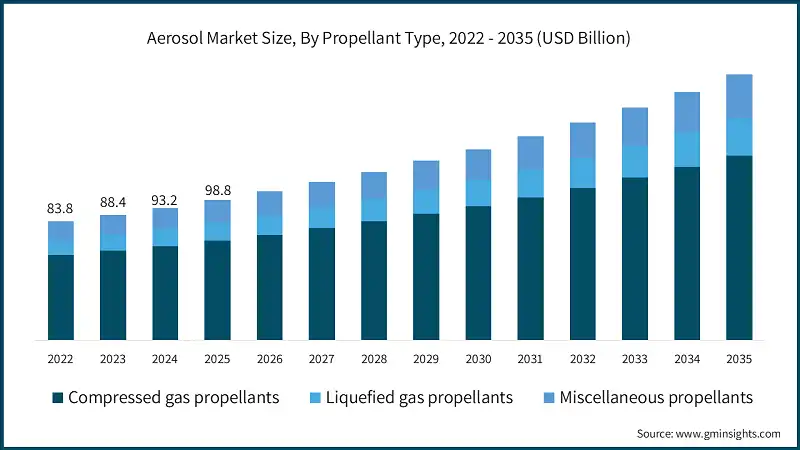
Based on propellent type the market is segmented as compressed gas propellants, liquefied gas propellants, miscellaneous propellants.
- Compressed gas propellants captured roughly 70.9% of the aerosol market share in 2025. Its suitability for bag-on-valve systems, precise dosing, and alignment with low-VOC objectives make them a pillar of reformulation strategies, with EPA’s SNAP program recognizing these gases as acceptable substitutes with zero ODP and minimal or zero GWP (gas-dependent).
- Liquefied gas propellants—hydrocarbons, dimethyl ether (DME), and legacy HFCs—provide stable can pressure over life for finer atomization and consistent foams; hydrocarbons carry very low GWPs (single digits) but require ATEX/DSEAR controls due to flammability. DME’s solvency and low odor broaden use in hair sprays, insecticides, and cleaners, while ultra low GWP HFOs such as HFO 1234ze support non flammable or near non flammable specs in premium technical aerosols.
Learn more about the key segments shaping this market
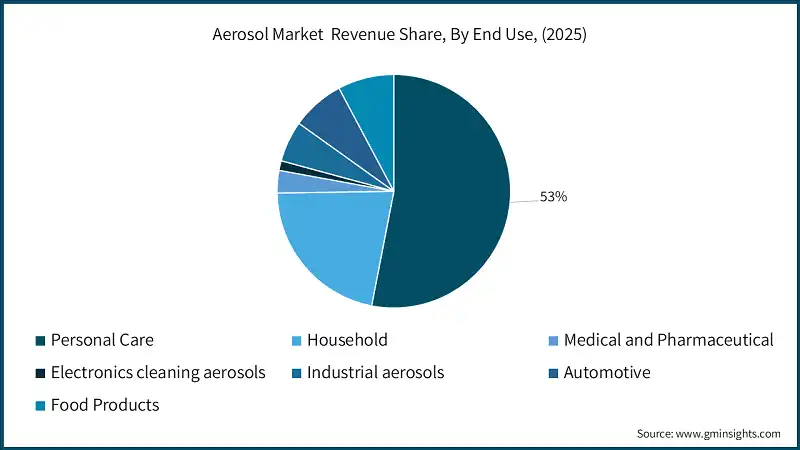
Based on end use the market is segmented as personal care, household, medical and pharmaceutical, electronics cleaning aerosols, industrial aerosols, automotive, food products.
- Personal care represented about 53% of the aerosol market in 2025. This segment encompasses deodorants, antiperspirants, hair sprays, dry shampoos, hair mousses, shaving foams, body sprays, sunscreens, and cosmetic setting sprays. Personal care aerosols are valued for hygiene, contactless application, contamination protection, precise dispensing, and the recyclability of metal cans. Spray deodorants including aerosol and pump sprays hold the largest share globally due to convenience, quick drying, lighter feel, perceived broader skin coverage, and longer freshness.
- Household aerosols are growing at a 7.1% CAGR through 2035. This category includes air fresheners, disinfectant sprays, insecticides, furniture polishes, oven cleaners, glass cleaners, bathroom and tile cleaners, and general-purpose cleaners. The household segment experienced significant growth during the COVID-19 pandemic due to heightened demand for disinfectant and sanitizing sprays, and this elevated baseline demand has persisted as consumers maintain increased hygiene practices.
Looking for region specific data?
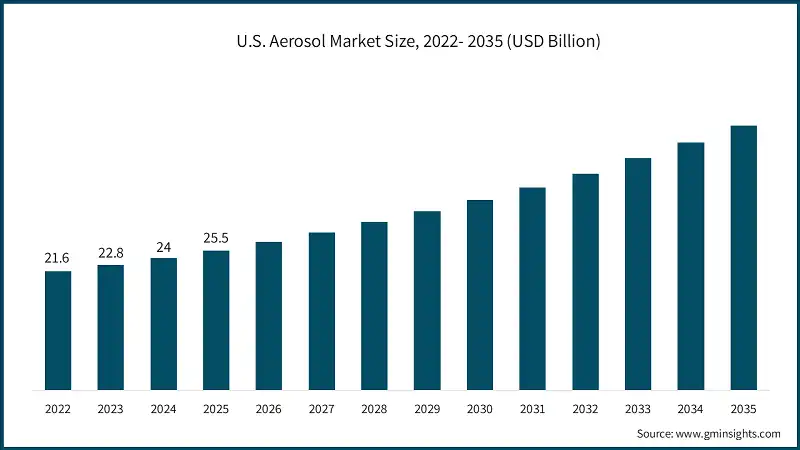
The U.S. aerosol market valued at USD 25.5 billion in 2025 and estimated to grow to almost USD 48.2 billion by 2035. North America holds around 30.7% of the market share in 2025.
- The North America market leans on high personal care spending, DIY maintenance culture, and a rigorous regulatory framework that sets reactivity-based standards for coatings while capping VOCs in consumer products. The United States also streamlined aerosol can recycling by classifying spent cans as universal waste at the federal level, with 36 states plus DC adopting this approach by early 2024, improving collection and bulk recycling logistics. The mid 2025 extension to January 2027 on aerosol coatings compliance allows reformulation and relabeling to proceed in step with supply chain realities. The U.S. aerosol market benefits from broad retail access and recycling initiatives that target 85% access by 2030, while Canada follows with aligned sustainability goals and consumer preferences for clean-label personal care.
- The Europe market remains the largest, supported by high per-capita personal care consumption and stringent environmental policies that push conversions to hydrocarbon, compressed gas, and BoV systems. Aluminum can adoption is reinforced by recycling infrastructure and circular economy priorities, and producers cite progress on recycled content and low-carbon primary sourcing. Auto production above 14 million units in 2023 supported demand for maintenance aerosols across Germany, France, Italy, and the UK, while national VOC limits and chemical restrictions influence category formulations. Lightweighting and PFAS/BPA liner shifts are active packaging themes as brands respond to EU regulatory changes.
- The Asia Pacific aerosol market is the fastest growing, anchored by China’s vehicle production scale and rising beauty/hygiene consumption in China and India. Regional policy pushes on green chemistry and plastic waste are accelerating adoption of recyclable metal packaging and lower-VOC formulations. As electronics manufacturing and maintenance expand, technical aerosols for precision cleaning provide incremental growth, with transition paths from high GWP to lower GWP propellants shaped by application-specific flammability and solvency requirements. Expect China and India to lead volume gains, with Japan and South Korea focusing on high-spec packaging and dispensing technologies.
Aerosol Market Share
The aerosol industry exhibits moderate concentration—large global brands and industrial specialists coexist with regional players and contract fillers. The top five (3M,Illinois Tool Works, DuPont, Henkel, SC Johnson) collectively held 53% of the market in 2025. Scale advantages matter because reformulation to low-reactivity propellants, BoV adoption, and packaging decarbonization all require multi-year investment and supplier coordination. Packaging suppliers, in particular, exert outsize influence on innovation cadence: aluminum can producers report strong progress on recycled content, hydropower-based low-carbon aluminum, and alloy-enabled lightweighting; steel can manufacturers document ~33% weight reduction over two decades, improving cost-to-serve and reducing emissions.
- 3M
- 3M is a diversified technology company with a broad aerosol product portfolio spanning industrial, automotive, personal care, and healthcare applications. The company's aerosol offerings include adhesives, lubricants, cleaners, protective coatings, and medical aerosols. 3M's innovation capabilities in materials science, chemistry, and dispensing systems enable continuous product development. The company's global distribution network and brand recognition across professional and consumer markets support its market leadership position. 3M's sustainability initiatives include efforts to reduce VOC emissions in aerosol formulations and increase use of renewable and recycled materials in packaging.
- Illinois Tool Works (ITW)
- Illinois Tool Works (ITW) operates in the aerosol market through its diverse industrial and automotive product lines. The company manufactures and markets lubricants, cleaners, and specialty coatings under various brands serving professional and consumer markets. ITW's focus on innovation in aerosol dispensing systems and formulations for industrial maintenance applications, combined with its operational excellence and customer-centric approach, supports its competitive position.
- Henkel Corporation
- Henkel Corporation maintains a strong position in personal care and household aerosols through brands spanning hair care, deodorants, and household cleaning products. The company's commitment to sustainability is evident in packaging initiatives and formulation improvements to reduce VOC content and environmental impact. Henkel's global manufacturing footprint, R&D capabilities, and brand portfolio support its competitive position across multiple aerosol categories.
Aerosol Market Companies
Major players operating in the aerosol industry are:
- 3M
- Illinois Tool Works
- DuPont
- Henkel Corporation.
- SC Johnson
- Aramco (Valvoline)
- Pidilite Industries Limited
- CRC Industries
- European Aerosols
- Aerol
- Rymax Lubricants
- Chemz Limited
- Guangdong Theaoson Technology Co.,Ltd
- Zenith Spray and Aerosols Private Limited
Aerosol Market Report Attributes
| Key Takeaway | Details |
|---|---|
| Market Size & Growth | |
| Base Year | 2025 |
| Market Size in 2025 | USD 98.8 Billion |
| Market Size in 2026 | USD 105 Billion |
| Forecast Period 2026-2035 CAGR | 6.6% |
| Market Size in 2035 | USD 187.4 Billion |
| Key Market Trends | |
| Drivers | Impact |
| Surge in Demand for Dry Shampoo & Personal Care Sprays | Demand surge in dry shampoo and broader personal care sprays—spray deodorants, hair sprays, and body sprays—continues to pull through volumes thanks to convenience, fast-dry, and broad coverage formats highlighted by category trackers in North America |
| Growth in Automotive & Industrial Maintenance | Expanding automotive and industrial maintenance use-cases—brake cleaners, degreasers, electronics cleaners, lubricants—leveraging the precision and portability of aerosols to service expanding vehicle fleets and manufacturing bases |
| Regulatory Push for VOC Reduction | Regulatory push for VOC reduction—EPAs 40 CFR Part 59 standards and the January 2025 aerosol coatings rule update reactivity tables and electronic reporting, which is accelerating reformulations to compressed gases and HFOs |
| Pitfalls & Challenges | Impact |
| Compliance with Evolving Environmental Norms | Manufacturers face multi-jurisdictional standards, testing burdens, and CAPEX needs to transition to low-VOC/low-GWP propellants |
| Supply Chain Volatility in Metal Packaging | Aluminum aerosol deliveries hit ~6.4 billion units in 2023 (+6% YoY), with 2024 growth projected 4%, pressuring supply; producers counter with low-carbon sourcing, higher recycled content, and lightweighting |
| Opportunities: | Impact |
| Refillable, low-VOC systems and BoV drive premiumization and compliance | Refillable formats, low-VOC formulations, and Bag-on-Valve (BoV) technology are pushing the aerosol market toward premiumization by offering sustainability and convenience, while ensuring regulatory compliance with stricter environmental standards. |
| Market Leaders (2025) | |
| Market Leaders |
17.7 % market share |
| Top Players |
|
| Competitive Edge |
|
| Regional Insights | |
| Largest Market | Europe |
| Fastest Growing Market | Asia Pacific |
| Emerging Country | China, India, Japan |
| Future Outlook |
|
What are the growth opportunities in this market?
Aerosol Industry News
- In October 2025, HCmed & Aerogen formed a global strategic partnership in aerosol therapy aiming to co-develop advanced inhalation systems.
- In September 2025, Bradford (under Gemspring Capital) acquired Solo Laboratories on September 2, 2025, integrating aerosol & liquid personal care across multiple U.S. sites.
- In July 2024, Everspray launched its non-flammable nanoparticle aerosol air freshener with press coverage signaling its market debut.
The aerosol market research report includes in-depth coverage of the industry, with estimates & forecast in terms of revenue (USD Billion) and volume (Kilo Tons) from 2022 to 2035, for the following segments:
Market, By Propellant Type
- Compressed gas propellants
- Liquefied gas propellants
- Miscellaneous propellants
Market, By Can Type
- Aluminum
- Steel
- Plastic
- Others
Market, By End Use
- Personal Care
- Hair Care
- Body Care
- Facial Care
- Others
- Household
- Surface & Furniture Cleaners
- Air Treatment
- Pest Control
- Fabric & Laundry Care
- Others
- Medical and Pharmaceutical
- Inhalation Therapies
- Nasal & Oral Sprays
- Topical Drug Delivery
- Others
- Electronics cleaning aerosols
- Circuit boards
- Coils
- Tuners
- Switches
- Others
- Industrial aerosols
- Heavy-Duty Lubricants & Greases
- Paints & Coatings
- Industrial Cleaners & Degreasers
- Adhesives & Sealants
- Maintenance & Repair
- Others
- Automotive
- Lubricants & Penetrants
- Paints & Coatings
- Cleaners & Degreasers
- Tire & Wheel Products
- Winter & Specialty
- Others
- Food Products
- Cooking Sprays
- Whipped Cream
- Edible Oils
- Others
The above information is provided for the following regions and countries:
- North America
- U.S.
- Canada
- Europe
- UK
- Germany
- France
- Italy
- Spain
- Rest of Europe
- Asia Pacific
- China
- India
- Japan
- South Korea
- Australia
- Rest of Asia Pacific
- Latin America
- Brazil
- Mexico
- Argentina
- Rest of Latin America
- Middle East & Africa
- UAE
- Saudi Arabia
- South Africa
- Rest of Middle East & Africa
Frequently Asked Question(FAQ) :
What is the aerosol market size in 2025?
The global market size for aerosol is valued at USD 98.8 billion in 2025. Strong demand from personal care, household, automotive, and medical applications continues to support market growth.
What is the market size of the aerosol industry in 2026?
The market size for aerosol is expected to reach USD 105 billion in 2026, reflecting steady expansion driven by rising usage of dry shampoos, deodorants, and maintenance sprays.
What is the projected value of the aerosol market by 2035?
The market is projected to reach USD 187.4 billion by 2035, growing at a CAGR of 6.6% from 2026 to 2035. Growth is fueled by innovation in low-VOC propellants, sustainable packaging, and expanding end-use industries.
How much revenue did the compressed gas propellant segment generate in 2025?
Compressed gas propellants accounted for around 70.9% of the market share in 2025, making it the dominant propellant type. Its growth is supported by regulatory compliance benefits, low environmental impact, and increasing adoption of bag-on-valve systems.
What was the market share of the personal care segment in 2025?
The personal care segment held approximately 53% of the aerosol market in 2025, driven by high demand for deodorants, hair sprays, dry shampoos, and grooming products.
What is the growth outlook for the household aerosol segment?
The household aerosol segment is projected to grow at a CAGR of 7.1% through 2035. Sustained demand for disinfectants, air fresheners, and cleaning sprays continues to drive expansion.
What is the size and growth outlook of the U.S. aerosol market?
The U.S. market was valued at USD 25.5 billion in 2025 and is estimated to grow to nearly USD 48.2 billion by 2035, driven by strong demand from personal care, household, automotive, and medical aerosol applications.
What are the key trends shaping the aerosol industry?
Key trends include the shift toward low-GWP and low-VOC propellants, rapid adoption of bag-on-valve technology, lightweight and recyclable aluminum packaging, and growing interest in smart and connected aerosol packaging.
Who are the key players in the aerosol market?
Major players include 3M, Illinois Tool Works, DuPont, Henkel, SC Johnson, CRC Industries, European Aerosols, and Pidilite Industries Limited, focusing on sustainable formulations and advanced dispensing technologies.
Aerosol Market Scope
Related Reports