Summary
Table of Content

Aerogel Composites for Aerospace Insulation Market
Get a free sample of this report
Form submitted successfully!
Error submitting form. Please try again.
Thank you!
Your inquiry has been received. Our team will reach out to you with the required details via email. To ensure that you don't miss their response, kindly remember to check your spam folder as well!
Request Sectional Data
Thank you!
Your inquiry has been received. Our team will reach out to you with the required details via email. To ensure that you don't miss their response, kindly remember to check your spam folder as well!
Form submitted successfully!
Error submitting form. Please try again.
Aerogel Composites for Aerospace Insulation Market Size
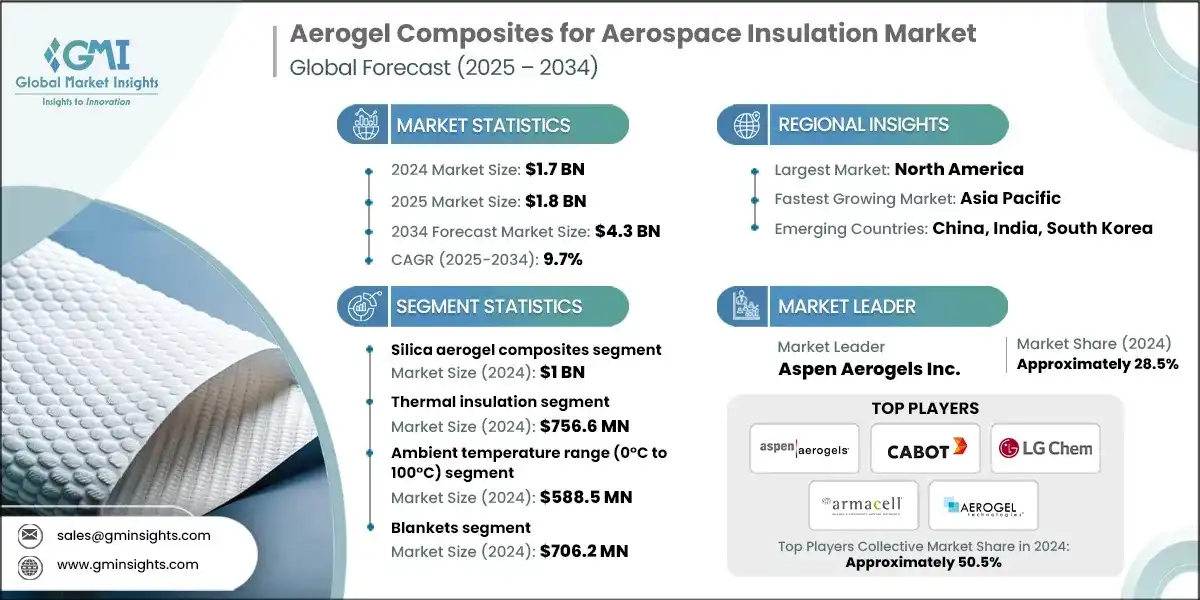
The global aerogel composites for aerospace insulation market was valued at USD 1.7 billion in 2024. It is projected to grow from USD 1.8 billion in 2025 to USD 4.3 billion by 2034, representing a 9.7% CAGR from 2025 to 2034, according to latest report published by Global Market Insights Inc.
Aerogel Composites for Aerospace Insulation Market Key Takeaways
Market Size & Growth
- 2024 Market Size: USD 1.7 billion
- 2025 Market Size: USD 1.8 billion
- 2034 Forecast Market Size: USD 4.3 billion
- CAGR (2025–2034): 9.7%
Key Market Drivers
- Increasing demand for lightweight thermal protection in commercial and military aircraft.
- Advances in fiber-reinforced and polymer aerogel composites enhancing mechanical durability.
- Growing electric aircraft and sustainable aviation initiatives requiring advanced thermal management.
- Government R&D funding and regulatory support for advanced aerospace materials.
Challenges
- High production costs compared to conventional insulation materials.
- Complex certification requirements for aerospace applications.
- Material brittleness and handling challenges in traditional aerogel formulations.
Opportunity
- Integration in next-generation hypersonic and space exploration vehicles.
- Development of multifunctional aerogel composites combining thermal, acoustic, and fire protection.
- Expansion into electric aircraft and urban air mobility thermal management systems.
- Strategic partnerships with aerospace OEMs for co-development of application-specific solutions.
Key Players
- Market Leader: Aspen Aerogels Inc. led with over 28.5% market share in 2024.
- Leading Players: Top 5 players in this market include Aspen Aerogels Inc., Cabot Corporation, LG Chem, Armacell International, Aerogel Technologies LLC, which collectively held a market share of 50.5% in 2024.
Get Market Insights & Growth Opportunities
- The market for aerogel composites in aerospace insulation is experiencing robust growth due to the increasing demand for lightweight, high-performance thermal protection systems in commercial and military aircraft. With the aerospace industry's focus on fuel efficiency and weight reduction, these ultra-lightweight materials provide exceptional thermal insulation while maintaining structural integrity. The superior thermal conductivity properties of aerogel composites, combined with their ability to withstand extreme temperatures from cryogenic to over 1,200°C, make them ideal for next-generation aircraft and spacecraft applications.
- Significant technological advancements in silica and polymer aerogel composites have enhanced their mechanical durability and processing capabilities, enabling broader adoption in aerospace thermal management systems. NASA's development of mechanically strong polyimide aerogels and fiber-reinforced composites has demonstrated up to 300× improvement in mechanical strength compared to native aerogels while maintaining exceptional thermal performance. These innovations have expanded applications from traditional cryogenic insulation to advanced thermal protection systems for hypersonic vehicles and space exploration missions.
- The growing emphasis on sustainable aviation and electric aircraft development is driving increased adoption of aerogel composites for battery thermal management and lightweight insulation systems. Electric aircraft require sophisticated thermal management solutions to ensure battery safety and performance, where aerogel composites provide critical thermal barriers while minimizing weight penalties. This trend is particularly evident in the development of urban air mobility vehicles and next-generation commercial aircraft incorporating hybrid-electric propulsion systems.
- Government initiatives and regulatory support for advanced aerospace materials are accelerating market growth through increased R&D funding and procurement programs. NASA's continued investment in aerogel technology development through SBIR programs and partnerships with industry leaders like Aspen Aerogels has resulted in commercially viable products now used across major aerospace applications. The Federal Aviation Administration's emphasis on fire safety and thermal protection standards is also driving adoption of advanced aerogel-based insulation systems in commercial aviation.
To get key market trends
Aerogel Composites for Aerospace Insulation Market Trends
- The integration of aerogel composites with advanced fiber reinforcement systems is gaining momentum to create hybrid materials that combine exceptional thermal performance with enhanced mechanical properties. These hybrid composites incorporate carbon fiber, ceramic fiber, or polymer reinforcement to address the traditional brittleness of aerogels while maintaining their ultra-low thermal conductivity. This trend is particularly relevant for aerospace applications requiring both structural integrity and thermal protection, such as engine nacelles and thermal protection systems.
- The aerospace industry's shift toward electric and hybrid-electric propulsion is driving demand for specialized aerogel composites designed for battery thermal management and power electronics cooling. These applications require materials that can provide thermal isolation while managing heat dissipation in confined spaces, leading to the development of tailored aerogel formulations with enhanced thermal conductivity control. The trend extends to urban air mobility vehicles and next-generation commercial aircraft incorporating electric propulsion systems.
- Advanced manufacturing techniques, including ambient pressure drying and continuous production processes, are revolutionizing aerogel composite production by reducing costs and enabling larger-scale manufacturing. NASA's development of flexible polyimide aerogels and improved processing methods has demonstrated significant cost reductions while maintaining performance characteristics. These manufacturing advances are making aerogel composites more accessible for broader aerospace applications beyond traditional high-value space missions.
Aerogel Composites for Aerospace Insulation Market Analysis

Learn more about the key segments shaping this market
The silica aerogel composites segment was valued at USD 1 billion in 2024, and it is anticipated to expand at 9.9% CAGR during 2025-2034, holding a market share of 60.2%.
- Silica aerogel composites dominate the aerospace insulation market due to their exceptional thermal insulation properties, with thermal conductivity values as low as 0.013 W/m·K, combined with excellent fire resistance and structural stability. These materials are extensively used in commercial aircraft engine compartments, spacecraft thermal protection systems, and cryogenic fuel tank insulation. Their proven performance in extreme temperature environments and compliance with stringent aerospace fire safety standards make them the preferred choice for critical thermal management applications across all aircraft types.
- Hybrid aerogel composites represent the second-largest segment, valued at USD 310.6 million in 2024 with an 18.5% market share, experiencing robust growth at 10% CAGR in 2025 to 2034. These advanced materials combine the superior thermal properties of silica aerogel with reinforcing materials such as ceramic fibers, carbon nanotubes, or polymer matrices to achieve enhanced mechanical properties while maintaining exceptional insulation performance. The segment is driven by increasing demand for multifunctional materials in next-generation aircraft designs where weight reduction, thermal management, and structural integration are equally critical.
- Carbon aerogel composites and polymer aerogel composites are experiencing significant growth, driven by specialized applications requiring unique property combinations. Carbon aerogel composites, holding 12 % market share, are gaining traction in electric aircraft applications where thermal management of battery systems and power electronics requires materials with both insulating and conductive properties. Polymer aerogel composites, representing 9.2% market share, offer enhanced flexibility and processability, making them ideal for complex geometries and applications requiring conformable insulation solutions in spacecraft and military aircraft systems.
Learn more about the key segments shaping this market
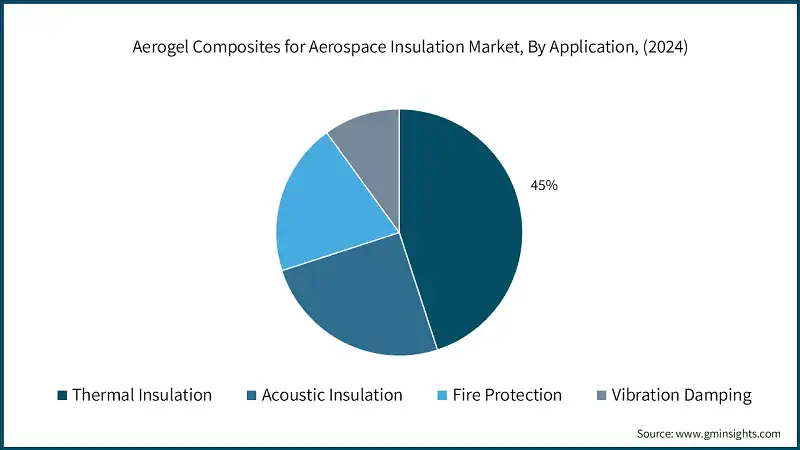
The thermal insulation segment was valued at USD 756.6 million in 2024, and it is anticipated to expand at 10% CAGR during 2025-2034, holding a market share of 45%.
- Thermal insulation represents the largest application segment, driven by the critical need for temperature control in aircraft engines, spacecraft thermal protection systems, and cryogenic fuel storage. Aerogel composites excel in these applications due to their ultra-low thermal conductivity, lightweight nature, and ability to maintain performance across extreme temperature ranges from cryogenic conditions (-200°C) to high-temperature environments (>500°C). The segment's growth is particularly strong in space applications where thermal protection systems must withstand the extreme temperature variations of space environments while providing reliable protection for sensitive equipment and crew compartments.
- Acoustic insulation applications, valued at USD 420.4 million with 25% market share, are experiencing steady growth as aerospace manufacturers focus on passenger comfort and regulatory noise reduction requirements. Aerogel composites provide excellent sound dampening properties while maintaining fire resistance and lightweight characteristics, making them ideal for cabin insulation, engine noise reduction, and ground noise mitigation applications. The segment benefits from increasing passenger expectations for quieter flight experiences and stricter airport noise regulations worldwide.
- Fire protection and vibration damping segments are growing steadily, driven by enhanced safety requirements and performance optimization needs. Fire protection applications, holding 20.0% market share, leverage aerogel composites' inherent fire resistance and non-toxic properties to meet stringent aerospace fire safety standards. Vibration damping applications, representing 10.0% market share, utilize aerogel composites' unique structural properties to reduce mechanical vibrations, improve component longevity, and enhance overall aircraft performance and passenger comfort.
The aerogel composites for aerospace insulation market from ambient temperature range (0°C to 100°C) segment was valued at USD 588.5 million in 2024, and it is anticipated to expand at 9.8% CAGR during 2025-2034, holding a market share of 35%.
- Ambient temperature applications represent the largest segment, encompassing cabin insulation, avionics cooling, and general aircraft thermal management systems. These applications benefit from aerogel composites' consistent performance characteristics and ease of integration into standard aircraft systems. The segment's dominance reflects the widespread use of aerogel composites in commercial aircraft where most operational environments fall within this temperature range, including passenger compartments, cargo holds, and electronic equipment bays.
- High temperature applications (100°C to 500°C), valued at USD 420.4 million with 25% market share in 2024, are driven by engine compartment insulation, exhaust system thermal protection, and high-performance military aircraft applications. These demanding environments require aerogel composites with enhanced thermal stability and mechanical properties to withstand prolonged exposure to elevated temperatures while maintaining structural integrity and insulation performance.
- Cryogenic applications (-200°C to -100°C), holding 11 % market share in 2024, represent a specialized but critical segment focused on spacecraft propulsion systems, rocket fuel tanks, and space exploration missions. The extreme low-temperature performance requirements drive demand for specialized aerogel composite formulations capable of maintaining flexibility and insulation properties in cryogenic environments. Extreme temperature applications (>500°C), representing 14.3% market share, serve the most demanding aerospace applications including rocket nozzles, hypersonic vehicle thermal protection, and advanced military aircraft systems requiring materials capable of withstanding the most severe thermal environments.
The aerogel composites for aerospace insulation market from blankets segment was valued at USD 706.2 million in 2024, and it is anticipated to expand at 10% CAGR during 2025-2034, holding a market share of 42%.
- Aerogel blankets represent the largest form factor segment, offering superior flexibility, ease of installation, and excellent conformability to complex aircraft geometries. These flexible insulation solutions are extensively used in aircraft engine compartments, spacecraft thermal protection systems, and areas requiring removable or serviceable insulation. The segment's dominance reflects the aerospace industry's preference for versatile insulation solutions that can be easily integrated during manufacturing or maintenance operations while providing consistent thermal performance across diverse applications.
- Panels, valued at USD 420.4 million with 25% market share in 2024, serve applications requiring rigid insulation solutions with precise dimensional control and structural integration capabilities. These form factors are particularly important in spacecraft applications, military aircraft systems, and commercial aircraft areas where insulation must also provide structural support or maintain specific geometric requirements. The segment benefits from increasing demand for integrated insulation solutions that combine thermal protection with structural functionality.
- Coatings and custom shapes segments address specialized applications requiring tailored solutions for unique geometric requirements or specific performance characteristics. Coatings, holding 20.0% market share, provide thin-film insulation solutions for applications where space and weight constraints are critical, such as electronic component protection and surface thermal management. Custom shapes, representing 13.0% market share, serve niche applications requiring precisely engineered insulation solutions for complex geometries, specialized equipment housings, and unique aerospace system configurations.
The aerogel composites for aerospace insulation market from supercritical drying segment was valued at USD 975.2 million in 2024, and it is anticipated to expand at 9.9% CAGR during 2025-2034, holding a market share of 58%.
- Supercritical drying represents the dominant manufacturing process, producing the highest quality aerogel composites with superior thermal insulation properties, structural integrity, and consistency required for critical aerospace applications. This process enables the production of aerogel composites with the lowest thermal conductivity values and best mechanical properties, making them essential for spacecraft thermal protection systems, cryogenic applications, and high-performance military aircraft systems where material performance is paramount.
- Ambient pressure drying, valued at USD 420.4 million with 25% market share in 2024, is gaining momentum as a cost-effective alternative for applications where the highest performance characteristics are not required but aerospace-grade quality standards must still be maintained. This process enables manufacturers to produce aerogel composites at lower costs while meeting the performance requirements for commercial aircraft cabin insulation, general thermal management applications, and less critical aerospace systems.
The commercial aircraft application segment was valued at USD 807.0 million in 2024, and it is anticipated to expand with a CAGR of 9.9% and holding a market share of 48% during 2025-2034.
- Commercial aircraft represents the largest end use segment, driven by increasing aircraft production rates, fleet modernization programs, and the introduction of next-generation aircraft designs. Major aircraft manufacturers including Boeing, Airbus, and emerging players are incorporating aerogel composites into their latest aircraft models to achieve weight reduction targets and improve fuel efficiency. The segment benefits from the large-scale production volumes and the continuous demand for replacement and upgrade programs in the global commercial aviation fleet.
- Military aircraft applications, valued at USD 437.2 million with 26% market share in 2024, are experiencing robust growth driven by defense modernization programs and expanding military aviation requirements. Military applications focus on stealth capabilities, survivability, and performance optimization, where aerogel composites provide critical advantages in thermal signature reduction, protection against extreme environments, and enhanced mission capabilities. The segment benefits from increasing defense budgets worldwide and the development of next-generation military aircraft systems requiring advanced thermal management solutions.
Looking for region specific data?
The North America aerogel composites for aerospace insulation market dominated the global market with a market share of 42% from 2025 - 2034.
- North America maintains its leadership position in the aerogel composites aerospace market, driven by the presence of major aerospace manufacturers, advanced research institutions, and significant government investment in aerospace and defense programs. The United States, in particular, benefits from the headquarters of Boeing, Lockheed Martin, Northrop Grumman, and other major aerospace companies that are actively integrating aerogel composites into their aircraft and spacecraft designs. NASA's space exploration programs and the Department of Defense's advanced materials initiatives provide substantial market support and drive technological innovation in aerogel composite applications.
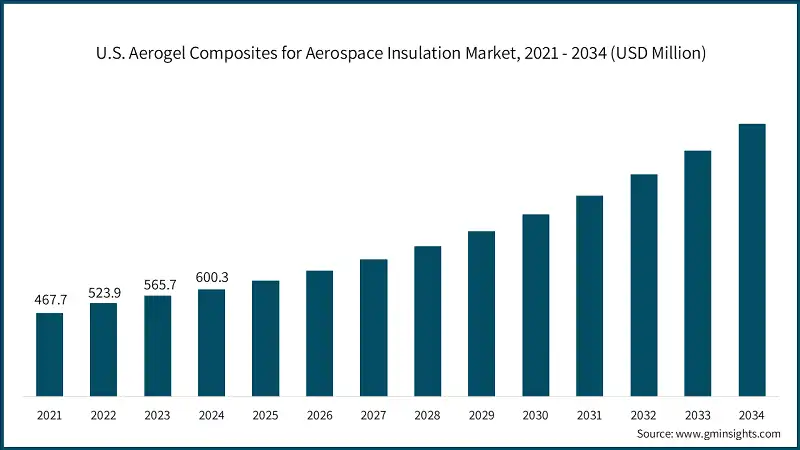
- U.S. dominates the North America aerogel composites for aerospace insulation industry, showcasing strong growth potential.
- The U.S. leads the regional market with robust demand from both commercial and military aerospace sectors. Major aircraft programs including the Boeing 787, F-35 Lightning II, and various NASA space missions extensively utilize aerogel composites for thermal protection and insulation applications. The country's strong research and development ecosystem, supported by institutions like MIT, Stanford, and various national laboratories, continues to drive innovation in aerogel composite technology. Additionally, the emerging commercial space sector, led by companies like SpaceX, Blue Origin, and Virgin Galactic, is creating new demand for advanced aerogel composite solutions.
The Europe aerogel composites for aerospace insulation market accounted for USD 470.8 million in 2024 and is anticipated to show lucrative growth over the forecast period.
- Europe's aerogel composites market is driven by the strong presence of Airbus, the region's leading commercial aircraft manufacturer, along with a robust aerospace supply chain and significant investment in sustainable aviation technologies. The European Union's commitment to reducing aviation emissions through the Green Deal and Sustainable and Smart Mobility Strategy is driving demand for lightweight materials that improve fuel efficiency. Countries like Germany, France, and the United Kingdom are at the forefront of aerogel composite research and application, with strong collaboration between industry, academia, and government research institutions.
- Germany dominates the Europe aerogel composites for aerospace insulation market, showcasing strong growth potential.
- Germany leads the European market through its advanced materials research capabilities and strong aerospace manufacturing base. The country hosts major aerospace companies including Airbus operations, MTU Aero Engines, and numerous specialized suppliers that incorporate aerogel composites into their products. German research institutions and companies are pioneering new manufacturing techniques for aerogel composites, particularly in ambient pressure drying and hybrid composite formulations. The country's focus on Industry 4.0 and advanced manufacturing technologies is enabling more efficient production of aerospace-grade aerogel composites.
The Asia Pacific aerogel composites for aerospace insulation market is anticipated to grow at a CAGR of 10% during 2025 to 2034.
- Asia Pacific represents the fastest-growing regional market, driven by rapid expansion of the aerospace industry, increasing aircraft production, and growing space programs in countries like China, Japan, and India. The region benefits from significant government investment in aerospace capabilities, growing domestic air travel demand, and the emergence of new aircraft manufacturers. China's ambitious space program, Japan's advanced materials research, and India's growing aerospace sector are creating substantial demand for aerogel composite solutions.
- China dominates the Asia Pacific market, estimated to grow with the highest CAGR in the region.
- China is experiencing the fastest growth in the Asia Pacific region, driven by its expanding commercial aviation sector, ambitious space exploration programs, and growing domestic aerospace manufacturing capabilities. The country's Commercial Aircraft Corporation of China (COMAC) and various space agencies are increasingly incorporating aerogel composites into their aircraft and spacecraft designs. China's significant investment in research and development, combined with government support for advanced materials development, is positioning the country as a major player in the global aerogel composites market.
The Latin America aerogel composites for aerospace insulation market accounted for 4% in 2024 and is anticipated to show steady growth over the forecast period.
- Latin America's market is primarily driven by Brazil's aerospace industry, led by Embraer, one of the world's largest commercial aircraft manufacturers. The region's market growth is supported by increasing aircraft production, growing regional aviation networks, and expanding space programs. Brazil's strong position in regional and business jet manufacturing creates consistent demand for aerogel composite solutions, particularly in thermal insulation and fire protection applications.
- Brazil leads the Latin America market, exhibiting steady growth during the analysis period.
- Brazil dominates the regional market through Embraer's global presence in commercial and military aircraft manufacturing. The country's aerospace sector benefits from strong government support, established supply chains, and growing export markets. Brazilian manufacturers are increasingly adopting aerogel composites to enhance aircraft performance and meet international safety standards, particularly in their regional jet and military aircraft programs.
Middle East & Africa aerogel composites for aerospace insulation market is anticipated to grow at a CAGR of 8% during 2025 to 2034.
- The Middle East & Africa region shows moderate growth potential, driven primarily by expanding airline fleets, growing maintenance, repair, and overhaul (MRO) activities, and emerging space programs. The region's harsh environmental conditions create specific demand for high-performance insulation materials capable of withstanding extreme temperatures and sandstorm conditions. Countries like the UAE and Saudi Arabia are investing in aerospace capabilities and space programs, creating new opportunities for aerogel composite applications.
- Saudi Arabia leads the Middle East & Africa market, experiencing substantial growth potential.
- Saudi Arabia is emerging as the regional leader through its Vision 2030 program, which includes significant investment in aerospace and space technologies. The country's growing airline industry, led by Saudi Arabian Airlines and the new national carrier, along with ambitious space exploration plans, is driving demand for advanced aerospace materials including aerogel composites. The establishment of aerospace manufacturing capabilities and research institutions is positioning Saudi Arabia as a key market for aerogel composite suppliers.
Aerogel Composites for Aerospace Insulation Market Share
In 2024, the global aerogel composites for aerospace insulation industry was led by a diverse group of established materials companies and specialized aerospace suppliers, where the top seven companies collectively held approximately 50% of the market share, including Aspen Aerogels Inc., Cabot Corporation, LG Chem, Armacell International, Aerogel Technologies LLC, Blueshift Materials and Svenska Aerogel Holding AB. These companies maintain strong positions in the market owing to their advanced manufacturing capabilities, aerospace certifications, extensive R&D investments, and established relationships with major aerospace OEMs and space agencies.
- Aspen Aerogels: Aspen Aerogels leads the aerogel composites for aerospace insulation market, leveraging its comprehensive product portfolio and strong aerospace heritage. The company’s leadership is built on extensive aerospace certifications and proven performance in critical space missions, including Mars rovers and International Space Station applications. Recent investments in advanced manufacturing and partnerships with major aerospace OEMs have strengthened its position in commercial and space sectors.
- Cabot Corporation: Cabot Corporation holds a significant position in the global aerogel market, supported by its extensive manufacturing capabilities, materials expertise, and strong presence in industrial and aerospace applications. Its Frankfurt facility and established European distribution networks enhance its regional strength, while ongoing R&D efforts in hybrid aerogel technologies support expansion into next-generation aerospace insulation solutions.
- Armacell International: Armacell International has developed a strong aerospace-focused presence based on its specialized expertise in thermal management. Its manufacturing facilities in Korea and India, combined with deep application knowledge, make it a preferred supplier for both commercial and defense aerospace projects. The company’s focus on customized aerogel insulation systems and close OEM collaboration continues to drive its growth in aerospace applications.
Aerogel Composites for Aerospace Insulation Market Companies
The major players operating in aerogel composites for aerospace insulation industry include:
- Aspen Aerogels, Inc.
- Cabot Corporation
- LG Chem
- Armacell International
- Aerogel Technologies LLC
- Blueshift Materials
- Svenska Aerogel Holding AB
- Active Aerogels
- Green Earth Aerogel Technologies
- FLEXcon
- EAS Fiberglass Co., Ltd.
- Guangdong Alison Technology
- Jucos Refractory
- WH Thermal Energy Technology
- Wedge India
Aerogel Composites for Aerospace Insulation Market Report Attributes
| Key Takeaway | Details |
|---|---|
| Market Size & Growth | |
| Base Year | 2024 |
| Market Size in 2024 | USD 1.7 billion |
| Market Size in 2025 | USD 1.8 billion |
| Forecast Period 2025 - 2034 CAGR | 9.7% |
| Market Size in 2034 | USD 4.3 billion |
| Key Market Trends | |
| Drivers | Impact |
| Increasing demand for lightweight thermal protection in commercial and military aircraft | Drives adoption of ultra-lightweight aerogel composites for fuel efficiency and performance optimization |
| Advances in fiber-reinforced and polymer aerogel composites enhancing mechanical durability | Enables broader aerospace applications from cryogenic systems to high-temperature thermal protection |
| Growing electric aircraft and sustainable aviation initiatives requiring advanced thermal management | Accelerates integration of aerogel composites in battery thermal barriers and next-generation propulsion systems |
| Government R&D funding and regulatory support for advanced aerospace materials | Encourages innovation and commercialization of aerogel-based thermal protection systems |
| Pitfalls & Challenges | Impact |
| High production costs compared to conventional insulation materials | Limits adoption in cost-sensitive applications, requiring continued manufacturing process improvements |
| Complex certification requirements for aerospace applications | Extends development timelines and increases market entry barriers for new products |
| Material brittleness and handling challenges in traditional aerogel formulations | Impacts manufacturing and installation processes, driving need for composite reinforcement solutions |
| Opportunities: | Impact |
| Integration in next-generation hypersonic and space exploration vehicles | Enables market expansion into high-value, performance-critical aerospace segments |
| Development of multifunctional aerogel composites combining thermal, acoustic, and fire protection | Creates new market segments and increases value proposition for aerospace OEMs |
| Expansion into electric aircraft and urban air mobility thermal management systems | Opens emerging market opportunities in sustainable aviation and advanced air mobility |
| Strategic partnerships with aerospace OEMs for co-development of application-specific solutions | Accelerates market penetration through integrated design and manufacturing approaches |
| Market Leaders (2024) | |
| Market Leaders |
Market Share Approximately 28.5% |
| Top Players |
Collective market share in 2024 is Collective Market Share Approximately 50.5% |
| Competitive Edge |
|
| Regional Insights | |
| Largest Market | North America |
| Fastest Growing Market | Asia Pacific |
| Emerging Country | China, India, South Korea |
| Future Outlook |
|
What are the growth opportunities in this market?
Aerogel Composites for Aerospace Insulation Industry News
- In September 2024, Armacell launched the ArmaGel XG aerogel blanket technology platform, expedited after the incident at its Cheonan plant on September 7, 2024. The first product, ArmaGel XGH, will be available from October 2024, with initial production in China and a new 1 million sq m/year facility in Pune, India, operational by mid-2025.
- In September 2024, Armacell acquired all remaining JIOS shares in Armacell JIOS Aerogels Limited (AJA), making it a wholly owned subsidiary. Established in 2016, the joint venture operates a Cheonan, South Korea facility with an aerogel powder production capacity exceeding 700 tonnes per year.
The aerogel composites for aerospace insulation market research report includes in-depth coverage of the industry with estimates & forecast in terms of revenue (USD Billion) & (Kilo Tons) from 2021 to 2034, for the following segments:
Market, By Product Type
- Silica aerogel composites
- Carbon aerogel composites
- Hybrid aerogel composites
- Polymer aerogel composites
Market, By Application
- Thermal insulation
- Acoustic insulation
- Fire protection
- Vibration damping
Market, By Temperature Range
- Cryogenic (-200°C to -100°C)
- Low temperature (-100°C to 0°C)
- Ambient (0°C to 100°C)
- High temperature (100°C to 500°C)
- Extreme temperature (>500°C)
Market, By Form
- Blankets
- Panels
- Coatings
- Custom shapes
Market, By Manufacturing Process
- Supercritical drying
- Ambient pressure drying
- Freeze drying
- Sol-gel processing
Market, By End Use
- Commercial aircraft
- Military aircraft
- Spacecraft
- Electric aircraft
The above information is provided for the following regions and countries:
- North America
- U.S.
- Canada
- Europe
- UK
- Germany
- France
- Italy
- Spain
- Rest of Europe
- Asia Pacific
- China
- India
- Japan
- South Korea
- Australia
- Rest of Asia Pacific
- Latin America
- Brazil
- Mexico
- Argentina
- Rest of Latin America
- MEA
- UAE
- Saudi Arabia
- South Africa
- Rest of Middle East and Africa
Frequently Asked Question(FAQ) :
What is the market size of the aerogel composites for aerospace insulation market in 2024?
The market size was USD 1.7 billion in 2024, with a CAGR of 9.7% expected through 2034 driven by increasing demand for lightweight thermal protection in commercial and military aircraft.
What is the current aerogel composites for aerospace insulation market size in 2025?
The market size is projected to reach USD 1.8 billion in 2025.
What is the projected value of the aerogel composites for aerospace insulation market by 2034?
The aerogel composites for aerospace insulation market is expected to reach USD 4.3 billion by 2034, driven by advancements in polymer aerogel composites and adoption in electric and sustainable aviation.
How much revenue did the silica aerogel composites segment generate in 2024?
The silica aerogel composites segment generated USD 1 billion in 2024, accounting for 60.2% market share.
What was the valuation of the thermal insulation segment in 2024?
The thermal insulation segment was valued at USD 756.6 million in 2024, holding a 45% share. Growth is fueled by rising demand for efficient temperature control in aircraft engines, spacecraft, and cryogenic systems.
What is the growth outlook for the blankets form segment from 2025 to 2034?
The blankets form segment is projected to grow at a CAGR of 10% through 2034. This growth is supported by increased preference for flexible, lightweight insulation solutions across commercial and space applications.
Which region leads the aerogel composites for aerospace insulation market?
North America led the market with 42% share in 2024. The U.S. drives regional growth through major aerospace programs from Boeing, Lockheed Martin, and NASA initiatives promoting advanced thermal protection materials.
What are the upcoming trends in the aerogel composites for aerospace insulation industry?
Key trends include development of fiber-reinforced hybrid composites, use in electric aircraft battery thermal management, and cost reduction through advanced manufacturing techniques like ambient pressure drying.
Who are the key players in the aerogel composites for aerospace insulation market?
Key players include Aspen Aerogels Inc., Cabot Corporation, LG Chem, Armacell International, Aerogel Technologies LLC, Blueshift Materials, Svenska Aerogel Holding AB, Active Aerogels, Green Earth Aerogel Technologies, and FLEXcon.
Aerogel Composites for Aerospace Insulation Market Scope
Related Reports