Summary
Table of Content

Advanced Traveller Information System Market
Get a free sample of this report
Form submitted successfully!
Error submitting form. Please try again.
Thank you!
Your inquiry has been received. Our team will reach out to you with the required details via email. To ensure that you don't miss their response, kindly remember to check your spam folder as well!
Request Sectional Data
Thank you!
Your inquiry has been received. Our team will reach out to you with the required details via email. To ensure that you don't miss their response, kindly remember to check your spam folder as well!
Form submitted successfully!
Error submitting form. Please try again.
Advanced Traveller Information System Market Size
The advanced traveller information system market is projected to witness robust growth in the coming years, driven by increasing urbanization, rising commuter demand for real-time travel information, growing adoption of intelligent transport systems (ITS), and government initiatives to enhance smart mobility solutions. Transport authorities and mobility service providers are accelerating investments in connected infrastructure, real-time traffic monitoring, and integrated information platforms to improve traveler experience, reduce congestion, and enhance network efficiency. The expansion of public transit networks, demand-responsive transport services, and multimodal mobility solutions is further strengthening the need for scalable and technology-enabled traveller information systems globally.
Advanced Traveller Information System Market Key Takeaways
Market Size & Growth
- 2025 Market Size: USD 6.2 Billion
- 2026 Market Size: USD 6.6 Billion
- 2035 Forecast Market Size: USD 15.7 Billion
- CAGR (2026–2035): 10.1%
Regional Dominance
- Largest Market: North America
- Fastest Growing Region: Asia Pacific
Key Market Drivers
- Rising Urbanization and Commuter Demand.
- Government Initiatives and Smart City Programs.
- Technological Advancements.
- Integration of Multimodal Transport.
Challenges
- High Implementation and Maintenance Costs.
- Data Privacy and Cybersecurity Concerns.
Opportunity
- AI-Driven Analytics and Predictive Services.
- Expansion of Mobile and Cloud-Based Traveler Platforms.
Key Players
- Market Leader: Siemens led with over 16.2% market share in 2025.
- Leading Players: Top 5 players in this market include Garmin, HERE Technologies, Kapsch TrafficCom, Siemens, Tom Tom, which collectively held a market share of 47% in 2025.
Get Market Insights & Growth Opportunities
Increasing pressure on transport operators to improve service reliability, reduce operational costs, and comply with stringent safety and environmental regulations has accelerated investments in AI-driven traffic prediction, IoT-enabled traffic sensors, and cloud-based information platforms. For instance, in January 2025, the city of Munich integrated its traffic management system with real-time ATIS dashboards, improving commuter routing and reducing average travel times across the metropolitan network.
Technological advancements such as AI-based route optimization, connected vehicle integration, and predictive traffic analytics are reshaping the market landscape. For example, in March 2025, Siemens Mobility deployed an AI-powered traffic information system across several European highways, providing real-time alerts and adaptive route recommendations to improve travel efficiency and reduce congestion.
The advanced traveller information system continues to evolve as digitalization, sustainability mandates, urban mobility transformation, and smart city initiatives reshape transport priorities. Industry stakeholders are emphasizing multimodal integration, dynamic information services, mobile-first traveler applications, and data-driven decision-making to improve commuter experience and network resilience. These developments are redefining the global urban mobility landscape, enabling enhanced operational visibility, optimized traffic flows, improved safety, regulatory compliance, and long-term value creation across public transport, highway networks, and private mobility services worldwide.
The global advanced traveller information system market was valued at USD 6.2 billion in 2025. The market is expected to grow from USD 6.6 billion in 2026 to USD 15.7 billion in 2035, at a CAGR of 10.1%, according to latest report published by Global Market Insights Inc.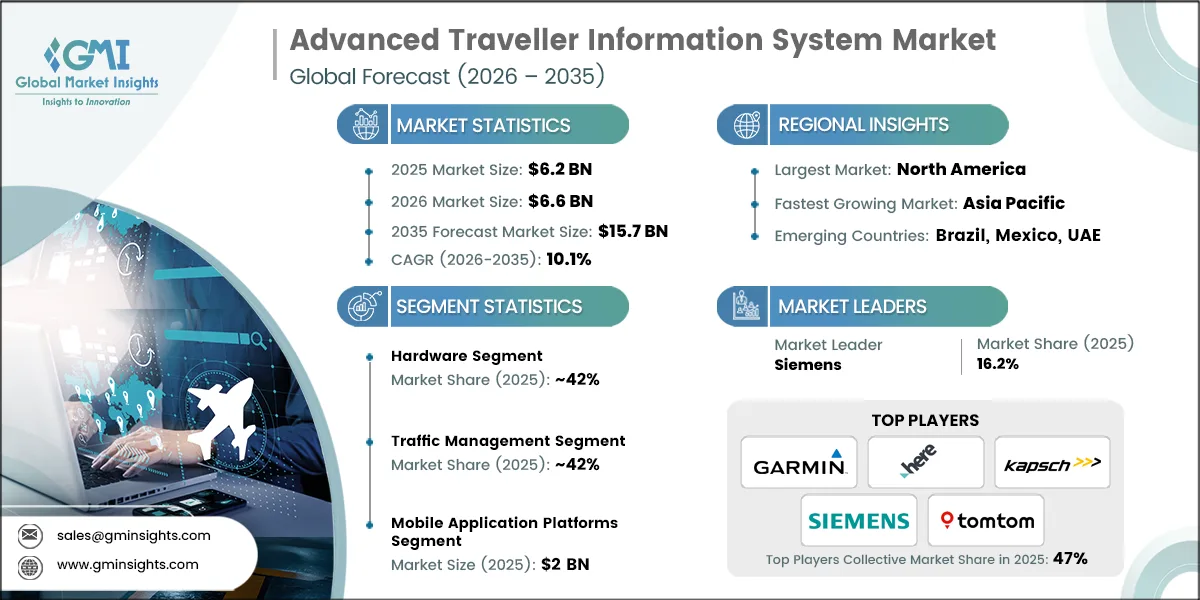
To get key market trends
Advanced Traveller Information System Market Trends
The demand for advanced traveller information system solutions is steadily increasing, driven by growing collaboration among transport authorities, mobility service providers, vehicle manufacturers, and regulatory bodies. These partnerships aim to improve operational efficiency, optimize traffic management, reduce congestion, enhance traveler experience, ensure compliance with safety and environmental standards, and support sustainable urban mobility across cities and highway networks. Stakeholders are developing integrated, modular, and software-enabled platforms incorporating AI-assisted route guidance, cloud-connected traffic monitoring, predictive congestion management, and high-speed data networks for public transport, highways, and private mobility services.
For instance, in March 2025, Siemens Mobility deployed AI-powered traffic management solutions across major European highways, optimizing traffic flow, reducing travel times, and supporting sustainable urban mobility. Such initiatives demonstrate the adoption of scalable, modular, and automated solutions that improve operational efficiency, enhance cybersecurity, and enable continuous upgrades to advanced traveller information system platforms worldwide.
Regional customization of advanced traveller information system solutions has emerged as a key trend. Major providers are developing region-specific digital traffic platforms, route optimization frameworks, and operational workflows tailored for North America, Europe, Asia Pacific, Latin America, and the Middle East & Africa. These solutions address local regulations, infrastructure variations, urban density requirements, and mobility patterns while supporting scalable and sustainable deployment across both mature and emerging markets.
The rise of specialized technology and platform providers is reshaping the competitive landscape. Companies focusing on AI-enabled route prediction, connected vehicle integration, cloud-based traffic monitoring, and predictive analytics are enabling scalable, cost-efficient, and data-driven adoption of next-generation mobility solutions. These innovations empower both established transport authorities and emerging mobility service providers to enhance operational efficiency, optimize traffic flows, improve system integration, and accelerate deployment of sustainable, future-ready mobility networks.
The development of standardized, interoperable, and modular traffic management platforms is transforming the market. Leading players are deploying systems that integrate seamlessly with route guidance, telematics, autonomous vehicle modules, predictive congestion frameworks, and real-time traveler information dashboards. These platforms support real-time data processing, cross-modal compatibility, predictive maintenance, regulatory compliance, and centralized reporting, enabling operators to deliver safe, efficient, resilient, and sustainable traveler services for urban, regional, and highway transport networks globally.
Advanced Traveller Information System Market Analysis
Learn more about the key segments shaping this market
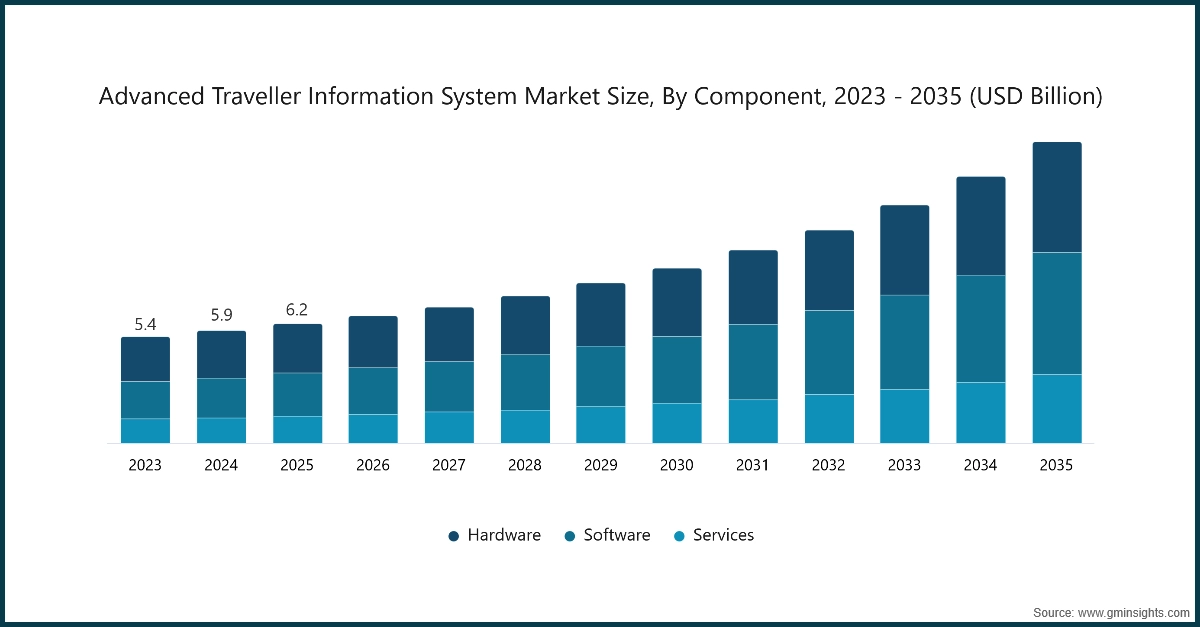
Based on component, the market is divided into hardware, software and services. The hardware segment dominated the market, accounting for around 42% share in 2025 and is expected to grow at a CAGR of over 8.7% from 2026 to 2035.
- The hardware segment dominates the advanced traveller information system market, primarily due to its critical role in supporting real-time data collection, traffic monitoring, connected vehicle integration, and communication networks across urban, regional, and highway transport systems. Hardware components, including sensors, cameras, GPS devices, roadside units, and communication infrastructure, form the backbone of advanced traveller information system platforms, enabling accurate traffic detection, predictive routing, and seamless interoperability with software and service layers.
- Other segments, including software and services, play complementary roles within advanced traveller information system solutions. Software platforms enable real-time data analytics, predictive traffic modeling, route optimization, and integration with mobile applications, while services encompass system installation, maintenance, consulting, and managed platform support. Although these segments contribute significantly to overall market adoption and enhanced traveler experience, their revenue share is smaller than that of hardware in infrastructure-intensive, high-performance, and large-scale deployments.
Learn more about the key segments shaping this market
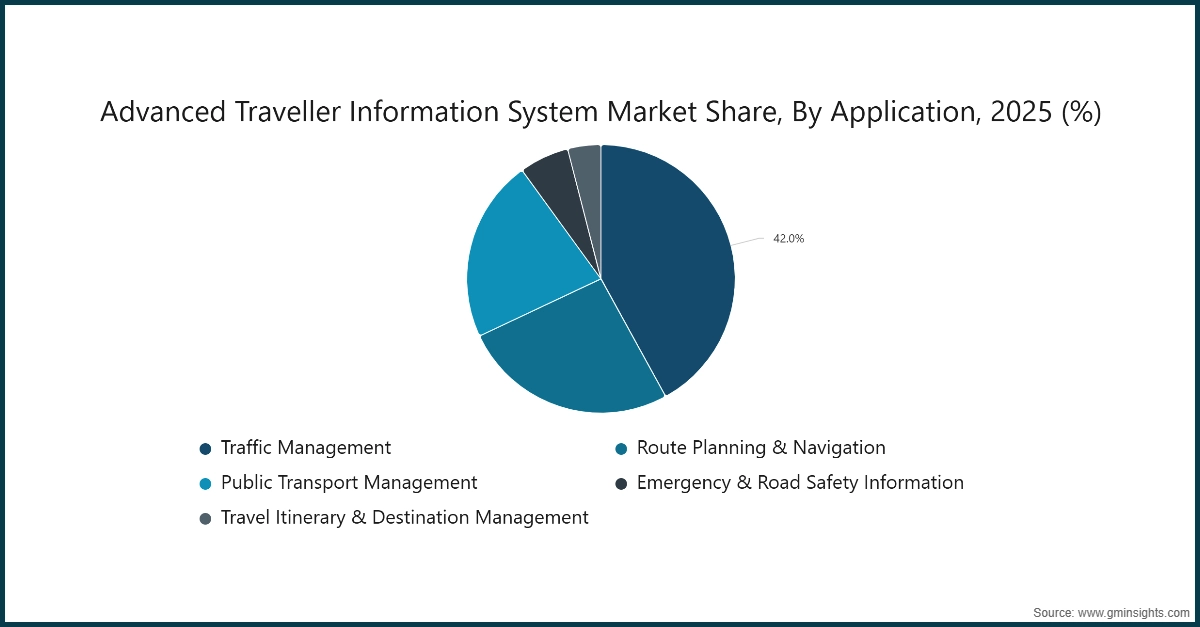
Based on application, the market is divided into traffic management, route planning & navigation, public transport management, emergency & road safety information and travel itinerary & destination management. The traffic management segment dominates the market, accounting for around 42% share in 2025, and the segment is expected to grow at a CAGR of over 12.2% from 2026 to 2035.
- The traffic management segment dominates the advanced traveller information system market, primarily due to its essential role in monitoring, controlling, and optimizing traffic flow across urban, regional, and highway networks. Growing demand for real-time congestion monitoring, AI-assisted traffic prediction, adaptive signal control, and connected vehicle integration has accelerated the adoption of traffic management solutions among city authorities, highway operators, and mobility service providers worldwide. Traffic management applications benefit from high data volumes, predictable infrastructure deployment, and integration with other mobility platforms, reinforcing this segment’s market leadership.
- Other segments, including route planning & navigation, public transport management, emergency & road safety information, and travel itinerary & destination management, play complementary roles within advanced traveller information system solutions. Route planning & navigation supports multimodal guidance and personalized traveler routing, public transport management enhances scheduling and service reliability, emergency & road safety systems improve incident response, and travel itinerary & destination management platforms provide traveler-centric journey planning.
Based on technology, the market is divided into mobile application platforms, cloud computing solutions, GPS navigation systems, communication technologies and digital signage solutions. The mobile application platforms segment dominated the market and was valued at USD 2 billion in 2025.
- The mobile application platforms segment dominates the advanced traveller information system market, primarily due to its critical role in providing real-time traveler information, route guidance, and multimodal connectivity across urban, regional, and highway networks. Mobile applications enable AI-assisted route planning, predictive congestion alerts, live traffic updates, and seamless integration with cloud-based platforms, connected vehicles, and public transport systems. Growing smartphone penetration, increasing demand for personalized traveler services, and adoption of mobile-first traffic management solutions reinforce this segment’s market leadership.
- Other technological segments, including cloud computing solutions, GPS navigation systems, communication technologies, and digital signage solutions, play complementary roles within advanced traveller information system solutions. Cloud computing platforms support data storage, analytics, and predictive modeling, GPS navigation systems provide location-based guidance, communication technologies enable vehicle-to-infrastructure and vehicle-to-vehicle connectivity, and digital signage solutions deliver real-time traveler updates at key points. Although these technologies contribute to overall system adoption and enhanced traveler experience, their revenue share is smaller than that of mobile application platforms due to the direct accessibility, scalability, and user engagement offered by mobile solutions.
Based on end use, the market is divided into government agencies, transport operators, individual consumers, and travel & tourism organizations. The government agencies segment dominated the market and was valued at USD 3 billion in 2025.
- The government agencies segment dominates the advanced traveller information system market, primarily due to its critical role in planning, managing, and regulating traffic, public transport, and urban mobility infrastructure. Government authorities are responsible for deploying city-wide traffic monitoring, congestion management, and smart mobility solutions that enhance commuter safety, reduce travel times, and improve overall network efficiency. Increasing investments in AI-assisted traffic prediction, IoT-enabled sensors, cloud-connected monitoring, and multimodal integration reinforce this segment’s market leadership.
- Other end-use segments, including transport operators, individual consumers, and travel & tourism organizations, play complementary roles within advanced traveller information system solutions. Transport operators leverage these systems for fleet management and route optimization, individual consumers use navigation and real-time travel information for personalized journey planning, and travel & tourism organizations utilize the platforms to enhance visitor mobility and experience. Although these segments contribute to overall market adoption and improved traveler services, their revenue share is smaller than that of government agencies due to the large-scale, infrastructure-driven deployments led by public authorities.
Looking for region specific data?
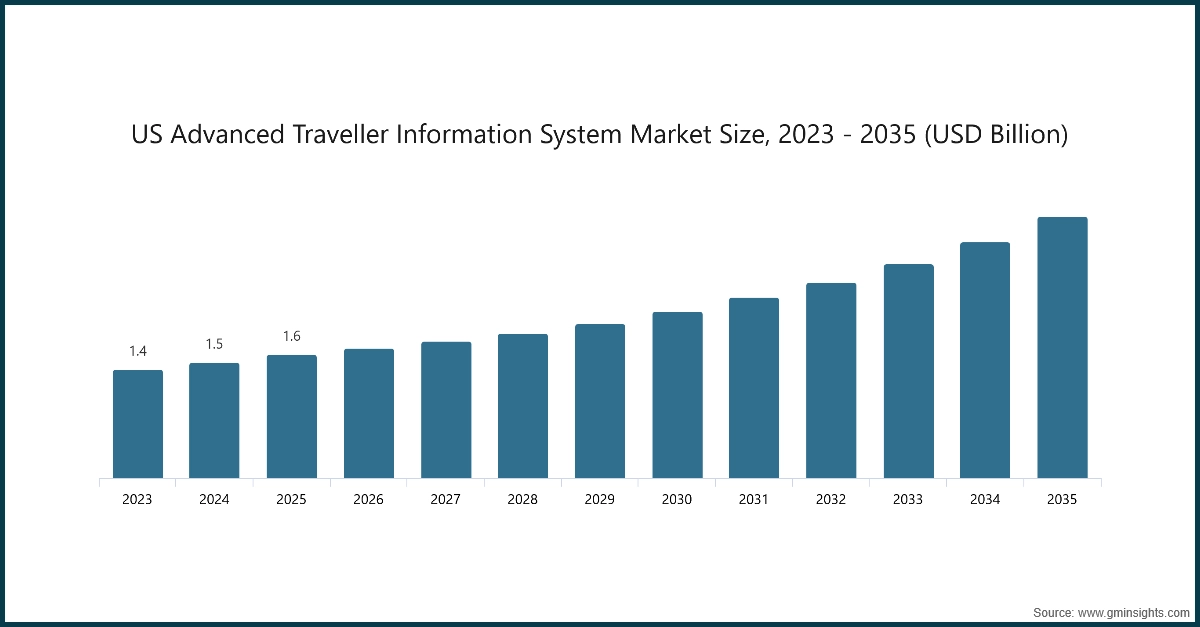
In 2025, US dominated the North America advanced traveller information system market with around 71% market share and generated approximately USD 1.6 billion in revenue.
- The North America region dominates the global market, supported by mature urban transport networks, widespread adoption of intelligent transport systems, and well-established traffic management infrastructure. The region benefits from highly developed highway and public transit systems, advanced digital traffic platforms, and integration of AI-driven route optimization and predictive analytics, positioning it as a global leader in efficient, safe, and technology-enabled traveler information services.
- Within North America, the United States accounts for the largest share, driven by a high concentration of major transport authorities, extensive urban and interstate mobility networks, and stringent traffic safety and environmental regulations. Widespread deployment of traffic monitoring sensors, cloud-connected management platforms, real-time congestion analytics, and predictive route guidance systems, combined with large-scale commuter and freight mobility demands, fuels market growth. Key metropolitan hubs such as New York, Los Angeles, Chicago, and Dallas serve as centers for smart traffic deployment, connected infrastructure, and innovation in traveler information systems.
- Leading U.S. advanced traveller information system providers, including Siemens Mobility, TomTom, HERE Technologies, Kapsch TrafficCom, and Garmin, continue to expand platform capabilities, enhance predictive analytics, and strengthen collaborations with transport authorities and mobility service providers. Ongoing investments in AI-enabled traffic monitoring, autonomous vehicle integration, cloud-connected traveler platforms, and real-time route guidance consolidate the United States’ dominant position in the market.
Germany holds share of 21% in Europe advanced traveller information system market in 2025 and it will grow tremendously between 2026 and 2035.
- Europe holds a major share of the global advanced traveller information system, supported by highly developed transport infrastructure, widespread deployment of intelligent transport systems, strict road safety regulations, and strong investments in smart mobility initiatives. European Union programs promoting connected mobility, sustainable urban transport, and digital infrastructure have accelerated the adoption of real-time traffic monitoring, AI-enabled route optimization, and cloud-based traveler information platforms across urban and intercity transport networks. Well-established highway systems, integrated public transportation, and increasing adoption of connected vehicle technologies reinforce Europe’s position as a key regional market.
- Within the region, Germany dominates the European advanced traveller information system market, driven by its advanced transportation infrastructure, strong automotive and mobility technology ecosystem, and significant government investment in smart city and intelligent transport systems. German cities and highway authorities are early adopters of real-time traffic monitoring, predictive congestion management, connected vehicle integration, and AI-powered traffic analytics platforms. Leading technology providers such as Siemens AG, HERE Technologies, Kapsch TrafficCom, Garmin, and TomTom actively collaborate with government agencies and mobility operators to deploy scalable digital traffic management solutions across highways and metropolitan areas. Continuous investments in connected mobility infrastructure, digital road networks, and integrated traveler information platforms strengthen Germany’s leadership in operational efficiency, traffic safety, and smart mobility innovation.
- Other European markets, including the United Kingdom, France, and the Netherlands, contribute significantly to regional growth. The United Kingdom emphasizes smart traffic management and connected mobility services, France focuses on sustainable urban transport systems and digital traffic platforms, while the Netherlands prioritizes smart city initiatives and integrated multimodal mobility networks. Despite growing adoption across these countries, Germany maintains its leading position in scale of deployment, technological innovation, infrastructure readiness, and comprehensive implementation of advanced traveller information system solutions across Europe.
China holds share of 55% in Asia Pacific Advanced traveller information system market in 2025 and it is expected to grow tremendously between 2026 and 2035.
- Asia-Pacific holds a major share of the advanced traveller information system, supported by rapid urbanization, expanding smart city initiatives, and increasing investments in intelligent transport systems across major economies. The region is witnessing steady growth as governments, mobility service providers, and technology companies invest in AI-driven traffic analytics, cloud-connected traffic management platforms, real-time traveler information services, and connected vehicle technologies. Expanding highway networks, large urban populations, and increasing demand for efficient traffic management solutions continue to strengthen Asia-Pacific’s position in the global advanced traveller information system market.
- China represents the largest market in Asia-Pacific, driven by large-scale deployment of smart traffic infrastructure, integrated urban mobility platforms, and real-time congestion monitoring systems across major metropolitan areas. Major urban centers such as Beijing, Shanghai, Shenzhen, and Guangzhou are experiencing high demand for predictive traffic analytics, AI-enabled route optimization, connected vehicle integration, and large-scale traffic monitoring networks.
- Other Asia-Pacific markets, including India, Japan, and South Korea, are emerging as high-growth regions supported by increasing investments in smart mobility platforms, digital traffic monitoring systems, and integrated public transport information services. India emphasizes smart city traffic management and real-time commuter information platforms, Japan focuses on advanced traffic control systems and road safety technologies, while South Korea prioritizes connected mobility infrastructure and intelligent highway management. Despite growing adoption across these countries, China remains the dominant market in Asia-Pacific, driven by large-scale infrastructure deployment, technological innovation, and strong government support for intelligent transportation and digital mobility systems.
Advanced traveller information system market in Brazil will experience significant growth between 2026 and 2035.
- Latin America holds a smaller but steadily growing share of the advanced traveller information system, supported by increasing investments in smart mobility infrastructure, urban traffic management platforms, and connected transport technologies. Governments and mobility providers across the region are gradually implementing intelligent transport systems, cloud-connected traffic monitoring platforms, real-time traveler information services, and AI-assisted congestion management solutions. Growing urban populations, expanding metropolitan transport networks, and the need to improve road safety and traffic efficiency continue to strengthen the adoption of advanced traveller information system solutions across the region.
- Within the region, Brazil dominates the Latin American advanced traveller information system market, driven by its large urban population, expanding smart city initiatives, and increasing deployment of digital traffic management technologies. Major metropolitan hubs such as São Paulo, Rio de Janeiro, and Brasília are investing in real-time traffic monitoring systems, AI-enabled route optimization platforms, connected traffic signals, and integrated traveler information services to reduce congestion and improve commuter mobility. Strong collaboration between government authorities, technology providers, and mobility service operators further accelerates the implementation of advanced traveller information system platforms across highways and urban transportation networks.
- Mexico represents the second largest and rapidly growing market in Latin America, supported by increasing investments in intelligent transport systems, connected traffic infrastructure, and digital mobility platforms. Major cities such as Mexico City, Monterrey, and Guadalajara are witnessing rising adoption of real-time traffic monitoring, cloud-based traveler information platforms, and AI-driven congestion management systems. While adoption continues to expand across the region, Brazil maintains its leading position in Latin America due to large-scale urban infrastructure, strong government initiatives in smart mobility, and increasing deployment of advanced traveller information system technologies across metropolitan transport networks.
Advanced traveller information system market in UAE will experience significant growth between 2026 and 2035.
- Middle East & Africa (MEA) holds a smaller but gradually expanding share of the global advanced traveller information system industry, supported by increasing investments in smart city infrastructure, intelligent transport systems, and digital traffic management platforms. Governments and mobility authorities across the region are adopting AI-enabled traffic monitoring, cloud-connected mobility platforms, real-time traveler information services, and integrated route optimization systems to improve road safety, reduce congestion, and enhance commuter experience. Rapid urbanization, infrastructure modernization programs, and the growing need for efficient urban mobility solutions continue to strengthen the adoption of advanced traveller information system technologies across the region.
- Within the region, the United Arab Emirates (UAE) dominates the MEA advanced traveller information system market, driven by its advanced digital infrastructure, strong smart city initiatives, and early adoption of intelligent mobility technologies. Major cities such as Dubai, Abu Dhabi, and Sharjah are investing heavily in real-time traffic monitoring platforms, AI-assisted route optimization systems, connected traffic signals, and integrated traveler information services to enhance traffic efficiency and commuter convenience. Strong collaboration between government authorities, transport operators, and technology providers further accelerates the deployment of advanced traveller information system platforms across highways, public transport systems, and urban mobility networks.
- Other MEA countries, including Saudi Arabia, South Africa, and Egypt, are emerging as high-growth markets supported by increasing investments in intelligent transport infrastructure, connected mobility platforms, and digital traffic monitoring systems. Saudi Arabia focuses on large-scale smart mobility initiatives and intelligent highway systems, South Africa emphasizes urban traffic monitoring and commuter information services, while Egypt prioritizes modernization of transport infrastructure and integrated traffic management platforms. Despite expansion across these countries, the UAE maintains its leading role in the MEA region due to its strong government support for smart mobility, advanced digital ecosystem, and large-scale implementation of advanced traveller information system solutions.
Advanced Traveller Information System Market Share
The top 7 companies in the market are Siemens, Tom Tom, Garmin, HERE Technologies, Kapsch TrafficCom, Trimble and Cubic. These companies hold around 53% of the market share in 2025.
- Siemens provides comprehensive advanced traveller information system solutions, including intelligent traffic management platforms, integrated mobility control systems, and real-time traveler information services. Siemens leverages AI-assisted traffic analytics, connected infrastructure, cloud-based mobility platforms, and predictive congestion management tools to enhance operational efficiency and traffic flow across urban and highway networks. Its strong presence in smart city infrastructure, digital mobility ecosystems, and large-scale intelligent transport deployments reinforces Siemens AG’s competitive position in the advanced traveller information system market.
- TomTom delivers advanced traveller information system solutions through high-precision digital mapping, real-time traffic intelligence, navigation software, and connected mobility platforms. TomTom integrates AI-powered route optimization, cloud-connected traffic analytics, and location-based services to provide accurate navigation guidance and congestion insights. Its strong expertise in automotive navigation systems, telematics platforms, and mobility data services strengthens TomTom’s market presence across Europe, North America, and Asia Pacific.
- Garmin offers advanced traveller information system solutions focused on GPS-based navigation, fleet monitoring platforms, and real-time route guidance technologies. Garmin leverages high-precision satellite navigation, connected vehicle platforms, and data-driven traffic information services to improve travel efficiency and user experience. Its strong portfolio in automotive navigation, consumer mobility devices, and fleet management technologies supports its growing role in the global advanced traveller information system market.
- HERE Technologies provides integrated advanced traveller information system solutions built on high-definition mapping, location intelligence platforms, and real-time traffic analytics. HERE Technologies utilizes AI-enabled geospatial data processing, predictive routing algorithms, and cloud-based mobility services to support connected vehicles, urban mobility platforms, and smart city infrastructure. Its strong collaborations with automotive manufacturers, transport authorities, and mobility service providers reinforce its strategic market position.
- Kapsch TrafficCom delivers advanced traveller information system solutions including intelligent transport infrastructure, tolling systems, and traffic monitoring platforms. Kapsch TrafficCom integrates connected road infrastructure, predictive traffic analytics, real-time traveler communication systems, and smart mobility platforms to enhance road safety and optimize traffic management. Its expertise in large-scale intelligent transport system deployments strengthens its presence across Europe, North America, and emerging mobility markets.
- Trimble provides advanced traveller information system technologies through GPS-based positioning systems, fleet management platforms, and connected mobility solutions. Trimble leverages are advanced geospatial analytics, telematics-enabled vehicle monitoring, route optimization tools, and real-time data integration to improve transportation efficiency and operational visibility. Its technology-driven solutions support logistics providers, transport operators, and mobility infrastructure developers worldwide.
- Cubic offers advanced traveller information system platforms focused on integrated transport management, public transit information services, and digital mobility infrastructure. Cubic integrates real-time passenger information systems, connected ticketing platforms, predictive mobility analytics, and cloud-based transportation management solutions to improve commuter experience and urban mobility efficiency. Its strong expertise in intelligent transport infrastructure and smart city mobility systems strengthens its competitive position in the market.
Advanced Traveller Information System Market Companies
Major players operating in the advanced traveller information system industry include:
- Cubic
- Garmin
- HERE Technologies
- INRIX
- Iteris
- Kapsch TrafficCom
- Siemens
- Thales
- TomTom
- Trimble
- The advanced traveller information system market is highly competitive, with leading providers such as Siemens, TomTom, Garmin, HERE Technologies, Kapsch TrafficCom, Trimble, Cubic, Iteris, Thales Group, and INRIX occupying key segments across intelligent traffic management systems, digital mapping platforms, real-time traveler information services, connected mobility infrastructure, and predictive traffic analytics solutions.
- Siemens, TomTom, Garmin, HERE Technologies, and Kapsch TrafficCom lead the market with comprehensive advanced traveller information system offerings, integrating real-time traffic monitoring, AI-enabled route optimization, high-precision digital mapping, connected vehicle platforms, and cloud-based mobility management solutions. These companies focus on enhancing traffic efficiency, system reliability, operational visibility, and traveler experience while maintaining strong technology ecosystems, partnerships with transport authorities, and advanced digital infrastructure capabilities.
- Trimble, Cubic, Iteris, Thales Group, and INRIX specialize in advanced, technology-driven mobility and traffic intelligence solutions, emphasizing geospatial analytics, connected infrastructure platforms, predictive congestion management, and software-enabled traveler information systems. Their technologies enable optimized traffic flow, enhanced connectivity, real-time data monitoring, and seamless integration across urban mobility networks, public transport systems, and intelligent highway infrastructure worldwide.
Advanced Traveller Information System Market Report Attributes
| Key Takeaway | Details |
|---|---|
| Market Size & Growth | |
| Base Year | 2025 |
| Market Size in 2025 | USD 6.2 Billion |
| Market Size in 2026 | USD 6.6 Billion |
| Forecast Period 2026-2035 CAGR | 10.1% |
| Market Size in 2035 | USD 15.7 Billion |
| Key Market Trends | |
| Drivers | Impact |
| Rising Urbanization and Commuter Demand | Rapid urban growth and increasing traffic congestion are driving demand for real-time traveller information systems that improve route planning and reduce travel time. |
| Government Initiatives and Smart City Programs | National and municipal investments in intelligent transport systems (ITS) and smart mobility infrastructure are accelerating ATIS deployment. |
| Technological Advancements | AI-based traffic prediction, IoT-enabled sensors, and connected vehicle technologies are enhancing system capabilities, enabling predictive routing and dynamic traveler guidance. |
| Integration of Multimodal Transport | The growing emphasis on seamless mobility across public transit, shared mobility, and private vehicles is increasing adoption of integrated ATIS platforms for optimized travel experiences. |
| Pitfalls & Challenges | Impact |
| High Implementation and Maintenance Costs | Large-scale deployment of ATIS infrastructure, including sensors, communication networks, and cloud platforms, requires significant capital investment, which may limit adoption in smaller municipalities. |
| Data Privacy and Cybersecurity Concerns | The collection, transmission, and processing of real-time traveler data pose privacy risks and make ATIS systems vulnerable to cyberattacks, which could reduce public trust. |
| Opportunities: | Impact |
| AI-Driven Analytics and Predictive Services | Advanced AI and machine learning algorithms can analyze traffic patterns, commuter behavior, and real-time conditions to provide predictive route guidance, congestion alerts, and personalized travel recommendations. |
| Expansion of Mobile and Cloud-Based Traveler Platforms | Growing smartphone penetration and cloud technology adoption enable scalable, real-time traveler information services through mobile apps, web portals, and connected platforms. |
| Market Leaders (2025) | |
| Market Leader |
16.2% market share |
| Top Players |
Collective market share in 2025 is 47% |
| Competitive Edge |
|
| Regional Insights | |
| Largest Market | North America |
| Fastest growing market | Asia Pacific |
| Emerging countries | Brazil, Mexico, UAE |
| Future outlook |
|
What are the growth opportunities in this market?
Advanced Traveller Information System Industry News
- In March 2025, Siemens launched an advanced traveller information system platform featuring AI-enabled traffic analytics, real-time congestion monitoring, connected traffic signal management, and integrated mobility control systems. The initiative aims to enhance traffic flow efficiency, operational visibility, system interoperability, and large-scale deployment across smart city and highway transportation networks.
- In February 2025, TomTom expanded its advanced traveller information system portfolio by introducing high-precision digital mapping services, cloud-based traffic intelligence platforms, and AI-powered route optimization tools. The rollout focuses on improving navigation accuracy, real-time traffic insights, and adoption across automotive manufacturers, mobility service providers, and urban transport authorities worldwide.
- In January 2025, HERE Technologies upgraded its location intelligence and traffic data solutions with advanced geospatial analytics, predictive congestion forecasting, and connected vehicle integration platforms. The initiative targets improved traveler information services, optimized routing efficiency, and enhanced operational performance for mobility operators and smart city infrastructure deployments.
- In December 2024, Kapsch TrafficCom introduced an advanced traveller information system solution combining intelligent transport infrastructure, AI-driven traffic monitoring systems, predictive traffic management tools, and real-time traveler communication platforms. The deployment aims to improve traffic safety, reduce congestion, and strengthen digital traffic management capabilities across urban and intercity transport networks.
- In October 2024, Trimble and Cubic launched integrated advanced traveller information system platforms featuring connected mobility management tools, GPS-based positioning systems, predictive traffic analytics, and cloud-enabled transportation management solutions. The initiative emphasizes enhanced connectivity, improved traveler experience, and seamless integration across public transport systems, highway networks, and smart mobility ecosystems.
The advanced traveller information system market research report includes in-depth coverage of the industry with estimates & forecasts in terms of revenue ($ Bn) and volume (Units) from 2022 to 2035, for the following segments:
Market, By Component
- Software
- Data Processing & Traffic Analytics Platforms
- Mobile Application Software
- Real-Time Routing & Navigation Algorithms
- API & Data Exchange Platforms
- AI-Based Predictive Traffic Modeling
- Hardware
- Sensors & Loop Detectors
- GPS Devices & Navigation Units
- Digital Signage & Variable Message Signs
- Kiosks & Public Display Terminals
- Cameras & Video Surveillance Equipment
- Edge Computing & Communication Controllers
- Services
- System integration & implementation
- Consulting & advisory services
- Maintenance & lifecycle support
- Data management & cloud hosting services
- Managed its services
Market, By Technology
- Mobile Application Platforms
- Cloud Computing Solutions
- GPS Navigation Systems
- Communication Technologies
- Digital Signage Solutions
Market, By Application
- Traffic Management
- Route Planning & Navigation
- Public Transport Management
- Emergency & Road Safety Information
- Travel Itinerary & Destination Management
Market, By End Use
- Government Agencies
- Transport Operators
- Individual Consumers
- Travel & Tourism Organizations
The above information is provided for the following regions and countries:
- North America
- US
- Canada
- Europe
- UK
- Germany
- France
- Italy
- Spain
- Belgium
- Netherlands
- Sweden
- Asia Pacific
- China
- India
- Japan
- Australia
- Singapore
- South Korea
- Vietnam
- Indonesia
- Latin America
- Brazil
- Mexico
- Argentina
- MEA
- South Africa
- Saudi Arabia
- UAE
Frequently Asked Question(FAQ) :
What is the market size of the advanced traveller information system in 2025?
The global advanced traveller information system (ATIS) market was valued at USD 6.2 billion in 2025, driven by rising commuter demand for real-time travel information, and growing government investments in intelligent transport systems.
What is the projected value of the advanced traveller information system industry by 2035?
The ATIS market is projected to reach USD 15.7 billion by 2035, growing at a CAGR of 10.1% from 2026 to 2035, supported by AI-based route optimization.
What is the advanced traveller information system industry size in 2026?
The ATIS market size is projected to reach USD 6.6 billion in 2026, fueled by accelerating investments in connected infrastructure, real-time traffic monitoring, and integrated traveler information platforms.
How much revenue did the hardware segment generate in 2025?
The hardware segment accounted for approximately 42% share in 2025, driven by its critical role in real-time data collection.
What was the valuation of the mobile application platforms segment in 2025?
The mobile application platforms segment was valued at USD 2 billion in 2025, driven by AI-assisted route planning, predictive congestion alerts, and seamless integration with cloud-based platforms and public transport systems.
What was the valuation of the government agencies end-use segment in 2025?
The government agencies segment was valued at USD 3 billion in 2025, reflecting its critical role in planning, managing, and regulating traffic, public transport.
Which region leads the advanced traveller information system market?
North America leads the global ATIS market, with the United States accounting for approximately 71% of the regional share and generating around USD 1.6 billion in 2025.
What are the upcoming trends in the advanced traveller information system market?
Key trends include the integration of AI-driven traffic prediction and IoT-enabled sensors, rising adoption of connected vehicle technologies, and increasing focus on sustainable and data-driven urban mobility solutions.
Who are the key players in the advanced traveller information system market?
Key players include Siemens, TomTom, Garmin, HERE Technologies, Kapsch TrafficCom, Trimble, Cubic, Iteris, Thales, and INRIX.
Advanced Traveller Information System Market Scope
Related Reports