Summary
Table of Content

Advanced Biofuel Market
Get a free sample of this report
Form submitted successfully!
Error submitting form. Please try again.
Thank you!
Your inquiry has been received. Our team will reach out to you with the required details via email. To ensure that you don't miss their response, kindly remember to check your spam folder as well!
Request Sectional Data
Thank you!
Your inquiry has been received. Our team will reach out to you with the required details via email. To ensure that you don't miss their response, kindly remember to check your spam folder as well!
Form submitted successfully!
Error submitting form. Please try again.
Advanced Biofuel Market Size
- The growing policy focus on reducing dependence on imported crude oil to strengthen national energy security is significantly driving advanced biofuel demand. Countries seeking to diversify their energy mix are increasingly prioritizing domestically produced, renewable fuels to mitigate supply disruptions and price volatility. Advanced biofuels support a resilient energy system by offering scalable alternatives compatible with existing infrastructure, while also aligning with long‑term energy independence goals across both developed and emerging economies.
- Advanced biofuels are produced from non‑food biomass such as agricultural residues, algae, waste oils, and lignocellulosic materials. Unlike conventional biofuels, they deliver higher greenhouse gas reductions, improved energy efficiency, and better compatibility with existing fuel infrastructure, supporting decarbonization across transport, power generation, and industrial energy systems, while enabling energy security and diversification through sustainable domestic fuel production globally.
- Increasing government backing through financial grants, fiscal incentives, and supportive policy frameworks is accelerating advanced biofuel adoption. Rising public-sector involvement is improving project bankability and reducing commercialization risks for emerging technologies. In January 2025, the U.S. Department of Energy’s Bioenergy Technologies Office, along with the Environmental Protection Agency, allocated USD 6 million to three projects focused on advancing biofuel innovation and emissions reduction, underlining strong federal commitment to sector growth.
- The expanding use of agricultural residues, algae, waste oils, and other non‑food biomass sources is improving feedstock availability while enhancing sustainability across the biofuel value chain. These resources reduce competition with food crops and support circular economy principles. Coupled with improvements in logistics and preprocessing, diversified feedstock integration is enabling stable input supplies, lowering production risk, and strengthening the environmental and economic viability of advanced biofuel deployment globally.
- Asia Pacific is among the dominant regions due to increasing government mandates and decarbonization targets are accelerating advanced biofuel adoption, as countries seek to cut transport emissions while improving energy security. Policies promoting low‑carbon fuels, blending obligations, and incentives for domestic biofuel production are encouraging investment in advanced technologies using non‑food feedstocks. Rapid growth in aviation, shipping, and heavy transport further strengthens demand for sustainable fuels that can integrate with existing infrastructure while supporting long‑term climate commitments across emerging and developed economies regionwide in the region.
- Ongoing government support to escalate advanced biofuel adoption will propel the business scenario. For instance, in January 2026, the Indian Sugar & Bio‑Energy Manufacturers Association (ISMA) sought up to USD 2.1 billion in budgetary support to boost advanced biofuels such as second‑generation ethanol and sustainable aviation fuel, aiming to manage sugar surplus, ease pricing pressures, and strengthen biofuel innovation.
- The Middle East & Africa is the fastest-growing region in the advanced biofuel market. Increasing regional commitments to diversify energy economies beyond fossil fuels are driving advanced biofuel adoption across the region, as governments pursue long‑term sustainability and energy transition goals. National strategies emphasize low‑carbon fuels for aviation, shipping, and industrial use, supported by renewable energy targets and pilot bioenergy programs. Rising interest in utilizing municipal waste, agricultural residues, and algae-based feedstocks further strengthens adoption, as these resources align with circular economy objectives while reducing emissions and enhancing domestic fuel production resilience.
The global advanced biofuel market was estimated at USD 1.6 billion in 2025. The market is expected to grow from USD 1.7 billion in 2026 to USD 6.3 billion in 2035, at a CAGR of 15.1%, according to Global Market Insights Inc.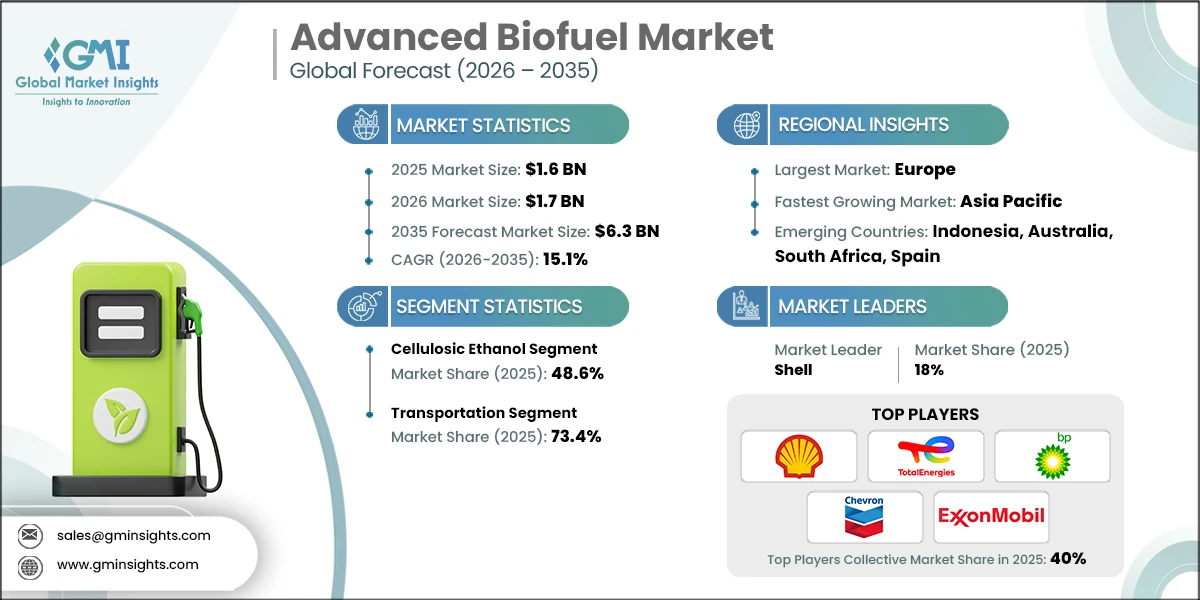
Advanced Biofuel Market Key Takeaways
Market Size & Growth
- 2025 Market Size: USD 1.6 Billion
- 2026 Market Size: USD 1.7 Billion
- 2035 Forecast Market Size: USD 6.3 Billion
- CAGR (2026–2035): 15.1%
Regional Dominance
- Largest Market: Europe
- Fastest Growing Region: Asia Pacific
Key Market Drivers
- Rising energy security and decarbonization focus.
- Increasing government policy and financial support.
Challenges
- High production and capital costs.
- Feedstock supply and infrastructure constraints.
Opportunity
- Growing demand for sustainable aviation and marine fuels.
- Advancements in conversion technologies and feedstock innovation.
Key Players
- Market Leader: Shell led with over 18% market share in 2025.
- Leading Players: Top 5 players in this market include Shell, TotalEnergies, BP, Chevron, ExxonMobil, which collectively held a market share of 40% in 2025.
Get Market Insights & Growth Opportunities
To get key market trends
Advanced Biofuel Market Trends
- Rising government support through favorable regulations and incentive mechanisms is significantly strengthening advanced biofuel industry penetration. Frameworks such as the U.S. Renewable Fuel Standard and the EU Renewable Energy Directive are creating assured demand, while fiscal tools, including investment‑linked and production‑based tax incentives, are lowering project risk. These measures are encouraging long‑term capital inflows, accelerating commercialization timelines, and fostering continuous innovation across advanced biofuel production pathways.
- Rising public funding allocations for bioenergy development are accelerating advanced biofuel adoption globally. Programs led by national and regional agencies are supporting pilot‑to‑commercial scale transitions, particularly for waste‑based and next‑generation fuels. In February 2024, U.S. authorities announced a dedicated funding opportunity under the Investing in America initiative to advance biofuel technologies, reinforcing the government's commitment to scaling low‑carbon fuel solutions.
- Rising corporate pressure to achieve net‑zero emissions is boosting demand for advanced biofuels across aviation, shipping, and logistics, where electrification remains challenging. Drop‑in fuels requiring minimal infrastructure changes are gaining preference. Simultaneously, oil‑importing economies are promoting domestic biofuel production to enhance energy security, reduce crude dependency, and stimulate rural development through biorefinery investments, strengthening long‑term market prospects.
- Companies' growing adoption of collaboration and agreement as a strategic move to grow in the advanced biofuel business will complement the industry growth. For instance, ECB Group and BP signed an advanced biofuel offtake agreement covering over 1 billion litres of low‑carbon fuels from the Omega Green biorefinery in Paraguay, with production starting in 2024, supporting renewable diesel and sustainable aviation fuel supply.
- Additionally, increasing focus on diversifying feedstocks beyond conventional waste oils is expanding advanced biofuel supply potential. Greater utilization of agricultural residues, forestry waste, municipal solid waste, and lignocellulosic biomass is improving feedstock security while reducing competition with food resources. This diversification enhances scalability, stabilizes input costs, and supports compliance with stricter sustainability criteria across global regulatory frameworks.
Advanced Biofuel Market Analysis
Learn more about the key segments shaping this market
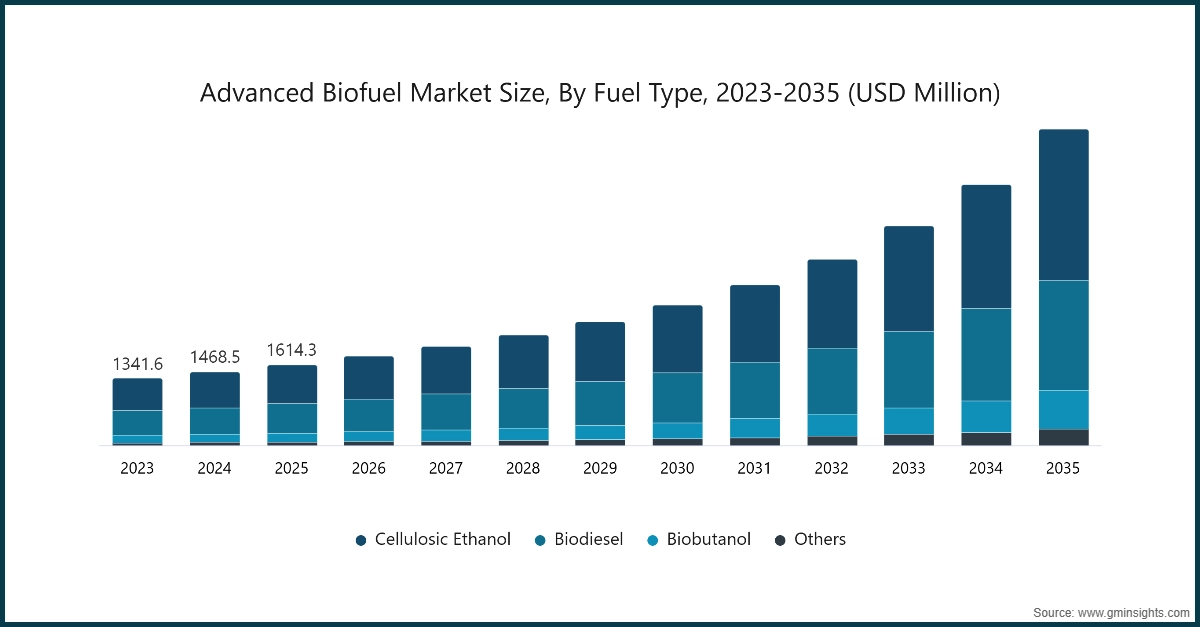
Based on fuel type, the industry is segmented into cellulosic ethanol, biodiesel, biobutanol and others. Cellulosic ethanol dominated the advanced biofuel market, accounting for 48.6% in 2025 and is expected to grow at a CAGR of 14.8% through 2035.
- Rising technological progress across pretreatment, enzymatic hydrolysis, and fermentation processes is improving the economic feasibility of cellulosic ethanol. Enhanced conversion efficiencies, better enzyme performance, and improved feedstock utilization are lowering production costs, supporting scale‑up, and enabling broader integration of cellulosic ethanol into transportation fuel markets.
- Additionally, increasing regulatory emphasis on non‑food‑based advanced biofuels is driving cellulosic ethanol adoption, as it is produced from agricultural residues, forestry waste, and dedicated energy crops. This pathway helps governments meet advanced biofuel blending mandates, reduce food‑fuel conflicts, and achieve deeper lifecycle greenhouse gas emission reductions.
- Biodiesel market will grow at a CAGR of 14.6% by 2035. Increasing regulatory support for low‑carbon, waste‑based fuels is driving biodiesel adoption within advanced biofuels. Biodiesel produced from used cooking oil, animal fats, and other residues qualifies under advanced biofuel mandates, enabling compliance with emission reduction targets while supporting rapid deployment through existing diesel infrastructure, leading to uplift its adoption.
- The biobutanol segment is expected to generate revenue of USD 700 million by 2035. The segment remains in an early growth phase, with rising government backing expected to unlock its full commercial potential and support market penetration. In November 2021, the U.S. Department of Energy’s ARPA‑E awarded USD 1.6 million to research teams from the University of Illinois Urbana‑Champaign, Ohio State University, and Southern Illinois University Edwardsville to advance biobutanol production technologies focused on improving yields and lowering production costs.
Learn more about the key segments shaping this market
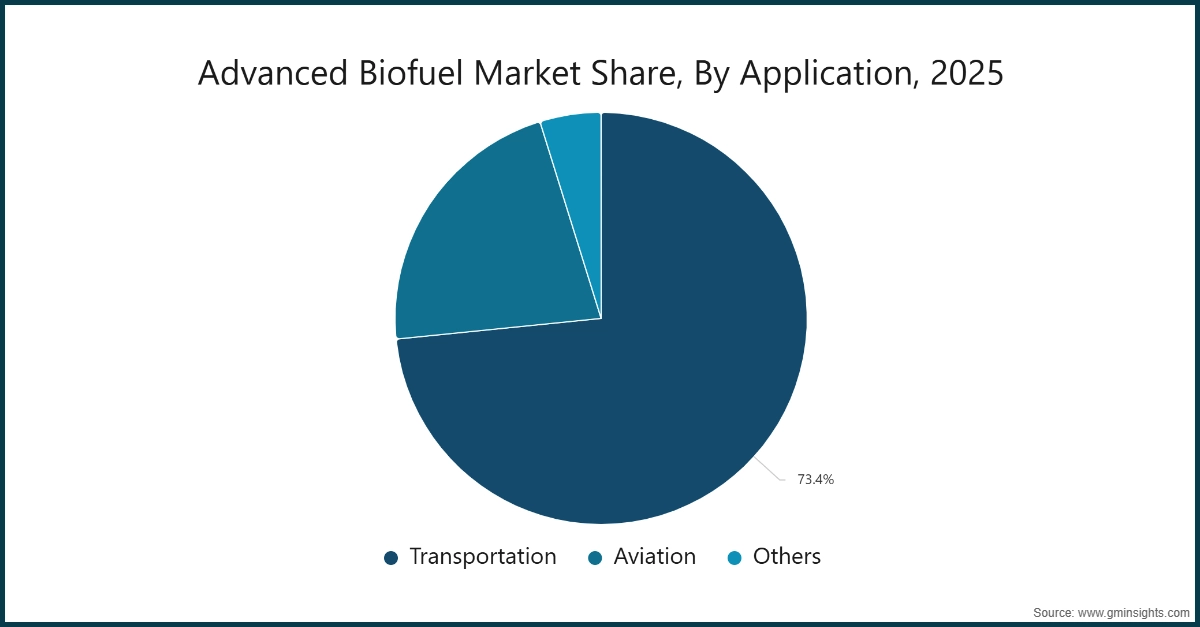
Based on application, the advanced biofuel market is segmented into transportation, aviation and others. Transportation application dominates the market with a 73.4% share in 2025, and the segment is expected to grow at a CAGR of 14.7% from 2026 to 2035.
- Rising commitments by national governments and large corporations to achieve net‑zero emissions targets by 2050 are accelerating advanced biofuel adoption. Biofuels deliver substantial lifecycle CO₂ reductions compared to conventional fossil fuels, making them a critical decarbonization pathway for transportation segments where electrification remains limited. As sustainability strategies mature, advanced biofuels are increasingly being integrated into long‑term emission‑reduction roadmaps for both public and private sector stakeholders.
- Growing adoption across hard‑to‑electrify sectors such as trucking, rail, and shipping is supporting advanced biofuel deployment due to their high energy density and infrastructure compatibility. In July 2022, Hapag‑Lloyd partnered with DHL Global Forwarding to transport cargo using advanced biofuels, initially covering 18,000 TEU, highlighting rising commercial acceptance of waste‑based fuels for lowering emissions in global freight operations.
- Aviation segment is set to grow at a CAGR of 16% till 2035. Growing government backing through new regulations, blending mandates, and financial incentives is creating strong growth opportunities for sustainable aviation fuel adoption. Policy measures aimed at reducing aviation emissions are encouraging airlines, fuel producers, and investors to prioritize SAF integration. These initiatives are strengthening market confidence, lowering investment risk, and supporting long‑term demand visibility, positioning SAF as a critical solution for decarbonizing the aviation sector.
- Ongoing capacity expansion initiatives for sustainable aviation fuel, supported by government collaboration, are accelerating market deployment. In May 2022, SGP BioEnergy partnered with the Government of Panama to develop Biorefineria Ciudad Dorada, a large‑scale biofuels hub in Colon and Balboa. Planned over five years, the facility is designed to produce substantial volumes of advanced biofuels, with SAF forming a core output to address global aviation fuel decarbonization needs.
Looking for region specific data?
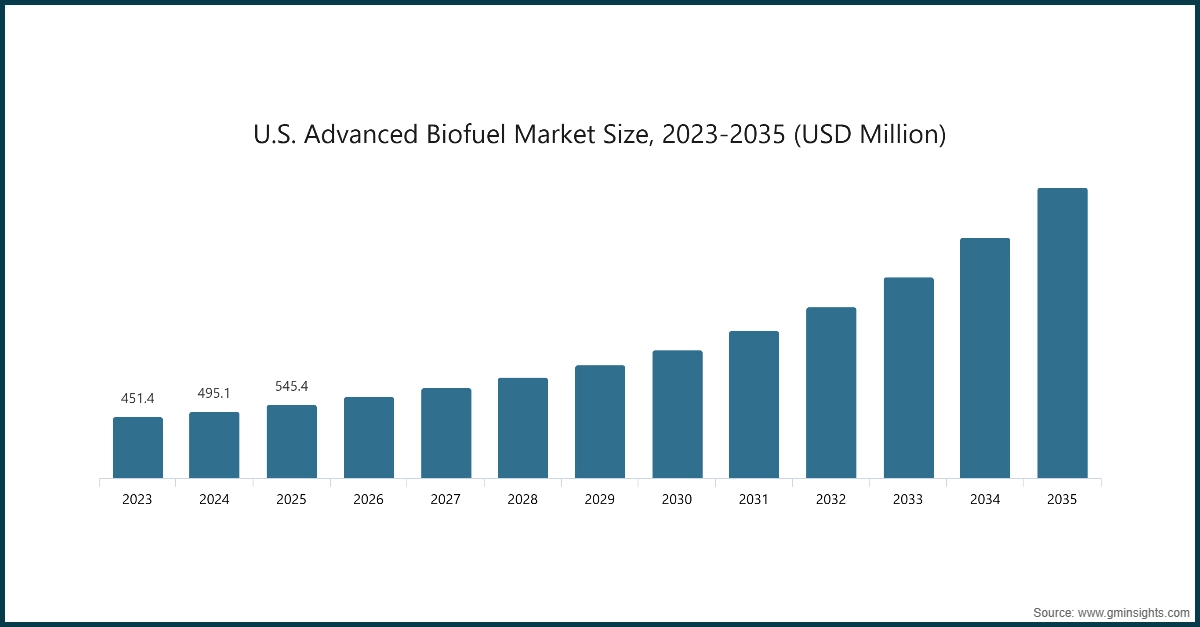
- The U.S. dominated the advanced biofuel market in North America with around 93.4% share in 2025 and is expected to generate over USD 2 billion in revenue by 2035.
- Widespread availability of agricultural feedstocks, including corn, soybeans, and agricultural residues, combined with growing climate change concerns, is strengthening advanced biofuel adoption in the U.S. For instance, as per USDA, the 2025/26 U.S. corn crop is projected to be the largest on record, with production estimated at over 17 billion bushels. These resources support large‑scale production while reducing lifecycle emissions. In parallel, supportive policy frameworks such as the Renewable Fuel Standard, administered by the U.S. Environmental Protection Agency, mandate renewable fuel blending, providing demand certainty and accelerating the commercialization of advanced biofuels across the national fuel mix.
- Moreover, strong presence of key industry players and continued investment in advanced biotechnology are enhancing the U.S. advanced biofuel landscape. Companies are focusing on cellulosic and algae‑based fuels to achieve deeper emission reductions. In January 2022, ExxonMobil reinforced its advanced biofuel strategy by acquiring a 49.9% stake in Biojet AS, aiming to convert forestry residues and wood‑based construction waste into lower‑carbon biofuels and fuel components for transportation markets.
- The North America advanced biofuel market accounted for a market value of USD 2.3 billion in 2025. Increasing strength of low‑carbon fuel credit markets in the region, particularly state‑ and province‑level programs such as California’s Low Carbon Fuel Standard and similar Canadian frameworks, is improving revenue certainty for advanced biofuels, encouraging regional production capacity expansion and accelerating adoption across transportation fuel markets.
- Europe advanced biofuel market is anticipated to grow to over USD 2.1 billion by 2035. Increasing deployment of advanced biofuels to decarbonize maritime and inland waterways in Europe is accelerating regional adoption, as shipping faces limited electrification options. European ports, logistics operators, and vessel owners are prioritizing low‑carbon liquid fuels to comply with tightening maritime emissions targets and fuel standards.
- Rising implementation of ambitious renewable energy targets under Europe’s Renewable Energy Directive (RED II) is supporting wider penetration of advanced biofuels across the region. Alongside policy momentum, increasing preference among European consumers and businesses for sustainable energy solutions is strengthening demand for renewable fuels, thereby accelerating the adoption and integration of advanced biofuels within the regional energy mix.
- Asia Pacific advanced biofuel market is anticipated to grow at a CAGR of 18% by 2035. Aggressive regional decarbonization goals and commitments to net‑zero emissions are supporting the rising adoption of advanced biofuels. As countries seek low‑carbon alternatives to conventional fuels, advanced biofuels are gaining traction. Simultaneously, growing investments in bio‑refinery infrastructure and continuous improvements in biomass conversion technologies are enhancing commercial viability, supporting faster market adoption.
Advanced Biofuel Market Share
- The top 5 companies, including Shell, TotalEnergies, BP, Chevron and ExxonMobil, account for around 40% market share. Key players are expanding access to diverse, non‑food feedstocks such as agricultural residues, forestry waste, and municipal solid waste. Securing long‑term feedstock supply agreements reduces cost volatility, improves scalability, and strengthens compliance with sustainability criteria across advanced biofuel regulations.
- Companies are prioritizing continuous improvements in conversion technologies, including enzymatic, thermochemical, and gasification pathways. Enhancing yield efficiency, lowering energy intensity, and increasing feedstock flexibility improve production economics, support commercialization, and enable competitive positioning within evolving advanced biofuel markets.
- Players are forming partnerships with airlines, logistics providers, and fuel distributors to secure long‑term offtake agreements. These collaborations reduce demand uncertainty, improve project bankability, and accelerate capacity expansion by aligning production growth directly with end‑user decarbonization commitments.
- Moreover, advanced biofuel producers are aligning products with existing fuel infrastructure to enable drop‑in compatibility. Leveraging current refineries, pipelines, and distribution networks minimizes capital expenditure, lowers adoption barriers, and accelerates market penetration across transportation and industrial fuel segments.
Advanced Biofuel Market Companies
Eminent players operating in the advanced biofuel industry are:
- Advance Biofuel
- Aemetis
- Blue Biofuels
- Borregaard
- BP
- Byogy Renewables
- Chevron
- Clariant
- Enerkem
- ExxonMobil
- Gevo
- GranBio
- Green Plains
- Galp
- Indian Oil Corporation Limited
- Logen
- Praj Industries
- Shell
- TotalEnergies
- Votion Biorefineries
- Shell is actively scaling advanced biofuel production through investments in sustainable aviation fuel, renewable diesel, and bio-based feedstocks. The company focuses on waste‑ and residue‑based pathways while integrating biofuels into its global refining and distribution network.
- TotalEnergies is expanding its advanced biofuel portfolio by converting conventional refineries into biorefineries and prioritizing low‑carbon feedstocks. Its strategy emphasizes sustainable aviation fuel, renewable diesel, and alignment with European decarbonization and energy transition targets.
- BP a leading player in the advanced biofuels market, posted strong financial performance in 2024, with operating cash flow reaching approximately USD 27.3 billion. In February 2024, BP Europe actively pushed for revisions to the European Union’s biofuel policy framework, advocating an expanded definition of “advanced” biofuels. The proposed changes aim to incorporate a broader range of crop‑based feedstocks, enabling their eligibility for use in sustainable aviation fuel as alternatives to conventional fossil fuels.
- Chevron is advancing biofuel development by investing in renewable fuels and partnering across the bioenergy value chain. Its approach focuses on scalable, drop‑in biofuels that leverage existing infrastructure while supporting long‑term emissions reduction goals.
- ExxonMobil reported fourth-quarter 2025 earnings of USD 6.5 billion, or 1.53 per share. The company generated USD 12.7 billion in operating cash flow, with free cash flow totaling USD 5.6 billion. The company is advancing biofuels through large‑scale research, partnerships, and pilot projects focused on algae‑based and waste‑derived fuels, aiming to deliver lower‑emission alternatives for transportation and industrial sectors while leveraging its refining, distribution, and commercialization expertise.
Advanced Biofuel Market Report Attributes
| Key Takeaway | Details |
|---|---|
| Market Size & Growth | |
| Base Year | 2025 |
| Market Size in 2025 | USD 1.6 Billion |
| Market Size in 2026 | USD 1.7 Billion |
| Forecast Period 2026-2035 CAGR | 15.1% |
| Market Size in 2035 | USD 6.3 Billion |
| Key Market Trends | |
| Drivers | Impact |
| Rising energy security and decarbonization focus | Rising national efforts to reduce dependency on fossil fuels and achieve climate commitments are accelerating advanced biofuel adoption, particularly for transport, aviation, and industrial sectors requiring low‑carbon fuel alternatives. |
| Increasing government policy and financial support | Increasing policy interventions, blending mandates, and targeted public funding for second‑generation ethanol, SAF, and renewable diesel are improving project economics and encouraging commercialization of advanced biofuel technologies globally. |
| Pitfalls & Challenges | Impact |
| High production and capital costs | High capital expenditure, complex conversion technologies, and elevated operational costs compared to conventional fuels limit widespread advanced biofuel deployment, particularly in price‑sensitive and developing markets. |
| Feedstock supply and infrastructure constraints | Limited availability of sustainable feedstocks, inconsistent biomass quality, and underdeveloped collection and logistics infrastructure create supply uncertainties, restricting large‑scale investment and long‑term capacity expansion. |
| Opportunities: | Impact |
| Growing demand for sustainable aviation and marine fuels | Rising aviation and maritime decarbonization requirements present strong growth opportunities for advanced biofuels, especially sustainable aviation fuel, due to limited direct electrification alternatives in these segments. |
| Advancements in conversion technologies and feedstock innovation | Continuous innovation in bioconversion processes, enzyme efficiency, and non‑food feedstocks such as algae and waste oils offers opportunities to improve yields, reduce costs, and enhance commercial viability. |
| Market Leaders (2025) | |
| Market Leader |
18% Market Share |
| Top Players |
Collective Market Share of 40% |
| Competitive Edge |
|
| Regional Insights | |
| Largest Market | Europe |
| Fastest growing market | Asia Pacific |
| Emerging countries | Indonesia, Australia, South Africa, Spain |
| Future outlook |
|
What are the growth opportunities in this market?
Advanced Biofuel Industry News
- In January 2025, Galp received key reactors for its Sines refinery advanced biofuel project in Portugal. The facility will manufacture advanced biofuels, including sustainable aviation fuel and renewable diesel, from 2026, supported by integration with an industrial‑scale green hydrogen unit.
- In August 2024, the Union Cabinet approved revisions to the Pradhan Mantri JI‑VAN Yojana to reflect evolving biofuel technologies and stimulate greater investment. The updated scheme extends its validity through 2028–29 and expands coverage to advanced biofuels derived from lignocellulosic sources, including agricultural and forestry residues, synthesis gas, and algae. It also places stronger emphasis on projects adopting innovative, multi‑feedstock technologies.
The advanced biofuel market research report includes an in-depth coverage of the industry with estimates & forecast in terms of revenue and volume in “USD Million & MT” from 2022 to 2035, for the following segments:
Market, By Fuel Type
- Cellulosic ethanol
- Biodiesel
- Biobutanol
- Others
Market, By Feedstock
- Agriculture
- Forestry
- Waste
- Others
Market, By Application
- Transportation
- Aviation
- Others
The above information has been provided for the following regions and countries:
- North America
- U.S.
- Canada
- Europe
- Germany
- France
- Spain
- UK
- Italy
- Asia Pacific
- China
- India
- Indonesia
- Australia
- Middle East & Africa
- Saudi Arabia
- South Africa
- Latin America
- Brazil
- Argentina
Frequently Asked Question(FAQ) :
What was the market size of the advanced biofuel in 2025?
The market was valued at USD 1.6 billion in 2025, with a CAGR of 15.1% expected through 2035. The market growth is driven by policy focus on reducing crude oil dependency and increasing energy security.
What is the projected value of the advanced biofuel market by 2035?
The market is poised to reach USD 6.3 billion by 2035, supported by government incentives, diversification of feedstocks, and rising demand for renewable energy solutions.
What is the expected size of the advanced biofuel industry in 2026?
The market size is projected to reach USD 1.7 billion in 2026.
What was the market share of cellulosic ethanol in 2025?
Cellulosic ethanol accounted for 48.6% of the market in 2025 and is expected to grow at a CAGR of 14.8% through 2035.
What was the market share of the transportation application in 2025?
The transportation application dominated the market with a 73.4% share in 2025 and is set to expand at a CAGR of 14.7% up to 2035.
What is the growth outlook for the aviation segment through 2035?
The aviation segment is expected to grow at a CAGR of 16% until 2035, led by government regulations, blending mandates, and financial incentives promoting sustainable aviation fuel (SAF) adoption.
Which region leads the advanced biofuel sector?
The U.S. leads the market in North America, holding a 93.4% share in 2025 and is expected to generate over USD 2 billion in revenue by 2035.
What are the upcoming trends in the advanced biofuel market?
Key trends include strong policy support and funding for bioenergy, expansion to diverse feedstocks, and rising corporate net-zero commitments, along with increasing strategic partnerships shaping the market.
Who are the key players in the advanced biofuel industry?
Key players include Advance Biofuel, Aemetis, Blue Biofuels, Borregaard, BP, Byogy Renewables, Chevron, Clariant, Enerkem, ExxonMobil, Gevo, GranBio, and Green Plains.
Advanced Biofuel Market Scope
Related Reports