Summary
Table of Content

ADAS Simulation Market
Get a free sample of this report
Form submitted successfully!
Error submitting form. Please try again.
Thank you!
Your inquiry has been received. Our team will reach out to you with the required details via email. To ensure that you don't miss their response, kindly remember to check your spam folder as well!
Request Sectional Data
Thank you!
Your inquiry has been received. Our team will reach out to you with the required details via email. To ensure that you don't miss their response, kindly remember to check your spam folder as well!
Form submitted successfully!
Error submitting form. Please try again.
ADAS Simulation Market Size
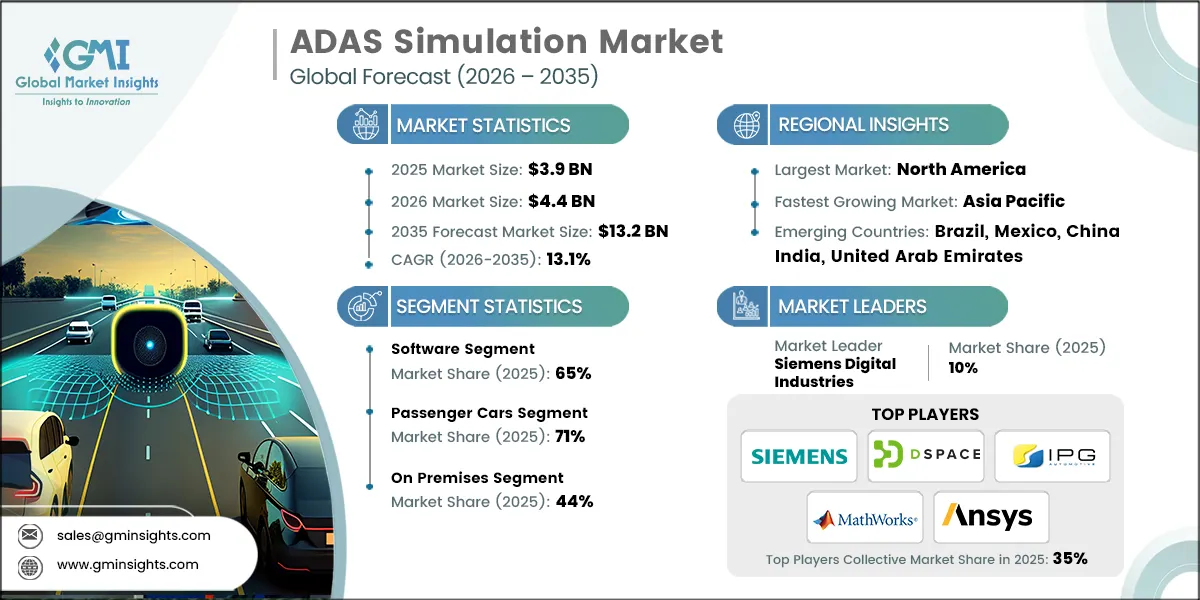
The global ADAS simulation market was estimated at USD 3.9 billion in 2025. The market is expected to grow from USD 4.4 billion in 2026 to USD 13.2 billion in 2035, at a CAGR of 13.1%, according to latest report published by Global Market Insights Inc.
ADAS Simulation Market Key Takeaways
Market Size & Growth
- 2025 Market Size: USD 3.9 Billion
- 2026 Market Size: USD 4.4 Billion
- 2035 Forecast Market Size: USD 13.2 Billion
- CAGR (2026–2035): 13.1%
Regional Dominance
- Largest Market: North America
- Fastest Growing Region: Asia Pacific
Key Market Drivers
- Rising stringency in government safety regulations.
- Need to reduce physical testing costs.
- Accelerated development timelines for ADAS.
- Growth in autonomous vehicle development.
- Technological advancements in AI & sensor fusion.
Challenges
- High initial investment for simulation platforms.
- Lack of standardization across platforms.
Opportunity
- Simulation-as-a-service (SaaS) business models.
- Expansion into emerging autonomous vehicle markets.
- Regional market growth in Asia Pacific.
- Integration with generative AI for scenario creation.
Key Players
- Market Leader: Siemens Digital Industries led with over 10% market share in 2025.
- Leading Players: Top 5 players in this market include Siemens Digital Industries, Ansys, dSPACE, MathWorks, IPG Automotive, which collectively held a market share of 35% in 2025.
Get Market Insights & Growth Opportunities
Advanced Driver Assistance Systems simulation has emerged as a critical enabling for automotive innovation, providing virtual testing environments that replicate real-world driving scenarios with unprecedented accuracy.
The market includes software platforms, hardware-in-the-loop systems, and professional services that help automotive manufacturers and technology providers validate ADAS functionalities. Simulation environments have advanced from basic testing to digital twins, capable of replicating millions of driving miles efficiently.
The rapid adoption of ADAS simulations is driven by regulatory, economic, and technological factors. For instance, January 2025, the European Commission announced enhanced safety assessment protocols requiring manufacturers to demonstrate ADAS performance across 10,000 standardized virtual scenarios before vehicle certification.
In March 2025, the US National Highway Traffic Safety Administration (NHTSA) expanded its New Car Assessment Program (NCAP) to include simulation-validated ADAS metrics. This move effectively mandated the use of virtual testing infrastructure throughout the automotive value chain. Such regulatory shifts have spurred a heightened demand for advanced simulation platforms. These platforms can replicate a wide array of environmental conditions, traffic patterns, and edge cases scenarios that would be either too costly or hazardous to test in real life.
North America dominates the market due to early autonomous vehicle commercialization by tech firms and OEMs. Europe faces growth challenges from GDPR compliance but benefits from advanced safety regulations. Asia Pacific sees rapid expansion, driven by high EV production, with Chinese manufacturers leveraging ADAS for domestic and export market differentiation.
To get key market trends
ADAS Simulation Market Trends
The market is undergoing significant transformation, driven by evolving regulations, technological advancements, and shifting economic models, accelerating the move toward autonomous mobility.
Subscription-based SaaS platforms are replacing the traditional capital expenditure model for ADAS simulation infrastructure, making advanced testing capabilities more accessible. This transition tackles the hefty initial investment barrier, ranging from USD 2.5 to 15 million, which has limited market entry for Tier 2 suppliers and startups in the autonomous vehicle sector.
Cloud-native simulation platforms enable pay-per-use pricing models where companies access enterprise-grade testing environments for monthly fees ranging from USD 15,000 to USD 200,000 depending on computational resources and feature sets.
Generative AI is revolutionizing ADAS testing by automating edge case scenario creation, which is impractical to program manually. While traditional libraries include 10,000 to 50,000 test cases, Level 3+ autonomous systems require validation across millions of scenarios.
Hardware-in-loop (HIL) simulation systems now enable real-time validation of safety-critical ADAS functions with microsecond-level precision, addressing prior delays that caused unrealistic system behaviors. Modern platforms integrate ADAS ECUs with simulated dynamics and environments, achieving 99.7% correlation accuracy in closed-loop testing.
Vehicle-to-everything (V2X) communication systems are advancing from trials to production, requiring advanced simulation platforms to model complex interactions. The Federal Communications Commission (FCC’s) allocation of 30 MHz in the 5.9 GHz band for C-V2X in November 2024 is driving infrastructure investments and simulation demand.
For instance, in January 2025, Hexagon’s Manufacturing Intelligence division launched Virtual Test Drive X (VTDx), a cloud-native ADAS simulation platform. It enables large-scale, pay-per-use testing of ADAS software via cloud infrastructure, marking a shift from traditional on-premises HIL setups.
Digital twin technology, which creates virtual replicas of physical vehicles with bidirectional data synchronization, is advancing ADAS simulation from pre-deployment validation to continuous monitoring. By leveraging real-world performance data, it enables replaying driving events, identifying ADAS gaps, and validating updates before over-the-air deployment.
ADAS Simulation Market Analysis
Learn more about the key segments shaping this market
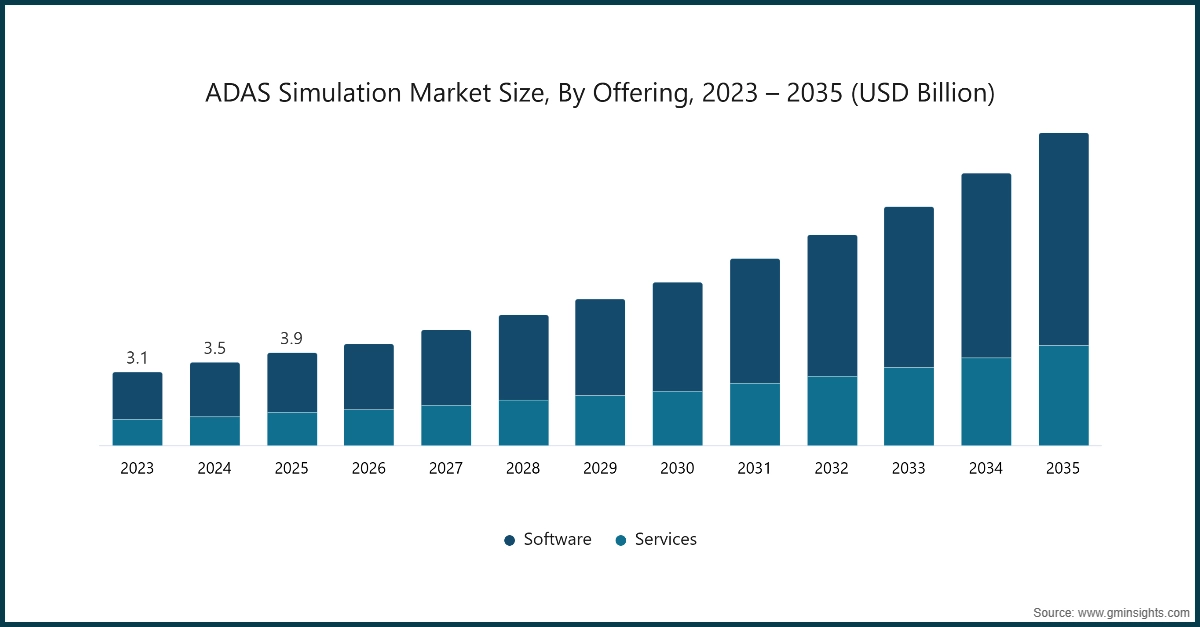
Based on offering, ADAS simulation market is segmented into software and services. The software segment dominates the market with 65% share in 2025, and the segment is expected to grow at a CAGR of 13.7% from 2026 to 2035 reflecting increasing platform sophistication and expanding feature sets that drive higher licensing values.
- Software offerings, including simulation engines, scenario generation tools, sensor models, vehicle dynamics libraries, and visualization frameworks, form a comprehensive tool chain that facilitates end-to-end ADAS validation workflows.
- The software segment dominance stems from recurring licensing models and continuous platform enhancements.
- Leading providers offer annual subscriptions ranging from USD 50,000 per seat for basic Model-in-the-Loop (MIL) capabilities to over USD 500,000 per seat for enterprise platforms with advanced features like real-time HIL, cloud computing, and AI-driven scenario generation.
- Cloud-native architectures are driving the software segment's shift to SaaS models, with the 2025 ASCIS standard enabling standardized API-based simulation workload distribution across cloud providers.
- Cloud-based software deployments reduce upfront costs from USD 2.5-15 million to monthly expenses of USD 15,000-200,000, enabling smaller autonomous vehicle developers and mobility service providers to access advanced simulation capabilities.
- The services segment, including consulting, system integration, model customization, and validation support, remains crucial but faces moderate growth as OEMs internalize simulation expertise and adopt automated platforms.
- Services segment growth is concentrated in emerging markets where local automotive industries lack internal simulation expertise.
- In 2024, Asia Pacific's professional services revenue grew by 16.3%, surpassing North America's 10.8%, fueled by accelerated ADAS integration in China, South Korea, and India.
- For instance, in May 2025, LeddarTech launched LeddarSim, a next-generation simulation platform for ADAS and autonomous driving, offering high-fidelity virtual environments to meet the growing demand for advanced simulation tools.
Learn more about the key segments shaping this market
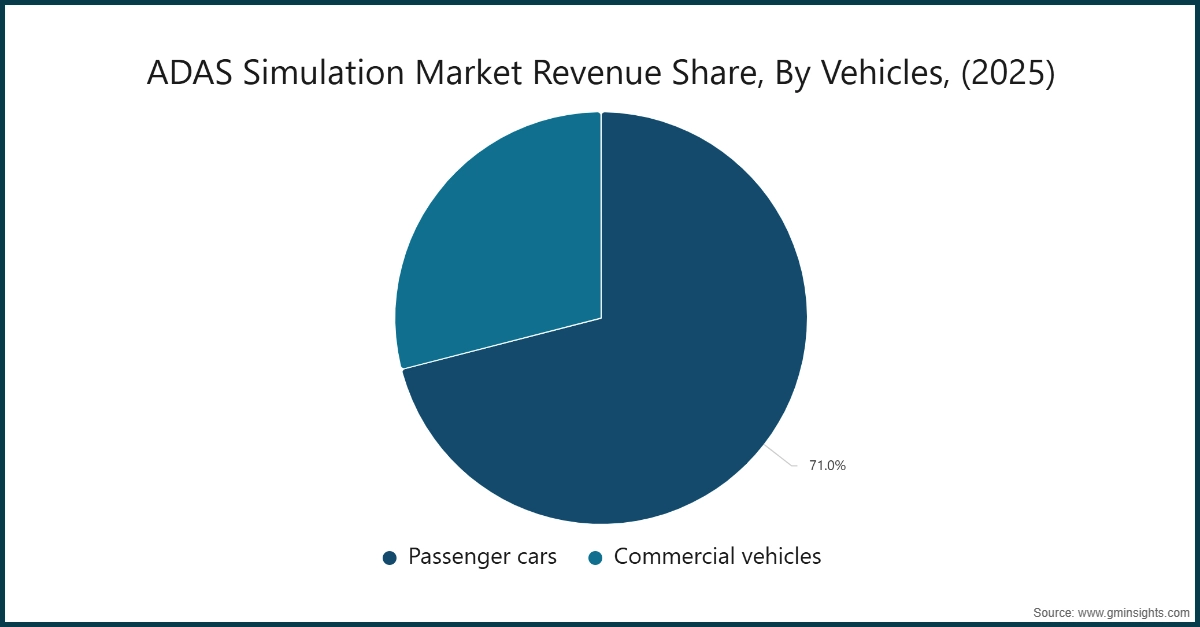
Based on vehicles, ADAS simulation market is divided into passenger cars and commercial vehicles with distinct adoption drivers, use cases, and value propositions characterizing each segment. The passenger cars segment dominates with 71% market share in 2025 and is growing at the rate of 13.3% CAGR.
- Passenger car ADAS simulation demand is driven by Euro NCAP and NHTSA safety rating requirements that heavily weight active safety system performance.
- For instance, in January 2025, Euro NCAP announced that maximum 5-star ratings require demonstration of advanced emergency braking effectiveness across 50+ scenario variations, validated through both physical and simulation testing.
- This regulatory pressure applies uniformly across vehicle segments from compact cars to luxury sedans, creating broad-based simulation platform demand.
- As consumers increasingly expect ADAS features to come standard rather than as premium add-ons, manufacturers are compelled to validate these systems across a broader range of vehicle platforms, moving beyond just high-margin models.
- Premium and luxury OEM programs dominate simulation spending in passenger vehicles, while mid-market brands focus on cost-efficient cloud simulations to balance safety and pricing pressures.
- Commercial vehicle ADAS simulation growth is propelled by economic incentives exceeding regulatory compliance drivers.
- According to the International Road Transport Union (IRU), commercial vehicles equipped with ADAS technology see a 37-42% drop in accident rates. This decline in accidents leads to an 18-25% reduction in insurance premiums and an annual savings of USD 8,200 in total ownership costs for each vehicle.
- Fleet operators managing hundreds or thousands of vehicles realize substantial economic benefits justifying ADAS investment, creating simulation demand as system validation prerequisite.
- ADAS systems in electric commercial vehicles improve energy efficiency by 12-16% through optimized routing and speed management, as reported by the International Energy Agency.
Based on simulation, the ADAS simulation market is segmented into model-in-the-loop (MIL), software-in-the-loop (SIL), processor-in-the-loop (PIL), hardware-in-the-loop (HIL) and driver-in-the-loop (DIL). The software-in-the-loop (SIL) segment dominates with 40% market share in 2025 with 13.5% CAGR during 2026 to 2035.
- Software-in-the-loop (SIL) simulation enables algorithm validation in software environments before hardware implementation, reducing development costs and accelerating iteration cycles.
- SIL platforms execute ADAS software stacks on standard computing hardware with simulated sensor inputs and vehicle dynamics, enabling engineers to test millions of scenarios without physical prototypes.
- The Society of Automotive Engineers updated SAE J3016 in May 2025 to include SIL validation requirements for automated driving system safety argumentation.
- SIL's 13.5% CAGR reflects expanding scenario coverage requirements—comprehensive Level 3 validation programs now incorporate 50-80 million SIL test cases compared to 10-15 million in 2022.
- Model-in-the-loop (MIL) simulation validates high-level algorithm concepts and control strategies before software implementation, serving as the initial testing phase where fundamental approach feasibility is established.
- MIL growth at 13.2% CAGR is driven by increasing ADAS functional complexity modern systems integrate perception, prediction, planning, and control modules requiring holistic validation.
- Platforms utilizing Model-in-the-Loop (MIL) technology operate at speeds 100 to 1000 times faster than real-time, facilitating swift exploration of design spaces.
- For instance, as of March 2025, over 340 universities, as reported by the US Department of Education, have integrated ADAS MIL simulation into their automotive engineering courses, underscoring the significant research emphasis on MIL in academic circles.
- Hardware-in-the-loop (HIL) simulation integrates physical ADAS electronic control units with simulated environments, validating hardware-software integration and real-time performance.
- HIL's 12.1% CAGR is driven by ISO 26262 mandates, which now include expanded HIL testing protocols for machine learning-based ADAS functions as of February 2025.
- HIL platforms, costing USD 500,000 to 3,000,000, are limited to 1× real-time simulation speed, with OEMs typically deploying 12-25 test benches per vehicle program.
Based on deployment mode, the ADAS simulation market is divided between on-premises, cloud-based and hybrid. On premises dominate with 44% market share in 2025, and with a CAGR of 12.6% during forecast period.
- On-premises simulation infrastructure retains a significant share due to data sovereignty, intellectual property protection, and real-time performance optimization needs, despite cloud migration trends.
- Automotive manufacturers managing proprietary sensor algorithms and vehicle dynamics models prefer on-premises deployments minimizing external data exposure.
- Cloud-based simulations using real-world driving data, especially those involving personally identifiable information, face compliance challenges due to the European Union's General Data Protection Regulation (GDPR) and China's Data Security Law.
- According to benchmarking by the National Institute of Standards and Technology, on-premises HIL systems achieve computational latencies that are 40-60% lower than their cloud counterparts, ensuring the deterministic timing performance essential for safety-critical validation.
- Cloud-based simulation eliminates capital expenditure, enables resource scalability, and drives a 13.7% CAGR outperformance during forecast period.
- Amazon Web Services, Microsoft Azure, and Google Cloud Platform provide automotive simulation solutions with pay-per-use pricing from USD 2.50 to 15.00 per compute hour, based on processor type and memory configuration.
- Hybrid deployments integrate on-premises infrastructure for HIL testing and algorithm development with cloud resources for SIL scenario generation and collaboration.
- This architecture delivers 25-35% total cost of ownership reduction versus pure on premises while maintaining performance for critical applications.
- Hybrid adoption is concentrated among established OEMs with existing infrastructure investments and data governance requirements.
- Hybrid deployments require effective workload orchestration to determine whether tasks run on-premises or in the cloud, based on computational needs, data sensitivity, and cost efficiency.
Looking for region specific data?
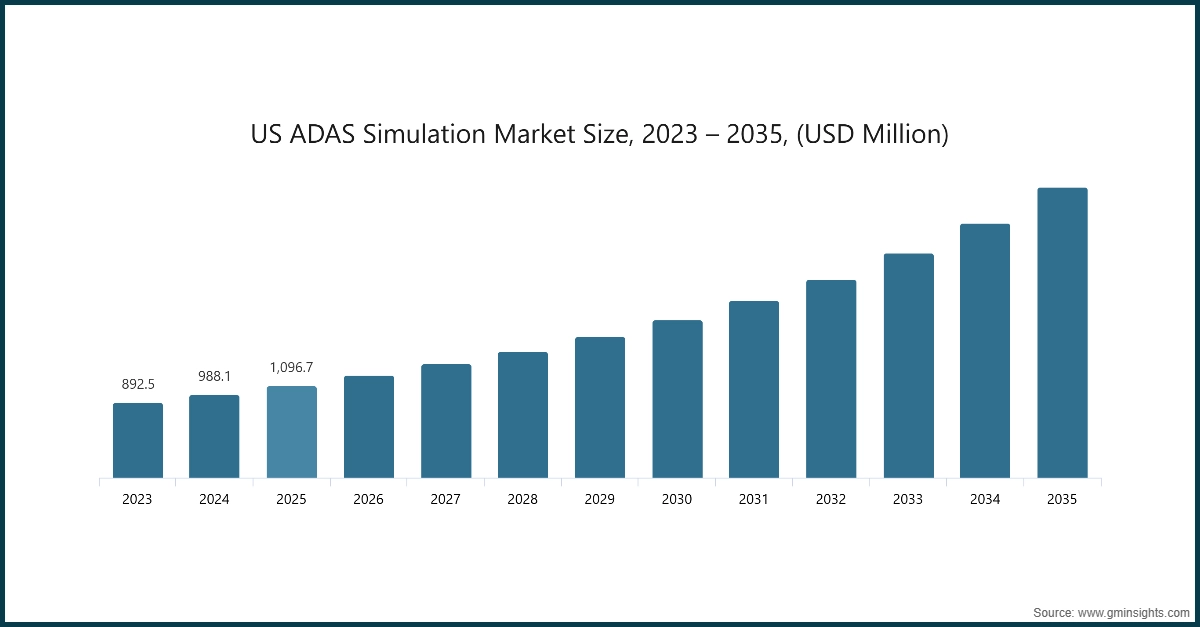
US dominated North America ADAS simulation market generating revenue of USD 1.1 billion in 2025 with CAGR of 12.4% during the forecasted timeframe from 2026 to 2035.
- The US market dominates globally, driven by stricter vehicle-safety standards, expanding V2X pilot programs, and regulatory oversight from agencies like the NHTSA.
- Highway-centric driving patterns and suburban mobility in the US are driving OEMs to prioritize freeway automation, including lane-keeping and adaptive cruise systems, requiring extensive simulations for complex scenarios.
- California, Michigan, Arizona, and Texas lead the US in autonomous vehicle development. As of March 2025, data from California's Department of Motor Vehicles reveals that 82 companies possessed active testing permits, collectively racking up over 35 million miles in test drives.
- Texas and Arizona are emerging as key simulation hubs, driven by expanding proving grounds, permissive testing environments, logistics-focused AV programs, and growing engineering operations from global OEMs and suppliers.
- In the US, the early adoption of software-defined vehicle strategies and an emphasis on OTA-centric development have led to a surge in demand for cloud-native simulation platforms. This is primarily because these strategies necessitate frequent virtual validation of ADAS functions prior to each software release.
- For instance, in February 2025, Waabi partnered with Volvo to integrate its virtual driver system into autonomous trucks, highlighting the use of advanced simulation technologies to enhance safety and efficiency in heavy-vehicle testing.
North America dominated the ADAS simulation market accounting for USD 1.4 billion in 2025 and is anticipated to show growth of 12.5% CAGR over the forecast period.
- The region's leadership stems from concentration of autonomous vehicle development programs, stringent safety regulations, advanced simulation technology providers, and substantial government research funding.
- In 2025, the United States is projected to account for a dominant 81% of the regional revenue, translating to an estimated USD 1.1 billion. Meanwhile, Canada is set to contribute a notable 19%, amounting to approximately USD 259.8 million.
- By 2035, the US market is set to reach USD 3.4 billion, growing at a robust 12.4% CAGR, driven by ongoing investments in autonomous mobility infrastructure and regulatory pushes for thorough ADAS validation.
- Canada's ADAS simulation market grows at 13.2% CAGR, exceeding US growth rates through autonomous public transit initiatives and favorable research tax incentives.
- In 2024-2025, the Canadian government's Strategic Innovation Fund allocated CAD 150 million (USD 110 million) to projects focused on autonomous vehicle development, emphasizing the need for simulation validation.
- For instance, in March 2025, Ontario expanded its autonomous vehicle pilot program, allowing Level 4 systems to be tested over 1,500 kilometers of designated highways, thereby generating a demand for scenario validation simulations.
- Canada's automotive sector relies on simulation capabilities, with major suppliers like Magna International and Linamar Corporation developing ADAS components for global OEMs.
The ADAS simulation market in China is expected to experience significant and promising growth with a CAGR of 15.1% from 2026 to 2035.
- China's government is fast-tracking the ADAS simulation market as part of its national strategy for intelligent connected vehicles (ICVs).
- The goal is to achieve a 50% penetration of Level 2+ vehicles by 2025, with a significant push towards deploying Level 3 vehicles by 2030.
- For instance, in January 2025, the Ministry of Industry and Information Technology rolled out updated ICV standards, mandating simulation validation for assisted driving features.
- In China's fiercely competitive domestic market, EV manufacturers like BYD, NIO, XPeng, and Li Auto are vying for an edge by emphasizing advanced driver-assistance systems (ADAS) features.
- In 2024, companies, as reported by the China Association of Automobile Manufacturers, poured around RMB 18 billion (USD 2.5 billion) into ADAS development, directing 25-30% of that sum towards simulation infrastructure.
- Chinese providers like Tencent Cloud, Baidu Apollo, and 51Sim are expanding market share through local integration, while international players excel in sensor modeling and scenario coverage.
- China's data security law and personal information protection law require simulation platforms processing driving data to localize infrastructure within the country and comply with export restrictions.
- The Cyberspace administration of China published implementing regulations in April 2025 specifically addressing connected vehicle data handling.
- Despite regulatory complexity, Chinese market growth substantially exceeds global averages through government support, manufacturing scale, and intense competition driving technology adoption.
Asia Pacific ADAS simulation market is anticipated to grow at a CAGR of 15.7% during the analysis timeframe.
- The Asia-Pacific market is growing rapidly, driven by increasing EV production, strong domestic automotive industries, and government-backed smart mobility initiatives.
- Massive infrastructure spending, smart-city initiatives, and V2X pilot corridors are driving OEMs and Tier-1 suppliers to adopt cloud-based and hardware-in-the-loop ADAS simulation platforms.
- China's position as the largest automotive production hub, coupled with its push into electric and intelligent vehicles, is fueling demand for simulation tools for advanced vehicle functions.
- Japan's simulation market reflects established automotive industry sophistication, with Toyota, Honda, and Nissan operating advanced simulation facilities.
- For instance, in March 2025, Japan's Ministry of Land, Infrastructure, transport and tourism (MLIT) revised its guidelines for automated driving systems, setting forth Level 4 testing criteria that now include simulation validation.
- South Korea demonstrates aggressive ADAS adoption driven by Hyundai Motor Group investments in electrification and automation.
- In February 2025, South Korea designated 330 kilometers of highways as autonomous vehicle priority zones, enabling faster testing approvals for simulation-validated systems.
- India's emerging simulation market grows from low base through Tata Motors and Mahindra & Mahindra ADAS integration into commercial vehicles and utility vehicles.
- Indian government's Production linked incentive scheme for automotive sector includes advanced technology development criteria, with simulation capabilities qualifying for incentive payments.
- Southeast Asian markets (Thailand, Indonesia, Vietnam) demonstrate nascent simulation adoption primarily through Japanese OEM subsidiaries conducting regional vehicle development.
Germany dominates the Europe ADAS subscription market, showcasing strong growth potential, with a CAGR of 11.6% from 2026 to 2035.
- Germany dominates the European ADAS simulation market, supported by premium OEMs like BMW, Mercedes-Benz, Audi, and Porsche, which heavily invest in virtual validation and autonomous driving.
- German federal transport authorities and EU homologation frameworks are driving automakers to enhance simulation programs for safety certification and software release cycles.
- The growing adoption of advanced vehicle technologies by German consumers drives simulation demand, as OEMs validate complex ADAS features in diverse real-world conditions.
- Germany's Autobahn, with its unrestricted speed sections, drives OEMs to increase virtual mileage through high-speed simulations for adaptive cruise, emergency braking, and lane-keeping systems.
- European Union safety regulations and national transport policies drive OEMs to use simulations to ensure ADAS compliance before market launch.
- Germany's EV infrastructure expansion and electrification strategy are driving autonomous-driving R&D, increasing demand for digital-twin platforms and cloud-based ADAS simulations among domestic OEMs.
Europe ADAS simulation market accounted for USD 1.2 billion in 2025 and is anticipated to show growth of 11.3% CAGR over the forecast period.
- The European market is driven by stringent safety regulations, premium OEM presence, domestic engineering expertise, and the growing need for virtual validation due to expanding connected-vehicle infrastructure.
- The mandatory implementation of UNECE R155 and R156 regulations in July 2024 is accelerating the adoption of advanced simulation platforms for cybersecurity and software-update testing before vehicle approval.
- European standardization bodies and research consortia are enhancing V2X and cooperative-driving frameworks, requiring automakers to simulate vehicle and infrastructure interactions across synthetic scenarios before commercial rollout.
- United Kingdom, France, Italy, Spain, and Nordic countries demonstrate varied ADAS simulation adoption reflecting automotive industry maturity.
- The UK market benefits from concentration of simulation software providers (rFpro, Ansible Motion) and motorsport engineering expertise transferring to ADAS applications.
- France's simulation market growth is driven by Stellantis (Peugeot-Citroën) and Renault investments in electrification with integrated ADAS.
- Nordic countries (Sweden, Norway, Finland) demonstrate high simulation adoption relative to vehicle production volumes, driven by government autonomous vehicle initiatives and winter testing requirements.
- Spain and Italy exhibit lower simulation penetration reflecting automotive sector challenges and limited autonomous vehicle activity, though European Union cohesion funding supports capability development.
Brazil leads the Latin American ADAS simulation Market, exhibiting remarkable growth of 14.3% during the forecast period of 2026 to 2035.
- Brazil leads the market in Latin America, driven by its strong automotive production, EV programs, road safety initiatives, and investments in connected and autonomous vehicle R&D.
- Mandatory emergency braking systems for trucks and buses (2024-2027) are driving Brazil's ADAS simulation market by increasing the demand for validation infrastructure.
- For instance, in February 2025, the Brazilian national traffic council (CONTRAN) rolled out updated vehicle safety regulations, integrating ADAS testing protocols modeled after European standards.
- Brazilian agricultural equipment manufacturers, such as AGCO and CNH Industrial, are adopting ADAS technologies in tractors and harvesters, requiring advanced off-road simulation capabilities.
- The ADAS simulation ecosystem in Brazil is centered in São Paulo, Campinas, and Rio de Janeiro, where OEMs and Tier-1 suppliers are adopting cloud-based virtual validation platforms.
- Due to macroeconomic volatility and currency fluctuations, the costs of imported simulation software, high-performance computing hardware, and sensor-modeling platforms have surged.
UAE to experience substantial growth in the Middle East and Africa ADAS simulation market in 2025.
- The UAE dominates Middle Eastern demand for ADAS simulation platforms, driven by high income, advanced infrastructure, and strong government support for autonomous mobility.
- The country's strong preference for premium and luxury vehicles drives OEMs and Tier-1 suppliers to invest in advanced virtual validation programs for high-end driver-assistance and automated-driving systems in Gulf markets.
- UAE logistics sector demonstrates ADAS adoption through international fleet operators (DHL, FedEx, Aramex) deploying collision avoidance and lane keeping systems.
- Abu Dhabi Department of Transport published connected vehicle infrastructure standards in March 2025 incorporating simulation validation requirements.
- International OEMs and technology providers are leveraging the UAE's hot climate to validate their Advanced Driver-Assistance Systems (ADAS), taking advantage of the country's lack of domestic automotive manufacturing.
- Between 2024 and 2026, UAE universities, including Khalifa University and the American University of Sharjah, established automotive research centers with AED 180 million (USD 49 million) in funding.
ADAS Simulation Market Share
The top 7 companies in the ADAS simulation market are Siemens Digital Industries, Ansys, dSPACE, MathWorks, IPG Automotive, NVIDIA, and Cognata contributed around 42% of the market in 2025.
- Siemens Digital Industries, leveraging its extensive Simcenter portfolio that encompasses model-based systems engineering, multi-physics simulation, and closed-loop testing, has solidified its position at the forefront of the market. In a move underscoring its commitment to AI-enhanced testing, the company acquired a niche ADAS scenario generation startup in January 2025.
- Ansys ranks second due to its precise physics simulations, excelling in sensor modeling under challenging conditions. Its VRXPERIENCE platform utilizes decades of electromagnetic and optical simulation expertise to develop realistic camera and LiDAR sensor models.
- dSPACE dominates the hardware-in-the-loop (HIL) simulation market with its SCALEXIO real-time platform, supporting ISO 26262 functional safety validation. The company holds over 45% global market share, with a strong presence in the German automotive industry.
- MathWorks' MATLAB and Simulink tools are used by over 85% of global OEMs and Tier 1 suppliers for algorithm development in automotive engineering. The company focuses on integrating its simulation tools into existing workflows rather than offering standalone platforms.
- IPG Automotive, through its CarMaker platform, specializes in vehicle dynamics and powertrain simulation, focusing on electric vehicles and autonomous driving. Its Virtual Test Drive concept integrates driver-in-the-loop simulation with realistic visualization.
- NVIDIA is transforming the simulation market with GPU-accelerated photorealistic rendering and AI-driven scenario generation. Its DRIVE Sim platform utilizes RTX technology, originally designed for gaming, to create virtual environments nearly indistinguishable from real-world footage.
- Cognata harnesses deep learning to generate synthetic training data, enhancing perception systems for autonomous vehicles. In February 2025, the company bolstered its presence in the Asia Pacific by partnering with multiple Chinese OEMs.
ADAS Simulation Market Companies
Major players operating in ADAS simulation industry are:
- Ansys
- Applied Intuition
- dSPACE
- Foretellix
- IPG Automotive
- MathWorks
- NVIDIA
- rFpro
- Siemens Digital Industries Software
- Vector Informatik
- Ansys, Applied Intuition, dSPACE, Foretellix, IPG Automotive, MathWorks, NVIDIA, rFpro, Siemens Digital Industries Software, and Vector Informatik lead the ADAS simulation market. They provide advanced simulation platforms and tools, enabling OEMs and Tier-1 suppliers to develop and validate driver assistance systems efficiently.
- These companies enhance ADAS simulation solutions by offering AI-driven scenario analysis, high-fidelity sensor and vehicle modeling, SiL and HiL testing, and scalable cloud-based environments. Their tools improve vehicle safety, accelerate development, and ensure accurate validation of autonomous driving features.
- The market is growing rapidly due to the increasing adoption of autonomous and connected vehicles, stringent safety regulations, and the demand for cost-effective testing solutions. Key players are enabling simulation adoption through virtual environments, modular software, and advanced analytics to optimize ADAS performance while reducing testing costs.
ADAS Simulation Market Report Attributes
| Key Takeaway | Details |
|---|---|
| Market Size & Growth | |
| Base Year | 2025 |
| Market Size in 2025 | USD 3.9 Billion |
| Market Size in 2026 | USD 4.4 Billion |
| Forecast Period 2026-2035 CAGR | 13.1% |
| Market Size in 2035 | USD 13.2 Billion |
| Key Market Trends | |
| Drivers | Impact |
| Rising stringency in government safety regulations | Encourages adoption of ADAS simulation platforms to validate systems virtually and comply with stricter safety norms. |
| Need to reduce physical testing costs | Drives usage of simulation tools to cut expenses on real-world testing while maintaining system accuracy. |
| Accelerated development timelines for ADAS | Promotes simulation-based development to speed up design cycles and reduce time-to-market for ADAS features. |
| Growth in autonomous vehicle development | Increases demand for high-fidelity simulation environments to safely test complex autonomous driving scenarios. |
| Technological advancements in AI & sensor fusion | Enhance simulation capabilities, enabling more realistic virtual testing of sensor integration and AI-driven ADAS functions. |
| Pitfalls & Challenges | Impact |
| High initial investment for simulation platforms | High setup costs may deter smaller OEMs and slow market adoption. |
| Lack of standardization across platforms | Inconsistent frameworks increase integration challenges and development time. |
| Opportunities: | Impact |
| Simulation-as-a-service (SaaS) business models | Enables OEMs and Tier-1 suppliers to access scalable simulation tools without heavy upfront costs, boosting adoption. |
| Expansion into emerging autonomous vehicle markets | Growing AV development drives demand for advanced simulation platforms, opening new revenue streams. |
| Regional market growth in Asia Pacific | Rapid automotive and technology adoption in APAC increases demand for ADAS simulation solutions. |
| Integration with generative AI for scenario creation | AI-generated scenarios accelerate testing and validation, improving efficiency and reducing time-to-market. |
| Market Leaders (2025) | |
| Market Leader |
10% Market Share |
| Top Players |
Collective Market Share is 35% |
| Competitive Edge |
|
| Regional Insights | |
| Largest Market | North America |
| Fastest growing market | Asia Pacific |
| Emerging countries | Brazil, Mexico, China, India, United Arab Emirates |
| Future outlook |
|
What are the growth opportunities in this market?
ADAS Simulation Market News
- In February 2025, dSPACE launched the SCALEXIO R6 HIL platform, featuring AI-powered automated testing that reduces validation time by 35-40% through intelligent test case prioritization and defect prediction. It enables concurrent testing of 32 ECUs with microsecond timing accuracy.
- In February 2025, Cognata partnered with four unnamed Chinese OEMs to supply AI-generated synthetic training data for perception system development. These partnerships strengthened their Asia Pacific presence, where revenue grew 89% year-over-year.
- In January 2025, Siemens Digital Industries acquired an AI-powered scenario generation startup (terms undisclosed). This integration enhances the Simcenter platform by increasing testing coverage 12× with minimal computational resources.
- In January 2025, NVIDIA Corporation launched the DRIVE Sim cloud service with unlimited scenario generation and testing for USD 100,000 annually. The service disrupts traditional per-seat licensing by utilizing global data center GPU capacity for large-scale simulations.
The ADAS simulation market research report includes in-depth coverage of the industry with estimates & forecasts in terms of revenue (USD Bn) from 2022 to 2035, for the following segments:
Market, By Offering
- Software
- Simulation software platforms
- application software
- Sensor simulation software
- Scenario generation tools
- D/physics‑based modeling tools
- Services
- Professional services
- Managed services
Market, By Vehicles
- Passenger cars
- Hatchbacks
- SUV
- Sedan
- Commercial vehicles
- Light commercial vehicles (LCVs)
- Medium commercial vehicles (MCVs)
- Heavy commercial vehicles (HCVs)
Market, By ADAS Features
- Adaptive cruise control (ACC)
- Lane keeping/departure systems
- Automated parking assist
- Collision avoidance systems
- Traffic jam assistance
- Highway pilot/full self-driving
- Blind spot detection
- Others
Market, By Simulation
- Model-in-the-loop (MIL)
- Software-in-the-loop (SIL)
- Processor-in-the-loop (PIL)
- Hardware-in-the-loop (HIL)
- Driver-in-the-loop (DIL)
Market, By Deployment Mode
- On premises
- Cloud-based
- Hybrid
Market, By End Use
- Automotive OEMs
- Tier 1 & Tier 2 suppliers
- Technology providers & software developers
- Semiconductor & hardware vendors
- Others
The above information is provided for the following regions and countries:
- North America
- US
- Canada
- Europe
- Germany
- UK
- France
- Italy
- Spain
- Russia
- Netherlands
- Sweden
- Denmark
- Poland
- Asia Pacific
- China
- India
- Japan
- Australia
- South Korea
- Singapore
- Thailand
- Indonesia
- Vietnam
- Latin America
- Brazil
- Mexico
- Argentina
- Colombia
- MEA
- South Africa
- Saudi Arabia
- UAE
- Israel
Frequently Asked Question(FAQ) :
What was the market size of the ADAS simulation market in 2025?
The market size was USD 3.9 billion in 2025, driven by advancements in autonomous mobility technologies, evolving regulations, and economic model shifts.
What is the projected value of the ADAS simulation industry by 2035?
The market is expected to reach USD 13.2 billion by 2035, growing at a CAGR of 13.1%, fueled by the adoption of cloud-native platforms, generative AI, and subscription-based SaaS models.
What is the projected size of the ADAS simulation market in 2026?
The market is expected to grow to USD 4.4 billion in 2026.
What was the market share of the software segment in 2025?
The software segment held the largest share, accounting for 65% of the market in 2025, reflecting the increasing sophistication of platforms and expanding feature sets.
Which region leads the ADAS simulation market?
North America, led by the United States, dominated the market in 2025 with an estimated revenue of USD 1.1 billion. The region is projected to grow at a CAGR of 12.4% from 2026 to 2035, supported by strong technological infrastructure and innovation.
What are the upcoming trends in the ADAS simulation industry?
Key trends include the adoption of subscription-based SaaS platforms, the use of cloud-native simulation environments with pay-per-use pricing models, and the integration of generative AI for automating edge case scenario creation.
Who are the key players in the ADAS simulation market?
Major players include Ansys, Applied Intuition, dSPACE, Foretellix, IPG Automotive, MathWorks, and NVIDIA.
ADAS Simulation Market Scope
Related Reports