Summary
Table of Content

Acrylate Market
Get a free sample of this report
Form submitted successfully!
Error submitting form. Please try again.
Thank you!
Your inquiry has been received. Our team will reach out to you with the required details via email. To ensure that you don't miss their response, kindly remember to check your spam folder as well!
Request Sectional Data
Thank you!
Your inquiry has been received. Our team will reach out to you with the required details via email. To ensure that you don't miss their response, kindly remember to check your spam folder as well!
Form submitted successfully!
Error submitting form. Please try again.
Acrylate Market Size
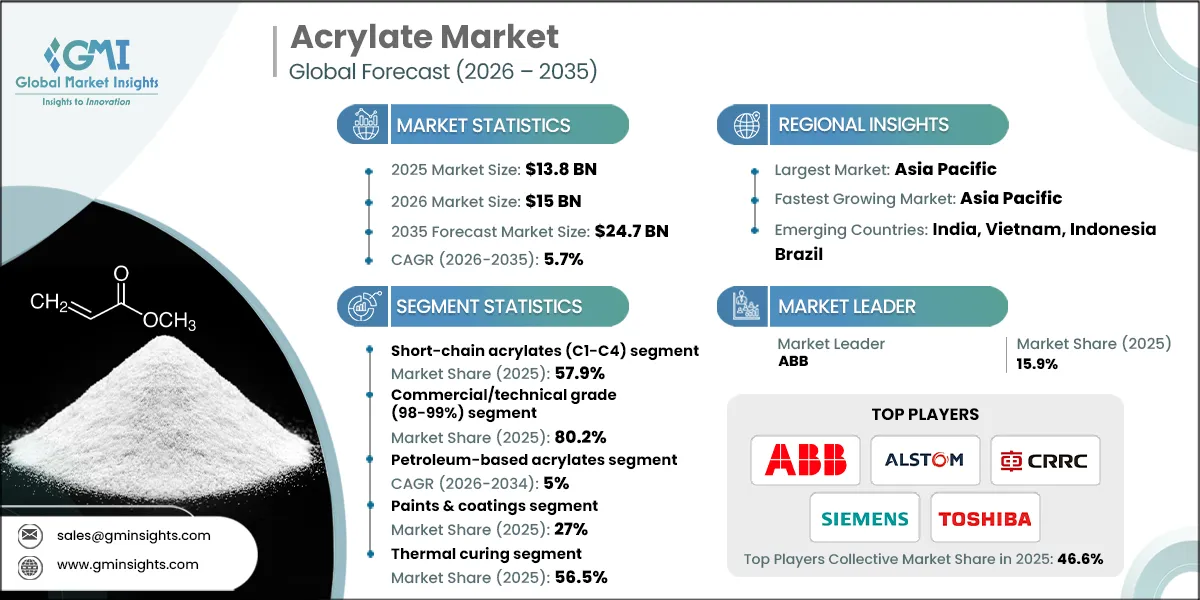
The global acrylate market was valued at USD 13.8 billion in 2025. The market is expected to grow from USD 15 billion in 2026 to USD 24.7 billion in 2035, at a CAGR of 5.7% according to latest report published by Global Market Insights Inc.
To get key market trends
- Acrylate transitioned over years from being a specific product category into an essential enabler of modern-day maritime operations. Most industries make use of acrylics in manufacturing coatings, adhesives, sealants, and specialty polymers. They become invaluable for the construction, automotive, packaging, and textile industries. Moving forward into the production trend, manufacturers have focused on new techniques to develop advanced formulations that would ensure better performance coupled with stricter environment related standards.
- Sustainable and environmentally friendly solutions are among the most significant trends shaping the market. With the regulatory framework aimed at reducing volatile organic compounds, it becomes too easy for water-based and bio-based acrylates to catch on. The latest innovations also enhance durability and strength while supporting decarbonization goals at a global level, thus putting acrylates in core position in green manufacturing practices.
- The global market is being led by the Asia-Pacific region, attributed to rapid industrialization, more infrastructure development, and strong demand from the shipbuilding and automotive sectors. Meanwhile, due to expanding industrial activities and the rising adoption of sustainable materials, Latin America is emerging as the fastest-growing region. The North American region continues to hold a significant market share, owing to technology and demand from industrial and recreational applications, whereas Europe continues to focus severely on green solutions under strict regulations.
Acrylate Market Report Attributes
| Key Takeaway | Details |
|---|---|
| Market Size & Growth | |
| Base Year | 2025 |
| Market Size in 2025 | USD 13.8 Billion |
| Market Size in 2026 | USD 15 Billion |
| Forecast Period 2026-2035 CAGR | 5.7% |
| Market Size in 2035 | USD 24.7 Billion |
| Key Market Trends | |
| Drivers | Impact |
| Growing demand from paints & coatings industry | Demand for acrylates mainly by manufacturers |
| Expanding superabsorbent polymer applications in hygiene products | Increases market penetration into personal care with a stable long-term demand |
| Rising adoption in adhesives & sealants | Usage in construction and automotive sectors has increased and drives the growth in volumes |
| Pitfalls & Challenges | Impact |
| Volatility in raw material (propylene) prices | Deflates margins and disrupts supply network and thus profitability |
| Stringent environmental regulations | Require reformulation and compliance costs thus slow-as adoption of conventional acrylates |
| Opportunities: | Impact |
| Bio-based acrylates development & commercialization | Open premium market segments and sustainability mandates |
| Growth in electric vehicle battery binders | Creates high-value niche applications, positioning acrylates in next-gen mobility solutions |
| Market Leaders (2025) | |
| Market Leader |
16% |
| Top Players |
Collective Market Share of 47% in 2025 |
| Competitive Edge |
|
| Regional Insights | |
| Largest Market | Asia Pacific |
| Fastest growing market | Latin America |
| Emerging countries | Brazil, Mexico |
| Future outlook |
|
| Companies covered: | 12 |
| Tables, Charts & Figures: | 205 |
| Countries covered: | 18 |
| No of Pages: | 190 |
What are the growth opportunities in this market?
Acrylate Market Trends
- Precursors propagating acrylates have evolved from a basic chemical commodity to basic enablers of advanced industrial solutions. These types are perfectly compatible with coatings, adhesives and sealants. Superabsorbent polymers deploy themselves across industry segments, such as construction, automotive, packing, and personal care. This change captured more emphatically the desire to go high into performance and durability and sustainability, such global regulations compel manufacturers towards reversed emission and eco-friendly products designs.
- New product standards are changing with the advent of bio-based acrylates and low-VOC and solvent-free formulations, while integrated production models enhance resource use and minimize waste. Such developments are not only increasing the efficiency of products but also match with circular economy principles, making acrylates commercially attractive and gaining strategic importance in a market that puts sustainability on high priority.
- Acrylates may ultimately also find a footing in electric vehicles, renewable energy and specialty polymers. With their high-performance characteristics and stringent environmental norms, these materials are becoming common denominators for next-generation manufacturing. Hence this newly expanded role best illustrates a migrating principle from commodity chemicals to strategic materials that drive innovation and compliance throughout the global industries.
Acrylate Market Analysis
Learn more about the key segments shaping this market
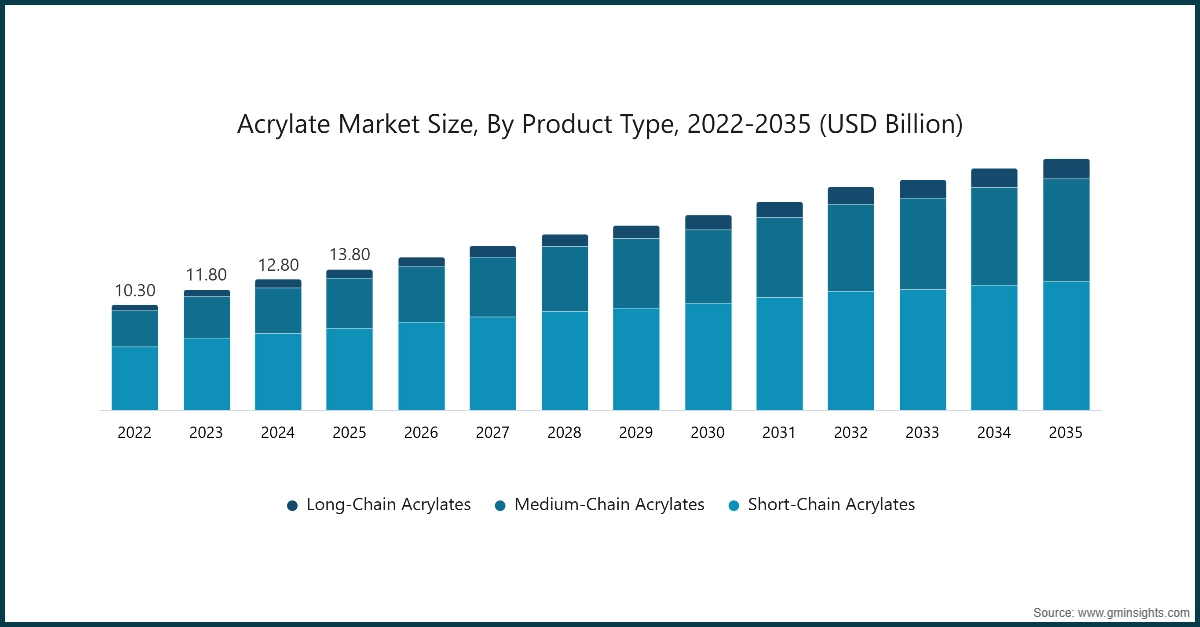
Based on product type, the market is segmented into short-chain acrylates (C1-C4), medium-chain acrylates (C6-C10), long-chain acrylates (C12-C22). Short-chain acrylates (C1-C4) dominated the market with an approximate share of 57.9% in 2025 and is expected to grow with a CAGR of 4.3% by 2035.
- Short-cha acrylates are the largest segment in paints, coatings, and adhesives, for their excellent reactivity and film-forming properties which make the indispensable in high-performance surface finishes and industrial coatings. Their versatility supplies demand throughout construction and automotive applications.
- Medium-chain acrylates are intended to be adopted in the improved flexibility-weather resistance application arena. Such formulations are used in those sealants, elastomers, and specialty coatings, which now provide a trade-off between durability and elasticity. Its capability of serving under a wider range of environmental conditions seems to make it the preferred candidate for outdoor and structural applications.
Learn more about the key segments shaping this market
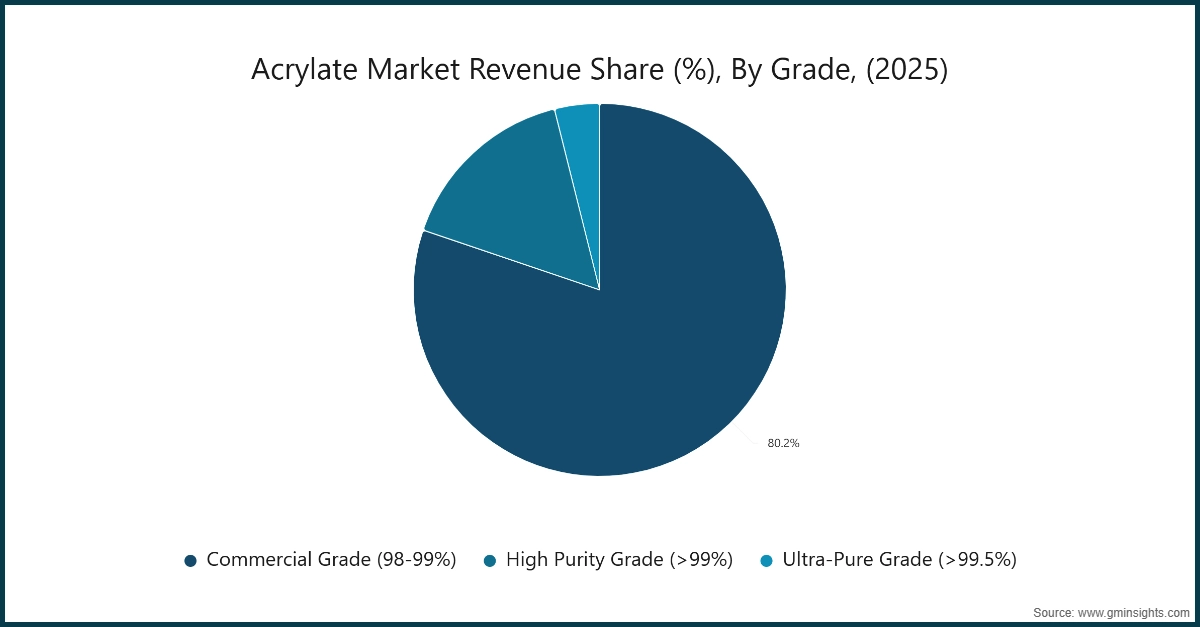
Based on grade, the acrylate market is segmented into commercial/technical grade (98-99%), high purity grade (>99%), ultra-pure grade (>99.5%). The commercial/technical grade (98-99%) held the largest market share of 80.2% in 2025 and is expected to grow at a CAGR of 4.8% during 2026-2035.
- Commercial or technical grade are those acrylates which are used in large quantities for paints, coatings, and adhesives where cost effectiveness and performance are to be balanced against each other. These grades dominate high-volume consumption sectors such as construction and automotive due to their versatility and economic viability. High-purity grades are required by industries needing enhanced performance and reliability such as electronics, medical devices, and specialty coatings. Their excellent chemical consistency thus guarantees long-lasting characteristics and compliance against strict quality standards and makes them a key player for all precision based applications.
Based on feedstock, the acrylate market is segmented into petroleum-based acrylates, bio-based acrylates, glycerol-derived (acrolein route). The petroleum-based acrylates segment dominated the market with an approximate market share of 90.2% in 2025 and is expected to grow with the CAGR of 5% by 2035.
- The currently available acrylates are petrochemical based or derived from petroleum resources because they already have established production infrastructures that are cost-effective and understandable. This allows for mass application in the fields of coating and adhesives along with sealants. However, the proclivity of this pathway towards the use of fossil resources and its carbon footprint is stirring up slow changes towards more sustainable sources.
- Bio-based forms of acrylates are now being projected for future growth underthrow political frameworks for transforming the world's future into a low-carbon economy and other laws on specifications that will direct the use of low-emission materials. Such formulations can thus compete with their fossil-derived counterparts without increased environmental impacts and thus challenge industries to commit to principles of green chemistry and circular economy.
Based on application, the acrylate market is segmented into adhesives & sealants, paints & coatings, superabsorbent polymers (sap), textiles & nonwovens, plastics & polymers, paper & paperboard, personal care & cosmetics, construction materials, electronics & electrical, medical & healthcare, others. The paints & coatings segment dominated the market with an approximate share of 27% in 2025 and is expected to grow with the CAGR of 4.4% by 2035.
- Paints and coatings have the large share, owing to extensive application in superior-delivering film forming properties, durability, and weather resistance required for industrial and decorative applications.
- Another important segment is that of adhesives and sealants. Demand is driven in construction, automotive, and packaging industries which require strong bonding and flexibility. Superabsorbent polymers, attaining their greatest popularity in hygiene products, provide a high absorption capacity for personal care use. Textiles and nonwovens will utilize acrylates for added softness and durability; plastics and polymers will benefit from their ability to improve performance characteristics in specialty materials.
- Emerging application sectors within electronics, healthcare, and renewable energy infrastructure have opened up promising growth avenues for acrylates, especially in high-purity and specialty formulations.
Based on curing technology, the acrylate market is segmented into thermal curing, UV curing, electron-beam (EB) curing, moisture curing, ambient/room temperature curing. Thermal curing dominated the market with an approximate share of 56.5% in 2025 and is expected to grow with the CAGR of 4.7% by 2035.
- Thermal curing has been traditionally used for the industrial coatings and adhesives, with the rationale of heat activation promoting stronger cross-linking and thereby durability. UV curing is gaining popularity for applications which requires fast processing and energy conservation, especially in electronics, packaging, and high-performance coatings.
- Electron-beam curing used in niche areas requiring ultra-fast curing and enhanced chemical resistance, perfectly fitting applications such as advanced composites and high-end industrial usage.
Based on distribution channel, the acrylate market is segmented into direct sales, distributors & resellers, online platforms. Direct sales dominated the market with an approximate revenue share of 66.8% in 2025 and is expected to grow with the CAGR of 5% by 2035.
- Direct sales hold a large share when it comes to most major manufacturers who rely on the close ties with large-scale industrial clients for replenishment and technical support for high-volume applications such as coatings, adhesives, and sealants. This mode is favored for strategic alliances as well as customized solutions.
- Distributors and resellers are instrumental in extending the reach of the market especially within the segmented demand regions or smaller buyers. They give flexibility along with localized service and also look after inventory management, thereby playing a vital role for mid-tier customers and niche applications.
Looking for region specific data?
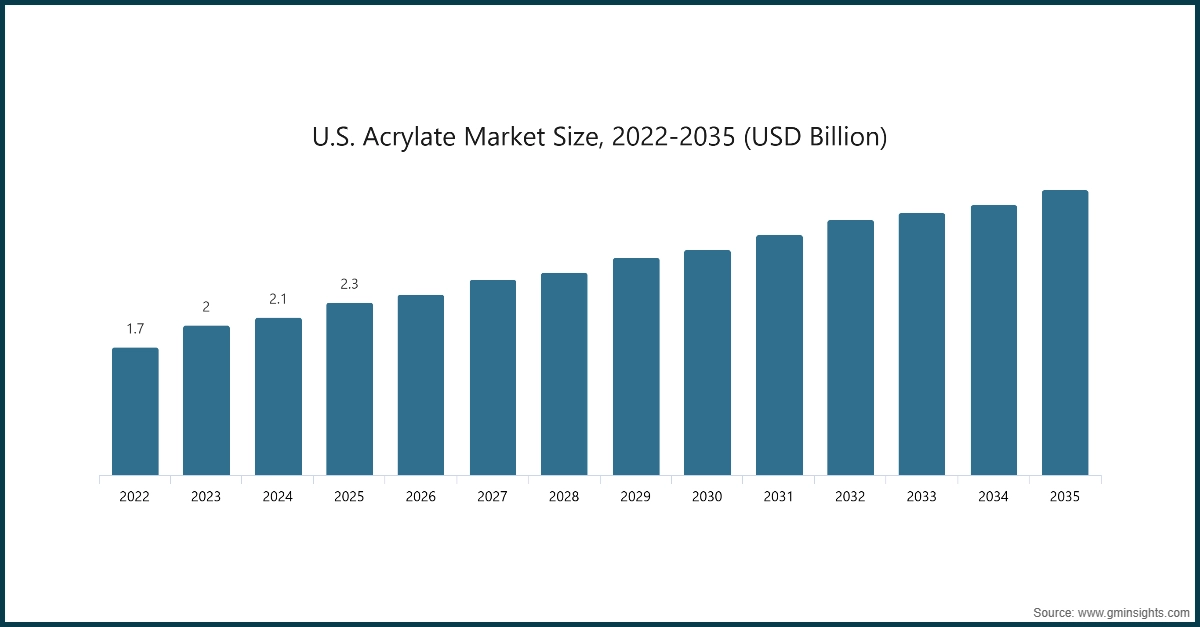
The North America Acrylate industry is growing rapidly on the global level with a market share of 19.6% in 2025.
- North America stands out as a mature and strategically important region for the acrylate market, being supported by strong industrial demand and advanced manufacturing capabilities. Its mature infrastructure supports coatings, adhesives, and specialty polymers in a region whose environmental regulations are focused on promoting low-VOC and sustainable formulations.
U.S. dominates the North America acrylate market, showcasing strong growth potential.
- The U.S. remains the dominant contributor along with its advanced technologies and policy structure that promote cleaner materials and modernization initiatives, thereby marking North America as the focal point for next-generation acrylate solutions.
Europe acrylate market growing in the industry with revenue of USD 2.9 billion in 2025 and is anticipated to show lucrative growth over the forecast period.
- Europe remains an important region for the acrylate industry, supported by stringent environmental regulations and a heavy emphasis on sustainable manufacturing methods. Demand within the region stems largely from high-performance applications such as coatings, adhesives, and specialty polymers, where industries focus on low-VOC and bio-based formulations in order to comply with these standards.
Germany dominates the European acrylate market, showcasing strong growth potential.
- Germany leads the European market, supported by an established chemical industry, good R&D infrastructure, and growing investments in green technologies. This position of leadership also makes Europe an incubator for acrylate innovations, so far as the global decarbonization goals are concerned, with opportunities for next-generation products within the automotive, construction, and renewable energy sectors.
The Asia Pacific acrylate market leads the market and is anticipated to grow at a CAGR of 6.2% during the analysis timeframe.
- The Asia-Pacific is leading the acrylate business on a global scale, propelled by various factors, including rapid industrialization, demand from the construction and automotive industries, and expansion in manufacturing capabilities. To support the growth of the region, large-scale investments in infrastructure as well as the adoption of modern coatings and adhesives across a range of industries are being channeled.
China acrylate market is estimated to grow with a significant CAGR in the Asia Pacific region.
- China's position is paramount in expanding this market, with its solid base in chemical production and increasing reliance on green sustainable formulations to satisfy local and foreign demand.
Latin America Acrylate accounted for 7.1% market share in 2025 and is anticipated to show highest growth over the forecast period.
- Latin America becoming emerging region for acrylates with rising industrialization, infrastructure development, and the adoption of advanced materials. Demand primarily come from applications in coatings, adhesives, and sealants in the construction and automotive industries, with a growing interest in green and low-VOC formulations.
Brazil leads the Latin American acrylate market, exhibiting remarkable growth during the analysis period.
- Brazil holds the largest share of the market with its existing chemical manufacturing base and ever-expanding industrial footprint to create opportunities for high-performance acrylates in packaging, personal care, and renewable energy projects.
Middle East & Africa Acrylate accounted for 4% market share in 2025 and is anticipated to show lucrative growth over the forecast period.
- Middle East and Africa acrylate market is now gaining impetus due to increased industrial pace, continuously increasing infrastructural outlines, and demand for new-age materials across construction, automotive, and packaging sectors.
Saudi Arabia Acrylate industry to experience substantial growth in the Middle East and Africa acrylate market in 2025.
- Saudi Arabia is rapidly emerging as growth-promoting in this region with its industrial transformation agenda and investments in advanced chemical technology.
Acrylate Market Share
The top 5 companies in Acrylate industry include BASF SE, The Dow Chemical Company, Nippon Shokubai Co Ltd, Arkema Group, LG Chem Ltd. These are prominent companies operating in their respective regions covering approximately 47% of the market share in 2025. These companies hold strong positions due to their extensive experience in acrylate market. Their diverse product portfolios, backed by robust production capabilities and distribution networks, enable them to meet the rising demand across various regions.
BASF SE is a polymer and chemical company globally, with a diversified product portfolio that includes chemicals, materials, industrial solutions, and performance products. The acrylate business of the company manufactures raw materials for coatings, adhesives as well as specialty polymers with a special emphasis on innovations in sustainable designs and high-performance formulations.
The Dow Chemical Company makes vast range of chemical products and solutions for many sectors, including packaging, infrastructure, and consumer goods. With respect to acrylates, Dow pursues advanced polymer technologies for coatings, adhesives, and sealants in applications that demand not only durability but also environmental compatibility.
Nippon Shokubai produces a wide range of chemicals, concentrating mainly on acrylic acid and its derivatives.The company's acrylate business focuses on applications in superabsorbent polymers, coatings, and adhesives used in hygiene, construction, and automotive.
Arkema is a specialty chemicals manufacturer supplying advanced materials and solutions to varied industrial applications.Arkema's activities within the domain of acrylates focus on coatings, adhesives, and performance polymers, with emphasis on low-VOC and bio-based formulations.
LG Chem Ltd. is a big chemical company producing in the areas of petrochemicals, advanced materials, and life sciences. Its acrylics line supports applications in coatings, adhesives, and specialty polymers targeting sectors like automotive, electronics, and packaging.
Acrylate Market Companies
Major players operating in the acrylate industry are :
- The Dow Chemical Company
- Arkema Group
- Nippon Shokubai Co Ltd
- LG Chem Ltd
- Formosa Plastics Corporation
- Jiangsu Jurong Chemical Co Ltd
- Sasol Limited
- Sartomer
- Allnex Group
- Toagosei Co Ltd
- Osaka Organic Chemical Industry Ltd
Acrylate Industry News
- In November 2025, AkzoNobel and Axalta Coating Systems announced they’ve entered into a definitive agreement to combine in an all-stock merger of equals, creating a premier global coatings company with an enterprise value of approximately $25 billion.
- In September 2023, IPS Adhesives, a global manufacturer of structural and surfacing products, has acquired a range of adhesives based on acrylate and methyl methacrylate (MMA) technology from L&L Products.
These acrylate market research report includes in-depth coverage of the industry, with estimates & forecasts in terms of revenue (USD Billion) and volume (Kilo Tons) from 2022 to 2035, for the following segments:
Market, By Product Type
- Short-Chain Acrylates (C1-C4)
- Methyl Acrylate (MA)
- Ethyl Acrylate (EA)
- Butyl Acrylate (BA)
- iso-Butyl Acrylate (iBA)
- Medium-Chain Acrylates (C6-C10)
- 2-Ethylhexyl Acrylate (2-EHA)
- 2-Octyl Acrylate
- iso-Decyl Acrylate (iDA)
- Long-Chain Acrylates (C12-C22)
- Lauryl Acrylate (C12)
- Stearyl Acrylate (C18)
- Behenyl Acrylate (C22)
Market, By Grade
- Commercial/technical grade (98-99%)
- High purity grade (>99%)
- Ultra-pure grade (>99.5%)
Market, By Feedstock
- Petroleum-based acrylates
- Bio-based acrylates
- Glycerol-derived (acrolein route)
Market, By Application
- Adhesives & sealants
- Pressure-sensitive adhesives (PSA)
- Hot melt adhesives
- Structural adhesives
- Water-based adhesives
- Sealants
- Paints & coatings
- Architectural coatings
- Industrial coatings
- Automotive coatings
- Wood coatings
- Coil coatings
- Marine coatings
- Signage coatings
- Specialty coatings
- Superabsorbent polymers (SAP)
- Textiles & nonwovens
- Textile finishing
- Performance textiles
- Nonwoven binders
- Carpet backing
- Plastics & polymers
- Impact modifiers
- Processing aids
- Acrylic sheets (PMMA)
- Acrylic resins
- Paper & paperboard
- Personal care & cosmetics
- Hair care
- Skin care
- Color cosmetics
- Construction materials
- Concrete additives
- Caulks & sealants
- Waterproofing membranes
- Tile adhesives
- Grouts & mortars
- Electronics & electrical
- Li-ion battery cathode binders
- Semiconductor coatings
- Display technologies
- Connector assembly adhesives
- Encapsulation materials
- Medical & healthcare
- Medical device coatings
- Dental materials
- Wound care adhesives
- Drug delivery systems
- Others
Market, by Curing Technology
- Thermal curing
- UV curing
- Electron-beam (EB) curing
- Moisture curing
- Ambient/room temperature curing
Market, By Distribution Channel
- Direct Sales
- Distributors & Resellers
- Online Platforms
The above information is provided for the following regions and countries:
North America
- U.S.
- Canada
Europe
- Germany
- UK
- France
- Spain
- Italy
- Rest of Europe
Asia Pacific
- China
- India
- Japan
- Australia
- South Korea
- Rest of Asia Pacific
Latin America
- Brazil
- Mexico
- Argentina
- Rest of Latin America
Middle East and Africa
- Saudi Arabia
- South Africa
- UAE
- Rest of Middle East and Africa
Frequently Asked Question(FAQ) :
Who are the key players in the acrylate market?
Key players include BASF SE, The Dow Chemical Company, Nippon Shokubai Co Ltd, Arkema Group, LG Chem Ltd, Formosa Plastics Corporation, Jiangsu Jurong Chemical Co Ltd, Sasol Limited, Sartomer, Allnex Group, Toagosei Co Ltd, and Osaka Organic Chemical Industry Ltd.
What is the market size of the acrylate in 2025?
The market size was USD 13.8 billion in 2025, with a CAGR of 5.7% expected through 2035 driven by demand from construction, automotive, packaging sectors, and growing focus on sustainable and environmentally friendly solutions.
Which region leads the acrylate market?
The North America Acrylate industry is growing rapidly on the global level with a revenue share of 19.6% in 2025.
What are the upcoming trends in the acrylate market?
Key trends include shift toward bio-based acrylates and low-VOC formulations, integrated production models minimizing waste, expansion into electric vehicles and renewable energy applications, and adoption of UV curing and electron-beam curing technologies for fast processing.
What was the market share of short-chain acrylates segment in 2025?
Short-chain acrylates (C1-C4) dominated the market with approximately 57.9% market share in 2025 and is expected to grow at a CAGR of 4.3% by 2035.
What is the growth outlook for Asia Pacific acrylate from 2026 to 2035?
Asia Pacific market is anticipated to grow at a CAGR of 6.2% during the forecast period, driven by rapid industrialization, infrastructure investments, and demand from construction and automotive industries.
What is the projected value of the acrylate market by 2035?
The acrylate market is expected to reach USD 24.7 billion by 2035, propelled by bio-based formulations, low-VOC solutions, and expanding applications in electric vehicles and renewable energy sectors.
What is the current acrylate market size in 2026?
The market size is projected to reach USD 15 billion in 2026.
How much revenue did the paints & coatings application segment generate in 2025?
The paints & coatings segment dominated the market with approximately 27% market share in 2025, driven by extensive applications requiring superior film-forming properties and weather resistance.
Acrylate Market Scope
Related Reports