Summary
Table of Content

Acoustic Emission Monitoring System Market
Get a free sample of this report
Form submitted successfully!
Error submitting form. Please try again.
Thank you!
Your inquiry has been received. Our team will reach out to you with the required details via email. To ensure that you don't miss their response, kindly remember to check your spam folder as well!
Request Sectional Data
Thank you!
Your inquiry has been received. Our team will reach out to you with the required details via email. To ensure that you don't miss their response, kindly remember to check your spam folder as well!
Form submitted successfully!
Error submitting form. Please try again.
Acoustic Emission Monitoring System Market Size
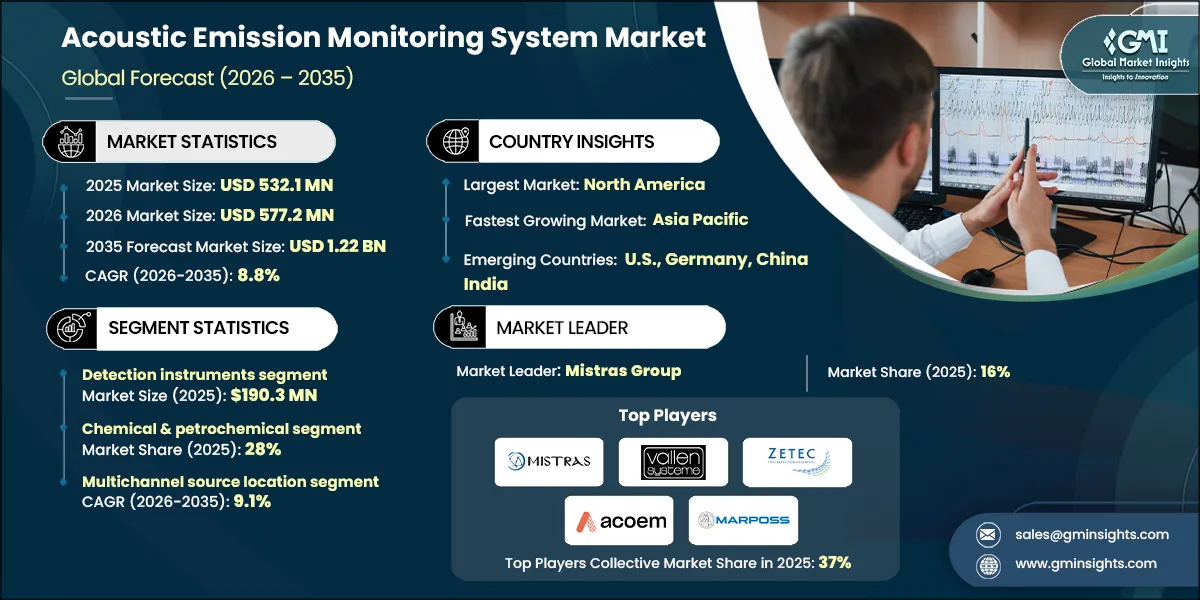
The global acoustic emission monitoring system market was estimated at USD 532.1 million in 2025. The market is expected to grow from USD 577.2 million in 2026 to USD 1.22 billion in 2035, at a CAGR of 8.8% according to latest report published by Global Market Insights Inc.
Acoustic Emission Monitoring System Market Key Takeaways
Market Size & Growth
- 2025 Market Size: USD 532.1 Million
- 2026 Market Size: USD 577.2 Million
- 2035 Forecast Market Size: USD 1.22 Billion
- CAGR (2026–2035): 8.8%
Regional Dominance
- Largest Market: North America
- Fastest Growing Region: Asia Pacific
Key Market Drivers
- Increasing demand for non-destructive testing methods across various industries.
- Rising adoption in oil and gas, aerospace, and automotive sectors.
Challenges
- High initial investment and maintenance costs.
- Complexity in system integration with existing infrastructure.
Opportunity
- Growing adoption of Industry 4.0 and IoT technologies.
- Development of portable and wireless systems.
Key Players
- Market Leader: Mistras Group led with over 16% market share in 2025.
- Leading Players: Top 5 players in this market include Mistras Group, Vallen Systeme, Zetec, Acoem, Marposs, which collectively held a market share of 37% in 2025.
Get Market Insights & Growth Opportunities
The market for acoustic emission monitoring systems is growing because of the increasing adoption of advanced monitoring technologies in various industries such as manufacturing, energy, aerospace, and construction.
The increasing need for real-time monitoring solutions for structural integrity and efficiency is a prime driver for the growth of the market. The increasing need for safety regulations and standards for critical infrastructure is also increasing the adoption of acoustic emission monitoring systems.
The advancements in sensor and analytical technologies are improving the functionality of acoustic emission monitoring systems. This is increasing the efficiency of these systems. Industries are now able to identify problems in advance and resolve them. This is reducing maintenance costs.
The energy industry, especially the oil and gas industry, is expected to make a significant contribution to the growth of the market. The requirement to continuously monitor the pipelines, storage tanks, and other critical infrastructure to avoid leaks or failures is propelling the demand for acoustic emission monitoring systems within the industry.
As per the government statistics, more than USD 321 billion was invested in manufacturing, electricity, and industries in the United States. On an aggregated basis, the cleanest energy-related investments have been made in Texas and California, with an investment of USD 62.3 billion and USD 34 billion, respectively, from 2022 through the first quarter of 2025.
The largest consuming state as well as the largest net exporter of energy to other states, Texas, has attracted over 60 billion dollars of investment in the areas of solar, wind, batteries, storage, critical minerals, carbon capture, hydrogen, sustainable aviation fuel, as well as carbon removal. There are 130 such projects under development, while 234 projects are operational.
To get key market trends
Acoustic Emission Monitoring System Market Trends
The market for acoustic emission monitoring systems is experiencing substantial growth, which is being driven by the increasing use of advanced technology. Another trend that is currently influencing the market is the increasing use of acoustic emission monitoring systems in the manufacturing industry.
Acoustic emission monitoring systems are increasingly being used for the purpose of structural defect detection, as they help in the efficiency of the operations. Additionally, the predictive maintenance trend is driving the adoption of such systems, as they help in the detection of failures, thus reducing the costs of maintenance.
- Advances in technology, including the incorporation of artificial intelligence and machine learning, are also changing this market at a fast pace. Such technologies improve the reliability and efficiency of acoustic emission monitoring systems by providing real-time analysis capabilities.
- The emergence of wireless and portable monitoring technologies is also gaining momentum, providing versatility and ease of use in different applications. In addition, the adoption of the Internet of Things in Industry (IIoT) is increasing the demand for networked acoustic emission monitoring technology, enabling smooth data acquisition and analysis.
- For instance, Hexagon Digital Wave developed the Modal Acoustic Emission (MAE) technology specifically for the compressed gas distribution market. MAE is an advanced non-destructive testing method that can determine the integrity of materials with high precision and is therefore perfect for the demanding environment of the gas distribution market.
Acoustic Emission Monitoring System Market Analysis
Learn more about the key segments shaping this market
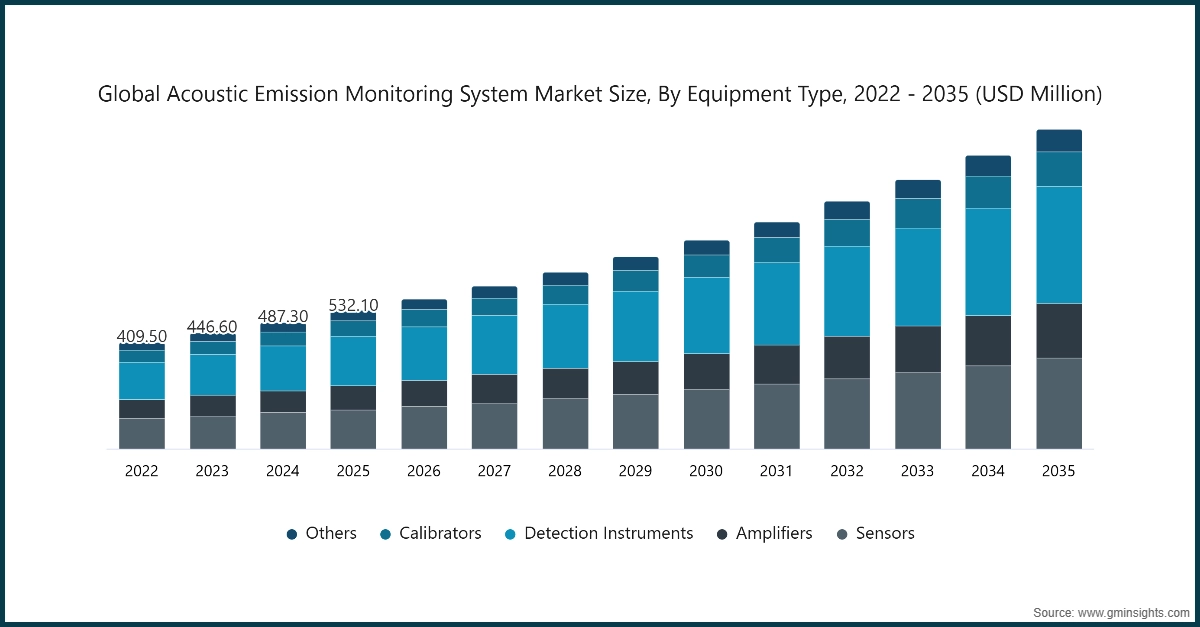
Based on the equipment type, the acoustic emission monitoring system market is divided into sensors, amplifiers, detection instruments, calibrators, and others. In 2025, detection instruments dominated the market generating revenue of USD 190.3 million and were expected to grow at a CAGR of 9.1% during the forecast period.
- Detection instruments are a crucial part of acoustic emission testing systems, and it is a growing market as there is innovation in analysis and diagnosis. The oil and gas industry, construction industry, and power industry are increasingly using detection instruments to maintain efficiency as well as safety.
- The sensors segment in the acoustic emission monitoring system market is experiencing notable growth and is expected to grow at a CAGR of 8.8% from 2026 to 2035, driven by their critical role in detecting structural changes and faults in real-time. Use of advanced sensors is on the increase in various sectors like aerospace, automotive, as well as the energy sector.
- The amplifiers segment is experiencing a constant growth trend, and this can be attributed to its significance in improving signal quality and ensuring accurate data transmission in acoustic emission monitoring systems.
Learn more about the key segments shaping this market
Based on end user industry, the acoustic emission monitoring system market is segmented into oil & gas, aerospace & defense, energy & power, construction & infrastructure, chemical & petrochemical, and others. In 2025, chemical & petrochemical segments dominate the market with 28% market share, and the segment is expected to grow at a CAGR of 8.8% from 2026 to 2035.
The construction and infrastructure sector is growing because of the rising adoption of acoustic emission systems for the structural health monitoring of bridges, buildings, and other infrastructure. These systems aid in the early identification of cracks and deterioration in the material.
- The energy and power industry is experiencing growth due to the demand for effective monitoring of power plants and renewable energy resources. The acoustic emission monitoring system assists in detecting any defects in turbines, generators, and other major components, ensuring continuous operation.
- Oil and Gas is anticipated to grow as there is a growing adoption of Acoustic Emission Monitoring Systems in the oil and gas industry for pipeline integrity and leak detection. Investment in exploration and production, along with safety regulations, is boosting the market.
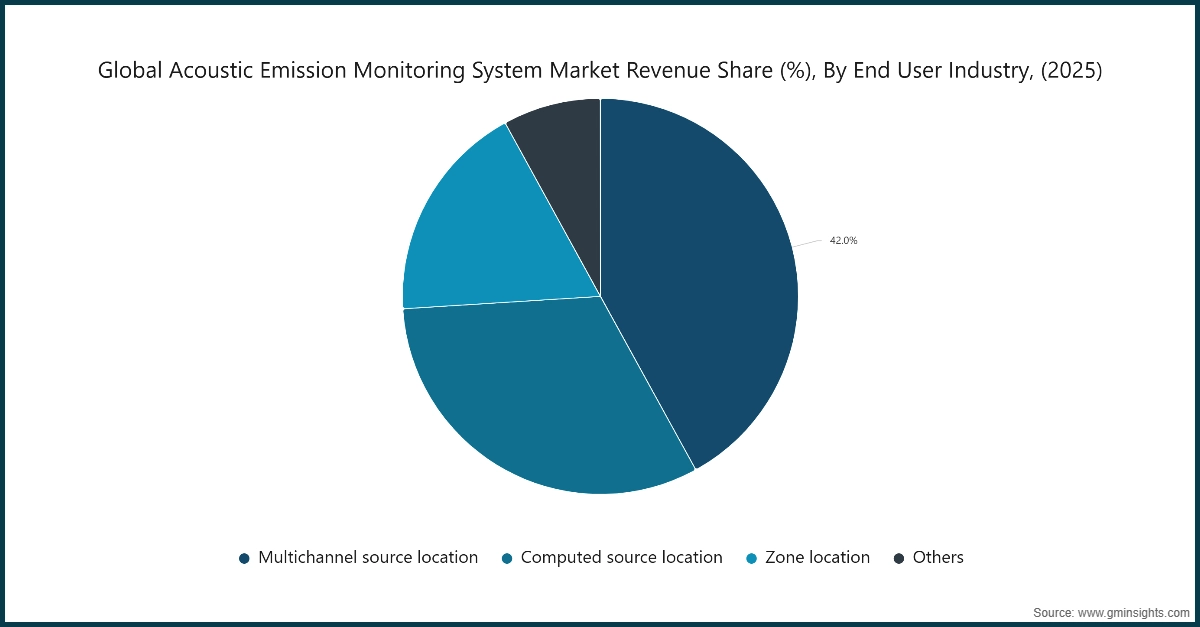
Based on testing technology, the acoustic emission monitoring system market is segmented into multichannel source location, computed source location, zone location, and others. In 2025, the multichannel source location segment dominates the market and is expected to grow at a CAGR of 9.1% from 2026 to 2035.
- The market for multichannel source location is growing at a significant pace because of its ability to detect multiple sources of acoustic emission at a time. This technique has been gaining popularity in the aerospace, automobile, and energy sectors, where it is essential to track complex systems.
- The source location segment is also experiencing growth in light of advances in computation algorithms. The source location technique has applications in industries that require accurate identification of emission sources, including the oil and gas sector.
Looking for region specific data?
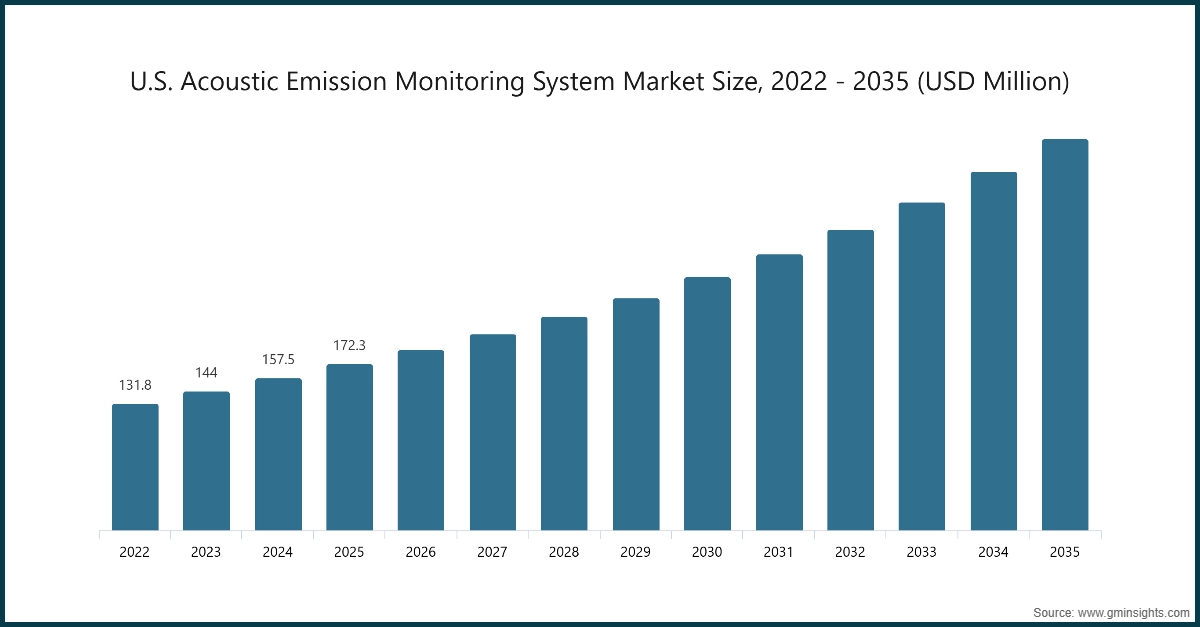
In terms of country, the United States led the acoustic emission monitoring system market with 80% of the North American market share and estimated USD 172.3 million in revenue during 2025.
- The major factor that propels the growth of the acoustic emission monitoring system industry in the United States is the rising use of advanced monitoring technology in oil and gas, aero, and manufacturing industries.
- The increasing importance of predictive maintenance and the need to ensure efficiency of operation are major factors propelling the demand for such systems. Moreover, the strict safety regulations and requirements of the United States are also pushing the adoption of effective monitoring systems by various industries.
- The presence of dominant market players and their relentless efforts in research and development activities is expected to boost innovation and market growth. The U.S. market is expected to retain its leading position in the North American market with its strong industry base and increasing investments in infrastructure development.
The Europe acoustic emission monitoring system market was valued at USD 154 million in 2025 and is projected to grow at a CAGR of 8.5% between 2026 and 2035.
- The market is growing due to rising safety regulations in the industrial sector, the development of monitoring technologies, and the increasing use of predictive maintenance strategies. Sectors such as oil and gas, aerospace, and the manufacturing sector have started using the acoustic emission monitoring system to improve efficiency and ensure safety.
- Regions such as Germany, the United Kingdom, and France are expected to lead the regional market because of their strong industry base and technological advancements.
The Asia Pacific acoustic emission monitoring system market was valued at USD 121.6 million in 2025 and is projected to grow at a CAGR of 9.4% between 2026 and 2035.
- The main driving factor for this growth is the rising adoption of sophisticated monitoring systems across various sectors such as oil and gas, manufacturing, and energy. Fast-growing industrialization, especially in countries such as China, India, and Japan, also contributes towards the rising demand for these systems.
- Government regulations concerning work environment safety and environment surveillance are pushing industries to adopt acoustic emission surveillance solutions.
The Middle East and Africa acoustic emission monitoring system market was valued at USD 17.9 million in 2025 and is projected to grow at a CAGR of 8.2% between 2026 and 2035.
- The factors that are propelling the growth of the market are the rising industrial activities in the oil and gas industry, the power industry, and the manufacturing industry. The region’s efforts to optimize efficiency and ensure safety compliance have led to an increase in the adoption of these systems.
- Countries such as Saudi Arabia, UAE, and South Africa are anticipated to drive the market because of their strong manufacturing base and investments in technology upgrades.
Acoustic Emission Monitoring System Market Share
The top 5 companies in the acoustic emission monitoring system industry are Mistras Group, Vallen Systeme, Zetec, Acoem, and Marposs collectively hold a share of 37% in the market.
These companies continue to acquire and merge with others, expand facilities, and make various collaborations to increase their product offerings, access customer bases, and secure their market positions.
Mistras Group is increasing its market share by utilizing their advanced technologies in acoustic emission monitoring and their services. The company is trying to offer tailored solutions to their customers in the oil and gas, aerospace, and power market sectors. The company is also innovating and improving their products by investing in R&D.
Vallen Systeme is able to capture a greater market share because it provides high-quality acoustic emission monitoring systems that cater to various industrial applications. The company focuses on the accuracy and reliability of its products, which have been widely used in industries such as manufacturing, automobile, and power generation. Vallen Systeme spends considerable effort on technological development to outperform other companies in the market and cater to the changing needs of customers.
Zetec is enhancing its market position through the provision of innovative acoustic emission monitoring technology that meets the critical needs of the nuclear, aerospace, and defense sectors. Its focus is on research and development to incorporate innovative technologies that boost efficiency and accuracy.
Acoem is making market entries by launching flexible and high-performance acoustic emission monitoring systems. Acoem focuses on the aspects of sustainability and innovation by incorporating the latest technologies to cater to the demands of the industry. The strategic collaboration of Acoem has helped the company enter the market with improved product offerings.
Acoustic Emission Monitoring System Market Companies
Major players operating in the acoustic emission monitoring system industry are:
- Acoem
- Baker Hughes
- GAOTek
- Hexagon Composites
- Innerspec Technologies
- Liangui Technology
- Marposs
- Miratech
- Mistras Group
- NDT Systems
- Olympus
- Qawrums
- RST Instruments
- Vallen Systeme
- Zetec
To improve the product and market share key players are constantly investing in technological activities and are also entering into partnerships to provide improved and better solutions for the customers. These investments are benefiting both companies and customers as they help develop and offer solutions as per the changing technological trends and thus the customer requirements.
Baker Hughes is a global energy technology company offering solutions to energy and industrial consumers around the world. The company is known to specialize in advanced solutions such as acoustic emission monitoring systems to improve efficiency as well as safety. With innovation as a primary objective, Baker Hughes is incorporating advanced monitoring solutions to cater to the increasing need for predictive maintenance solutions.
GAOTek is a major supplier of high-quality engineering products like acoustic emission monitoring systems for industries like manufacturing, construction, and energy sectors. GAOTek is recognized for its innovative and economical solutions for businesses looking for ways to optimize their operations. GAOTek’s offerings also include advanced monitoring systems used for the detection of structural defects in equipment.
Hexagon Composites is a world leader in the supply of composite pressure vessels as well as acoustic emission monitoring systems. Hexagon Composites uses its competence in advanced materials and engineering to supply high-quality monitoring systems. Hexagon Composites is known for its focus on innovation, safety, and sustainability. Its products improve safety, performance, and efficiency.
Qawrums is a rising name in the market for acoustic emission monitoring systems, which has gained recognition for its innovative and customer-centric approach. Qawrums has expertise in creating innovative monitoring solutions for various sectors that can help them identify and resolve structural issues. Qawrums aims at creating high-quality monitoring systems that cater specifically to the needs of manufacturing, power, and construction sectors, among others.
Acoustic Emission Monitoring System Market Report Attributes
| Key Takeaway | Details |
|---|---|
| Market Size & Growth | |
| Base Year | 2025 |
| Market Size in 2025 | USD 532.1 Million |
| Market Size in 2026 | USD 577.2 Million |
| Forecast Period 2026-2035 CAGR | 8.8% |
| Market Size in 2035 | USD 1.22 Billion |
| Key Market Trends | |
| Drivers | Impact |
| Increasing demand for non-destructive testing methods across various industries | This is driving the adoption of acoustic emission monitoring systems, as industries prioritize safety and efficiency, leading to steady market growth |
| Rising adoption in oil and gas, aerospace, and automotive sectors | These sectors rely heavily on monitoring systems for critical applications, significantly boosting market demand |
| Pitfalls & Challenges | Impact |
| High initial investment and maintenance costs | These costs function as a barrier for small and medium-sized enterprises, limiting market penetration |
| Complexity in system integration with existing infrastructure | Integration challenges slow down implementation rates, particularly in legacy systems, restraining market growth |
| Opportunities: | Impact |
| Growing adoption of Industry 4.0 and IoT technologies | These advancements are creating new opportunities for system integration, enhancing market potential |
| Development of portable and wireless systems | Innovations in portable and wireless acoustic emission monitoring systems are expanding their application scope, positively influencing market growth |
| Market Leaders (2025) | |
| Market Leader |
16% market share |
| Top Players |
Collective market share in 2025 is 37% |
| Competitive Edge |
|
| Regional Insights | |
| Largest Market | North America |
| Fastest growing market | Asia Pacific |
| Emerging countries | U.S., Germany, China, India |
| Future outlook |
|
What are the growth opportunities in this market?
Acoustic Emission Monitoring System Industry News
- In January 2026, Miratech announced that it has acquired Advanced Catalyst Systems (ACS), a Maryville, Tennessee–based manufacturer of high-performance catalyst technologies and emission control systems. This acquisition marks a significant expansion of Miratech's catalyst manufacturing capacity and reinforces its commitment to support customers, both domestically and globally.
- In December 2025, Hexagon Digital Wave launches in-situ requalification of Type 3 gas distribution trailers, using its proprietary Modal Acoustic Emission (MAE) technology. MAE is an advanced non-destructive testing (NDT) technique that can accurately detect and assess damage in composite materials, making it an ideal solution for the rigorous demands of the gas distribution industry.
- In January 2025, Baker Hughes launched Sureconnect FE, the industry’s first field-proven downhole fiber-optic wet-mate system that enables real-time, optimized reservoir performance in high-pressure, high-temperature environments. Sureconnect FE enables operators to seamlessly implement fiber-optics monitoring, electronic monitoring, and electric intelligent completion systems across the entire wellbore at the sandface without an intervention, leading to enhanced production and more informed operational decisions.
The acoustic emission monitoring system market research report includes in-depth coverage of the industry with estimates & forecasts in terms of revenue (USD Million) and volume (Thousand Units) from 2022 to 2035, for the following segments:
Market, By Equipment Type
- Sensors
- Amplifiers
- Detection Instruments
- Calibrators
- Others (connectors, mounting accessories etc.)
Market, By Testing Technology
- Multichannel source location
- Computed source location
- Zone location
- Others (point location etc.)
Market, By Application
- Pressure vessels
- Storage tanks
- Pipelines & piping systems
- Aerospace structures
- Civil infrastructure
- Others (manufacturing equipment etc.)
Market, By End Use Industry
- Oil & gas
- Aerospace & defense
- Energy & power
- Construction & infrastructure
- Chemical & petrochemical
- Others (marine etc.)
Market, By Distribution Channel
- Direct sales
- Indirect sales
The above information is provided for the following regions and countries:
- North America
- U.S.
- Canada
- Europe
- UK
- Germany
- France
- Italy
- Spain
- Netherlands
- Asia Pacific
- China
- India
- Japan
- South Korea
- Australia
- Latin America
- Brazil
- Mexico
- Argentina
- MEA
- South Africa
- Saudi Arabia
- UAE
Frequently Asked Question(FAQ) :
What is the acoustic emission monitoring system market size in 2025?
The market size for acoustic emission monitoring system is valued at USD 532.1 million in 2025. Increasing demand for non-destructive testing methods across industries supports steady market growth.
What is the market size of the acoustic emission monitoring system industry in 2026?
The market size for acoustic emission monitoring systems is projected to reach USD 577.2 million in 2026, reflecting consistent growth driven by adoption in critical sectors like oil and gas, aerospace, and automotive.
What is the projected value of the acoustic emission monitoring system market by 2035?
The market size for acoustic emission monitoring systems is expected to reach USD 1.22 billion by 2035, growing at a CAGR of 8.8%. This growth is fueled by advancements in Industry 4.0, IoT technologies, and portable system innovations.
How much revenue did the detection instruments segment generate in 2025?
The detection instruments segment generated USD 190.3 million in revenue in 2025, making it the leading equipment type. Its dominance is supported by strong demand for accurate and efficient monitoring solutions.
What was the market share of the chemical and petrochemical segment in 2025?
The chemical and petrochemical segment accounted for 28% of the market in 2025, making it the largest end-user industry. Its growth is driven by the need for safety and efficiency in critical operations.
What is the growth outlook for the multichannel source location segment from 2026 to 2035?
The multichannel source location segment is projected to grow at a CAGR of 9.1% from 2026 to 2035. Its growth is attributed to its ability to provide precise monitoring and analysis in complex applications.
Which country leads the acoustic emission monitoring system market?
The United States led the market in North America with USD 172.3 million in revenue in 2025, representing 80% of the regional market share. Its dominance is driven by advancements in monitoring technologies and widespread adoption across industries.
What are the upcoming trends in the acoustic emission monitoring system industry?
Key trends include the growing adoption of Industry 4.0 and IoT technologies, development of portable and wireless systems, and increasing integration of advanced monitoring solutions with existing infrastructure. These trends are enhancing market potential and expanding application scope.
Who are the key players in the acoustic emission monitoring system market?
Key players include Mistras Group, Vallen Systeme, Zetec, Acoem, Marposs, Baker Hughes, GAOTek, Hexagon Composites, Innerspec Technologies, Liangui Technology, Miratech, and NDT Systems.
Acoustic Emission Monitoring System Market Scope
Related Reports