Summary
Table of Content

Acetone Market
Get a free sample of this report
Form submitted successfully!
Error submitting form. Please try again.
Thank you!
Your inquiry has been received. Our team will reach out to you with the required details via email. To ensure that you don't miss their response, kindly remember to check your spam folder as well!
Request Sectional Data
Thank you!
Your inquiry has been received. Our team will reach out to you with the required details via email. To ensure that you don't miss their response, kindly remember to check your spam folder as well!
Form submitted successfully!
Error submitting form. Please try again.
Acetone Market Size
Acetone has progressed from its original function as a basic industrial solvent to become an essential element which supports contemporary manufacturing processes and chemical production operations and material development practices throughout the world. Its unique solvency, compatibility with diverse substrates, and role as a precursor in high‑value chemical chains give it a strategic position across multiple value‑driven ecosystems. Industries utilize acetone for their operational efficiency goals and their requirement of sustainable production methods which permits its use in both traditional systems and modern technological advances to maintain its status as a critical chemical in worldwide markets.
- The acetone industry now uses sustainability as its primary guiding principle which determines its future development path. Market players now give priority to production methods that create minimal environmental impact while implementing circular chemistry systems and using bio‑derived production methods to meet international environmental requirements. The upcoming changes will affect product development and procurement strategies and partnership models which companies use in their downstream operations for plastics and coatings and pharmaceuticals and personal care products.
- Environmental control technologies together with waste minimization systems and integrated production‑phenol value chains create new competitive advantages and cost changes which transform supply base operations for companies worldwide.
The global acetone market was valued at USD 6.9 billion in 2025. The market is expected to grow from USD 7.4 billion in 2026 to USD 12.2 billion in 2035, at a CAGR of 5.8% according to latest report published by Global Market Insights Inc.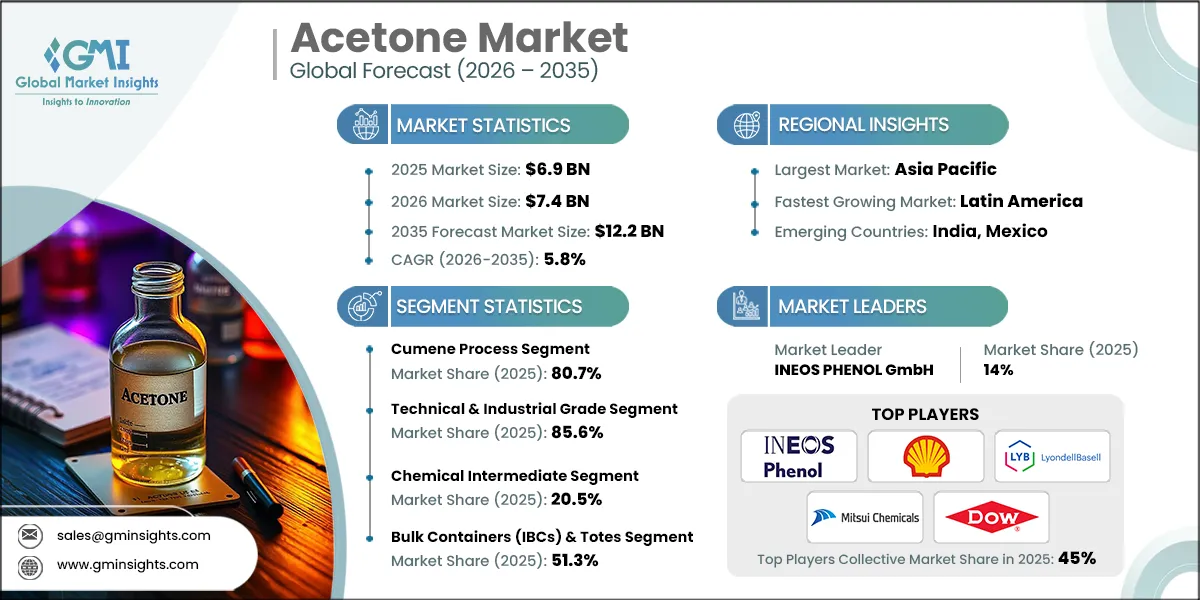
Acetone Market Key Takeaways
Market Size & Growth
- 2025 Market Size: USD 6.9 Billion
- 2026 Market Size: USD 7.4 Billion
- 2035 Forecast Market Size: USD 12.2 Billion
- CAGR (2026–2035): 5.8%
Regional Dominance
- Largest Market: Asia Pacific
- Fastest Growing Region: Latin America
Key Market Drivers
- Increasing demand in paints and coatings.
- Expansion of the pharmaceutical sector.
- Rising automotive industry activities.
Challenges
- Volatility in raw material prices.
- Stringent environmental regulations & compliance costs.
Opportunity
- Carbon-negative acetone via gas fermentation.
- Ultra-high-purity electronic-grade for advanced semiconductors.
Key Players
- Market Leader: INEOS PHENOL GmbH led with over 14% market share in 2025.
- Leading Players: Top 5 players in this market include Ineos phenol gmbh, Royal Dutch Shell PLC, LyondellBasell industries holdings B.V., Mitsui Chemicals, INC., The Dow Chemical Company, which collectively held a market share of 45% in 2025.
Get Market Insights & Growth Opportunities
To get key market trends
Acetone Market Trends
- The global market is entering a phase of transformation driven by the convergence of performance expectations and sustainability imperatives. Acetone which used to function as an essential industrial solvent now serves as an all-purpose resource for manufacturing operations which need cleaner production methods and faster production speeds and better compatibility with new production methods. The material has become strategically vital for industries because its properties enable operational efficiency while organizations adopt environmentally sustainable materials for their production processes.
- Production technology innovations create new competitive environments because manufacturers now prioritize process efficiency improvements and product purity enhancements and better environmental results. Acetone production now operates according to circular economy standards because of advancements in integrated manufacturing systems and pathways that reduce waste and methods that utilize clean feedstock. The developments create cost stability which decreases operational risk while increasing acetone value as a chemical input that meets future requirements for high-performance downstream applications.
- Acetone suppliers must create specialized performance attributes that fulfill strict regulatory and functional and quality standards because semiconductor and medical formulation and advanced material sectors now require more sophisticated products. The shift results in stronger partnerships between producers and end‑use innovators which help speed up acetone adoption in next‑generation processes that require precise chemical reliability and safety and exacting control.
- Acetone will evolve from its current role as a common solvent to become an industrial catalyst which drives operational resilience while enabling companies to achieve sustainability leadership. The material functions as a strategic asset for organizations which face international regulatory changes and need to achieve decarbonization targets through its growing use in sustainable manufacturing processes and eco-friendly product development and advanced technological fields.
Acetone Market Analysis
Learn more about the key segments shaping this market
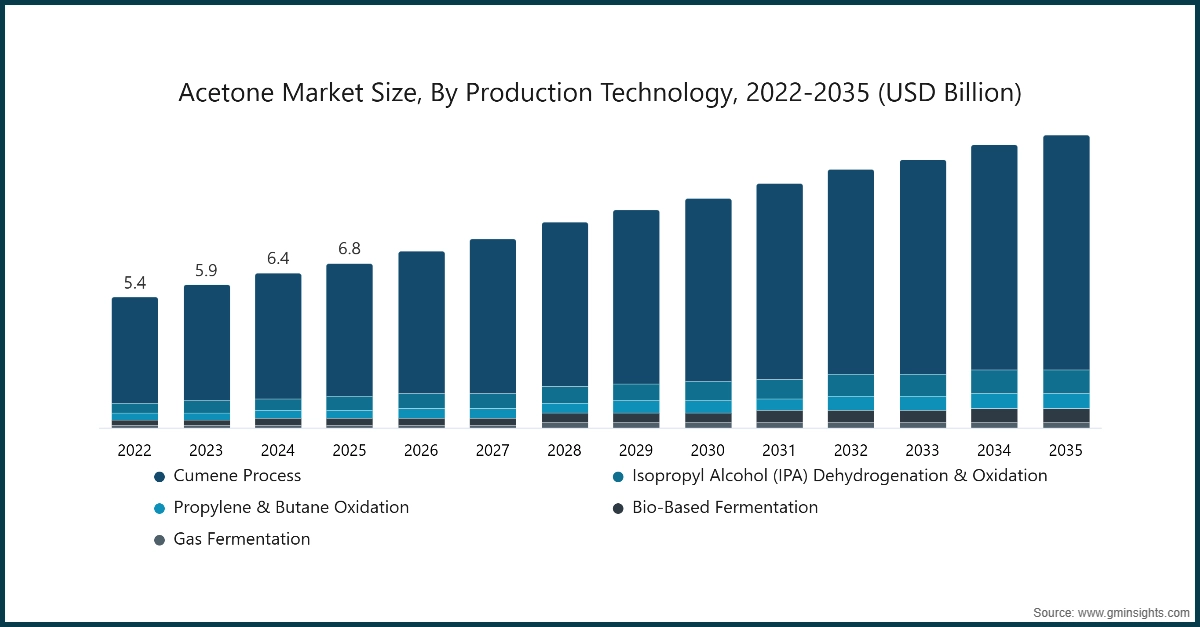
Based on production technology, the market is segmented into cumene process, isopropyl alcohol (ipa) dehydrogenation & oxidation, propylene & butane oxidation, bio-based fermentation, gas fermentation. Cumene process dominated with an approximate market share of 80.7% in 2025 and is expected to grow with a CAGR of 6.8% by 2035.
- The conventional cumene process remains the industry’s anchor due to its integration with phenol manufacturing and its ability to deliver consistent quality at scale, while IPA dehydrogenation and oxidation offer flexibility for producers who need to maintain production speed while creating products for their high purity downstream markets. Business operations in areas that focus on feedstock diversification and operational flexibility can use propylene oxidation and butane oxidation as methods to obtain their needed materials.
Learn more about the key segments shaping this market
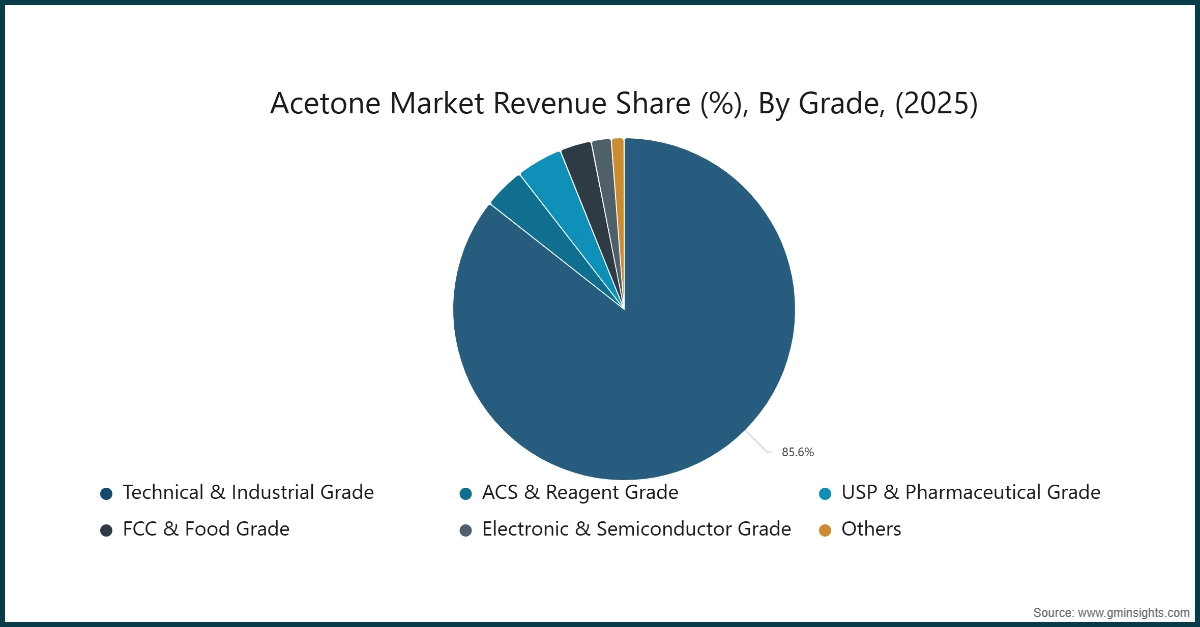
Based on grade, the acetone market is segmented into technical & industrial grade, acs & reagent grade, usp & pharmaceutical grade, fcc & food grade, electronic & semiconductor grade, others. Technical & industrial grade held the largest market share of 85.6% in 2025 and is expected to grow at a CAGR of 5.8% during 2026-2035.
- Technical and industrial grade acetone supports large-volume production for coatings and plastics and chemical intermediates which require stable solvency and streamlined operational processes. ACS and reagent grade acetone serves laboratory and analytical and controlled process applications which need high purity and chemical stability and predictable chemical properties. USP and pharmaceutical grade acetone functions as compliance-based material for drug development and extraction and purification processes which require strict safety and quality control to verify supplier trustworthiness. FCC and food grade acetone supplies essential materials for food contact and flavoring processes which require proven safety standards and traceability systems and regulated material management.
Based on application, the acetone market is segmented into chemical intermediate, industrial applications, pharmaceutical solvent & processing aid, electronics & semiconductor cleaning, cosmetics & personal care, laboratory & analytical chemistry, 3d printing & additive manufacturing, food processing & flavor extraction, others. Chemical intermediate segment dominated with an approximate market share of 20.5% in 2025 and is expected to grow with the CAGR of 6.6% by 2035.
- Chemical intermediate use sustains the market because it enables large-scale production of downstream polymers and resins while industrial applications depend on acetone to provide fast-evaporation solvency for better manufacturing processes in coatings and adhesives and specialty chemicals. Acetone functions as a pharmaceutical solvent and processing aid because it enables pharmaceutical professionals to create stable and pure drugs through precise formulation and purification and extraction processes which must meet stringent compliance standards.
Based on distribution channel, the acetone market is segmented into manufacturer-to-distributor-to-end-user, online & E-commerce platforms. Manufacturer-to-distributor-to-end-user segment dominated with an approximate market share of 95.5% in 2025 and is expected to grow with the CAGR of 5.6% by 2035.
- Acetone distribution through the manufacturer‑to‑distributor‑to‑end‑user channel uses established logistics systems that prioritize reliable delivery and compliance with regulations and capacity to supply industrial customers who need constant product quality and technical assistance and long-term secure supply contracts.
- Online and e‑commerce platforms function as market accessibility accelerators because they help small and mid‑scale users to obtain products more quickly while achieving better transparency in their buying process. The platforms use digital catalogs and real-time availability and streamlined fulfillment to create new customer interaction methods which position acetone as a digital-enabled industrial commodity that matches current buying needs.
Based on packaging, the acetone market is segmented into Intermediate bulk containers (IBCs) & totes, drums (55-Gallon & 360 lb), small containers (1-5 Liters). Bulk containers (IBCs) & totes dominated with an approximate market share of 51.3% in 2025 and is expected to grow with the CAGR of 5.3% by 2035.
- Large volume customers who need effective product management and want to minimize packaging waste and achieve better logistical operations at their chemical production sites now prefer intermediate bulk containers and totes as their most effective handling solution. The industry uses 55-gallon and 360-lb drum sizes as their primary packaging solution for mid-scale production because these drums provide both strength and hazardous materials safety and they work with automated filling and distribution systems. The drums provide industrial sectors with packaging solutions that meet their needs for transportation protection and safe storage and simple handling in various industrial settings.
Looking for region specific data?
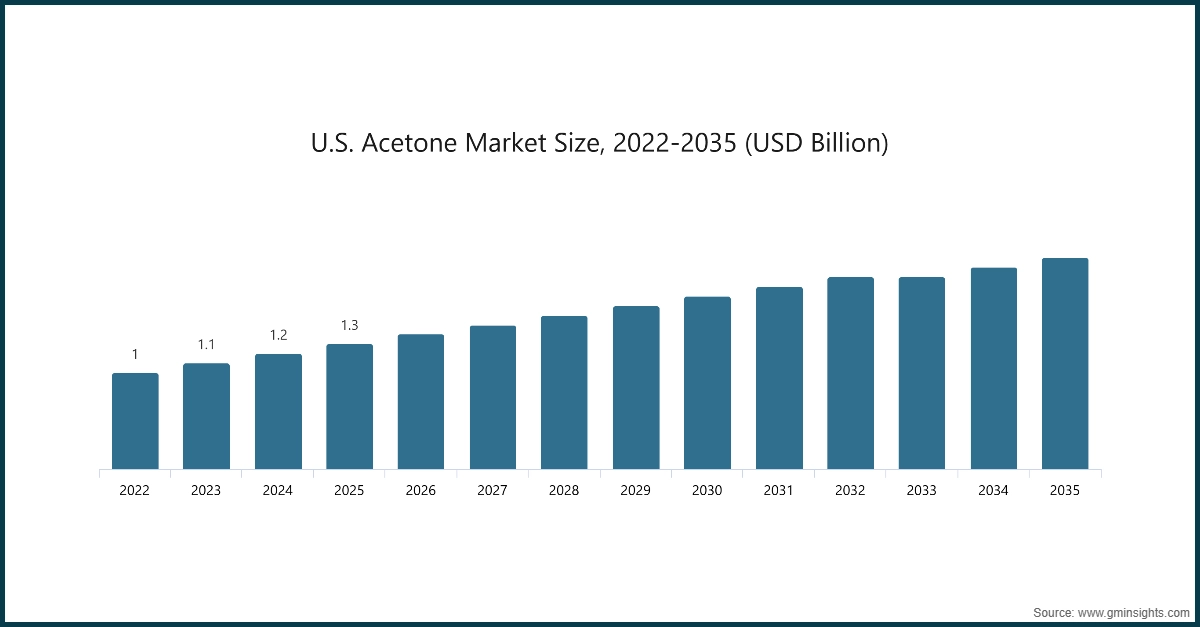
The North America acetone industry is growing rapidly on the global level with a revenue share of 22.7% in 2025.
- North America serves as a crucial strategic element which sustains the worldwide acetone market because its industrial base operates at full capacity while its manufacturing competencies develop advanced production methods and its customers who create downstream requirements drive acetone production.
U.S. dominates the North America acetone market, showcasing strong growth potential.
- The U.S. operates as the primary power in the country because it generates the highest level of market activity which creates regional market impact through its industrial capacity and technological progress and its complete control of the acetone production process.
Europe acetone market was valued USD 1.5 billion in 2025 and is anticipated to show lucrative growth over the forecast period.
- The market growth results from increased acetone applications and the chemical industry shift toward environmentally friendly chemical manufacturing processes. The industrial sector needs acetone as a key resource because it helps organizations achieve their goals of improving material performance and operational safety and environmental sustainability.
The Asia Pacific acetone market is anticipated to grow at a CAGR of 5.9% during the analysis timeframe.
- Asia Pacific has become the most important center because its chemical manufacturing base and increasing need for advanced materials and its fast growth in pharmaceutical and electronic and downstream processing sectors. The region develops advanced production technologies at its manufacturing sites which drive market growth and become the main investment area for new production capacity and innovative technologies.
Latin America accounted for 5.6% market share in 2025 and is anticipated to show highest growth over the forecast period.
- Industrial modernization enables Latin America to develop its acetone capacity as new value-adding industries grow in specialty chemicals and consumer products and manufacturing sectors. The region attracts acetone applications which use sustainable production practices because of its regulatory support and growing supply chain participation and environmental production requirements.
Middle East & Africa accounted for 2.9% market share in 2025 and is anticipated to show lucrative growth over the forecast period.
- The Middle East & Africa becomes more important because investment in industrial ecosystems and chemical production corridors expands. The region's economic diversification push together with its policies which back sustainable industrial development creates conditions for manufacturing industries to use acetone of high quality.
Acetone Market Share
The top 5 companies in Acetone industry include Ineos phenol gmbh, Mitsui chemicals, inc., LyondellBasell industries holdings B.V., Mitsui Chemicals, INC., The Dow Chemical Company. These are prominent companies operating in their respective regions covering approximately 45% of the market share in 2025. These companies hold strong positions due to their extensive experience in acetone market. Their diverse product portfolios, backed by robust production capabilities and distribution networks, enable them to meet the rising demand across various regions.
- INEOS Phenol GmbH functions as a subsidiary of INEOS Phenol, which operates as a worldwide chemical enterprise that produces phenol and acetone along with their chemical intermediates. The company operates production plants throughout Europe and the United States and Asia to deliver materials used in manufacturing automotive parts and construction materials and electronic devices and products for consumers.
- Royal Dutch Shell plc (Shell plc) operates as a worldwide energy and petrochemical corporation which has its main office in London after changing its name from Royal Dutch Shell plc. Its business activities extend to operations in integrated gas and upstream oil and gas and chemicals and products and marketing and emerging renewable energy and energy solution sectors.
- Mitsui Chemicals, Inc. operates as a Japanese chemical manufacturing company that produces diverse products for mobility solutions and life and healthcare materials and ICT-related chemicals and basic and green materials. The company provides elastomers and petrochemicals and packaging materials and semiconductor products and agricultural chemicals which serve the automotive and electronics and healthcare and consumer goods sectors.
- LyondellBasell Industries Holdings B.V. operates as a subsidiary of LyondellBasell to conduct its business as one of the leading global companies that manufacture chemical products and polymer materials and processing systems. The company produces olefins and polyolefins and their intermediate and derivative products and advanced polymer solutions which customers use to create products for packaging and automotive and construction and industrial needs.
- The Dow Chemical Company which operates as Dow Inc. functions as a materials science company which provides chemicals and plastics and specialty materials to industries including packaging and infrastructure and mobility and consumer products. The company provides three major business segments which include packaging and specialty plastics and industrial intermediates and infrastructure and performance materials and coatings.
Acetone Market Companies
Major players operating in the acetone industry include:
- INEOS Phenol GmbH
- Royal Dutch Shell plc
- Mitsui Chemicals, Inc.
- LyondellBasell Industries Holdings B.V.
- The Dow Chemical Company
- BASF SE
- Formosa Chemicals & Fibre Corporation
- Sumitomo Chemical Co., Ltd.
- LG Chem Ltd.
- Reliance Industries Limited
- PTT Global Chemical Public Company Limited
- Celanese Corporation
- LanzaTech, Inc.
- Honeywell International Inc.
Acetone Market Report Attributes
| Key Takeaway | Details |
|---|---|
| Market Size & Growth | |
| Base Year | 2025 |
| Market Size in 2025 | USD 6.9 Billion |
| Market Size in 2026 | USD 7.4 Billion |
| Forecast Period 2026-2035 CAGR | 5.8% |
| Market Size in 2035 | USD 12.2 Billion |
| Key Market Trends | |
| Drivers | Impact |
| Increasing demand in paints and coatings | The basic acetone usage maintains steady growth because acetone serves as a key solvent for efficient formulation and quick-drying systems |
| Expansion of the pharmaceutical sector | Acetone functions as a vital component in API synthesis and extraction and formulation processes |
| Rising automotive industry activities | Higher solvent usage because coatings and adhesives and composite materials are essential for manufacturing processes |
| Pitfalls & Challenges | Impact |
| Volatility in raw material prices | Price fluctuations of raw materials force producers to reduce their profit margins because they make it difficult to establish long-term contracts |
| Stringent environmental regulations & compliance costs | The environmental standards together with their associated costs create higher operational expenses while they force businesses to adopt sustainable practices |
| Opportunities: | Impact |
| Carbon-negative acetone via gas fermentation | Enables producers to choose sustainable methods which help them achieve their decarbonization targets |
| Ultra-high-purity electronic-grade for advanced semiconductors | The chip fabrication process requires extreme purity levels which creates a high-margin growth frontier |
| Market Leaders (2025) | |
| Market Leader |
14% market share |
| Top Players |
Collective Market Share of 45% in 2025 |
| Competitive Edge |
|
| Regional Insights | |
| Largest Market | Asia Pacific |
| Fastest growing market | Latin America |
| Emerging countries | India, Mexico |
| Future outlook |
|
What are the growth opportunities in this market?
Acetone Industry News
- In January 2024, Haldia Petrochemicals Ltd, located in Kolkata, launched a significant phenol plant in India. The plant is expected to be completed by the first quarter of 2026. Once operational, the plant will produce 185,000 tons per annum (KTPA) of acetone and 300,000 tons of phenol yearly.
- In December 2023, PTT Global Chemical (PTTGC), based in Thailand, announced its plans to resume acetone and phenol production at 90% capacity by the end of the month. This initiative aims to enhance resource allocation and improve operational efficiency. The company's manufacturing facility has an annual production capacity of 150,000 tons of acetone and 250,000 tons of phenol.
This acetone market research report includes in-depth coverage of the industry, with estimates & forecasts in terms of revenue (USD Billion) and volume (Kilo Tons) from 2022 to 2035, for the following segments:
Market, By Production Technology
- Cumene process
- Isopropyl alcohol (IPA) dehydrogenation & oxidation
- Propylene & butane oxidation
- Bio-based fermentation
- Gas fermentation
Market, By Grade
- Technical & Industrial Grade
- ACS & Reagent Grade
- USP & Pharmaceutical Grade
- FCC & Food Grade
- Electronic & Semiconductor Grade
- Others
Market, By Application
- Chemical Intermediate
- Methyl Methacrylate (MMA) Production
- Bisphenol A (BPA) Production
- Methyl Isobutyl Ketone (MIBK)
- Solvent - Industrial Applications
- Paints & Coatings Solvent Applications
- Adhesives & Sealants
- Printing Inks
- Cleaning & Degreasing
- Pharmaceutical Solvent & Processing Aid
- API Synthesis & Drug Manufacturing
- Crystallization & Purification Applications
- Equipment Cleaning & Sterilization Preparation
- Electronics & Semiconductor Cleaning
- Wafer Cleaning & Photoresist Removal
- PCB Fabrication & Precision Cleaning
- Cosmetics & Personal Care
- Laboratory & Analytical Chemistry
- Sample Preparation & Extraction
- Chromatography & Spectroscopy Applications
- 3D Printing & Additive Manufacturing
- Food Processing & Flavor Extraction
- Others
Market, By Distribution Channel
- Manufacturer-to-Distributor-to-End-User
- Online & E-Commerce Platforms
Market, By Packaging
- Intermediate Bulk Containers (IBCs) & Totes
- Drums (55-Gallon & 360 lb)
- Small Containers (1-5 Liters)
The above information is provided for the following regions and countries:
- North America
- U.S.
- Canada
- Europe
- Germany
- UK
- France
- Spain
- Italy
- Rest of Europe
- Asia Pacific
- China
- India
- Japan
- Australia
- South Korea
- Rest of Asia Pacific
- Latin America
- Brazil
- Mexico
- Argentina
- Rest of Latin America
- Middle East and Africa
- Saudi Arabia
- South Africa
- UAE
- Rest of Middle East and Africa
Frequently Asked Question(FAQ) :
What is the market size of the acetone in 2025?
The global acetone market was valued at USD 6.9 billion in 2025, driven by increasing demand in paints and coatings, expansion of the pharmaceutical sector, rising automotive industry activities, and acetone's critical role as a chemical intermediate in the production of downstream polymers, resins, and specialty chemicals.
What is the projected value of the acetone industry by 2035?
The acetone market is projected to reach USD 12.2 billion by 2035, growing at a CAGR of 5.8% from 2026 to 2035, supported by high-purity applications in semiconductors and pharmaceuticals.
What is the acetone industry size in 2026?
The acetone market size is projected to reach USD 7.4 billion in 2026, fueled by rising industrial consumption, and continued expansion of chemical intermediate applications globally.
Which production technology segment dominated the acetone market in 2025?
The cumene process dominated the market with an approximately 80.7% share in 2025 and is expected to grow at a CAGR of 6.8% by 2035, attributed to its deep integration with phenol manufacturing, ability to deliver consistent quality at scale, and established infrastructure across major production regions worldwide.
Which grade segment held the largest market share in the acetone market in 2025?
The technical and industrial grade segment held the largest market share of 85.6% in 2025 and is expected to grow at a CAGR of 5.8% till 2035, driven by large-volume production requirements in coatings, plastics, and chemical intermediates.
Which application segment dominated the acetone market in 2025?
The chemical intermediate segment dominated with approximately 20.5% market share in 2025 and is expected to grow at a CAGR of 6.6% by 2035, driven by large-scale production of downstream polymers.
Which region leads the acetone market?
North America holds a 22.7% global market share in 2025, with the U.S. as the primary driver. Latin America is identified as the fastest-growing regional market.
What are the upcoming trends in the acetone market?
Key trends include the shift toward sustainable and circular production methods including bio-based fermentation and gas fermentation pathways enabling carbon-negative acetone, integration of waste minimization and clean feedstock systems, and expanding pharmaceutical and 3D printing applications.
Who are the key players in the acetone market?
Key players include INEOS Phenol GmbH, Royal Dutch Shell PLC, LyondellBasell Industries Holdings B.V., Mitsui Chemicals Inc., The Dow Chemical Company, BASF SE, Formosa Chemicals & Fibre Corporation, Sumitomo Chemical Co., LG Chem Ltd., Reliance Industries Limited, Celanese Corporation, LanzaTech Inc., and Honeywell International Inc.
Acetone Market Scope
Related Reports