Summary
Table of Content

800V Electric Vehicle Architecture Market
Get a free sample of this report
Form submitted successfully!
Error submitting form. Please try again.
Thank you!
Your inquiry has been received. Our team will reach out to you with the required details via email. To ensure that you don't miss their response, kindly remember to check your spam folder as well!
Request Sectional Data
Thank you!
Your inquiry has been received. Our team will reach out to you with the required details via email. To ensure that you don't miss their response, kindly remember to check your spam folder as well!
Form submitted successfully!
Error submitting form. Please try again.
800V Electric Vehicle Architecture Market Size
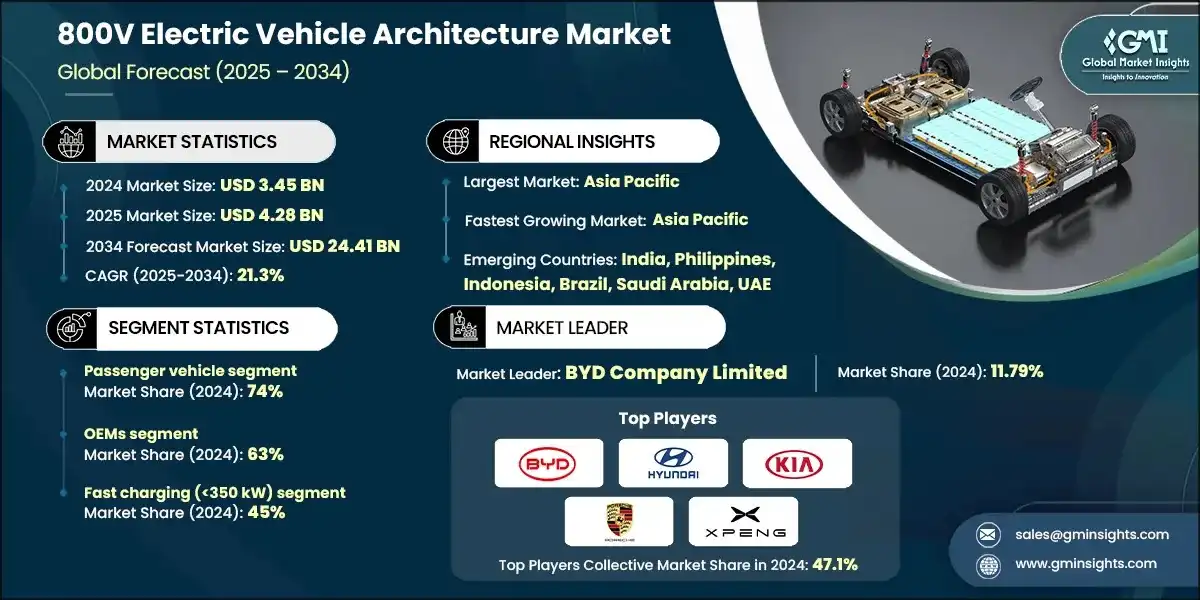
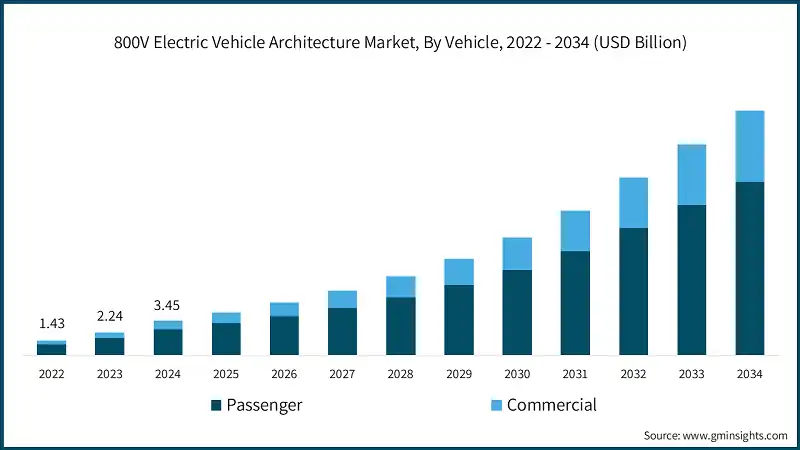
The 800V electric vehicle architecture market size was estimated at USD 3.45 billion in 2024. The market is expected to grow from USD 4.28 billion in 2025 to USD 24.41 billion in 2034, at a CAGR of 21.3%, according to latest report published by Global Market Insights Inc.
800V Electric Vehicle Architecture Market Key Takeaways
Market Size & Growth
- 2024 Market Size: USD 3.45 Billion
- 2025 Market Size: USD 4.28 Billion
- 2034 Forecast Market Size: USD 24.41 Billion
- CAGR (2025–2034): 21.3%
Key Market Drivers
- Rise in demand for faster charging and extended driving range.
- Surge in production of high-performance electric vehicles.
- Increase in government incentives and regulatory support for EVs.
- Growth in collaboration between OEMs and semiconductor suppliers.
Challenges
- High cost of 800V components and integration.
- Limited availability of compatible charging infrastructure.
Opportunity
- Rise in adoption of 800V systems in commercial and fleet EVs.
- Surge in investment toward next-generation battery technologies.
- Increase in demand for 800V-ready autonomous and connected vehicles.
- Expansion of EV manufacturing in emerging economies.
Key Players
- Leading Players: Top 5 players in this market include BYD Company Limited, Hyundai Motor Company, Kia Corporation, Porsche, Xpeng Motors, which collectively held a market share of 47.1% in 2024.
Get Market Insights & Growth Opportunities
The rapid adoption of 800 V electric vehicle architectures in the global automotive industry is creating a transformative shift in the EV ecosystem. Modern 800 V platforms enable faster charging, higher energy efficiency, lighter wiring, and improved thermal management, which are critical for next-generation electric vehicles. These architectures allow high-voltage operation across batteries, inverters, motors, and onboard electronics, facilitating ultra-fast charging and higher power output, supporting both performance and mainstream EV adoption.
In October 2024, MITRE and other automotive technology reports indicated that the demand for vehicles supporting ultra-fast charging (>350 kW) and high-voltage architectures increased dramatically, particularly in premium and mass-market EV segments. Leading OEMs are transitioning from 400–450 V systems to full 800 V architectures to enable faster charging times, reduced energy loss, and higher range efficiency, fueling market adoption globally.
Strategic investments and ecosystem collaborations between semiconductor suppliers, battery manufacturers, OEMs, and power electronics companies are accelerating the deployment of 800 V systems. Companies like Porsche, Hyundai, Kia, Lucid Motors, and Volkswagen are developing vehicles and platforms specifically built for 800 V operations, while component suppliers such as Infineon, BorgWarner, and ZF provide inverters, DC/DC converters, and battery management systems optimized for high-voltage performance. Collaborations across these stakeholders are streamlining integration, thermal management, reliability, and cost efficiency in centralized EV designs.
For example, in September 2025, Hyundai Motor Group’s E-GMP platform and Porsche Taycan leveraged full 800 V systems to enable ultra-fast charging capabilities, reduced charging times to under 20 minutes, and improved overall vehicle efficiency, setting a benchmark for future EV platforms globally.
In addition, the COVID-19 pandemic spurred accelerated EV adoption and infrastructure development, as governments and OEMs emphasized sustainability, low emissions, and contactless vehicle technologies. This drove demand for advanced high-voltage EV systems capable of supporting long-range travel and fast charging networks.
North America and Europe are leading the adoption of 800 V EV architectures due to strong OEM presence, advanced EV regulations, and infrastructure readiness. Premium EV manufacturers such as Tesla, Porsche, BMW, and Mercedes-Benz are pioneering high-voltage platforms to support fast-charging and high-performance EVs.
Asia-Pacific is the fastest-growing region, driven by mass production of EVs in China, Japan, and South Korea, supported by local battery manufacturers like CATL, LG Energy Solution, and Panasonic, along with inverters and power electronics suppliers. Companies such as BYD, NIO, XPeng, and Zeekr are adopting 800 V architectures in their premium and performance EVs. Asia-Pacific is emerging as a global hub for high-performance 800 V EV technology, thanks to strong research, development capabilities, and cost-effective large-scale production.
To get key market trends
800V Electric Vehicle Architecture Market Trends
The 800V system, once exclusive to luxury EVs, is rapidly entering mid-range vehicle segments as automakers pursue higher efficiency, faster charging, and lighter designs. Falling component costs and scalable platform designs are enabling broader integration, marking a major transition of 800V technology from premium innovation to mainstream automotive standard.
For instance, in October 2025, BYD, the Chinese electric vehicle giant, has introduced the 2026 Atto 3 equipped with a next generation 800V system. The model delivers 308 hp, supports ultra-fast DC charging, and features upgraded driver-assistance and efficiency systems, reinforcing BYD’s global EV leadership and competitive positioning.
The rollout of ultra-fast charging stations capable of supporting 800V vehicles is accelerating worldwide. Governments and private players are investing heavily to reduce charging times from hours to minutes. This rapid expansion is a key enabler of long-distance travel for EVs, improving user convenience and boosting 800V vehicle adoption.
Automakers are increasingly integrating 800V systems with centralized and zonal electronic architectures to optimize power distribution, reduce wiring complexity, and enhance efficiency. This evolution supports modular vehicle design, streamlined thermal management, and improved safety, establishing 800V architecture as the core platform for next-generation software-defined and high-performance electric vehicles.
800V Electric Vehicle Architecture Market Analysis
Learn more about the key segments shaping this market
Based on vehicle, the 800V electric vehicle architecture market is divided into passenger vehicle, and commercial vehicle. The passenger vehicle segment dominated the market, accounting for around 74% share in 2024 and is expected to grow at a CAGR of more than 20.8% through 2034.
- The passenger vehicle segment dominates the 800V electric vehicle architecture market due to the rising demand for high-performance electric cars with faster charging, longer driving ranges, and improved energy efficiency. Leading automakers such as Porsche, Hyundai, and BYD are integrating 800V platforms in flagship EVs like the Taycan, Ioniq 5, and Han EV to deliver superior acceleration and charging capabilities. This transition is strongly supported by increasing consumer preference for technologically advanced and premium EV models.
- Moreover, the global surge in EV adoption, coupled with expanding fast-charging infrastructure, has further boosted 800V system penetration in the passenger vehicle category. As governments enforce stricter emission norms and offer purchase incentives, manufacturers are prioritizing 800V platforms to enhance performance, reduce charging downtime, and appeal to the growing eco-conscious consumer base.
- For example, in January 2024, Porsche unveiled the 2025 Macan EV, showcasing a major advancement in electric vehicle technology. The model features an 800-volt architecture and a 95-kWh battery, enabling 10–80% charging in just 21 minutes and delivering up to 630 hp with 0–60 mph acceleration in 3.1 seconds.
- The commercial vehicle segment in the 800V electric vehicle architecture market is expected to grow at a CAGR of over 22.9% due to the increasing demand for high-power, long-range electric trucks, buses, and delivery vans. The 800V system enables faster charging, reduced downtime, and greater energy efficiency key advantages for fleet and logistics operators.
Learn more about the key segments shaping this market
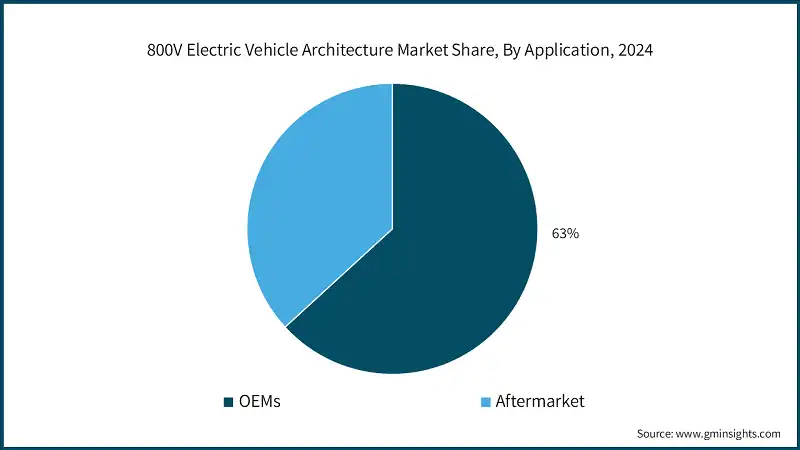
Based on application, the 800V electric vehicle architecture market is segmented into OEMs, and aftermarket. OEMs segment dominates the market accounting for around 63% share in 2024, and the segment is expected to grow at a CAGR of over 20.4% from 2025 to 2034.
- The OEMs segment holds the largest market share in the 800V electric vehicle architecture market due to The OEMs segment holds the largest market share in the market due to the rapid integration of advanced high-voltage systems in next-generation electric vehicles by leading automakers. Companies such as Porsche, Hyundai, BYD, and Mercedes-Benz are increasingly adopting 800V platforms to enhance vehicle efficiency, performance, and charging speed. OEMs are focusing on developing in-house architectures that optimize thermal management, reduce wiring complexity, and support ultra-fast charging to strengthen their competitive positioning in the EV market.
- Furthermore, the growing emphasis on sustainability and regulatory mandates for carbon reduction have prompted OEMs to accelerate R&D investments in 800V-enabled EV models. Strategic collaborations with semiconductor firms and battery manufacturers are helping automakers streamline production, lower costs, and ensure scalability consolidating OEMs’ dominance in the 800V EV ecosystem globally.
- In June 2024, Tata Motors announced its roadmap to adopt 800–1,000 V EV architectures, targeting a broad vehicle range from passenger cars to heavy commercial vehicles. The plan includes deploying higher voltage modules, enabling megawatt class charging, and implementing advanced localization of components.
- The Aftermarket segment will grow with a CAGR of more than 22.7% because of the increasing demand for retrofitting existing EVs with high-voltage 800 V components, including inverters, onboard chargers, and battery modules. As more EVs enter the roads, consumers and fleet operators seek performance upgrades, faster charging capabilities, and extended driving range.
Based on charging, the market is segmented into ultra-fast charging (>350 kW), fast charging (<350 kW), and standard charging. Fast charging (<350 kW) segment dominates with around 45% share due to its widespread availability, compatibility with most EVs, cost-effectiveness, and ability to significantly reduce charging times compared to standard chargers.
- The Fast charging (<350 kW) segment dominates the 800V electric vehicle architecture market owing to its optimal balance between charging speed, cost, and infrastructure availability. Unlike ultra-fast charging (>350 kW), which requires specialized high-capacity stations and higher investment, fast chargers are more widely deployed across urban areas, highways, and commercial hubs. This makes them accessible for both passenger and commercial EV users, supporting convenient and reliable charging without significant grid or installation constraints.
- Additionally, fast charging systems are compatible with the majority of EV models, including high-performance 800V platforms, enabling broader adoption of electric vehicles. Automakers and charging network providers prioritize fast-charging infrastructure expansion, as it reduces charging downtime, improves operational efficiency, and supports the growing EV fleet globally, reinforcing the segment’s market dominance.
- The ultra-fast charging (>350 kW) segment is expected to expand at a CAGR of more than 22.6% due to the rising demand for rapid recharging of high-performance 800V electric vehicles. Ultra-fast chargers significantly reduce charging time, enabling 10–80% battery charge in under 20 minutes, which appeals to premium EV users and long-distance commuters.
Based on architecture type, the 800V electric vehicle architecture market is divided into full 800v system, and hybrid system. The integrated image signal processors segment dominated the market.
- The Full 800V system segment holds the largest market share in the 800V electric vehicle architecture market due to its ability to deliver maximum efficiency, higher power density, and ultra-fast charging capabilities. Full 800V architectures allow for reduced current flow, minimizing energy loss and heat generation, which improves overall battery performance and longevity. Leading EV manufacturers, such as Porsche, Hyundai, and BYD, are integrating full 800V systems in premium and high-performance models to achieve rapid 10–80% charging within 20–25 minutes and enhanced driving dynamics.
- Additionally, full 800V systems simplify vehicle powertrain design by enabling smaller, lighter, and more efficient inverters, onboard chargers, and wiring harnesses. This integration reduces complexity while supporting advanced features such as regenerative braking and high-voltage fast-charging compatibility, making it the preferred choice for both passenger and commercial EV platforms.
- The hybrid system segment is expected to expand at a CAGR of more than 21.4% due to its ability to upgrade existing 400–600 V EV platforms to higher-voltage performance without a full redesign. This approach allows automakers to achieve faster charging, improved energy efficiency, and higher power output while controlling costs.
Looking for region specific data?
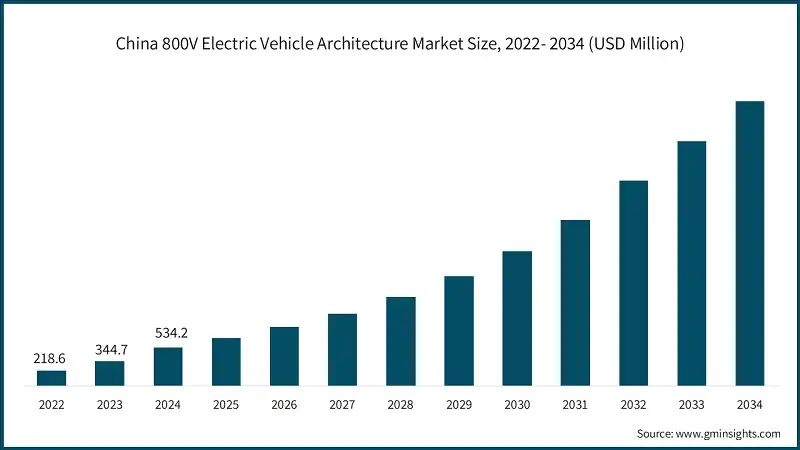
China dominated the 800V electric vehicle architecture market in Asia Pacific with around 40% share and generated USD 534.2 million in revenue in 2024.
- China dominates the market because of its strong manufacturing ecosystem, government-backed EV incentives, and large-scale adoption of high-voltage platforms by leading automakers such as BYD, XPENG, NIO, and GAC Aion. The country’s rapid industrialization and deep supply chain integration from batteries and semiconductors to charging infrastructure enable large-scale production and cost efficiency, giving Chinese OEMs a technological and economic edge.
- Furthermore, China’s aggressive push for nationwide deployment of ultra-fast charging stations and its leadership in battery innovation, particularly in LFP and solid-state technologies, have accelerated the transition toward 800V systems. Continuous R&D investments, collaboration with global semiconductor companies, and strong domestic demand are further cementing China’s role as the global hub for 800V EV architecture development.
- In January 2025, Chinese EV manufacturer Xpeng Motors and Germany’s Volkswagen AG have agreed to expand their cooperation on ultra-fast charging infrastructure in China. They will open their respective networks totaling over 20,000 charging piles across 420 cities to each other’s customers and explore jointly branded high-power stations.
- In the Asia-Pacific 800V electric vehicle architecture market, India is becoming one of the fastest-growing markets due to strong government initiatives promoting EV adoption, rapid expansion of domestic manufacturing under the “Make in India” program and rising investments in high-voltage charging infrastructure. The introduction of policies such as FAME-II, PLI schemes for advanced battery production, and incentives for EV component localization are encouraging automakers to introduce 800V-capable platforms in the country.
The 800V electric vehicle architecture market in Germany is expected to experience significant and promising growth from 2025-2034.
- Europe accounts for over 25% of the market in 2024 and is expected to grow at a CAGR of around 19.8% driven by strong regulatory support for zero-emission vehicles, rapid expansion of ultra-fast charging networks, and early adoption by premium automakers such as Porsche, Audi, BMW, and Mercedes-Benz.
- Germany dominates the 800V electric vehicle architecture market due to its strong automotive heritage, advanced engineering capabilities, and leadership in premium electric vehicle manufacturing. Major automakers such as Porsche, Audi, BMW, and Mercedes-Benz were among the earliest to commercialize 800V platforms, setting performance benchmarks for efficiency, power density, and charging speed. Germany’s robust R&D ecosystem and partnerships with semiconductor and battery technology firms like Bosch, Infineon, and Siemens further enhance innovation and large-scale production efficiency.
- Additionally, the country benefits from a well-established high-voltage charging infrastructure and strong government initiatives supporting e-mobility and carbon neutrality targets. Continuous investment in ultra-fast charging corridors across Europe, combined with a skilled workforce and export-oriented automotive supply chain, positions Germany as the central hub for 800V EV technology development and deployment.
- In February 2025, BMW Group unveils its sixth-generation eDrive technology for the Neue Klasse, featuring 800 V architecture and a high-voltage “Energy Master” control unit. The new system promises 30% faster charging and 30% longer range, with production set across global sites including Hungary and China.
- The U.K. 800V electric vehicle architecture market is growing steadily due to strong government decarbonization initiatives, rapid charging infrastructure expansion, and increasing investments from both domestic and global automakers. The U.K.’s commitment to phase out internal combustion engine (ICE) vehicles by 2035 has accelerated demand for high-efficiency EV platforms.
The 800V electric vehicle architecture market in US is expected to experience significant and promising growth of 21.4% from 2025 to 2034.
- North America accounts for over 29% of the market in 2024 and is expected to grow at a CAGR of around 21.6% owing to strong presence of leading EV manufacturers, rising investments in ultra-fast charging infrastructure, and growing consumer demand for high-performance electric vehicles.
- The U.S. dominates the 800V electric vehicle architecture market due to its strong base of EV innovation, advanced R&D ecosystem, and leadership of major automakers pioneering next-generation electric platforms. Companies like Tesla, Lucid Motors, General Motors, and Rivian have adopted 800V systems in models such as the Lucid Air and GMC Hummer EV, setting new benchmarks for performance, range, and ultra-fast charging capabilities. The country’s robust semiconductor and power electronics industry also supports high-voltage integration in EVs.
- Furthermore, the U.S. government’s aggressive electrification policies and infrastructure investments such as the Bipartisan Infrastructure Law and NEVI (National Electric Vehicle Infrastructure) program are accelerating the development of 350 kW+ charging corridors. These initiatives, coupled with strong venture capital backing and consumer adoption, position the U.S. as a global hub for 800V EV technology growth and commercialization.
- For instance, in April 2024, Stellantis has revealed its new “STLA Frame” electric-vehicle platform incorporating an 800 V architecture, enabling pure EV models with up to 500 miles of battery-only range and support for ultra-fast charging at up to 350 kW). The system is designed for large trucks and SUVs, offering flexibility to also use gas extenders or hydrogen in future variants.
- Canada is also expected to expand at a CAGR of approximately 23.2% due to growing investments in electric vehicle manufacturing, rapid deployment of ultra-fast charging infrastructure, and strong government incentives for zero-emission vehicles. The Canadian government’s “Zero-Emission Vehicle (ZEV) Program” and partnerships with automakers like Stellantis and LG Energy Solution for 800V battery plants are accelerating this growth.
The 800V electric vehicle architecture market in Brazil is expected to experience significant and promising growth from 2025-2034.
- Latin America holds around 5% of the market and is growing steadily at a CAGR of around 18.4% driven by the gradual expansion of EV infrastructure, government incentives for clean mobility, and growing interest from Chinese and European automakers. Countries like Brazil, Mexico, and Chile are promoting electric mobility through tax benefits and public charging initiatives.
- Brazil dominates the 800V electric vehicle architecture market in Latin America because of its strong automotive manufacturing base, supportive government policies, and rapid EV adoption initiatives. The country has introduced tax incentives and import duty reductions for electric vehicles, encouraging both local production and foreign investment. Major automakers like BYD, GWM, and Volvo have announced plans to manufacture or assemble 800V-capable EVs locally to meet rising consumer demand.
- Furthermore, Brazil’s expanding renewable energy capacity and efforts to develop a national fast-charging network have created favorable conditions for high-voltage EV adoption. Collaborations between the public and private sectors such as the installation of ultra-fast DC chargers on major highways are enabling long-distance electric mobility, making Brazil a leading hub for 800V EV technology in Latin America.
- For example, in August 2025, Brazil recorded a 59% surge in public and semi-public DC fast-charging installations within six months, reaching nearly 16,880 stations nationwide. This rapid infrastructure expansion reflects Brazil’s strong commitment to supporting next generation 800V electric vehicles and advancing ultra-fast EV charging capabilities.
- The 800V electric vehicle architecture market in Mexico is growing at a high pace due to strong foreign investments, government-backed clean mobility initiatives, and its strategic role as a North American EV manufacturing hub. Major automakers such as Tesla, BMW, and BYD are expanding EV production facilities in Mexico to serve both domestic and export markets. Additionally, the U.S.-Mexico-Canada Agreement (USMCA) has strengthened cross-border EV supply chains, enabling faster adoption of advanced 800V systems.
The 800V electric vehicle architecture market in UAE is expected to experience significant and promising growth from 2025-2034.
- MEA holds around 3% share of the 800V electric vehicle architecture market and is growing steadily at a CAGR of around 16.5% due to increasing government initiatives for clean mobility, expansion of EV infrastructure, and growing investments from global automakers. Countries like the UAE, Saudi Arabia, and South Africa are leading regional adoption through national EV roadmaps, public charging deployments, and sustainability targets under Vision 2030 programs.
- The UAE has been a dominant player in the MEA 800V electric vehicle architecture market due to its strong government focus on sustainability, rapid charging infrastructure development, and active promotion of high-performance EVs. The country’s UAE Net Zero 2050 Strategy and Green Mobility Program have encouraged both public and private investment in electric mobility. With advanced infrastructure, the UAE is home to one of the highest densities of fast-charging stations in the region, supporting 800V-compatible vehicles from brands like Porsche, Lucid, and BYD.
- Furthermore, the UAE’s partnerships with global automakers and energy companies such as DEWA’s collaboration with Siemens and ABB are enabling next-generation ultra-fast charging solutions. Luxury EV adoption in cities like Dubai and Abu Dhabi continues to grow, reinforcing the UAE’s position as a regional hub for high-voltage electric vehicle technology.
- Saudi Arabia is projected to experience the highest CAGR in the MEA 800V electric vehicle architecture market due to its massive investments in electric mobility, supportive government policies, and the establishment of large-scale EV manufacturing projects. The Kingdom’s Vision 2030 initiative aims to diversify the economy by fostering green technologies, including EV infrastructure and production.
800v Electric Vehicle Architecture Market Share
- The top 7 companies in the 800V electric vehicle architecture industry are BYD Company, Xpeng Motors, Hyundai Motor Company, NIO, Kia, Zeekr Automobile, and Porsche, contributed around 59% of the market in 2024.
- BYD focuses on developing high-performance EVs with modular 800V architectures, integrating fast-charging capabilities and advanced battery technology. The company emphasizes domestic market leadership, global expansion, and strategic partnerships with suppliers to scale production efficiently while enhancing energy density, vehicle range, and overall EV performance.
- Xpeng leverages its proprietary 800V systems for high-voltage charging and improved power efficiency. The company invests heavily in smart EV technologies, autonomous driving features, and AI-driven battery management, targeting both Chinese and international markets to strengthen its premium EV positioning.
- Hyundai implements 800V architectures across its high-performance EV lineup, enabling ultra-fast charging and reduced charging time. It emphasizes hydrogen-electric integration, smart connectivity, and global EV expansion, aiming to combine efficiency, reliability, and advanced driving technologies.
- NIO focuses on 800V EV platforms to support ultra-fast charging and extended range. The company emphasizes battery swapping technology, premium features, and intelligent connectivity, along with expansion into European markets and collaboration with global tech partners.
- Kia adopts 800V systems in its EV portfolio to enable rapid charging and higher efficiency. The company focuses on affordability, smart EV technologies, sustainable powertrains, and seamless integration of digital services to attract a broad consumer base.
- Zeekr integrates 800V architectures to enhance fast-charging and energy efficiency in premium EVs. The company leverages parent company Geely’s modular platforms, advanced software, and AI-driven performance optimization to differentiate its products globally.
- Porsche employs 800V technology in high-performance EVs, such as the Taycan, enabling ultra-fast charging, superior power delivery, and optimized range. Its strategy focuses on luxury, precision engineering, and integration of advanced driving dynamics and connected EV services.
800V Electric Vehicle Architecture Market Companies
Major players operating in the 800V electric vehicle architecture industry are:
- BorgWarner
- BYD Company
- Hyundai Motor Company
- Kia
- Lucid Motors
- NIO
- Porsche
- Volkswagen
- Xpeng Motors
- Zeekr Automobile
- Manufacturers and technology providers in the 800V electric vehicle architecture market are increasingly focusing on high-voltage power electronics, modular battery packs, and ultra-fast charging systems. These innovations enable higher energy efficiency, longer driving ranges, faster charging times, and improved thermal management, supporting the widespread adoption of next-generation electric vehicles globally.
- Collaborations between automotive OEMs, battery manufacturers, and semiconductor suppliers are transforming the market landscape. Partnerships focus on integrating 800V architectures with advanced EV platforms, inverters, and on-board chargers to optimize performance, reduce costs, and accelerate commercialization. Such joint efforts enhance system reliability, enable scalable EV production, and drive adoption across passenger, commercial, and fleet segments worldwide.
800V Electric Vehicle Architecture Market Report Attributes
| Key Takeaway | Details |
|---|---|
| Market Size & Growth | |
| Base Year | 2024 |
| Market Size in 2024 | USD 3.45 Billion |
| Market Size in 2025 | USD 4.28 Billion |
| Forecast Period 2025 - 2034 CAGR | 21.3% |
| Market Size in 2034 | USD 24.41 Billion |
| Key Market Trends | |
| Drivers | Impact |
| Rise in demand for faster charging and extended driving range | Consumers are increasingly demanding EVs that charge quickly and deliver longer range. The 800V architecture enables ultra-fast charging, reducing charging times to under 20 minutes and supporting high-performance batteries for improved driving range and convenience. |
| Surge in production of high-performance electric vehicles | Leading automakers are ramping up production of high-performance EVs requiring efficient power delivery. The 800V system enhances acceleration, power output, and energy efficiency, making it ideal for sports and luxury EVs like Porsche Taycan and Hyundai Ioniq 5 N. |
| Increase in government incentives and regulatory support for EVs | Governments worldwide are implementing subsidies, tax benefits, and emission regulations to boost EV adoption. These policies encourage automakers to develop advanced 800V architectures that meet sustainability goals and improve charging efficiency. |
| Growth in collaboration between OEMs and semiconductor suppliers | Strong partnerships between automotive OEMs and semiconductor firms are accelerating innovation in power electronics. Companies are co-developing efficient inverters, SiC MOSFETs, and onboard chargers to optimize 800V system performance and cost-effectiveness. |
| Pitfalls & Challenges | Impact |
| High cost of 800V components and integration | The production and integration of 800V systems require costly components such as silicon carbide semiconductors and advanced cooling systems. This increases overall vehicle cost, limiting adoption among mid-range EVs and price-sensitive markets. |
| Limited availability of compatible charging infrastructure | Despite the potential of 800V systems, public charging networks supporting ultra-fast charging are limited. The lack of widespread 800V-compatible chargers restricts the real-world usability and growth of these high-voltage EV architectures. |
| Opportunities: | Impact |
| Rise in adoption of 800V systems in commercial and fleet EVs | Commercial and fleet operators are adopting 800V architectures to minimize downtime and operational costs. Faster charging and higher energy efficiency make these systems ideal for delivery vans, buses, and logistics fleets. |
| Surge in investment toward next-generation battery technologies | Global investment in advanced battery materials, solid-state designs, and thermal management supports 800V EV systems. These innovations enhance safety, energy density, and overall charging efficiency, accelerating market growth. |
| Increase in demand for 800V-ready autonomous and connected vehicles | Autonomous and connected vehicles require powerful, energy-efficient electrical systems. 800V architectures support high computing loads and sensor fusion while maintaining efficient power delivery and thermal control. |
| Expansion of EV manufacturing in emerging economies | Emerging markets like India, Thailand, and Brazil are investing in EV production infrastructure. Local manufacturing of 800V-compatible components and vehicles is driving regional competitiveness and affordability. |
| Market Leaders (2024) | |
| Market Leaders |
11.79 % market share |
| Top Players |
Collective Market Share in 2024 is 47.1% |
| Competitive Edge |
|
| Regional Insights | |
| Largest Market | Asia Pacific |
| Fastest Growing Market | Asia Pacific |
| Emerging Country | India, Philippines, Indonesia, Brazil, Saudi Arabia, UAE |
| Future Outlook |
|
What are the growth opportunities in this market?
800V Electric Vehicle Architecture Industry News
- In March 2025, BYD unveiled its Super E-Platform featuring 1,000V architecture capability, representing a significant advancement beyond traditional 800V systems. The platform enables DC charging up to 1MW power levels, with demonstration vehicles achieving 470km range in addition to just 5 minutes during testing. BYD announced plans to deploy over 4,000 ultra-fast charging units in China to support the new platform, marking the largest single commitment to megawatt-class charging infrastructure according to IEEE Spectrum technical documentation.
- In January 2025, the Biden administration issued Executive Order 14154 pausing disbursement of National Electric Vehicle Infrastructure (NEVI) program funds pending comprehensive review, creating uncertainty for planned charging infrastructure deployments. The pause affects the $5 billion federal program designed to support corridor fast charging development, potentially impacting the rollout of 800V-compatible ultra-fast charging stations as per the International Energy Agency.
- In December 2024, Hyundai Motor Group announced a $200 million strategic investment in Rimac Technology to accelerate development and production of 800V electric vehicle systems. The partnership focuses on high-performance EV platforms and advanced battery management systems, leveraging Rimac's expertise in high-voltage powertrains and Hyundai's manufacturing scale.
- In November 2024, The European Union's Alternative Fuels Infrastructure Regulation implementation reached a milestone with over 77,000 ultra-fast chargers (≥150kW) deployed across member states, representing 60% growth year-over-year. Approximately 20% of these chargers deliver ≥350kW power levels specifically designed for 800V vehicle compatibility according to the International Energy Agency.
- In October 2024, India launched the PM E-DRIVE program allocating INR 20 billion (~USD 240 million) for electric vehicle charging infrastructure development. The program specifically targets high-power charging stations capable of supporting 800V vehicle architectures, with plans for 22,100 charging points through March 2026 as per the International Energy Agency.
- In September 2024, Tesla announced Cybertruck availability with 800V system architecture, marking the company's first departure from its traditional 400V platform. The announcement signals broader industry adoption of high-voltage systems and Tesla's recognition of 800V benefits for high-performance applications.
The 800V electric vehicle architecture market research report includes in-depth coverage of the industry with estimates & forecasts in terms of revenue ($Bn), Shipment (Units) from 2021 to 2034, for the following segments:
Market, By Vehicle
- Passenger vehicles
- Hatchbacks
- Sedans
- SUV
- Commercial vehicles
- Light commercial vehicles (LCV)
- Medium commercial vehicles (MCV)
- Heavy commercial vehicles (HCV)
Market, By Architecture
- Full 800V System
- Hybrid / Boosted System
Market, By Charging
- Ultra-Fast Charging (>350 kW)
- Fast Charging (<350 kW)
- Standard Charging
Market, By Propulsion
- Battery electric vehicles (BEVs)
- Plug-in hybrid electric vehicles (PHEVs)
- Fuel cell electric vehicles (FCEVs)
Market, By Application
- OEMs
- Aftermarket
Market, By Component
- Battery
- Inverter
- On-board Charger
- Electric Motor
- Power Distribution Module
- Others
Market, By End Use
- Private
- Commercial/Fleet
The above information is provided for the following regions and countries:
- North America
- US
- Canada
- Europe
- Germany
- UK
- France
- Italy
- Spain
- Russia
- Asia Pacific
- China
- India
- Japan
- Australia
- South Korea
- Philippines
- Indonesia
- LAMEA
- Brazil
- Mexico
- Argentina
- South Africa
- Saudi Arabia
- UAE
Frequently Asked Question(FAQ) :
What is the market size of the 800V electric vehicle architecture in 2024?
The market size was estimated at USD 3.45 billion in 2024, with a CAGR of 21.3% expected through 2034. The rapid adoption of 800V architectures in the automotive industry is driving this growth.
What is the projected value of the 800V electric vehicle architecture market by 2034?
The market is projected to reach USD 24.41 billion by 2034, driven by advancements in ultra-fast charging, energy efficiency, and mainstream adoption of 800V systems.
What is the expected size of the 800V electric vehicle architecture industry in 2025?
The market size is projected to reach USD 4.28 billion in 2025.
What was the market share of the passenger vehicle segment in 2024?
The passenger vehicle segment dominated the market with a 74% share in 2024 and is expected to witness more than 20.8% CAGR through 2034.
What was the market share of the OEMs segment in 2024?
The OEMs segment accounted for approximately 63% of the market share in 2024 and is set to expand at a CAGR of over 20.4% till 2034.
What was the valuation of the fast charging (<350 kW) segment in 2024?
The fast charging segment dominated with a 45% market share in 2024, led by its widespread availability, compatibility with most EVs, and ability to significantly reduce charging times.
Which region leads the 800V electric vehicle architecture sector in Asia Pacific?
China led the Asia Pacific market with a 40% share, generating USD 534.2 million in revenue in 2024.
What are the upcoming trends in the 800V electric vehicle architecture market?
Key trends include 800V system integration, ultra-fast charging expansion, zonal architectures, and modular vehicle designs for efficiency and safety.
Who are the key players in the 800V electric vehicle architecture industry?
Key players include BorgWarner, BYD Company, Hyundai Motor Company, Kia, Lucid Motors, NIO, Porsche, Volkswagen, Xpeng Motors, and Zeekr Automobile.
800V Electric Vehicle Architecture Market Scope
Related Reports