Summary
Table of Content

3D Printed Medical Device Prototyping Market
Get a free sample of this report
Form submitted successfully!
Error submitting form. Please try again.
Thank you!
Your inquiry has been received. Our team will reach out to you with the required details via email. To ensure that you don't miss their response, kindly remember to check your spam folder as well!
Request Sectional Data
Thank you!
Your inquiry has been received. Our team will reach out to you with the required details via email. To ensure that you don't miss their response, kindly remember to check your spam folder as well!
Form submitted successfully!
Error submitting form. Please try again.
3D Printed Medical Device Prototyping Market Size
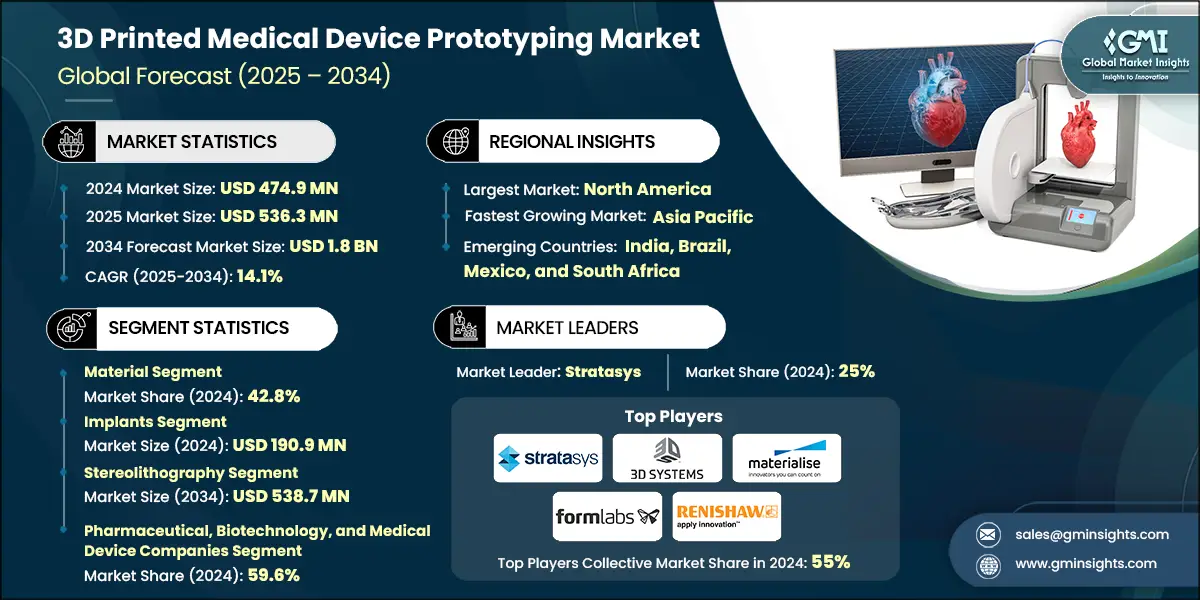
The global 3D printed medical device prototyping market was valued at USD 474.9 million in 2024 and is projected to grow from USD 536.3 million in 2025 to USD 1.8 billion by 2034, expanding at a CAGR of 14.1%, according to the latest report published by Global Market Insights Inc. This steady growth is driven by the high prevalence of orthopedic and dental disorders, continuous technological advancements in 3D printing technologies, rising investment in healthcare innovation and digital manufacturing, and the growing application of 3D printed medical devices.
3D Printed Medical Device Prototyping Market Key Takeaways
Market Size & Growth
- 2024 Market Size: USD 474.9 Million
- 2025 Market Size: USD 536.3 Million
- 2034 Forecast Market Size: USD 1.8 Billion
- CAGR (2025–2034): 14.1%
Regional Dominance
- Largest Market: North America
- Fastest Growing Region: Asia Pacific
Key Market Drivers
- High prevalence of orthopedic and dental disorders.
- Continuous technological advancement in 3D printing technologies.
- Rising investment in healthcare innovation and digital manufacturing.
- Growing application of 3D printed medical devices.
Challenges
- Stringent regulatory compliance requirements.
- High cost of raw materials.
Opportunity
- Integration of 3D printing with medical imaging and CAD software.
- Development of bioresorbable and patient-specific implants.
Key Players
- Market Leader: Stratasys led with over 25% market share in 2024.
- Leading Players: Top 5 players in this market include Stratasys, 3D Systems, Materialise, Formlabs, Renishaw, which collectively held a market share of 55% in 2024.
Get Market Insights & Growth Opportunities
3D printed medical device prototyping is the process of creating early models of medical devices using additive manufacturing. It allows rapid testing of design, fit, and function before final production. This technique supports customization for patient-specific needs and accelerates development cycles. Major companies in the industry include Stratasys Ltd., 3D Systems Corporation, Materialise NV, Formlabs, and Renishaw plc. Top companies in 3D printed medical devices offer patient-specific customization, high-resolution anatomical modeling, and biocompatible materials for implants and surgical tools.
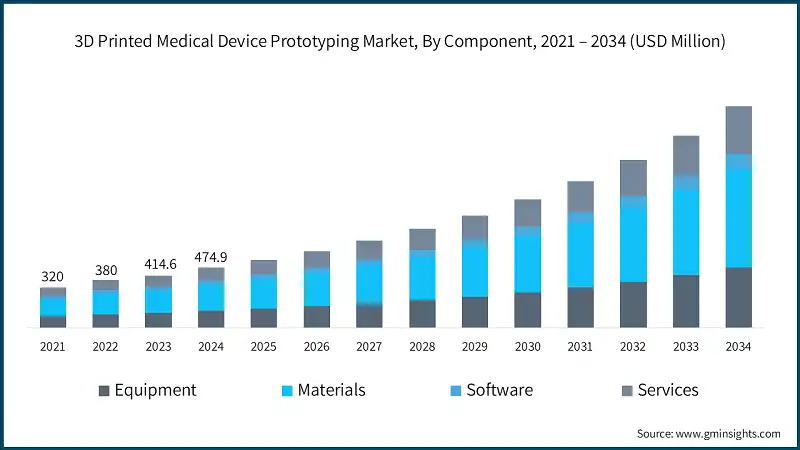
The market increased from USD 320 million in 2021 to USD 414.6 million in 2023. This growth can be primarily attributed to the rising investment in healthcare innovation and digital manufacturing. These investments enable faster development cycles, support advanced materials research, and promote regulatory pathways for personalized and biocompatible devices. As governments prioritize digital transformation in healthcare, 3D printing technologies are increasingly adopted for creating precise, patient-specific prototypes to improve clinical outcomes and reduce the time of approvals.
In addition, the high prevalence of orthopedic and dental disorders is one of the key factors aiding in the growth of the 3D printed medical device prototyping industry. According to the World Health Organization, approximately 1.71 billion people globally suffer from musculoskeletal and orthopedic conditions like osteoarthritis, rheumatoid arthritis, and scoliosis. These conditions account for 17.1% of all physical disabilities globally, making them the largest contributor to disability.
These conditions often lead to joint damage, deformity, or loss of function that cannot be managed effectively with medication or therapy alone. They can be improved by joint replacement and other surgical interventions. 3D printing allows clinicians to rapidly produce prototypes for pre-surgical planning and develop implants tailored to the patient’s unique anatomy, enhancing fit, reducing surgical time, and improving recovery outcomes during surgeries.
Further, the growing application of 3D printed medical devices is fueling market growth because these solutions address critical needs in modern healthcare. For example, implants, including craniomaxillofacial, dental, and orthopedic, are essential for restoring damaged bones and joints. 3D printing ensures precise fit and biocompatibility. Surgical guides are needed for accurate cutting and drilling during complex procedures, reducing errors and operative time. Tissue-engineered products help regenerate damaged tissues, meeting the demand for advanced regenerative therapies.
3D-printed medical device prototyping is essential for validating design, fit, and functionality before full-scale production of medical devices. It enables rapid iteration and testing, ensuring that the final device meets clinical requirements and patient-specific needs with precision. The expanding use of 3D printed medical devices across healthcare is revolutionizing patient care by delivering personalized, precise, and cost-effective solutions. This growing adoption is accelerating innovation, making 3D printing a key driver of growth in the medical device prototyping market.
To get key market trends
3D Printed Medical Device Prototyping Market Trends
- The market is undergoing a dynamic transformation, driven by continuous technological advancements in 3D printing technologies.
- Additive manufacturing technologies such as stereolithography, fused deposition modeling, electron beam melting, laser sintering, binder jetting, and digital light processing enable high precision, complex geometries, and patient-specific customization, which are critical for medical applications.
- Stereolithography and digital light processing technologies are finding significant adoption for producing detailed prototypes and surgical guides due to their ability to deliver smooth surface finishes and fine resolution. For instance, the Form 4B SLA printer offered by Formlabs and the Stratasys J5 DentaJet offered by Stratasys are used in medical prototyping. These printers deliver high resolution, rapid print speeds, and compatibility with biocompatible resins for use in dental and surgical applications.
- Beyond hardware, software platforms from Materialise and SolidWorks Corporation are enabling seamless digital workflows, ensuring regulatory compliance and precision in medical device prototyping. Collectively, these innovations are expanding the application scope of 3D printing in healthcare, fueling growth in the market.
3D Printed Medical Device Prototyping Market Analysis
Learn more about the key segments shaping this market
The 3D printed medical device prototyping market based on components is segmented into equipment, materials, software, and services. The material segment accounted for the majority of market share at 42.8% in 2024 and is expected to dominate throughout the analysis period.
- Materials dominate this market segment as they are the foundation of every prototype’s functionality and safety. The ability to choose from plastics, metals, and advanced biomaterials allows manufacturers to meet stringent medical standards for biocompatibility, strength, and sterilization.
- Plastics offer lightweight and cost-effective solutions for non-load-bearing components, while metals provide structural integrity for implants and surgical tools. Biomaterials and ceramics add value to specialized applications like tissue engineering and dental implants. This versatility makes materials the most critical factor in achieving precision, reliability, and patient-specific customization in medical device prototyping.
- The material segment is growing rapidly due to advancements in additive manufacturing technologies and the increasing demand for personalized healthcare solutions. Innovations in photopolymers and thermoplastics have improved flexibility and sterilization capabilities. For instance, leading companies driving this growth include Stratasys, which uses biocompatible photopolymers for surgical guides, and 3D Systems, offering VisiJet MED photopolymers for dental and orthopedic applications.
- As research advances and new materials emerge, the material segment is expected to continue its revenue growth in the forecast period, further driving the market.
The 3D printed medical device prototyping market based on applications is classified into prosthetics, implants, surgical guides, tissue engineered products, wearable medical devices, and other applications. The implants segment dominates the market, valued at USD 190.9 million in 2024.
- The implants segment dominates the market, driven by the increasing prevalence of orthopedic and dental disorders worldwide. According to the World Health Organization (WHO), oral diseases affect approximately 3.5 billion people globally, with untreated dental caries impacting 2.5 billion individuals and severe periodontal disease affecting 1 billion. Additionally, complete tooth loss affects around 350 million people, creating significant demand for dental implants.
- Similarly, musculoskeletal disorders rank among the leading causes of disability globally, particularly in aging populations, further fueling the demand for orthopedic implants. This rising burden of conditions requiring surgical intervention positions implants as a critical application in the 3D printed medical device prototyping market.
- 3D printed implants offer patient-specific solutions that traditional manufacturing methods cannot achieve. In orthopedic applications, implants can be designed with porous structures to enhance bone integration and reduce the risk of rejection. In dental applications, custom implants ensure precise fit and alignment, improving both comfort and durability. The capability to produce complex geometries and lightweight designs enables surgeons to perform minimally invasive procedures, leading to shorter recovery times and improved treatment outcomes.
- With advancements in additive manufacturing technologies and the development of new biomaterials, the implants segment is expected to remain a key driver of innovation in the market.
Based on technologies, the 3D printed medical device prototyping market is divided into stereolithography, fused deposition modeling, electron beam melting, laser sintering, binder jetting, and digital light processing. The stereolithography segment accounted for a significant market position and is predicted to reach USD 538.7 million by 2034.
- Stereolithography uses a laser to cure liquid resin layer by layer, producing highly detailed and accurate prototypes. This capability is essential for creating surgical guides, dental models, and intricate implant components where dimensional accuracy and smooth surfaces are mandatory. Its ability to work with biocompatible resins further strengthens its position as the preferred technology for medical device prototyping.
- The technology is also expanding into applications like custom prosthetics and anatomical models for surgical planning. Integration with digital workflows and improvements in printer speed and scalability are making SLA more accessible to hospitals, research centers, and medical device manufacturers, fueling its adoption.
- For instance, 3D Systems Corporation provides industrial systems like the SLA 750 and SLA 250, which deliver medical prototyping by using stereolithography, and Stratasys Ltd offers the Neo Series, including the Neo450s and Neo800+, optimized for high-speed, large-format SLA printing with Somos resins like WaterShed XC+.
- With ongoing advancements in material technology and printer capabilities, stereolithography is expected to remain a significant contributor to the market, driving innovation and shaping the future of personalized healthcare.
Learn more about the key segments shaping this market
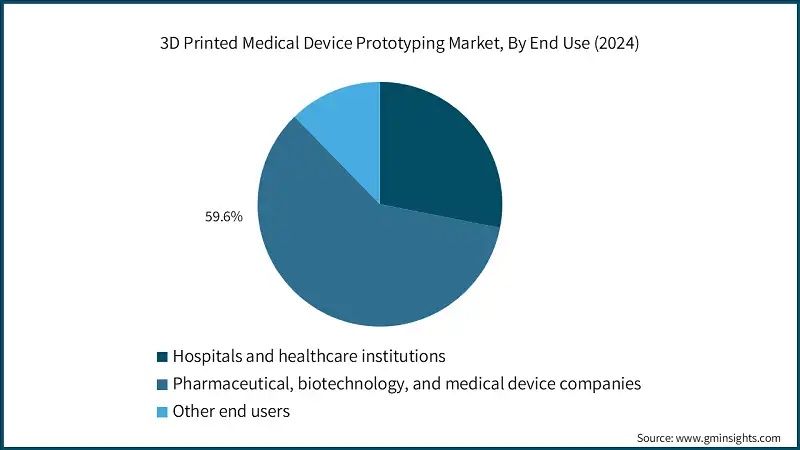
Based on end use, the 3D printed medical device prototyping market is segmented into hospitals and healthcare institutions; pharmaceutical, biotechnology, and medical device companies; and other end users. The pharmaceutical, biotechnology, and medical device companies segment held a market share of 59.6% in 2024.
- Pharmaceutical, biotechnology, and medical device companies are at the forefront of innovation in healthcare solutions. These companies require rapid prototyping for complex devices such as drug delivery systems, surgical instruments, and implantable devices.
- 3D printing enables them to accelerate product development cycles, reduce costs, and create patient-specific solutions. Additionally, the ability to produce prototypes for clinical trials and regulatory submissions speeds up regulatory approvals. As these companies invest in digital manufacturing technologies and biocompatible materials, the role of 3D printing in their workflows continues to expand, supporting innovation in drug-device combinations and regenerative medicine.
- The continuous innovation in personalized medicine and advanced therapies by pharmaceutical, biotechnology, and medical device companies is expected to significantly increase demand for 3D printed medical device prototypes during the forecast period.
Looking for region specific data?
North America 3D printed medical device prototyping market
North America dominated the market with the highest market share of 41.8% in 2024. The presence of technologically advanced infrastructure, regulatory clarity, and the presence of key additive manufacturers in the region contribute to its revenue growth in the market.
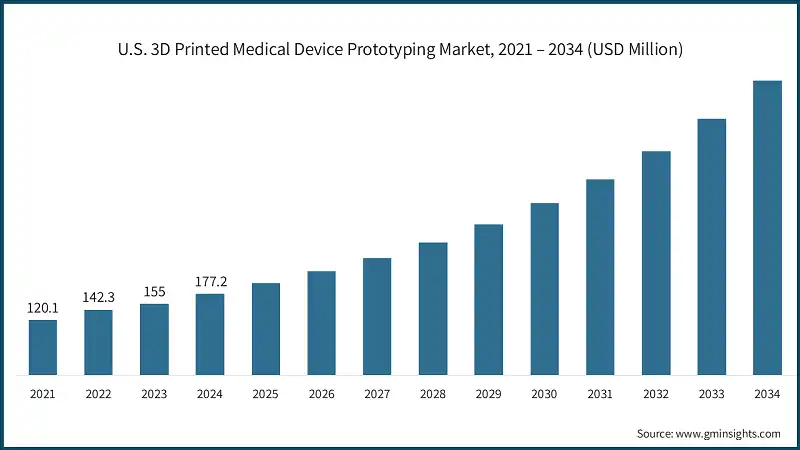
- The U.S. dominates the 3D printed medical device prototyping market in North America and was valued at USD 177.2 million in 2024. The revenue growth in the U.S. can be attributed to the high prevalence of orthopedic and dental disorders. Orthopedic disorders affect more than half of the U.S. adult population, making them the leading cause of disability in the U.S.
- Additionally, about 21.2% of U.S. adults (53.2 million) reported diagnosed arthritis between 2019 and 2021, according to CDC data. These conditions create a strong demand for customized implants, surgical guides, and anatomical models, which 3D printing can deliver with precision and speed. The region’s advanced healthcare infrastructure and early adoption of additive manufacturing technologies further reinforce its leadership position.
- Healthcare providers and medical device companies increasingly integrate 3D printing into their workflows. The combination of high disease prevalence, technological innovation, and strong regulatory support positions the U.S. as a leading country for 3D printing and prototype manufacturing in healthcare.
Europe 3D Printed Medical Device Prototyping Market
Europe market accounted for USD 135.4 million in 2024 and is anticipated to show lucrative growth over the forecast period.
- Europe is witnessing significant growth in the market, driven by the growing incidence of dental disorders. The WHO European Region has stated that Europe has the highest prevalence of major oral diseases, with over 50.1% of adults affected in 2019.
- Dental caries of permanent teeth impacts 33.6% of the population, representing nearly 335 million cases, while tooth loss prevalence stands at 12.4%, almost double the global average, affecting about 88 million adults aged 20 and above. These alarming figures highlight the urgent need for advanced dental implants, surgical guides, and prosthetic solutions, which 3D printing can deliver with precision and customization.
- The ability of 3D printing to produce patient-specific implants and dental restorations is transforming treatment outcomes across Europe. For dental disorders, custom crowns, bridges, and surgical guides improve accuracy and reduce treatment time. These advantages, coupled with Europe’s strong regulatory framework and investment in healthcare innovation, are accelerating adoption and ensuring sustained market growth.
Germany 3D printed medical device prototyping market is projected to experience steady growth between 2025 and 2034.
- Germany is emerging as a key growth region in the market, driven by the increasing number of joint replacement surgeries. In 2021, around 240,000 hip prostheses were implanted, primarily due to coxarthrosis (hip joint osteoarthritis), a progressive degenerative disease. Similarly, knee arthroplasty procedures accounted for approximately 190,000 knee prostheses annually, with gonarthrosis (knee joint arthrosis) being the most common reason for these operations.
- Germany also ranks first among OECD countries for hip replacement rates, with 351 procedures per 100,000 population in 2023, underscoring the scale of demand for orthopedic solutions. This surge in surgeries highlights the growing need for patient-specific implants and surgical guides. Combined with Germany’s advanced healthcare infrastructure and strong adoption of digital manufacturing technologies, these factors are positively influencing market in Germany.
Asia Pacific 3D Printed Medical Device Prototyping Market
The Asia Pacific is projected to value USD 431.3 million by 2034, growing at a CAGR of 15.1% during the forecast period.
- The Asia-Pacific is witnessing significant growth in the 3D printed medical device prototyping market, driven by the rising prevalence of osteoarthritis and other orthopedic disorders. The capability of 3D printing to create biocompatible and customized implants is revolutionizing orthopedic care across the region.
- Demographic trends indicate a sharp increase in the elderly population, prompting healthcare providers to adopt additive manufacturing to address joint degeneration and related conditions.
- Additionally, increasing investments in healthcare infrastructure and advancements in technology are positioning Asia-Pacific as a critical growth area for 3D printed medical device prototyping.
Japan 3D printed medical device prototyping market is poised to witness lucrative growth between 2025-2034.
- Japan is rapidly growing in the market, driven by its rapidly aging population and the associated rise in orthopedic disorders. According to an article published in September 2025 by the World Economic Forum, nearly 29.3% of Japan’s population is aged 65 or older, and this proportion is projected to reach 34.8% by 2040, making Japan the most aged society globally.
- This demographic shift is strongly linked to an increase in conditions such as osteoarthritis, which is prevalent in the knee, hip, and hand joints. The growing burden of these disorders is fueling demand for advanced prototypes of orthopedic implants and surgical guides for efficient treatment.
- Moreover, growing support provided by Japan's Pharmaceuticals and Medical Devices Agency (PMDA) and the Ministry of Health, Labour and Welfare (MHLW) has significantly driven innovation in the medical device sector. The PMDA has introduced expedited approval pathways specifically for personalized and breakthrough devices. Additionally, Japan's PMD Act includes a well-defined classification system for medical devices, which also covers 3D printed devices.
Latin America 3D Printed Medical Device Prototyping Market
Brazil is experiencing significant growth in the market.
- Brazil is witnessing significant growth in the adoption of surgical guides, driven by the increasing number of surgeries requiring precision tools. The country’s aging population and the rising prevalence of musculoskeletal and oral health disorders are key factors contributing to the growing volume of orthopedic and dental surgeries.
- According to a study published by Springer Nature Journal in May 2025, approximately 40 million individuals in Brazil are affected by musculoskeletal disorders.
- This trend has created a substantial demand for customized surgical guides to enhance surgical accuracy and reduce operative time. The use of 3D printing technology enables efficient production of these guides through rapid prototyping and patient-specific designs.
- Moreover, healthcare providers in Brazil are increasingly adopting digital workflows in 3D printing, facilitating cost-effective production and faster turnaround times for hospitals and clinics. The market growth is further fueled by rising investments in healthcare technology and the growing demand for minimally invasive surgeries.
Middle East and Africa 3D Printed Medical Device Prototyping Market
The market in Saudi Arabia is expected to experience significant and promising growth from 2025 to 2034.
- Saudi Arabia is positioning itself as a significant player in the 3D-printed medical device prototyping market, driven by its emphasis on digital manufacturing and the rising demand for surgical guides due to increasing surgical procedures.
- As part of its Vision 2030 initiative, Saudi Arabia has made substantial investments in healthcare modernization, including advanced additive manufacturing technologies. The growing volume of surgeries has amplified the need for precision tools such as surgical guides, which 3D printing efficiently provides through patient-specific designs and rapid prototyping.
3D Printed Medical Device Prototyping Market Share
- The top five players, including Stratasys, 3D Systems, Materialise, Formlabs, and Renishaw, collectively accounted for 55% of the total market share.
- Leading companies are driving the growth of the 3D printed medical device prototyping market by advancing additive manufacturing technologies. These players are focusing on introducing high-precision 3D printing systems, developing specialized software, and creating biocompatible materials to meet stringent medical standards.
- Stratasys continues to expand its portfolio with integrated solutions for surgical planning and anatomical modeling. For example, the Stratasys J850 Digital Anatomy 3D Printer produces ultra-realistic anatomical models that replicate the appearance, texture, and biomechanical behavior of human tissue. This innovation supports surgical planning, medical training, and device development.
- 3D Systems leverages its expertise in stereolithography and metal printing to deliver patient-specific implants, while Materialise focuses on enhancing digital workflows with advanced design platforms that streamline customization for complex medical devices.
- Through continuous innovation, strategic partnerships with hospitals and research institutions, and expansion into emerging healthcare markets, these companies are accelerating the adoption of 3D printing prototyping technologies and setting new standards in medical device development.
3D Printed Medical Device Prototyping Market Companies
Few of the prominent players operating in the market industry include:
- 3D Systems
- Arcam
- COSA
- Empire Group USA
- Envision TEC
- EOS
- Formlabs
- Inventex Medical
- Materialise
- Organovo Holdings
- Paragon Medical
- Proto Labs
- Renishaw
- SolidWorks
- Stratasys
- Stratasys
Stratasys stands out in the medical device prototyping space with its advanced PolyJet and FDM technologies, enabling the creation of highly detailed, multi-material anatomical models and surgical tools. Its J850 Digital Anatomy 3D Printer is a flagship solution, capable of replicating the biomechanical properties of human tissue, making it ideal for surgical planning, device testing, and physician training. Stratasys also partners with healthcare innovators like Axial3D and Siemens Healthineers to deliver patient-specific models that enhance preoperative accuracy and reduce procedural risks, solidifying its leadership in clinical-grade prototyping.
3D Systems leverages its deep expertise in SLA and SLS printing technologies to offer precision prototyping for dental, orthopedic, and cardiovascular applications. Its DMP (Direct Metal Printing) and Figure 4 platforms support rapid iteration of biocompatible implants and surgical instruments, accelerating time-to-market for medical device manufacturers. The company’s end-to-end solutions, from software like 3D Sprint to sterilizable materials, make it a preferred partner for hospitals and OEMs seeking validated workflows for regulatory compliance and functional testing.
Formlabs has democratized access to medical device prototyping through its affordable, high-resolution desktop SLA printers, such as the Form 3B+, which are widely used in dental labs, clinics, and research institutions. Its ecosystem supports a wide range of biocompatible and sterilizable resins, enabling the production of surgical guides, hearing aids, and anatomical models with clinical precision. With a strong focus on usability, validated workflows, and material innovation, Formlabs empowers smaller healthcare providers and startups to prototype and iterate medical devices without the need for large-scale industrial infrastructure.
3D Printed Medical Device Prototyping Market Report Attributes
| Key Takeaway | Details |
|---|---|
| Market Size & Growth | |
| Base Year | 2024 |
| Market Size in 2024 | USD 474.9 Million |
| Market Size in 2025 | USD 536.3 Million |
| Forecast Period 2025 - 2034 CAGR | 14.1% |
| Market Size in 2034 | USD 1.8 Billion |
| Key Market Trends | |
| Drivers | Impact |
| High prevalence of orthopedic and dental disorders | Drives the demand for customized anatomical models and implant prototypes tailored to patient-specific conditions. |
| Continuous technological advancement in 3D printing technologies | Enables faster, more precise prototyping with improved material performance and design flexibility. |
| Rising investment in healthcare innovation and digital manufacturing | Accelerates adoption of 3D printing for rapid prototyping and short-run production of medical devices. |
| Growing application of 3D printed medical devices | Expands the scope of prototyping across surgical tools, implants, and diagnostic models. |
| Pitfalls & Challenges | Impact |
| Stringent regulatory compliance requirements | Slows down prototyping cycles due to complex validation and approval processes. |
| High cost of raw materials | Limits scalability and accessibility for smaller MedTech firms and research institutions. |
| Opportunities: | Impact |
| Integration of 3D printing with medical imaging and CAD software | Enhances precision and efficiency in designing patient-specific prototypes directly from imaging data. |
| Development of bioresorbable and patient-specific implants | Opens new avenues for prototyping next-gen implants with tailored biomechanical properties and improved biocompatibility. |
| Market Leaders (2024) | |
| Market Leaders |
25% Market Share |
| Top Players |
Collective market share in 2024 is 55% |
| Competitive Edge |
|
| Regional Insights | |
| Largest market | North America |
| Fastest growing market | Asia Pacific |
| Emerging countries | India, Brazil, Mexico, and South Africa |
| Future outlook |
|
What are the growth opportunities in this market?
3D Printed Medical Device Prototyping Market News:
- In September 2024, Formlabs announced a successful collaboration with Arbutus Medical and Ember Prototypes to fast-track the development of the QuikBow orthopedic device. Leveraging Formlabs’ advanced 3D printing technology, the partnership enabled rapid prototyping and stopgap production, allowing the device to reach commercialization within just four months. This initiative highlighted the growing role of additive manufacturing in critical healthcare solutions.
- February 2025, COSA, a UK-based medical technology company, partnered with Formlabs to enhance anatomical model development for ENT and cochlear implant training. Using Formlabs’ precision 3D printers, COSA has been able to produce bespoke anatomical models that support surgical planning and device validation. The collaboration underscored the importance of customizable, high-fidelity models in improving clinical outcomes and training efficiency.
The 3D printed medical device prototyping market research report includes an in-depth coverage of the industry with estimates and forecast in terms of revenue in USD Million and from 2021 – 2034 for the following segments:
Market, By Component
- Equipment
- 3D printer
- 3D bioprinter
- Software
- Materials
- Plastic
- Photopolymers
- Thermoplastics
- Metals and alloys
- Titanium
- Stainless steel
- Cobalt-chromium
- Biomaterials
- Ceramic
- Other materials
- Plastic
- Services
Market, By Application
- Prosthetics
- Implants
- Craniomaxillofacial implants
- Dental implants
- Orthopedic implants
- Surgical guides
- Tissue engineered products
- Wearable medical devices
- Other applications
Market, By Technology
- Stereolithography
- Fused deposition modeling
- Electron beam melting
- Laser sintering
- Binder jetting
- Digital light processing
Market, By End Use
- Hospitals and healthcare institutions
- Pharmaceutical, biotechnology, and medical device companies
- Other end use
The above information is provided for the following regions and countries:
- North America
- U.S.
- Canada
- Europe
- Germany
- UK
- France
- Italy
- Spain
- Netherlands
- Asia Pacific
- China
- India
- Japan
- Australia
- South Korea
- Latin America
- Brazil
- Mexico
- Argentina
- Middle East and Africa
- Saudi Arabia
- South Africa
- UAE
Frequently Asked Question(FAQ) :
What is the market size of the 3D printed medical device prototyping in 2024?
The market size was USD 474.9 million in 2024, with a CAGR of 14.1% expected through 2034, driven by the prevalence of orthopedic and dental disorders, advancements in 3D printing technologies, and increasing healthcare innovation.
What is the projected value of the 3D printed medical device prototyping market by 2034?
The market is expected to reach USD 1.8 billion by 2034, fueled by rising investments in digital manufacturing and the growing application of 3D printed medical devices.
What is the projected size of the 3D printed medical device prototyping market in 2025?
The market is projected to reach USD 536.3 million in 2025.
How much revenue did the material segment generate?
The material segment accounting for 42.8% of the market share and leading the component segmentation.
What was the valuation of the implants segment?
The implants segment was valued at USD 190.9 million in 2024, dominating the application segmentation.
Which region leads the 3D printed medical device prototyping market?
North America led the market with a 41.8% share, generating USD 198.6 million in 2024. The region's dominance is attributed to advanced infrastructure, regulatory clarity, and the presence of key additive manufacturers.
What are the upcoming trends in the 3D printed medical device prototyping industry?
Key trends include the adoption of stereolithography and digital light processing for detailed prototypes, advancements in biocompatible materials, and increasing use of additive manufacturing technologies for patient-specific customization.
Who are the key players in the 3D printed medical device prototyping market?
Key players include 3D Systems, Arcam, COSA, Empire Group USA, Envision TEC, EOS, Formlabs, Inventex Medical, Materialise, Organovo Holdings, and Paragon Medical.
3D Printed Medical Device Prototyping Market Scope
Related Reports