
Generative AI Market Trends 2026: Key Drivers, Emerging Opportunities, and Challenges Reshaping the Industry Landscape
Published Date: April 27, 2026
The generative AI market has emerged as one of the most disruptive and rapidly evolving segments within the broader artificial intelligence ecosystem. Over the past few years, organizations across industries have accelerated the adoption of generative AI tools to enhance productivity, automate content creation, improve decision-making, and enable hyper-personalized user experiences. Unlike traditional AI systems designed primarily for classification or prediction, generative AI models can produce original outputs, including text, images, audio, video, and code, fundamentally reshaping digital workflows and creative processes.
Enterprises are increasingly integrating these technologies into core operations, supported by advancements in large language models, diffusion models, and multimodal AI systems. The growing availability of cloud-based AI infrastructure, combined with enterprise demand for automation and efficiency, has further strengthened market expansion. At the same time, regulatory discussions, ethical considerations, and data governance frameworks are beginning to shape the long-term trajectory of adoption.
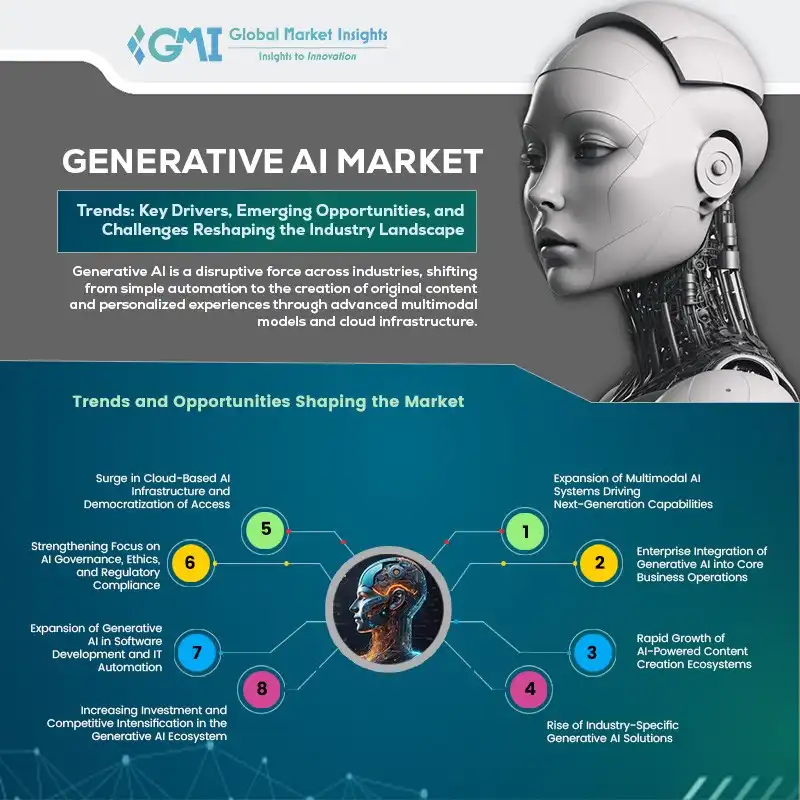
Trends and Opportunities Shaping the Market
1. Expansion of Multimodal AI Systems Driving Next-Generation Capabilities
One of the most significant trends reshaping the generative AI landscape is the rapid evolution of multimodal systems capable of processing and generating multiple forms of data simultaneously, including text, images, audio, and video.
Organizations are increasingly deploying multimodal AI to enhance customer engagement and operational efficiency. For instance, advanced AI systems are now being used in retail and e-commerce platforms to generate product descriptions while simultaneously producing visual content tailored to user preferences. In healthcare, multimodal models are being explored to interpret medical imaging alongside patient records for improved diagnostic accuracy.
A key opportunity lies in the development of unified AI systems that reduce the need for multiple specialized tools. However, challenges remain in ensuring data consistency, computational efficiency, and model interpretability across diverse data formats.
2. Enterprise Integration of Generative AI into Core Business Operations
Generative AI is no longer confined to experimental or pilot projects; it is increasingly embedded into core enterprise workflows. Businesses across sectors such as finance, manufacturing, healthcare, and retail are leveraging AI-driven automation for content generation, software development, marketing personalization, and customer service enhancement.
A notable example includes global financial institutions using generative AI to streamline report generation and risk analysis documentation. Similarly, multinational corporations are deploying AI-powered copilots to assist employees in drafting emails, summarizing meetings, and generating code.
The primary opportunity in this trend lies in productivity enhancement and operational cost reduction. However, organizations face challenges related to workforce adaptation, change management, and integration with legacy systems that were not originally designed for AI compatibility.
3. Rapid Growth of AI-Powered Content Creation Ecosystems
The content creation industry has undergone a fundamental transformation due to generative AI adoption. Marketing agencies, media houses, and digital publishers are increasingly utilizing AI tools to generate articles, advertisements, scripts, and visual assets at scale.
For example, several global media organizations now use AI-assisted platforms to generate localized news summaries and real-time sports updates. Similarly, advertising firms are leveraging AI to design personalized campaigns tailored to consumer behavior patterns.
This trend presents significant opportunities in reducing content production timelines and scaling creative output. However, it also raises concerns regarding originality, intellectual property rights, and potential over-reliance on automated systems, which may impact creative authenticity.
4. Rise of Industry-Specific Generative AI Solutions
Another major trend is the emergence of domain-specific generative AI models designed for industry-focused applications. Rather than relying on generalized models, enterprises are increasingly investing in customized AI systems trained on proprietary datasets.
In the pharmaceutical sector, generative AI is being used to design molecular structures for drug discovery. In the automotive industry, it supports simulation-based design optimization. Legal firms are adopting AI tools to draft contracts and analyze case documentation more efficiently.
The opportunity here lies in improved accuracy, compliance, and domain relevance. However, the challenge involves high development costs, data availability constraints, and the need for continuous model training to maintain relevance in dynamic industries.
5. Surge in Cloud-Based AI Infrastructure and Democratization of Access
Cloud computing has become a critical enabler of generative AI adoption, allowing organizations of all sizes to access advanced AI capabilities without investing in extensive on-premise infrastructure. Major cloud service providers are offering scalable AI platforms that support model training, deployment, and integration. This democratization has significantly expanded access for small and medium-sized enterprises, enabling them to compete with larger organizations in digital innovation.
A key opportunity is the reduction of entry barriers, which is fostering innovation across startups and mid-sized companies. However, challenges persist in the form of high operational costs at scale, dependency on cloud vendors, and data privacy concerns associated with centralized infrastructure.
6. Strengthening Focus on AI Governance, Ethics, and Regulatory Compliance
As generative AI adoption accelerates, governments and regulatory bodies are increasingly emphasizing the need for ethical AI deployment, transparency, and accountability.
Organizations are being encouraged to implement governance frameworks that address issues such as bias mitigation, data protection, and responsible model usage. Several industries have already begun adopting internal AI ethics committees to monitor deployment practices. The opportunity in this area lies in building trust and ensuring sustainable adoption across regulated industries such as healthcare and finance. However, evolving regulatory landscapes and a lack of global standardization present significant challenges for multinational organizations operating across multiple jurisdictions.
7. Expansion of Generative AI in Software Development and IT Automation
Generative AI is transforming the software development lifecycle by enabling automated code generation, debugging, testing, and documentation. AI-powered coding assistants are increasingly being integrated into development environments to enhance productivity and reduce development timelines.
Tech companies are using AI to automate repetitive coding tasks, allowing developers to focus on complex problem-solving and system architecture design. This shift has significantly improved software delivery efficiency across organizations.
The opportunity lies in accelerated innovation cycles and reduced development costs. However, challenges include code reliability concerns, security vulnerabilities, and the need for human oversight to ensure accuracy and maintain system integrity.
8. Increasing Investment and Competitive Intensification in the Generative AI Ecosystem
The generative AI market has witnessed substantial investment activity from venture capital firms, technology giants, and institutional investors. This influx of capital is driving rapid innovation, model development, and competitive expansion across the ecosystem.
Leading technology companies are actively competing to develop more advanced and efficient models while expanding partnerships with enterprises across sectors. This competition has led to accelerated breakthroughs in model performance and scalability.
The primary opportunity lies in continuous innovation and ecosystem expansion. However, challenges include market saturation risks, high research and development costs, and the need to maintain differentiation in an increasingly competitive environment.
9. From Imagination to Implementation: The Future of Generative AI Unfolds
The generative AI market continues to evolve at an unprecedented pace, driven by technological innovation, enterprise adoption, and expanding use cases across industries. While opportunities remain substantial in areas such as automation, personalization, and productivity enhancement, the market also faces challenges related to regulation, ethics, infrastructure scalability, and operational integration.
As organizations continue to refine their AI strategies, the focus is expected to shift toward responsible deployment, domain-specific customization, and sustainable AI ecosystems that balance innovation with governance and accountability.