
What’s Fueling the Next Wave of Firearms Innovation? A Deep Dive into Market Trends, Challenges and Opportunities.
Published Date: April 27, 2026
The global firearms market is undergoing a significant transformation, influenced by regulatory developments, technological advancements, shifting consumer preferences, and evolving defense requirements. Once driven by traditional manufacturing and defense procurement cycles, the industry is now witnessing dynamic changes across both civilian and military segments. Governments are modernizing arsenals, law enforcement agencies are prioritizing advanced weapon systems, and civilian demand patterns are evolving in response to safety, security, and recreational considerations.
From a macroeconomic perspective, geopolitical tensions, border security concerns, and defense budget allocations continue to play a crucial role in shaping market demand. At the same time, innovation in materials, digital integration, and manufacturing processes is redefining product development strategies. The emergence of smart firearms, modular weapon systems, and precision-enhanced technologies reflects a broader shift toward performance optimization and user-centric design.
In parallel, regulatory frameworks across regions are becoming more structured, influencing production, distribution, and ownership patterns. Manufacturers are adapting to these changes by enhancing compliance mechanisms, diversifying product portfolios, and strengthening global supply chains. Additionally, sustainability considerations and ethical sourcing practices are gradually gaining traction within the industry.
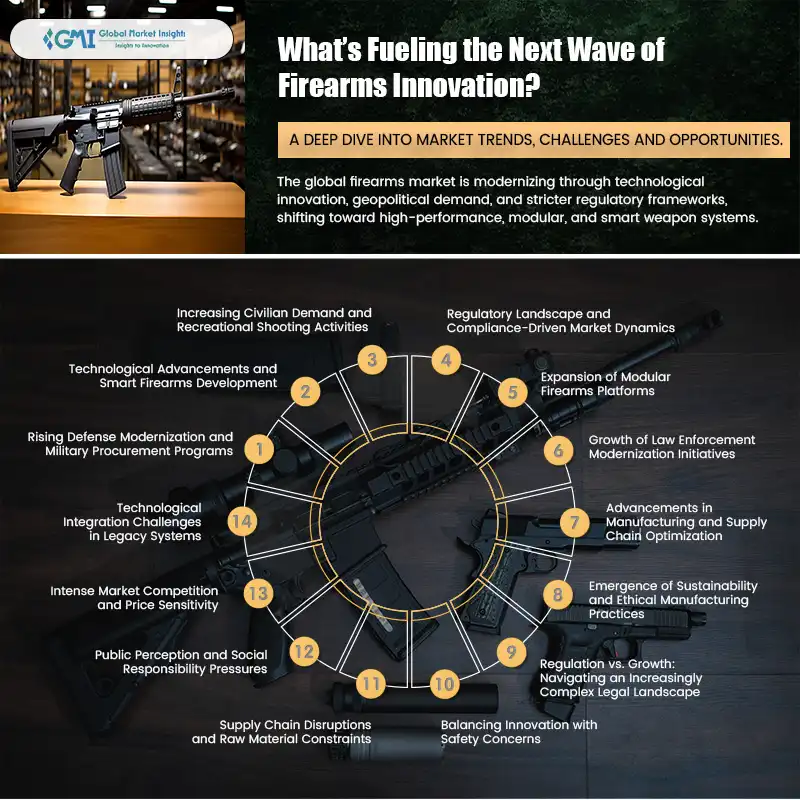
Rising Defense Modernization and Military Procurement Programs
Defense modernization initiatives remain one of the most influential drivers of growth in the firearms market. Governments worldwide are investing heavily in upgrading their military capabilities, focusing on next-generation small arms, advanced rifles, and precision weapon systems.
Military forces are increasingly prioritizing lightweight, durable, and high-performance firearms that enhance operational efficiency in diverse combat environments. Modernization programs often include replacing legacy systems with advanced firearms that offer improved accuracy, reduced recoil, and enhanced ergonomics. These upgrades are critical for improving soldier effectiveness and mission success rates.
In recent years, several countries have launched large-scale procurement programs aimed at equipping armed forces with modern assault rifles and modular weapon platforms. These programs are not only boosting demand but also encouraging manufacturers to invest in research and development to meet stringent defense specifications.
Additionally, the integration of firearms with advanced targeting systems and optics is becoming standard in military operations. This trend underscores the growing importance of interoperability between firearms and other defense technologies, positioning modernization as a cornerstone of market expansion.
Technological Advancements and Smart Firearms Development
Innovation is rapidly reshaping the firearms industry, with a strong focus on integrating advanced technologies into traditional weapon systems. The development of smart firearms represents a significant shift toward enhancing safety, control, and user accountability.
Smart firearms incorporate features such as biometric authentication, RFID-based access control, and digital tracking mechanisms. These technologies aim to prevent unauthorized use while improving overall safety standards. For instance, biometric-enabled firearms can restrict usage to authorized individuals, reducing the risk of accidental discharge or misuse.
In addition to safety features, advancements in materials science are enabling the production of lighter and more durable firearms. High-strength polymers and advanced alloys are increasingly being used to improve performance while reducing overall weight.
Precision engineering and digital manufacturing techniques are also enhancing product consistency and reliability. These technological advancements are not only improving product quality but also enabling manufacturers to differentiate themselves in a highly competitive market.
Increasing Civilian Demand and Recreational Shooting Activities
The civilian segment continues to play a vital role in shaping the firearms market, driven by rising interest in recreational shooting, personal safety, and sporting activities. Shooting sports and hunting activities are gaining popularity across various regions, contributing to sustained demand for firearms.
Recreational shooting ranges and training facilities are expanding, offering consumers access to controlled environments where they can develop skills and engage in shooting sports. This growth is supported by increasing participation in competitive shooting events and organized sports leagues.
In addition, personal safety concerns are influencing purchasing decisions among civilian users. Consumers are seeking firearms that are easy to handle, reliable, and designed with safety features. Manufacturers are responding by offering a wide range of products tailored to different user preferences and experience levels.
The civilian market is also witnessing a shift toward aesthetically customized firearms, with consumers showing interest in design variations and ergonomic enhancements. This trend reflects a broader move toward personalization and user-centric product development.
Regulatory Landscape and Compliance-Driven Market Dynamics
Regulatory frameworks continue to shape the firearms market, influencing manufacturing processes, distribution channels, and end-user access. Governments across regions are implementing stricter regulations to ensure safety, accountability, and responsible usage.
Compliance with licensing requirements, background checks, and product standards has become a critical aspect of market operations. Manufacturers are investing in compliance systems and documentation processes to align with evolving legal requirements.
Regulatory changes often have a direct impact on market demand, as restrictions or relaxations can influence purchasing behavior. For instance, stricter regulations may lead to short-term fluctuations in demand, while long-term policies can reshape market structure.
Furthermore, international trade regulations and export controls are affecting cross-border transactions, requiring companies to navigate complex legal environments. As a result, regulatory compliance is emerging as a key factor in strategic planning and risk management.
Expansion of Modular Firearms Platforms
Modularity is becoming a defining feature in modern firearm design, allowing users to customize and adapt weapons based on specific operational requirements. Modular platforms enable the interchangeability of components such as barrels, stocks, and accessories.
This flexibility is particularly valuable in military and law enforcement applications, where operational conditions can vary significantly. Modular firearms allow users to configure weapons for different missions, enhancing versatility and efficiency.
Manufacturers are increasingly focusing on developing platforms that support a wide range of configurations. This approach not only improves product utility but also extends the lifecycle of firearms by enabling upgrades and modifications.
The growing demand for modular systems is also influencing supply chains, as companies collaborate with accessory manufacturers to offer integrated solutions. This trend highlights the shift toward ecosystem-based product offerings within the firearms market.
Growth of Law Enforcement Modernization Initiatives
Law enforcement agencies are playing an increasingly important role in driving demand for advanced firearms. Modern policing strategies require reliable, high-performance weapons that support rapid response and operational efficiency.
Agencies are investing in updated firearms that offer improved accuracy, reduced maintenance requirements, and enhanced safety features. Training programs are also evolving to incorporate the use of advanced weapon systems, ensuring that personnel are equipped to handle modern challenges.
The adoption of standardized firearms across departments is another notable trend, aimed at improving interoperability and simplifying logistics. This approach enables agencies to streamline procurement and maintenance processes.
In addition, law enforcement agencies are emphasizing accountability and transparency, leading to the adoption of technologies that enable tracking and monitoring of firearm usage. This trend aligns with broader efforts to enhance public trust and operational integrity.
Advancements in Manufacturing and Supply Chain Optimization
The firearms industry is benefiting from advancements in manufacturing technologies and supply chain optimization strategies. Techniques such as precision machining, automation, and additive manufacturing are improving production efficiency and product quality.
Manufacturers are adopting lean production models to reduce waste and enhance operational efficiency. These approaches are enabling companies to respond more effectively to fluctuations in demand and maintain consistent product standards.
Supply chain resilience has become a key focus area, particularly in the context of global disruptions. Companies are diversifying supplier networks and investing in local manufacturing capabilities to mitigate risks.
Digitalization plays a role in supply chain management, with data analytics and tracking systems improving visibility and decision-making. These advancements are contributing to a more agile and responsive industry framework.
Emergence of Sustainability and Ethical Manufacturing Practices
Sustainability is gradually becoming an important consideration within the firearms market, as stakeholders seek to align with broader environmental and ethical standards. Manufacturers are exploring ways to reduce environmental impact through responsible sourcing and efficient production processes.
Efforts to minimize waste, optimize resource usage, and adopt eco-friendly materials are gaining traction. While sustainability initiatives are still in the early stages compared to other industries, they are expected to play a more prominent role in the future.
Ethical considerations are also influencing corporate strategies, particularly in relation to supply chain transparency and responsible business practices. Companies are increasingly focusing on maintaining compliance with international standards and promoting accountability.
This shift toward sustainability and ethical practices reflects a broader transformation within the industry, driven by stakeholder expectations and global trends.
Regulation vs. Growth: Navigating an Increasingly Complex Legal Landscape
The firearms market operates under one of the most tightly regulated frameworks globally, with laws varying significantly across regions. Evolving policies related to ownership, licensing, manufacturing standards, and distribution create operational complexities for manufacturers and distributors. Frequent regulatory updates can disrupt supply chains and influence consumer demand patterns.
Balancing Innovation with Safety Concerns
As technological advancements accelerate, the industry faces growing pressure to ensure that innovation does not compromise safety. The introduction of smart firearms and advanced features raises concerns about reliability, cybersecurity vulnerabilities, and unintended misuse. Stakeholders, including regulators and consumers, demand rigorous testing and validation processes. Ensuring that new technologies meet high safety standards while maintaining performance and affordability presents a significant challenge for manufacturers.
Supply Chain Disruptions and Raw Material Constraints
Global supply chain instability continues to impact the firearms industry, particularly in sourcing critical raw materials such as metals and specialized components. Fluctuations in material availability and pricing can affect production timelines and cost structures. Additionally, dependence on a limited number of suppliers increases vulnerability to geopolitical tensions and trade restrictions. Manufacturers are under pressure to build resilient supply chains while maintaining product quality and cost efficiency.
Public Perception and Social Responsibility Pressures
The firearms market is heavily influenced by public opinion and societal concerns regarding safety and ethical use. Negative perceptions and heightened scrutiny from advocacy groups and policymakers can impact brand reputation and market positioning. Companies are increasingly expected to demonstrate responsible business practices, transparency, and commitment to safety. Balancing commercial objectives with social responsibility is becoming a critical aspect of long-term sustainability in the industry.
Intense Market Competition and Price Sensitivity
The presence of numerous global and regional players has intensified competition across the firearms market. Price sensitivity, particularly in civilian and entry-level segments, forces manufacturers to maintain competitive pricing while ensuring quality and compliance. This dynamic creates pressure on profit margins and necessitates continuous innovation to differentiate products. Companies must also invest in branding, distribution networks, and customer engagement to sustain market share.
Technological Integration Challenges in Legacy Systems
Integrating advanced technologies into existing firearm platforms presents technical and operational challenges. Many defense and law enforcement agencies still rely on legacy systems that may not be compatible with modern upgrades. Retrofitting these systems requires significant investment, time, and technical expertise. Ensuring seamless integration without compromising reliability or performance remains a key hurdle for manufacturers and end users alike.
Conclusion: Strategic Transformation Defining the Future of the Firearms Market
The firearms market is evolving within a complex landscape shaped by technological innovation, regulatory frameworks, and shifting demand dynamics. The trends highlighted in this report demonstrate the industry’s transition toward advanced, efficient, and user-focused solutions.
As modernization efforts continue across defense and law enforcement sectors, and as civilian demand evolves, manufacturers must remain agile and forward-thinking. The integration of smart technologies, modular designs, and sustainable practices will play a critical role in defining competitive advantage.
Looking ahead, the market is expected to maintain steady growth, supported by ongoing investments, innovation, and strategic collaborations. Companies that effectively navigate regulatory challenges while embracing technological advancements will be well-positioned to capitalize on emerging opportunities and drive long-term success in the global firearms industry.